


Should literary plagiarism still be an issue, let alone a scandal, in our digital day and age? Back in Shakespeare's day, before the cult of individual genius and the fetishized book, authorship was a loose and often collective concept. The parallels between the literary conventions of the pretic past and writing online, ‘after the book', in an age of cut-and-paste, are the subject of two books just published in France, one by professor Roger Chartier and the other by writer François Bon, and which are set to cause a heated debate. Joseph Confavreux examines the arguments for what could be the new paradigm for the 21st-centry digital author, or which might just be much ado about nothing.
-------------------------
Every new literary season seems fraught with yet another plagiarism scandal. But we ought to remember that plagiarism is a fairly recent concept in the history of literature. Before the 18th century and the Romantics, contemporary authors, especially if published by the same house, often produced kindred, and even collective, works.
So, back then, a writer like Camille Laurens couldn't have accused a writer like Marie Darrieussecq of "psychological plagiarism". Moreover, a great deal of writing used to be deemed as being in the public domain. In those times, a publisher like Flammarion wouldn't have had to knock itself out defending Michel Houellebecq, winner of the 2010 Prix Goncourt, when he got nabbed pilfering whole passages from Wikipedia for his latest novel. Likewise, Joseph Macé-Scaron, a novelist and director of Magazine littéraire, would have had no need to invoke "inter-textuality" in dubious defence of his recurrent recourse to cut-and-pasting, because in those days palimpsests and quotes without inverted commas used to be common practice.
In our day, however, when Macé-Scaron cites in self-defence some four hundred passages Montaigne borrowed from Plutarch, he is referring to long-dead literary conventions. In the 16th and 17th centuries, extant stories were indeed regarded as treasure troves to be collectively co-opted ad libitum; authorship was a loose concept and there was little point in trying to draw hard and fast distinctions between quotation, allusion and plagiarism.
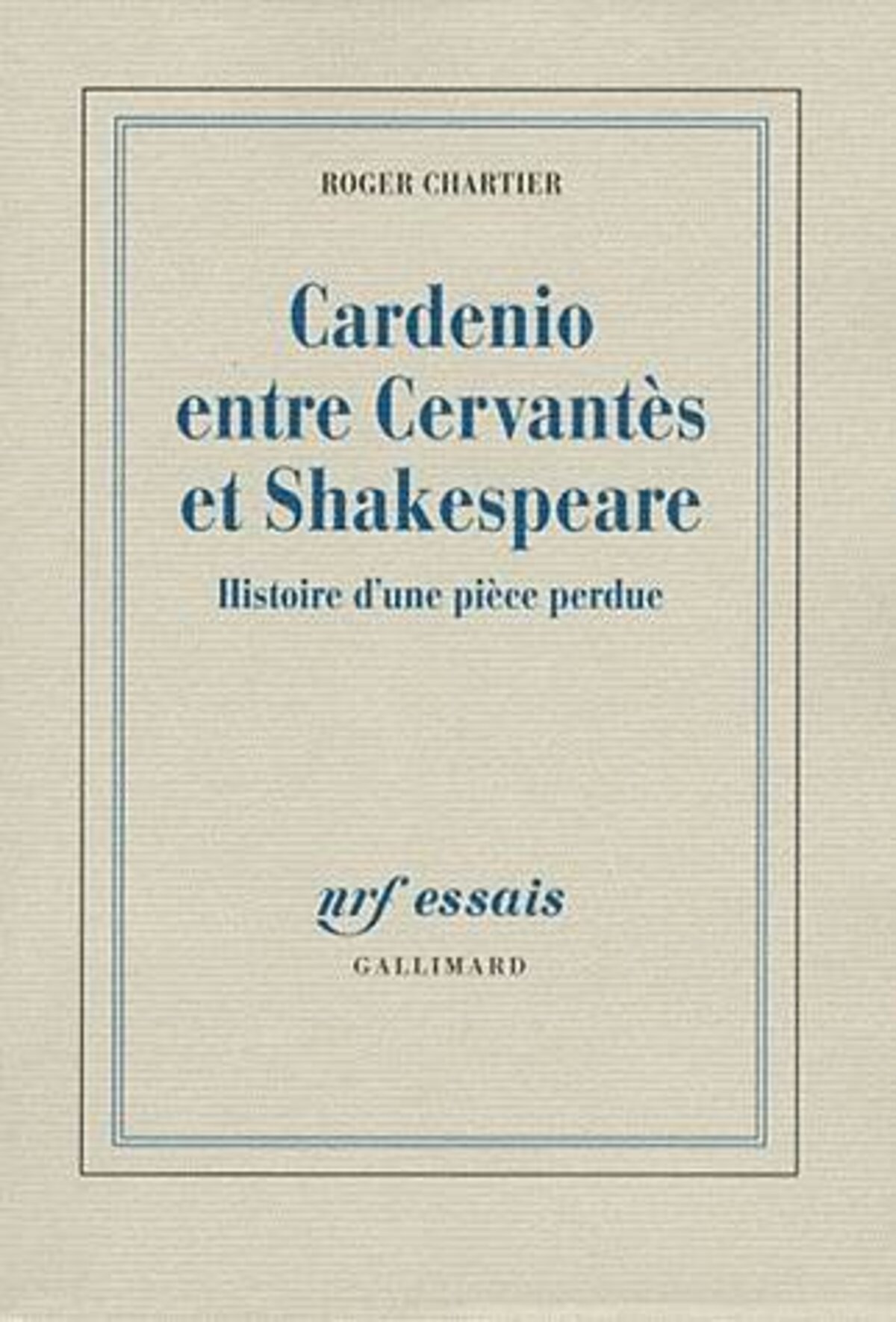
Those notions were eventually superseded in the 18th century by a conception of literature "based on the individualisation of writing, on intellectual property and the originality of the text, which gave rise to the opposite notion, that of plagiarism", explains historian Roger Chartier in his recent book Cardenio entre Cervantes et Shakespeare. The book is about how our conceptions of writing have evolved over the centuries - a literary sea change that Macé-Scaron simply disregards in his anachronistic reference to Montaigne and his borrowings from the ancients.
In Cardenio entre Cervantes et Shakespeare, Chartier explores a literary consciousness far removed from the latter-day apotheosis of the author and fetishization of the original manuscript. He describes a mode of writing that relativizes the canonical form of the book and our belief in the intangible stability of the text. And that bygone approach strangely prefigures what could be the new paradigm for the 21st-centry digital author, as novelist François Bon forecasts in his new book, Après le livre, on the upheavals in writing in the age of the World Wide Web.
Malleable future written in the past
Roger Chartier's book pieces together a literary puzzle: the story of a lost play, The History of Cardenio. Though it was never published and there is no surviving manuscript, we do know the play was performed in England in 1612 or 1613. Several decades later, Cardenio, which takes up an episode and some of the characters (though not the eponymous hero) from Don Quixote, was eventually attributed to none other than William Shakespeare.
At first glance, this scholarly inquiry seems driven by a desire to dig up a treasure in the sands of the land of lost works. (On the subject of lost works, Chartier relates the story of the Chinese emperor Qin Shi Huang, who ordered the construction of the Great Wall of China - and the burning of all books about the millennia of history preceding his reign). But Chartier's chief interest in Cardenio is that this play, which was variously adapted, revamped and transmogrified over the years, raises the key question of the "mobility of literary works that are transposed from one language or genre to another, works written collectively or rewritten in several stages".
The play does indeed draw its inspiration and dramatis personae from Cervantes' novel. Some 40 years after its premiere, it was attributed to two playwrights, Shakespeare and his occasional collaborator John Fletcher - only to be exclusively credited to the more illustrious of the twain another 70 years later. But the strange fate of this lost play is nothing exceptional. Roger Chartier points out that roughly 60% of the plays produced by the English theatre in the 16th and 17th centuries have left no textual trace for posterity. That absence reflects what was a "widespread consciousness of the collective dimension of all text production and the meagre recognition of the writer as such", writes Chartier. "His manuscripts are not worth preserving, his works are not his property."
The fate of Cardenio took a new turn when, in 1727, English editor and author Lewis Theobald, keen on proving himself to be a better Shakespeare editor than Alexander Pope, ascribed exclusive authorship to the Bard and, after "revising and adapting the play for the stage" himself, revived it in London under the title Double Falshood, or the Distrest Lovers.
The publishing, literary and theatre scene at the time was promptly beleaguered by doubts about the work's authenticity. The ensuing controversy was a telltale sign of how much the concept of authorship had swelled since Shakespeare's day.
In a word, collaborative writing and the re-use of twice- and thrice-told tales had become less common by Theobald's time. The new focus on the origin and originality of the text, as well as the glorification of the author figure had given rise, as Chartier puts it, to "a nascent order of discourse based on the individualisation of writing, the originality of works and the canonisation of the author. The articulation of these three notions, which was decisive in defining literary ownership, did not attain to definitive form till the late 18th century, in an era given over to the consecration of the author, the fetishization of the autograph manuscript and an obsession with the hand of the author, which had become the guarantee of the work's authenticity." So this lost play, somewhere "between Cervantes and Shakespeare", is a striking instance of a literary market of which we have no conception nowadays, although it may well presage the malleable future of literature in the digital age.
A world beyond the book

While Roger Chartier's book might have been aptly subtitled Avant le livre, (Before the book), French novelist François Bon's opus is actually entitled Après le livre (After the book). It opens with "Here we are, facing the unstable": the instability of writing in the wake of the book's demise. For writers like François Bon who do the bulk of their literary work on their websites, the digital revolution has done away with the author's manuscript and the successive stages of textual production, even the very idea of writing books.
"Each and every one of us would then be the writer of a single book," he philosophises. "That book would grow with us, it would be like a tree. It would be made up of all our traces, bearing forever the marks of all our scars and all the cuttings. We'd be able to define what the trunk of that tree is by how much we'd grown, and what is a branch, our projects and pursuits, our hold-ups and hang-ups; and even what is the foliage, where we brush up against and mix with neighbouring trees, what would be, by commentaries and networks, the borders of our personal tree." In rejecting the form of the self-enclosed book and opening it up to others, François Bon describes the experience of free writing, in the sense of free software: a common trunk, accessible codes, branchings-out, encounters and exchanges.
But in de-materialising the stages before the book, in giving up the concepts of the autograph and the manuscript, "are we undermining writing itself?" asks François Bon, to which he says ‘Non': "We are definitely moving forwards without a trace and nothing would be more harmful than the opposite: leaving the status or idea of the work, or even of the writer, on that false pedestal that the Web has literally blown away." Roger Chartier concurs. Even if "the present age cannot be compared to the 16th century, in writers like François Bon one does find desires or attempts that bear some relation to the pre-Romantic period."
Is the present-day instability of texts as perceived by François Bon akin to their malleability in the 16th and 17th centuries as described by Roger Chartier? Although the disappearance of the traces of the creative process, the author no longer a sacred notion, and the questioning of the intangible form of the book do all echo that past malleability, "This is not about a reversion to the past," insists Roger Chartier. "But it is true that the digital world might call into question the three canons of originality, uniqueness and intellectual property. We find ourselves in a system of open texts and quasi-collective writing by virtue of the very layout of web pages on which comments and glosses are posted in the same manner as the initial text."
Paradoxically for a writer asserting the obsolescence of the book, François Bon resorts to that very form, the good old book, to bring together some short texts mostly drawn from his website. He shows how his writing methods have been influenced by the new computer tools he uses, and how this online writing might well herald a new way of defining and practicing literature, an upheaval comparable to the sea change in writing between the 17th and 18th century.
To buttress his case, François Bon summons up the "ultra-modernity of the clay tablet", which seems to treat the surface of writing as a layer, anticipating hypertext, as well as "those black blocks of literature that reach us today in book form, but which dispensed with the book only then to take literary form as such": Baudelaire, Sévigné, Kafka, Char et al. In his enthusiasm for this new mode of writing, Bon proceeds to settle some scores with those "imperturbable writers" who "won't have a website", who "like the idea of themselves as book authors" more than books themselves, and who "sit down at their desk in the morning and continue their novel." He also bashes all those fetishists of the "smell of paper", which actually happens to be more the odour of the quicklime in the paper and the chemicals in the ink. But beyond these jibes, the charge is serious, because it goes as far as to redraw the relations between authors and outline a whole different code of literary conventions.
Still, François Bon is one of the few writers so wholly given over to the digital mode, and the revolution he proclaims in the redefinition of the book and of literature is doubtless still at the embryonic stage. Moreover, he stops short of totally deconstructing the pillars which, from 18th century on, have sustained the prevailing order of literary discourse: the uniqueness of genius, the originality of the writing, and intellectual property.
For one thing, he scarcely touches on the question of how one is to live by one's pen, or rather keyboard, in the digital age. And though he shakes up the concept of authorship, he isn't ready to do without it entirely. While he militates for more open, collective and malleable texts than those making up the bulk of what we know as contemporary literature, the publications of his online publishing house (publie.net) are invariably listed by author. And in one of the last texts in Après le livre, François Bon cites the question Roger Chartier has been asking since 2001, namely "how these two elements are going to connect in the electronic world: the ideal dream of textuality without appropriation and the confirmed presence of that figure of identification which is the author".
The answer is not set in stone for the writer. Nor is it entirely clear-cut as far as plagiarists are concerned, for whom the internet and the new digital tools likewise amount to a small-scale revolution. Certainly, the web makes it much easier to spot cut-and-paste jobs. But it also puts us all on a much more tangled and tenuous literary footing, creating an easier environment for forgers and fakes, charlatans and shams to run amok in.
Roger Chartier's Cardenio entre Cervantès et Shakespeare, Histoire d'une pièce perdue is published in French by Gallimard (NRF essais).
François Bon's Après le livre is published by Le Seuil, in French, available from September 22nd 2011.
-------------------------
English version: Eric Rosencrantz
(Editing by Graham Tearse)