


It is yet another crisis to add to the string of upheavals that regularly shake French overseas départements and regions. Since September 1st, campaigners fighting against the the high cost of living in the Caribbean département of Martinique have launched yet more protests. The issue of expensive food and other essential items has long been a simmering source of discontent in France's far-flung territories and Martinique is no exception; more than 90% of all its consumer goods are imported.
This massive reliance on imports – the 90% figure also applies to foodstuffs alone - leads to significant additional costs. In 2023, a study by the official French statistical agency INSEE estimated that food prices in Martinique exceed those in mainland France by 40%. “Using the Martinican [shopping] basket as a reference, food prices are on average 31% higher than those in mainland France. If we look at a typical Metropolitan [shopping] basket, food prices are 50% higher than those in France,” the authors of the study noted. In other words, even when buying local produce, the cost of food is still much higher.
Enlargement : Illustration 1
“Our demand is to have the same prices as those in mainland France, in the spirit of territorial consistency: it's not right for a couple with a child to have to spend €250 on groceries every ten days for basic food items,” insists Aude Goussard, secretary of the cost of living campaign group the Rassemblement pour la Protection des Peuples et des Ressources Afro-Caribéens (RPPRAC), which has been protesting since September 1st against what it sees as “profiteering” in the food distribution chain. These protests have involved supermarket blockades and targeted actions at checkouts. “We remain committed to peaceful actions; the slogan is no violence,” emphasises Aude Goussard.
Structural constraints and lack of oversight
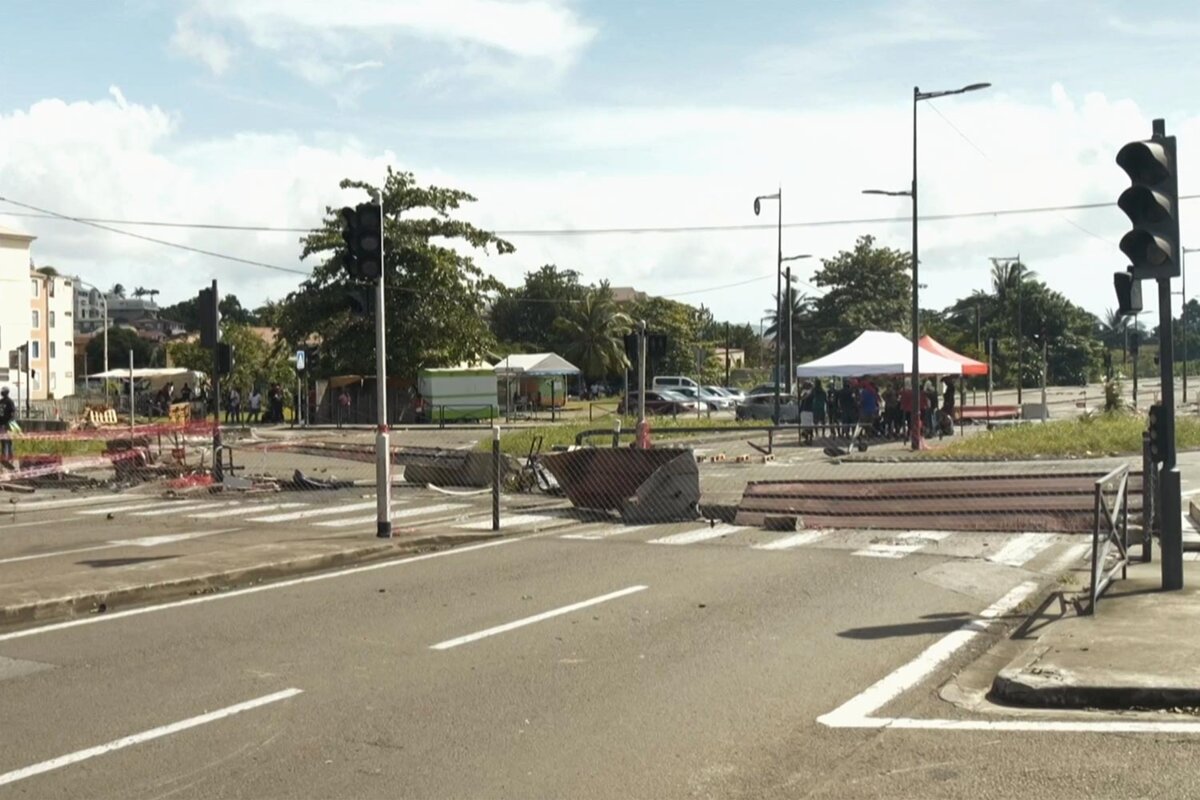
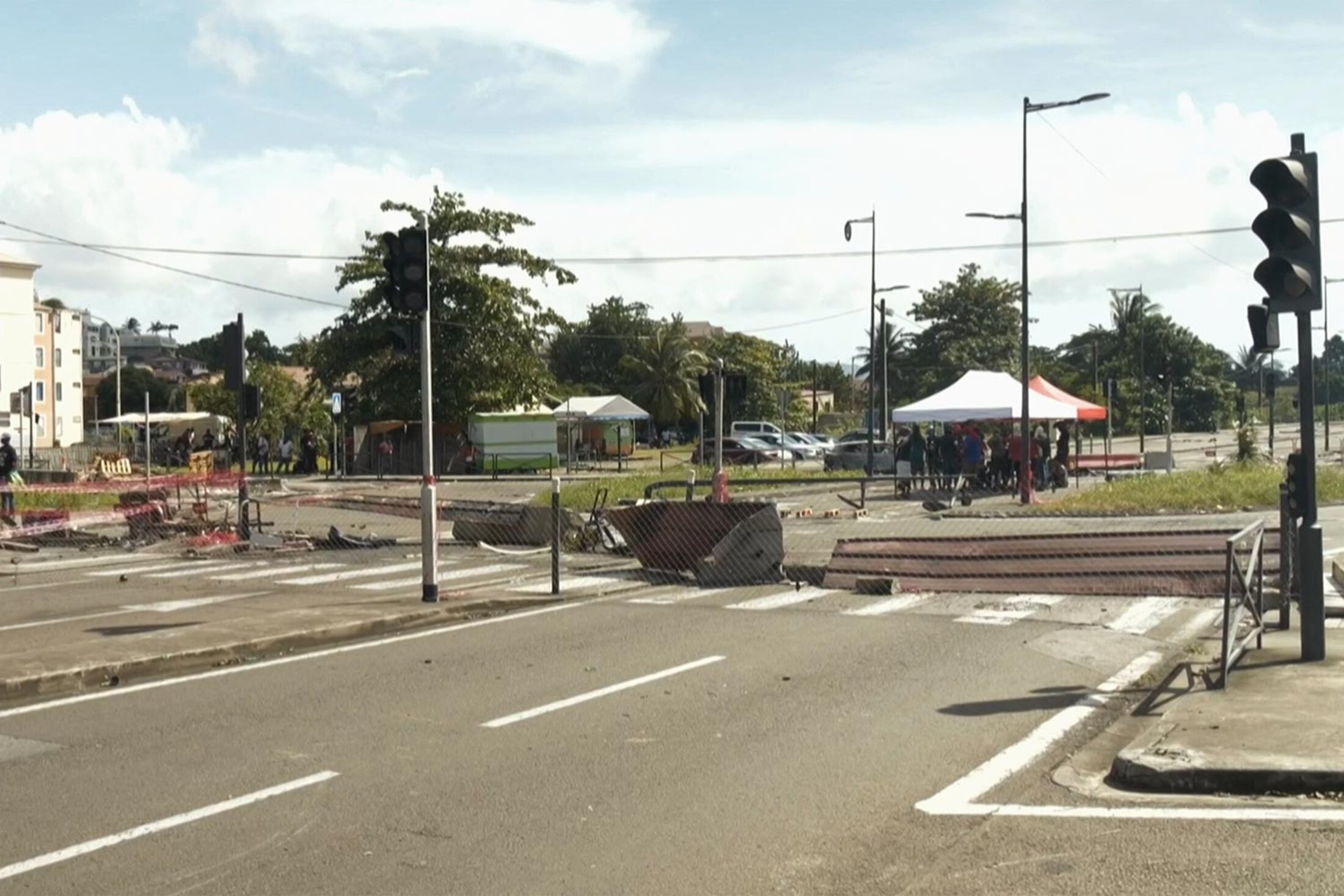
Nevertheless, tension is rising in Martinique, particularly in the capital Fort-de-France, which has experienced several nights of urban violence, leading to some areas being placed under a nightly curfew. And the movement is spreading: taxi drivers carried out a go-slow protest on September 19th, and city centre shopkeepers in Fort-de-France closed their shutters in solidarity with the movement.
Before the protests began, there had been an exchange of letters. “Those of you involved in large-scale retail and the prefect of Martinique, we accuse you, with justified anger and indignation, of being responsible for the glaring injustices relating to the consumer prices to which we are subjected,” activists wrote in early July. By late August, the “food distributors of Martinique” had responded, backed by figures and a report from the competition body the Autorité de la Concurrence. They claimed that these price discrepancies stemmed from “structural constraints”, namely distance, the insular nature of the territory, and the need for goods to be transported by ship.
“We're essentially dealing with a system of intermediaries that is a relic of colonial times,” asserts Victorin Lurel, a senator on another French Caribbean département, that of Guadeloupe. This socialist parliamentarian was behind a 2013 law on the cost of living which, among other things, prohibited monopolies on imports and established price watchdogs known as Observatoires des Prix des Marges et des Revenus (OPMR). This came a few years after the major strikes of 2009, which were driven by this very issue. It is clear that, despite some progress, the problem remains unresolved, or in some cases has even got worse, in societies where nearly a third of the population lives in poverty.
“We created these tools, but we're not doing much with them,” laments the senator, who introduced a new bill in early July aimed at “increasing the transparency of prices and [profit] margins in the overseas territories”. Since the 2013 law, this work on transparency of costs has fallen to the hard-pressed OPMRs. “I propose strengthening their action, which is currently non-existent, with an additional 417,000 euros for their budget,” he says.
Currently the OPMR for the Caribbean territories and French Guiana only has an allocation of 50,000 euros, barely enough to cover one salary and a few trips. “We do manage to conduct some studies, but it's true that our work is limited,” admits Patrick Plantard, president of the Antilles-Guyana OPMR, who says that he lacks access to certain data, particularly company profit margins, which are often protected by “commercial confidentiality”.
We created an [income] gap that we've been trying to close ever since, and we haven't fully succeeded even today.
“Only one institution has access to this information: the Autorité de la Concurrence [competition authority],” he notes. The latter even published a report on the subject in 2019. “While some levels of margin or profitability may appear high or higher than those observed in mainland France, the impact of each intermediary, taken individually, is too small on average for any extra margins potentially made at one stage of the value chain to be responsible for the bulk of the price differentials,” that report stated.
“It's true that the net margin, once everything is paid, barely exceeds 2%,” notes Catherine Rodap, president of the employers' organisation Medef Martinique, who also points out that “large groups such as [automotive parts firm] Ho Hio Hen ended up leaving the island when their margins became too thin”. Such departures have contributed to still further concentration in an already tight market, one which could be described as 'oligopolistic' - controlled by a few players. And this has been the case since slavery times.
During his testimony before a 2023 parliamentary commission on the cost of living in French overseas territories, Guadeloupean economist Sébastien Mathouraparsad placed the issue in an historical context. “Economist Thomas Piketty points out that in former slave colonies, which are among the most unequal systems in history, the richest 10% received more than 80% of the income and even had close to 100% of the assets. This unequal distribution of income dates back to the abolition of slavery in 1848: at that time, former slave owners were compensated, while the former slaves started with nothing. We created a gap that we've been trying to close ever since, and we haven't fully succeeded even today.”
Massive increase in middlemen
As for the issue of margins, the high prices are also due to the layers of intermediaries. In their parliamentary report, published in July 2023, Members of Parliament Guillaume Vuilletet and Johnny Hajjar note that there are “many intermediaries between the producer and the distributor: while there are generally three in mainland France, in Martinique the number can exceed fourteen”.
And in this enlarged supply chain each of the intermediaries takes their margin on the service they provide. Moreover, not all middlemen are necessarily transparent about the mark-ups they apply, particularly in the transport sector, where the parliamentary report highlights a certain lack of openness.
In relation to the shipping company CMA CGM, one of the main carriers serving the French Caribbean, MP Johnny Hajjar notes that the “estimated average margin over ten years for the overseas territories served by the company is apparently 81 dollars per twenty-foot equivalent container, or 12%. However, these results, because they are given as a ten-year average, do not allow us to assess the change in these margins over time, nor to know exactly the reality of the margins, in volume and value, for each of the last ten years.”
The eternal debate on dock dues
“On top of all this, there are the dock dues [editor's note, known in French as 'octroi de mer'],” points out MEDEF's Catherine Rodap. This import tax, with rates voted on by the local assemblies in the overseas departments, dates back to the 17th century. It was introduced to protect local production in the overseas territories from ultra-competitive imported goods, but is regularly blamed for putting up the cost of living.
Indeed, the protectionism provided by the dock dues drives up prices by bringing the cost of imported goods closer to that of local products. This import tax is also regularly criticised for being set with varying levels of opacity depending on the territory, for lacking coherence, and for being outdated, not to say completely obsolete. Calls to reform or even abolish it are frequent but these face resistance from local elected officials: revenue from this tax forms a significant part of the operating budgets of their councils.
In response, specific solutions are being rolled out. After two recent round-table meetings, the business, political and prefectoral authorities in Martinique announced a 20% reduction in prices on 54 product categories, covering 2,500 items, through dock dues exemptions. However, members of the RPPRAC say this is just a “sticking plaster” and they have refused to take part in the discussions.
“We wanted the discussions to be filmed, but this was refused: we won’t be attending all of that,” says Aude Goussard, criticising what she sees as the self-serving collusion of those she accuses of benefiting from the problem. Other solutions have been proposed: addressing the high costs of shipping – with freight subsidies, reducing price differentials between products, etc. - or revisiting the approach on tax - removing dock dues from prices or reducing sales tax from 2.1% to 0% - for essential goods, and so on.
Another focus is on food self-sufficiency. Although according to agricultural data the ability of the Caribbean territories to meet their own needs has significantly deteriorated in recent years, local people still remain hopeful. “We want to redirect POSEI payments [editor's note, a European fund dedicated to agriculture in the EU's more remote areas] towards agricultural diversification, not just towards sugar cane and bananas,” explains Aude Goussard.
This widely-shared idealistic goal is hindered by the westernisation of lifestyles in the former colonies: despite a renewed interest in “local” and a movement to reclaim pre-colonial food culture, the path to a form of local development that is able to reduce the high cost of living remains a long one.
----------------------------------------------------------------------------
- The original French version of this article can be found here.
English version by Michael Streeter