


The Fondation Abbé Pierre, one of France’s leading charitable foundations dedicated to eradicating bad housing conditions endured by the country’s poorest social categories, today released its 18th annual report on the state of the French housing crisis. It estimates that 3.6 million people in France live in rotten housing conditions, ranging from the dilapidated to the thoroughly insalubrious. Most of these properties are situated in major towns and cities, but the report also sounds the alarm at the often overlooked situation in France’s economically declining rural and semi-rural regions, where increasing numbers of the nearby urban population are fleeing to escape the housing crisis. Renaud Ceccotti reports from a rural area close to Paris where he met with a family whose descent into semi-slum living conditions is typical of many.
-------------------------
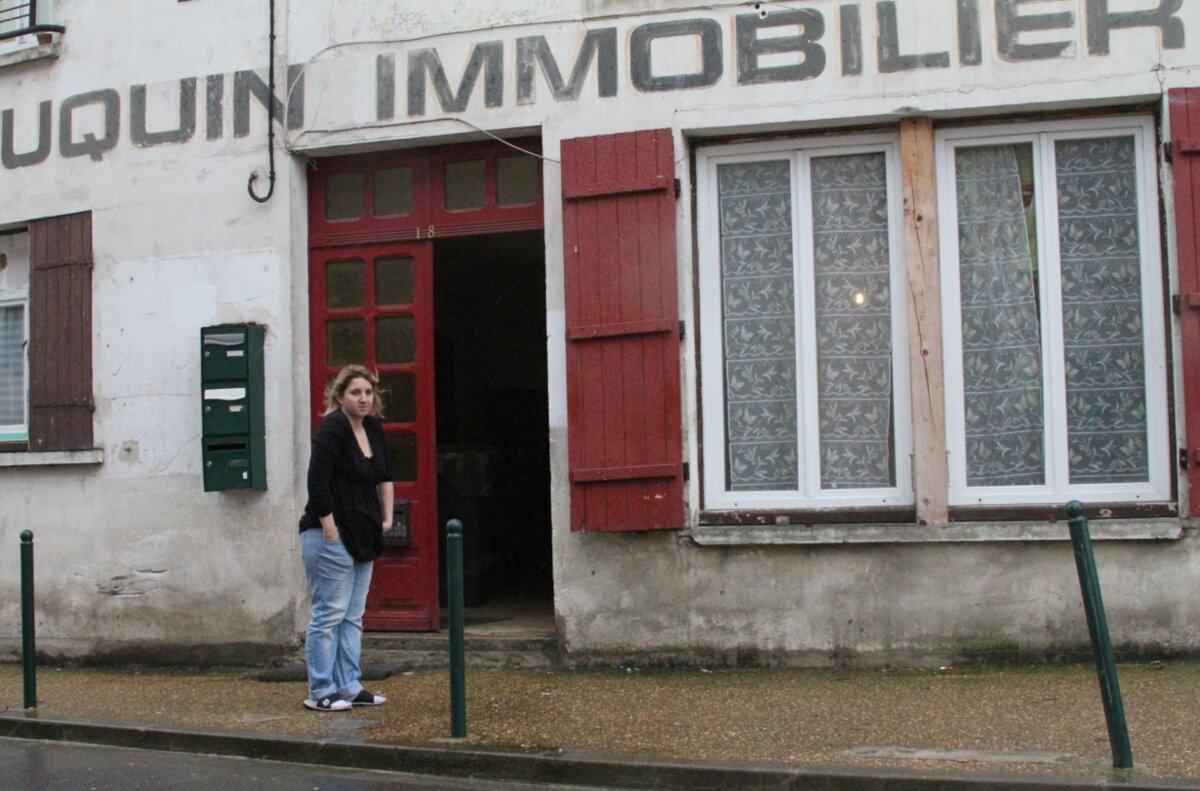
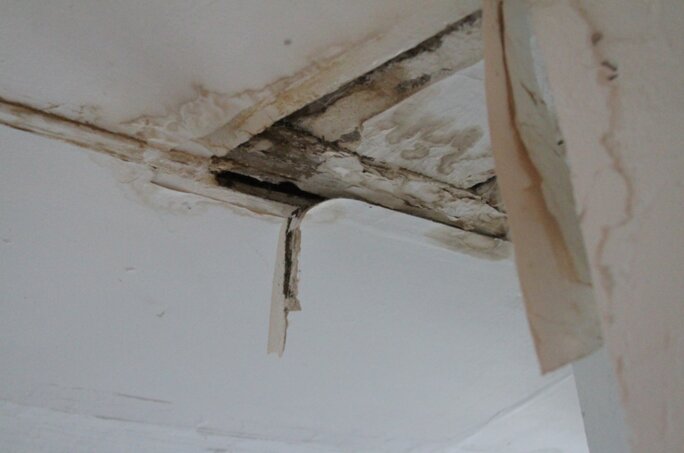
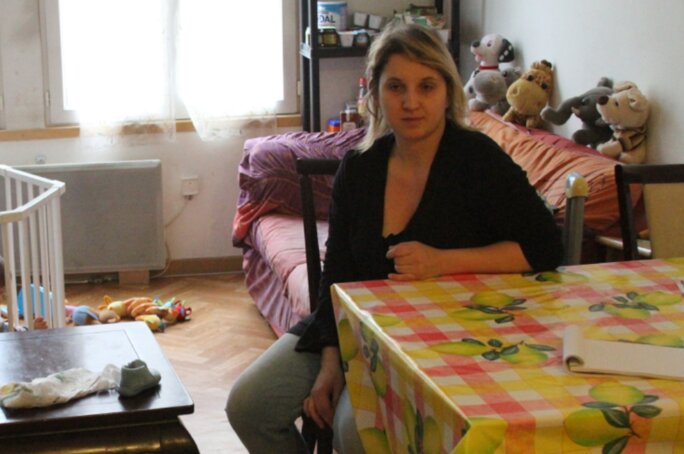
For two years, Létitia Goumain, her partner and two children, one aged 5 years and the other 13 months, have lived in a small flat which reeks of humidity due to water leaks in the two bedrooms. There is lead in the walls, and just now the place suffers from draughts of the cold winter air which blows through a gap in the window frame where the joints are missing.
“My children are constantly ill, the [repair] work that we’ve been asking for ever since we arrived has never been done,” complains Goumain, 31. “When we manage to reach the owner, he tells us that if we’re not happy we’re free to leave. He knows very well we’re stuck here.”
Enlargement : Illustration 1
The young family live in Touquin, a small village of about 1,000 inhabitants close to the twon of Coulommiers, in the Seine-et-Marne département (equivalent to a county) south-east of Paris. Their flat and three others in the same building, all belonging to the same owner, have been officially declared as indecent habitation by the local Regional Health Agency, the Agence régionale de santé (ARS), which has the task of ensuring homes in the Greater Paris Region, the Île-de-France, are maintained in proper sanitary state.
Enlargement : Illustration 2
Adeline Bouc, belongs to an association called AIPI, which works as a partner organisation in the Seine-et-Marne area with the Fondation Abbé Pierre. It was the AIPI that alerted the local authorities to the problems in Létitia Goumain’s building. But while the four flats are categorized as indecent, they are not yet sufficiently degraded for legal action to be taken by the authorities against the owner. “It’s not yet insalubrious, the stage above in terms of sanitary faults and which would allow the launching of an administrative procedure by the authorities, but it is already bad housing,” explained Bouc, whose association is pursuing its own action to force the owner to repair Goumain’s flat. “We’re just at the beginning of the procedure, but we hope to move ahead quickly” says Bouc. “It’s very difficult though with an owner who permanently changes addresses and phone numbers.”
Létitia Goumain’s background is typical of many who live in sub-standard housing in French rural areas. She was laid off from her job as a sales assistant in a pet shop, and her husband, a builder, was unable to earn enough to pay the rent for their former home. They were temporarily lodged in a hotel by the local family benefits office, the Caisse d’allocation familiale (CAF), until a friend told Goumain about a three-roomed flat available for rent in Touquin.
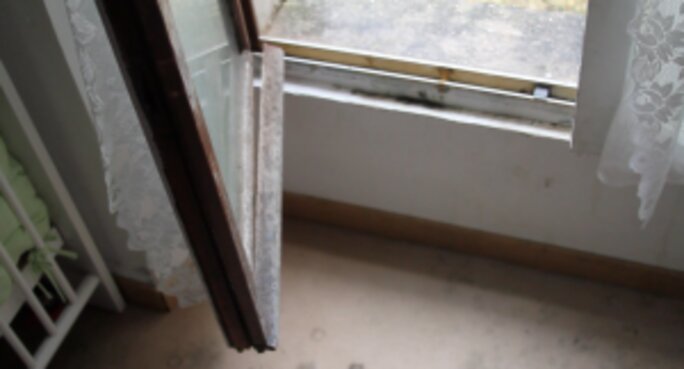
When she first visited the flat it was already in poor shape: there were water leaks visible on the ceiling, dangerous electrical wiring, a roof in need of repairs and no insulation. But it was that or stay in the hotel room. “The rent isn’t even cheap, 740 euros a month,” she said. “He rented it to us as 70 square metres, but when the ARS did the tests of the lead in the walls they measured just 58 square metres. The other tenants left as soon as they found something better elsewhere, but it’s not easy in these times to find a flat for four.”
The turnover of tenants has made the AIPI’s attempts to help them even more difficult. “The tenants move on because they’ve had enough, and we understand them, but as a result the procedures stop there and we have to start all over again every time," explained Adeline Bouc. “The town hall has summoned the owner to carry out the [repair] work, but to no effect. We contacted the public prosecutor’s office in May 2012, we’re waiting, we’ve had no news.”
Mediapart made several attempts to contact the owner of Goumain's flat, but he did not reply to requests for an interview.
'Abandoning regions and populations'
Enlargement : Illustration 4
Many people in sub-standard housing in the countryside come from large towns nearby, hoping to find a better life and a cheaper rent they can more easily afford in declining rural areas. “In the Seine-et-Marne we have an enormous number of people who have left the [economically and socially deprived département] Seine-Saint-Denis and its housing estates hoping for a better lifestyle, but the rents here are relatively high,” said Bouc.
“With the commuting costs, heating charges and all the rest, they find themselves in the same economically difficult conditions," she added. "But the housing market in areas close to Paris is so in over-demand that we see new [home-seekers] arrive here everyday who don’t even know the département. Sometimes they are [illegal immigrants] who were trying to join their families living in [subsidised] housing provided by nearby towns but who can only find lodgings in flats in very bad condition.”
As the report published February 1st by the Fondation Abbé Pierre underlined, some of the sub-standard rented housing is the result of people on modest financial incomes who became homeowners through buying cheaper properties in rural areas, but who then found themselves unable to maintain their acquisition and who then rent it out.
“There is a lack of subsidized housing in these [rural] areas which pushes the most financially modest households into looking at flats with little comfort and which are sometimes dilapidated,” said Christophe Robert, the deputy general secretary of the Fondation Abbé Pierre. He hopes the foundation’s report will urge rural municipal authorities, whose members face local elections in 2014, to act on the problems of sub-standard housing.
The report sounds a clear alarm over the consequences of neglecting the problem of poor housing in rural and semi-rural zones. “The intensification of the housing crisis these last years has focalised attention upon the regions worst affected by the rise in property prices and the tension in the rental market, to the danger of not paying sufficient attention to the geographical diversity of rotten housing,” it notes. “To the danger, also, of letting it be believed that areas of industrial or demographic decline have been saved [from the problem], that average- and small-sized towns are more protected than larger agglomerations. To the danger, finally, of abandoning regions and populations to their difficulties.”
Meanwhile, the AIPI, with the foundation’s backing, has begun a programme in partnership with some municipalities in the Seine-et-Marne to turn suitable publicly-owned buildings into lodgings. “If a municipality owns a barn that’s in bad shape and which it has no use for, it hands it over to us on a lease of a few years,” explained Adeline Bouc. “We repair it to a habitable state and create subsidized lodgings for the length of the lease, and we hand it back [to the municipality] at the end of the lease. Everybody wins.”
-------------------------
English version: Graham Tearse