


He is one of the workers on the “front line” that the French president Emmanuel Macron likes to talk about, one of the unsung heroes who has had to continue to work despite the coronavirus pandemic. Though Mehdi Medjahed is not a nurse, firefighter or ambulance driver, he is a qualified fire safety security guard. But he is also an undocumented worker, despite having come to France from his native Algeria 13 years ago. And now he faces deportation after being arrested by police officers following a routine identity check.
The 36-year-old says that he suffered violence at the hands of the police officers who arrested him. While still being held in custody he was made the subject of a deportation order and then placed in an administrative detention centre. This is despite the fact that according to the French government these centres should only be used for foreign nationals who have just come out of prison after serving sentences for serious offences and who are awaiting deportation.
The incident began at around 5pm on Friday April 24th when Mehdi Medjahed arrived at the Barbès-Rochechouart metro station in Paris. He lives in the Belleville area in the north-east of central Paris and works at Porte de Saint-Cloud in the south-west of the capital. But to break his Ramadan fast in the evening he does his food shopping in the central-northern district of Barbès where many of the shops are run by Algerians who, like him, originally come from Annaba in the north-east of Algeria. At the bottom of some steps, close to the metro's exit, three police officers were waiting, each tasked with “maintaining security during Ramadan and inspecting travel declarations [editor's note, which French citizens need to justify the purpose of their journey during the Covid-19 lockdown] because of the health emergency”, according to their subsequent police reports.
A police sergeant asked Mehdi Medjahed for his identity documents and his travel declaration. He showed the declaration supplied by his employer, an online form on which he usually fills in his own details. The fire safety agent says that he told the officers that he did not have immigration documents but that he was on his way to work. He said the police sergeant replied: “How can you work when you don't have any documentation?”
Mehdi Medjahed arrived in France 13 years ago and initially had a residence permit marked “sick foreign national”, a status which is granted to people with a serious illness who cannot be treated in their country of origin. When he renewed his permit he wanted the new one to say “employee” as by then he was working in the security industry. He sent the authorities an employment contract but was then told he needed to show that he had received appropriate training. However, he sent in his training documentation too late and his request for residency was formally rejected in February this year. Since then he has been staying in France without official legal status.
The discussion with the officer became more heated and Mehdi Medjahed accepts that at this point he tried to take back the papers from the sergeant's hands saying: “I don't like the way you're talking, I'm going to show my papers to your colleagues.” Then, as he turned his head towards the other two officers, he says that the sergeant hit him before pushing him to the ground, at which point the other officers helped to handcuff him. “One of them behaved better,” said Mehdi. “From his look, he was showing me that he did not agree with what his colleagues were doing.”
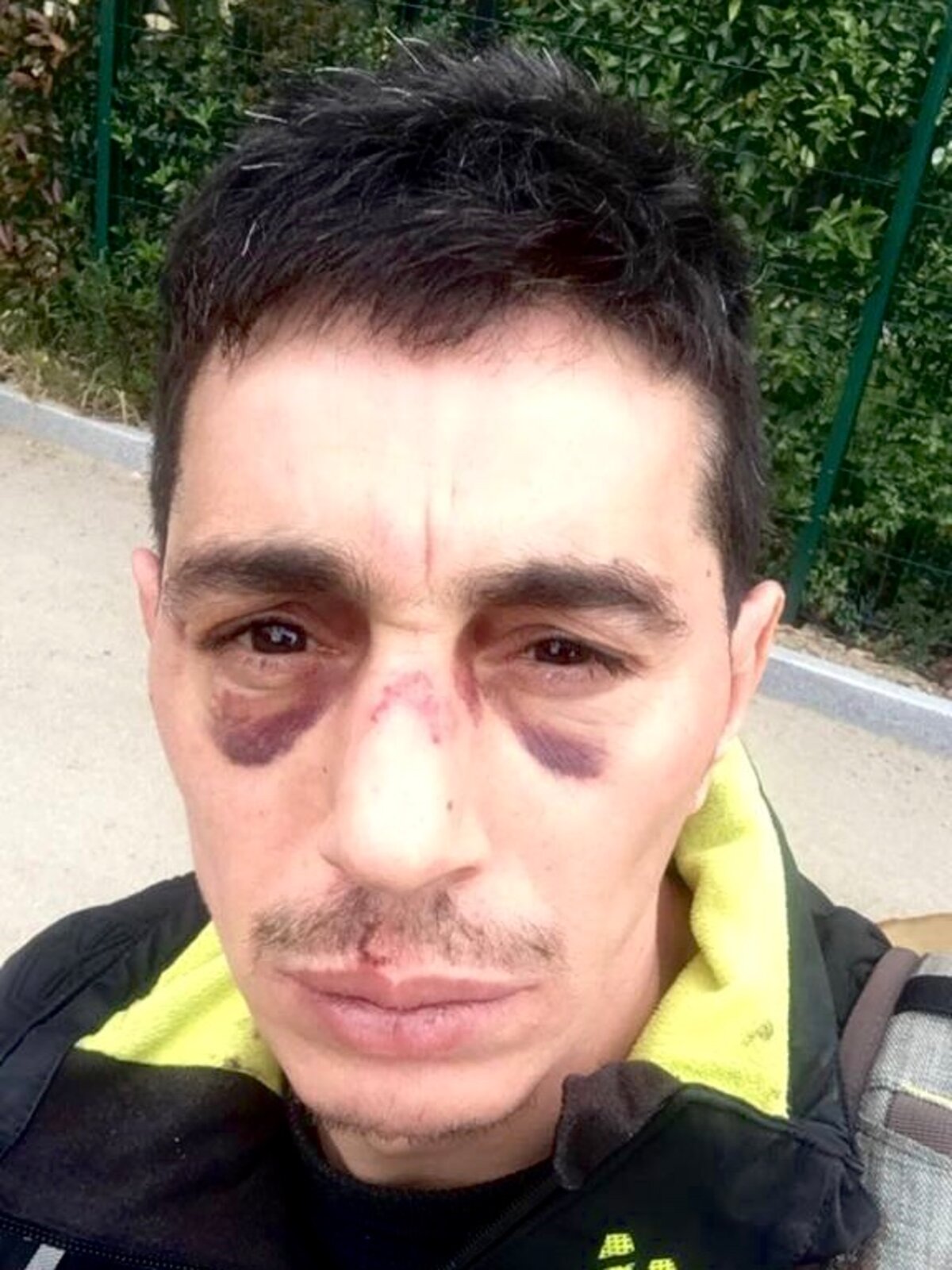
The police version of events is different. One officer said in his report that the person being questioned was initially “violent and aggressive in his gestures and words”. When this person “snatched” the papers from the sergeant's hands he caused the latter's work phone to fall to the ground, the police officer said in his report. “At the same time, the subject lowered himself quickly to grab hold of his backpack that had been put on the ground at the start of the check and before he had finished getting up to run off, the sergeant grabbed hold of him around the waist.” According to this officer's account, the “individual” was then “knocked off balance” by the weight of the sergeant, and his head “struck the ground” causing “light bleeding”. This account is hard to reconcile with the marks that were still apparent on the arrested man's face five days later.
Enlargement : Illustration 1
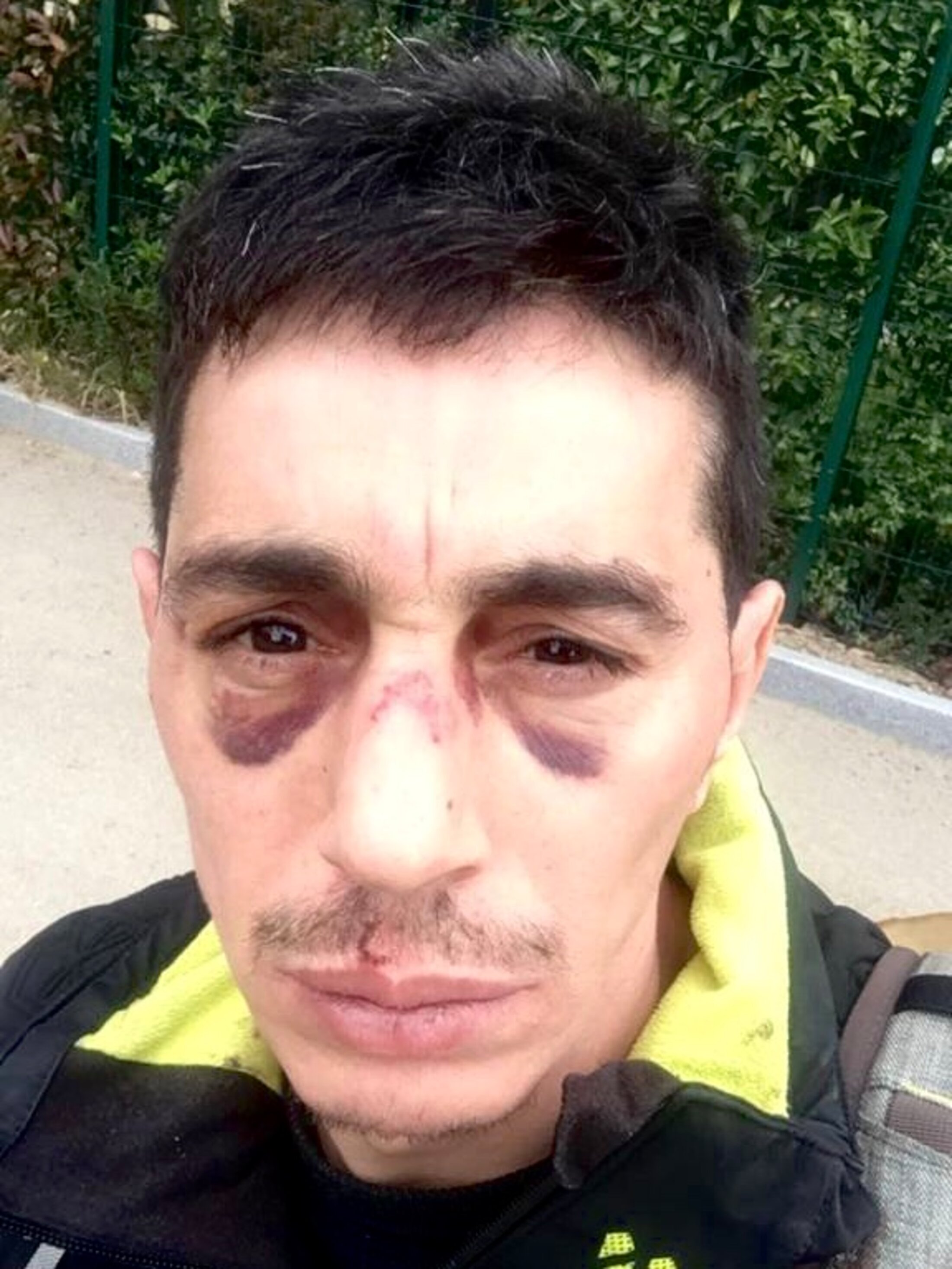
Mehdi Medjahed was taken into custody at the police station in Paris's 18th arrondissement or district where he finally saw a duty forensic doctor at around 11.15pm. “He was joking with the police officers, he knew them all,” said Mehdi of the doctor. “I told him that my nose was broken, he said to me 'It's not broken, don't worry, it's nothing serious'.” The medical certificate signed by the doctor stated that he would need four days off work and that the arrested man simply had “superficial injuries” to the face.
A senior official of the medical forensic unit for Paris-Nord, the area where the events took place, told Mediapart that their doctors see people who have “taken a blow … thirty times a day”. If the doctors consider that there is no emergency and that “it can wait a few hours” they recommend to those in custody that they “go and get an X-ray when they leave”. In any case, said the official, those whom they see in custody “have already gone through an initial filter. If they're not well the police officers call the fire brigade [editor's note, who are first aid specialists] who take them to hospital, they don't put them in a cell.”
On the Saturday evening Mehdi Medjahed was put in a detention centre at Mesnil-Amelot north-east of Paris, near Charles de Gaulle airport, one of the administrative detention centres (CRA) around France to which people are sent pending deportation. On the Sunday, two days after his arrest and because of his condition, officers from the detention centre took him to the hospital at the nearby town of Meaux. Speaking from the centre by telephone on Tuesday Mehdi Medjahed said: “The police here are not like those who stopped me. They behave well. When I arrived a lady said to me: 'You can't stay here like that, you'll have to be taken to the hospital'.” A new medical certificate was provided which indicated that Mehdi had suffered head trauma, a fractured nose, bruising around the eyes, neck pain and multiple bruises to the body.
Meanwhile the police from the 18th arrondissement accuse Mehdi Medjahed of resisting arrest and of violence towards a person in a position of public authority. The sergeant who stopped him is said to be suffering “serious pain on the fourth finger of his left hand”. Yet at the end of his custody period the local prosecutor ordered Mehdi to be released without charge, something which is rare in cases of alleged violence against the police. When asked about the case on Tuesday April 28th, the police prefecture – the police authority in Paris – said nothing about the circumstances of the arrest or about the alleged violence.
However, even before Mehdi Medjahed had been released from police custody the police prefecture had decided that he should be given a deportation order to remove him from France without delay. This type of administrative procedure – which is governed by administrative rather than criminal law - includes a ban on any return to France within three years. No attempt was made to investigate the contradictory versions given by the police officers and the Algerian, who has no criminal record.
Mehdi Medjahed's lawyer Ruben Garcia said: “It's interesting because if you listen to the minister of the interior [editor's note, Christophe Castaner] you only place in detention [centres] someone who is coming out of prison, people who have committed serious crimes or offences. Clearly that's not true. This was an arrest on the public highway. I've another client who was put into detention for smuggling, they found some cigarette packets in his car ...”
As of Wednesday April 29th there were 62 people still detained in the administrative detention centre (CRA) at Mesnil-Amelot, with most of them unable to be deported. The only deportations that have taken place in recent days have involved European citizens sent back to Holland and Portugal, a group deportation of detained people from Lille in northern France, Lyon in eastern France and Mesnil-Amelot to Albania, and a flight involving 15 Romanian detainees on April 29th.
There is no possibility of anyone being deported back to Algeria at the moment as that country's borders are currently closed. Yet Mehdi Medjahed still spent two days in detention. Finally, on Tuesday April 28th, he was brought before a judge whose role under French law is to determine whether someone is being held lawfully or not. The judge ordered Mehdi to be released on the grounds that he had been detained in police custody contrary to procedure, as the extension of the period beyond 24 hours had not been formally notified and recorded. He left the detention centre that same evening, after the prosecution authorities decided not to appeal the verdict. However, Mehdi Medjahed remains at risk of deportation. In the meantime he is returning to work, back to the front line, even though each trip he takes in public now represents an extra danger for him.
-------------------------
If you have information of public interest you would like to pass on to Mediapart for investigation you can contact us at this email address: enquete@mediapart.fr. If you wish to send us documents for our scrutiny via our highly secure platform please go to https://www.frenchleaks.fr/ which is presented in both English and French.
-------------------------
- The French version of this article can be found here.
English version by Michael Streeter