


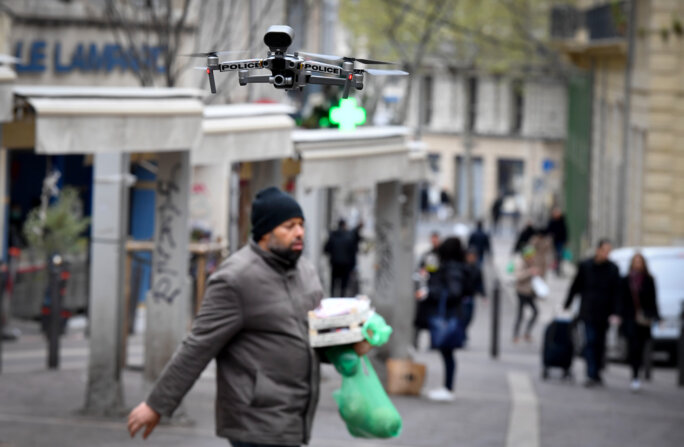
The first thing you notice is the buzzing of the propellers. Then you hear the pre-recorded message: “Stay at home, you can't go out here.” The words are coming from a drone flying up above. These machines have long been used in specific security operations but since France introduced its coronavirus restrictions on March 17th they have also regularly been deployed by police forces to help enforce that lockdown. They are being used across France, in urban and rural areas, by both gendarmes – who are typically based in the countryside and smaller towns - and the national police.
The Ministry of the Interior told Mediapart: “There are around 400 drones being used by the police and gendarmerie.” This figure fits with the data collected by the press agency AEF Info, which reported that the gendarmes have 300 drones and the police 110. It also revealed that 400 gendarmes have apparently been trained to fly drones.
Though it is not yet the norm, some municipal police forces run by towns and cities also have their own drones. According to the local authority publication the Gazette des Communes, these municipal police drones have been used to enforce the lockdown in Orléans, south of Paris, Charleville-Mézières, north east of Paris, and Istres on the Mediterranean coast.
“Until now they've been used to monitor demonstrations or fly over migrant camps, still in a quite limited way,” said Martin Drago, a legal expert at Quadrature du Net, the leading digital liberties defence group in France. For example from January to June 2018 some “six or seven” drones a day were used to monitor the camp set up by protestors opposed to the construction of a new airport at Notre-Dame-des-Landes in western France.
“These devices were used first of all in the Bouches-du-Rhône and the Var [editor's note, départements or counties in the south of France]. Their purpose was to fly over the major roads and accident blackspots,” said Paris barrister Thierry Vallat. A specialist in digital law, he said that the use of drones has got more and more invasive as the technology has become more mature. “From monitoring forested mountains, their use has extended to the gilets jaunes [editor's note, 'yellow vest'] demonstrations and sporting events.”
Enlargement : Illustration 1
At the start of April Quadrature du Net used press articles published since the start of the lockdown to highlight around fifteen occasions on which drones have been used to enforce the lockdown. Mediapart has also looked at press articles from between March 17th and April 17th that have mentioned operations by municipal police, national police or the gendarmerie using drones. In all we counted more than 60 across France, the great majority of cases involving lockdown enforcement. In comparison, a study of the same press from February 17th to March 17th shows that fewer than ten articles mention police drone operations.
So evidence is mounting that having initially been reserved for just a few limited types of police operation, drones are now being used in new ways. At Lille in northern France, Lyon in eastern France and Melun south-east of Paris, as in many areas of France, drones have been equipped with loudhailers that the police and gendarmes use to broadcast their messages about preventing the spread of the virus and telling people out in the street to “stay at home”. In the Mediterranean city of Marseille, the southern town of Nîmes and the central town of Romorantin, drones have been used to identity people who have broken lockdown rules, who have subsequently been fined. In rural areas, such as the Doubs département in eastern France, and coastal areas such as Corsica, the devices have supported the police's surveillance operations by allowing them to monitor remote areas or to keep watch over larger areas.
This new deployment of the machines to support the lockdown inevitably raises questions. The first is whether this novel use of drones will actually help the authorities to fight the spread of the coronavirus. “No,” says Maryse Artiguelong, vice-president of the human rights group the Ligue des Droits de l’Homme. She said the main effect of the drones was to “frighten people”. Meanwhile drones have not widely been used to disinfect the streets, and even where they have its effectiveness has been disputed, including by the public health body the Haut Conseil de la Santé Publique.
Laurent Mucchielli, sociologist and author of 'Vous êtes filmés ! Enquête sur le bluff de la vidéosurveillance' ('You're being filmed! Investigation into the bluff of video surveillance') published in 2018, is of a similar view. “The fundamental challenge is not actually to identify people who have gone for a walk in the fields or the forest, but to avoid contamination in confined meeting places such as supermarkets,” he said. “Drones don't help people to respect this social distancing.”
Even some people involved in the drone industry query the value of some of the uses to which the drones are put by the police. “It's a gimmicky use,” said Thomas Nicholls, director of marketing at Delair, a leading drone firm from Toulouse in south-west France. “A drone with a loud speaker requires the use of a police or gendarme remote pilot close by. How is is that more effective than a gendarme with a loudhailer?”
'The big fear is that they are cross-checked with biometric files'
Video surveillance, such as the use of body cameras by the police, is nowadays subject to certain rules, even though civil rights groups say these are not strong enough. For example, the law bans filming in private areas and limits the length of time that video surveillance images can be stored to a month. In addition, a département or county's video protection committee has to approve the installation of any new surveillance camera.
But the police authorities in Paris, the police prefecture, say that such safeguards do not cover their use of drones, and insist this is governed by article 9 of the Civil Code and Article 226-1 of the Criminal Code relating to privacy. Martin Drago, legal expert at Quadrature du Net, says he is shocked by this stance. “Article 9 says that everyone is entitled to privacy. It's almost a joke to say that you can regulate drone usage by employing that provision,” he said. “Moreover, the police prefecture admits that it doesn't even respect the guidelines for video surveillance.”
Outside of these articles in the civil and criminal codes, the legal guidelines for the use of drones is defined by a decree issued on December 17th 2015, which sets how “aircraft which fly with no one on board” can use the airspace. It states that each drone flight should be declared to the prefecture at least five days in advance. However, this decree exempts the national police and gendarmerie from making any declaration when “the circumstances of the mission and the requirements of public order and security justify it”.
Lawyer Thierry Vallat noted: “We don't know if we're being filmed, if the data is being stored, transmitted or cross-referenced. The big fear is that they are cross-checked with biometric files such as the national identity card.”
Since March 18th the police authorities in Paris have deployed 18 drones which were bought from the French company Flying Eye under a public sector framework agreement. These drones are currently being flown under a legal derogation for the police contained in the emergency provisions that govern the virus crisis and lockdown.
As well as using a loudhailer to repeat the lockdown instructions, the police in Paris also use the drones' cameras which transmit images to a tablet used by those piloting the device, or to a dedicated computer at the command centre of the group conducing the operation. “They use a wide angle lens to film the circulation flows, gatherings, urban or rural areas and the progress of marches,” said the police prefecture. “They only enable an individual to be identified when [the drones] are used in a legal context, whether that is during the commission of an offence, during the prelude to one, or as part of an investigation,” added the Paris police, who also say that such images are deleted at the end of the operation and are not cross-checked with police files. Meanwhile Thierry Vallat noted: “The drones are not supposed to film in private areas but that's a difficult task in a very dense urban area.”
Enlargement : Illustration 3
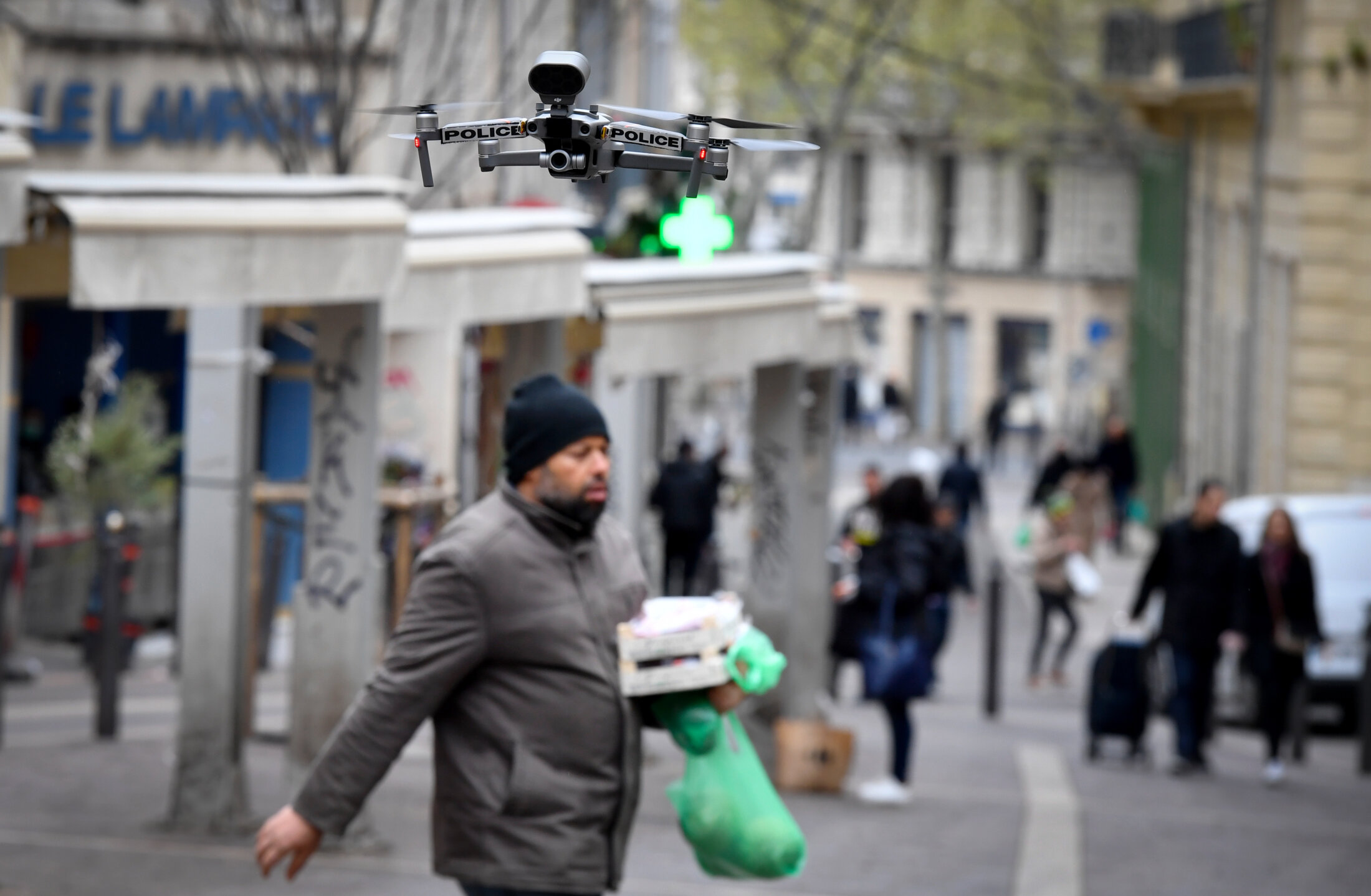
The absence of a legal framework for these flights drastically limits the potential for action by civil rights groups. “Our legal approach is based on actions over which we can seek legal remedies,” said Martin Drago. “There aren't any with the drones. We can't go before the administrative court relying on a press article.”
When asked by Mediapart to say give more details about the use of drones, the Ministry of the Interior simply said they were used for “observation, surveillance and rescue” and, since March 17th, in the context of “measures put in place to enforce the lockdown”. Meanwhile the national council on informatics and freedom, the Commission Nationale de l'Informatique et des Libertés (CNIL), says that is it working with the ministry to ensure that the “rules relating to the protection of personal data are scrupulously respected”.
Zoom lenses and thermal camera
Mediapart has contacted several drone companies to find out more about the types of drone used by the police and gendarmes. The company Parrot has not been in contact with the police during the lockdown but said that some of its models have been used by the police for several months. These include the ANAFI Thermal drone bought through specialist dealers rather than direct from the company. The principal attribute of this model is its thermal imagery, which in firefighting is able to “detect a hot spot or a smouldering fire; for night surveillance it can pick out a human or animal form even when it's pitch black”.
Alexandre Thomas, chief executive of drone firm Flying Eye, said that they had sold “around thirty additional machines to the forces of law and order across all of France”. The firm, which supplies the police authorities in Paris, said that the models used are from the DJI Mavic Enterprise series, made by the Chinese firm DJI who are global market leaders. Among their main attributes are the quality of their zoom lens and camera. Flying Eye also confirmed that it had sold to the police and gendarmes several of the DJI Mavic 2 DUAL models, drones which can measure body temperature. On its website Flying Eye says that “DJI is hoping to help in the fight against the global spread of Covid-19” using this thermal camera. Though it confirmed it used these models, the police prefecture in Paris evaded the question and said that it had never envisaged using that particular technology “even supposing it exists”.
Fears of more widespread use
On April 12th 2020 the Ministry of the Interior published an invitation to tender for a sum close to 4 million euros to purchase more than 650 drones. Some 565 of these are to be for daily use, and are the same kind as have been flying over French cities since the start of the lockdown. Though the ministry told Libération newspaper that this order had no link with the current health crisis, the situation worries civil liberties groups.
“I'm afraid that, under the pretext of security, these devices will become accepted socially,” said lawyer Thierry Vallat. Maryse Artiguelong, vice-president of the Ligue des Droits de l’Homme (LDH) human rights league, said: “Decisions taken in times of emergency have a tendency to remain and become habits.” She added: “An extra 650 drones won't lead to everyone being under surveillance but it's moving in the direction of widespread surveillance.”
The industry itself says that the use of drones will remain marginal. “A place such as Lyon is under-equipped, with three drones for the whole city. The English police are much better equipped with drones than [the police] in France,” said Alexandre Thomas of Flying Eye.
Martin Drago, of Quadrature du Net, who is calling for a public debate on the police use of drones, sees this phenomenon in a broader perspective of so-called “safe cities”, marked by the much greater use of new digital public surveillance tools in public areas. “Citizens are already filmed by video surveillance cameras and body cameras,” he said. “With drones in addition to that, we are giving our police the potential to carry out surveillance over almost all of a city. Is that really the model [of society] we want?”
---------------------------------------------------------------------------
- The French version of this article can be found here.
English version by Michael Streeter