


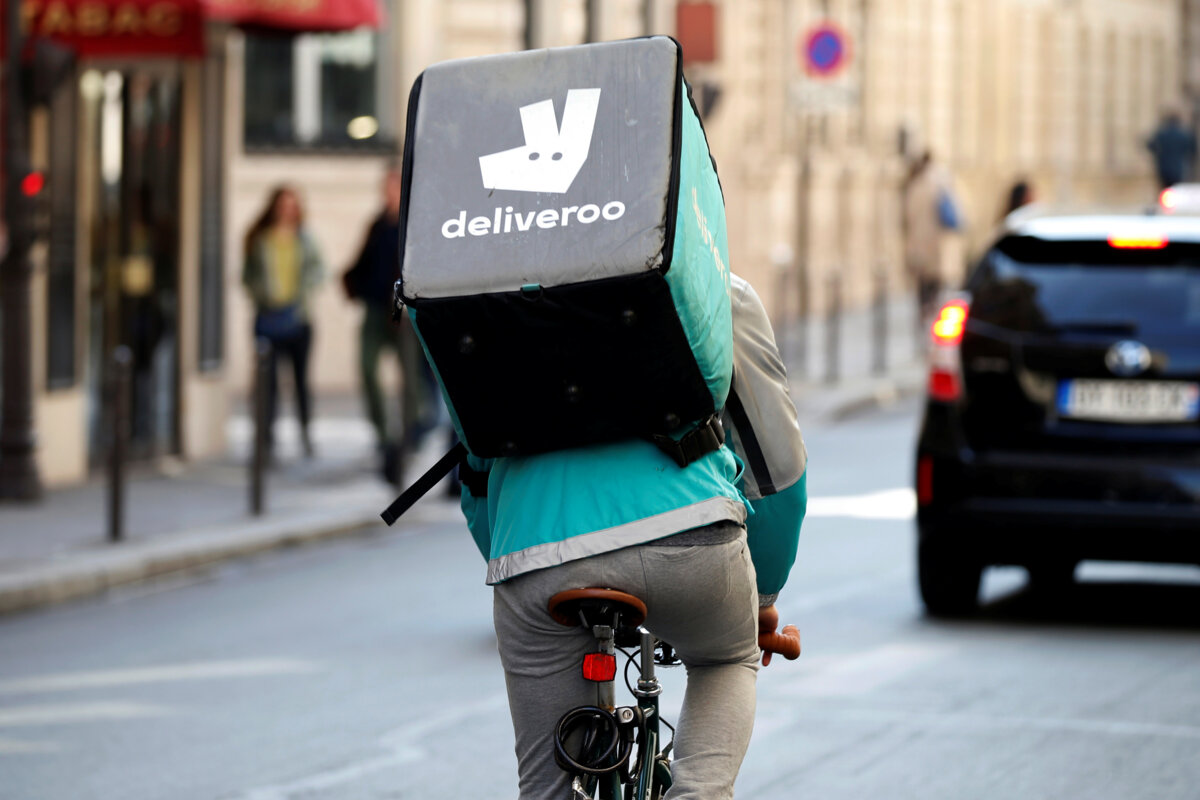
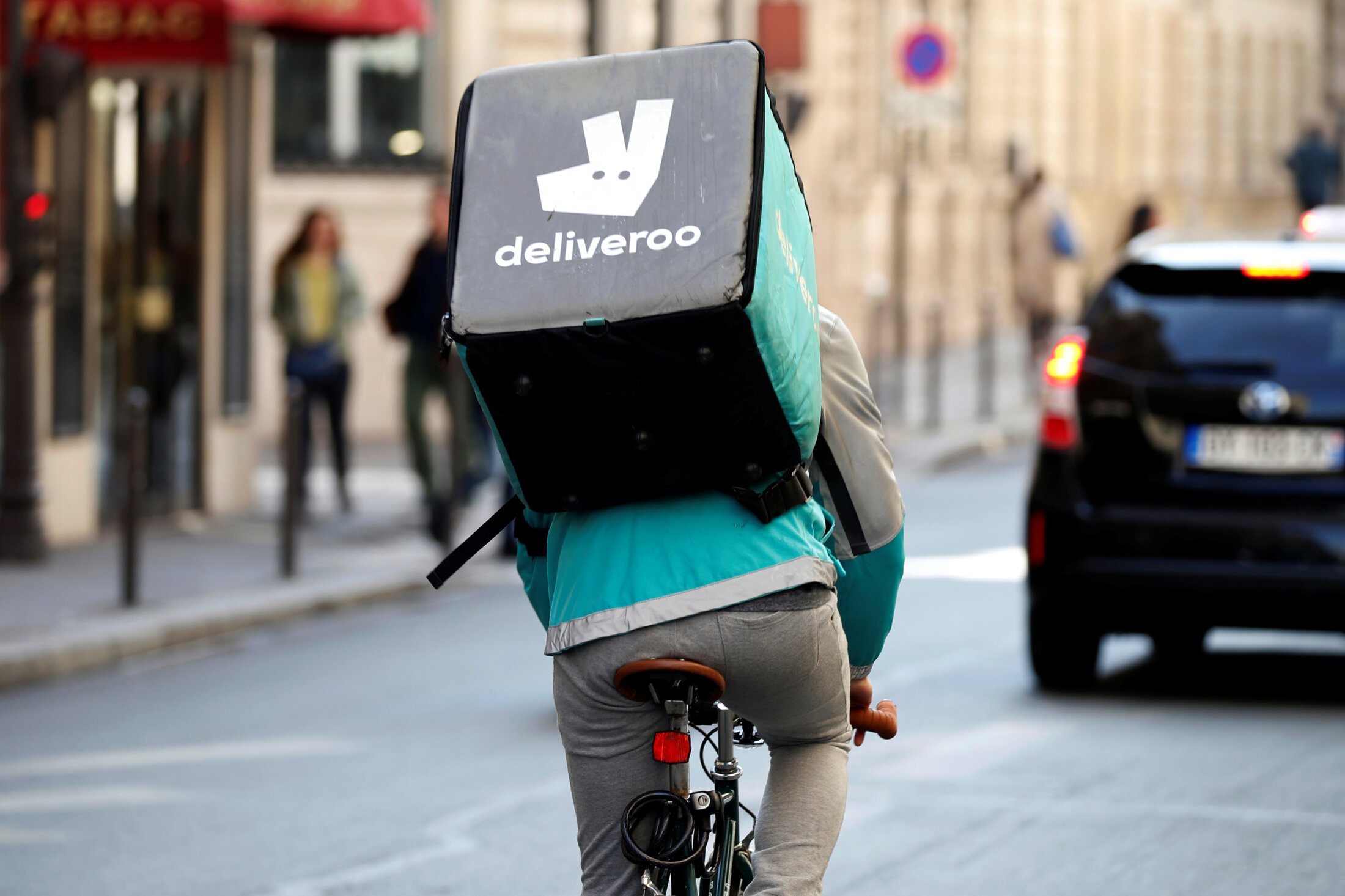
Food couriers working for the delivery company Deliveroo have staged protests outside the company's offices in Bordeaux. The 50 riders or so who took part in the demonstrations on July 28th, 31st and August 1st, are angry at changes in the way that they are being paid and claim some of them will be losing up to 600 euros a month as a result.
When the British company, which delivers food from restaurants to people's doorsteps, launched in France in 2015 it was keen to build up a network of cycle and scooter riders as soon as possible. So at the start the company offered them a fixed rate of 7.5 euros an hour for the period they declared themselves available for work. On top of that the riders – who are not employees but work under the auto-entrepreneur status - received an extra two to four euros a delivery, depending on their seniority and performance.
Enlargement : Illustration 1
However, this began to change in September 2016 when the company announced that all new riders would in future be paid per delivery only. They were paid 5.75 euros a delivery in Paris and 5 euros in other towns regardless of the distance covered or the length of time they had to wait at the restaurant.
These two payment systems - hourly rates for existing riders and cash per delivery for new ones - then existed side by side. But on Thursday July 27th, Deliveroo contacted all riders who were on the old hourly payment to announce that this system will disappear altogether and that from September 1st they will have to accept the per job rate.
The move was immediately denounced by Jérôme Pimot, from the Collectif des Livreurs Autonomes de Paris (CLAP) which defends the rights of couriers at a host of different delivery companies, including Deliveroo. “Couriers in Paris have been invited to change system for some months now, undergoing varying degrees of pressure,” says Pimot. “The new contract arrived just after Deliveroo's main competitor Take Eat Easy went into administration in July 2016. Now that Deliveroo has a sufficient mass of riders its managers can afford to take away the privileges of the older [riders].”
Comment @Deliveroo, forts de leur position dominante, font une proposition "QU'ON NE PEUT REFUSER"
— Jérôme PIMOT (@Eldjai) 28 juillet 2017
sur des chiffres invérifiables (en jaune) pic.twitter.com/PPzT0MuvBk
This change in payment method also follows a major reduction by the company in the number of periods when riders are guaranteed a minimum amount of money. Previously a minimum payment equivalent to three deliveries was guaranteed to couriers on Thursday, Friday, Saturday and Sunday evenings, plus Sunday lunchtime. Now the guarantee covers just a two-hour period on Sunday evenings.
These changes have proved unacceptable for the protesting riders in Bordeaux, who demonstrated under the auspices of the new local courier branch of the CGT trade union. “We're calling for the scrapping of the contract change or compensation of 50,000 euros for those who decide to leave,” says Arthur Hay, secretary general of the new union section. “We're trying to start a movement that lasts. Deliveroo is like all the other big companies that launch redundancy plans, they don't budge without determined and planned opposition.”
In addition to the gatherings outside Deliveroo's offices in Bordeaux, the protesters also asked restaurateurs who use the app-based service to show solidarity with the couriers and to stop using the delivery app on the evening of Tuesday August1st. They did a tour of the city in a bid to convince them.
In Bordeaux more than a hundred Deliveroo riders will be hit by the compulsory switch to pay per delivery. The company itself says that across all of France some 600 delivery riders out of a total of 7,500 will be affected, though the CGT says the figure could be closer to 1,200.
“This desire to put the activities of Deliveroo's 7,500 delivery partners under an identical contract results from an attempt to adapt to the constant increase in the number of jobs since Deliveroo's arrival in France two years ago, while continuing to offer a flexibility activity,” the company said in a statement. Internally the company accepts that having needed to win the loyalty of young people prepared to cycle or scooter to deliver food, there is now less need to guarantee a fixed minimum income. This is because there are more potential riders, the service is better known and so there are – insists the company - more deliveries for the riders to carry out.
This argument has not convinced the riders in Bordeaux. The CGT branch there estimates that for any courier on the equivalent of the minimum wage – 1,140 months net a month – the changes could cost them 300 euros a month. However, the company says that over the last three months riders paid by the delivery have seen their incomes grow on average by 7.5%. This is due in particular to a new algorithm used by the company which limits the waiting time for couriers at restaurants and manages the travel distances involved more effectively.
The demonstrators in Bordeaux say they have asked on several occasions to meet a company representative to start negotiations, and on Tuesday they invited the firm to debate the issue at the local trade union centre. Deliveroo apparently said they did not want to discuss the issue in a “public setting”. However, in its statement the company said that on several occasions it had met some riders individually or in small groups and had a “constructive dialogue”.
According to enquires made by Mediapart, under the new payment system a rider earns between 9 and 11 euros an hour during peak times in the evenings and at weekends, 25% of which will go in mandatory social contributions towards health care, social security and pensions (though this can be a lot less for a few months for those on the ACCRE scheme to help people get back to work). For the rest of the time earnings fall considerably below this level, for the simple reasons that there are fewer food deliveries. These figures concern the Deliveroo rates; its smaller competitors such as Foodora, Eber Eats and Stuart are said to pay less well.
Interests of couriers and company in opposition
As they are auto-entrepreneurs, the delivery riders do not get paid holidays or unemployment benefit if they lose their job. Nor do they have proper cover against accidents at work, even if the law has now has moved a little in their direction in this respect. They are also responsible for the purchase and upkeep of their bikes and scooters.
The conflict between Deliveroo and its riders recalls a dispute involving another service company in the so-called 'gig economy': Uber. The first drivers who worked on behalf of the American ride-sourcing company were happy with their income and working conditions, until the firm cut its prices by 20% in October 2015. This led to several strikes and the creation of a drivers' collective. That episode does not augur well for the bike couriers because Uber continued to chip away at drivers' income, increasing the commissions they take on each fare from 20% to 25% a few months ago.
In fact there is an inbuilt contradiction between the interests of the drivers and delivery riders on the one hand and those who manage their services on the other. The companies are looking for ever more workers to meet the growing demand of consumers, while the drivers and riders need their own numbers to be limited if they want to earn a decent income. The riders in Bordeaux are thus calling for a freeze on new entrants to their industry. And like the Uber drivers, some bike couriers are taking legal action to get their contracts reclassified as standard employment contracts, so they can have the same benefits as those enjoyed by employees. The first nine riders to go down this route have launched proceedings in Paris. “We're working in a system which is using the auto-entrepreneur system in an outrageous, abusive way,” says Arthur Hay.
This point of view is growing and in recent months several local collectives have sprung up across the country to defend the couriers' rights. In Bordeaux it is the CGT who have picked up the mantle, while in Paris it has been Jérôme Pimot and his organisation CLAP, whose evocative slogan is: “The street is our factory.” Jérôme Pimot says: “Bike couriers are the new pieceworkers of the 21st century. We're visible and in the street and we have to take advantage of that to make ourselves heard.”
CLAP has been taking part in the protests against the reforms to the employment law since May 1st, and they are working on setting up their own independent delivery service cooperative, CoopCycle. In the spring of this year collectives were also set up in Marseille and Lyon, and their protest actions are likely to resume after the summer break.
Among couriers these movements are seen as protecting the interests of colleagues who spend all or most of their time working in the sector and who depend on it for their livelihood. Deliveroo points out that 80% of their delivery people have another job and the company sees this work as being perfectly suited to a student who wants to make a little money. But for the new CGT couriers branch in Bordeaux “it's really the company itself which is putting the sector at risk, to stop it from becoming a full-time activity”. This is despite the suggestion that at the beginning the firm reportedly lured riders with claims they could earn 2,000 euros a month.
In fact, some riders at the Bordeaux demonstrations say they are earning monthly amounts of between 2,000 and 2,500 euros and estimate they will lose up to 600 euros a month under the new system. At Deliveroo they barely conceal their desire to end these rare cases of relatively high-earners, in order to maintain what they call the “sustainability” of the economic model.
For the moment the company does not seem inclined to back down on its decision. But Arthur Hay from the CGT says they have already scored some minor victories. “We've succeeded in starting real collective action. When we tried to get organised before the couriers hesitated because they were afraid of losing their job. Today, in their minds, they've already lost it,” he says. And now, he says, more and more customers are also starting to worry about the working conditions of the couriers who deliver their meals. “There are even some who apologise for having ordered,” says Arthur Hay.
--------------------------------------------------------------------------------------
- The French version of this article can be found here.
English version by Michael Streeter