


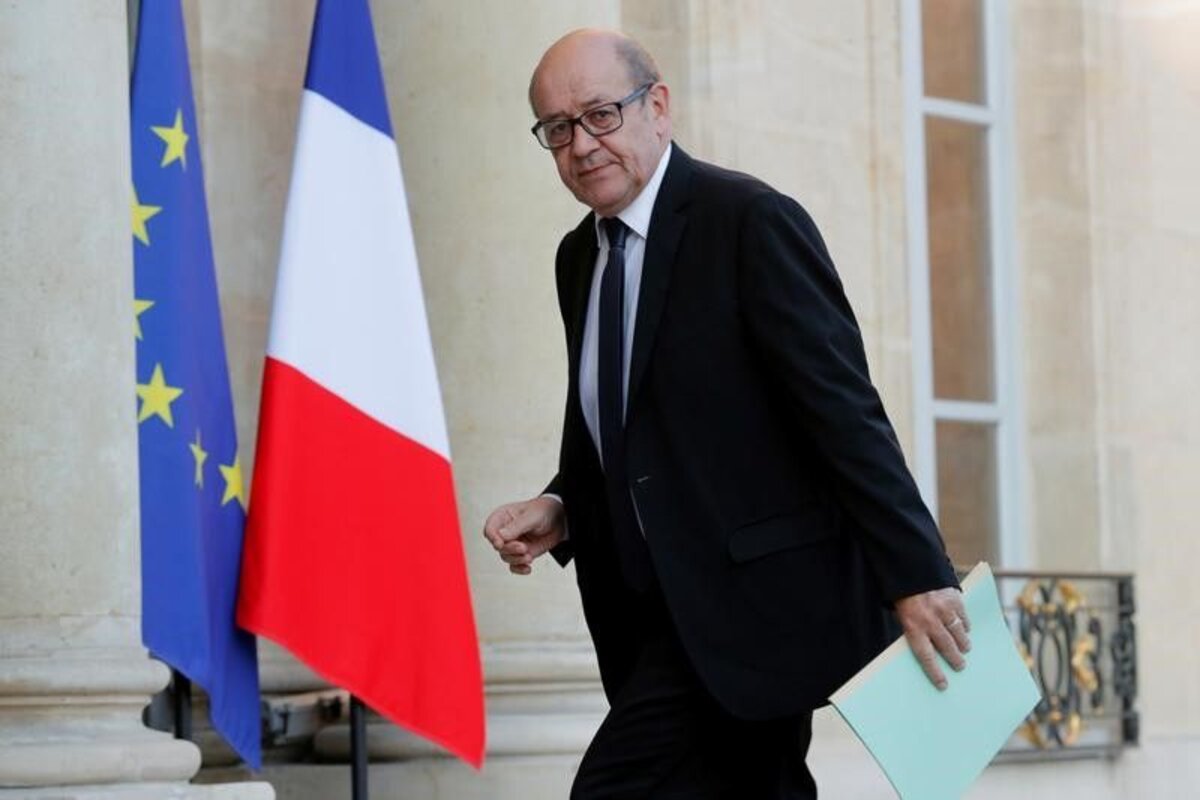
French foreign minister Jean-Yves Le Drian is a discreet figure who talks little about his family. But he never forgets those close to him. Mediapart has learnt that Le Drian, one of the real heavyweights of President Emmanuel Macron's government, intervened via his private office to help with the applications of two of his grandsons for places at the popular Lycée Français de Barcelone school in Spain.
In June 2017 'Paul' and 'Jacques' – Mediapart has chosen not to use their real names or exact ages – put in their completed applications for the prestigious school after the official application deadline had passed, but received support from the French Ministry of Foreign Affairs. When questioned about this direct intervention by Mediapart Jean-Yves Le Drian's private office simply stated that “the head of the establishment [editor's note, the school] was informed by the Ministry of the children's arrival”. But according to documents seen by Mediapart, the ministry's intervention in reality led to their late application being successful, even though hundreds of children who had applied on time saw their applications rejected for that year.
Enlargement : Illustration 1

The story goes back to June 7th, 2017. Jean-Yves Le Drian, who had reluctantly given up his post as defence minister under former president François Hollande to become President Macron's foreign minister, was very busy at the start of the new presidency. On that particular day he was involved in some very important meetings, One was a special defence committee meeting held at the Elysée at 9am, a meeting held just three days after a major terrorist attack in London, followed by a cabinet meeting of ministers an hour later. In the afternoon Le Drian hosted meetings at his ministry with Khaldoon Al Mubarak, chairman of Abu Dhabi's Executive Affairs Authority, and then Polish and Norwegian foreign ministers Witold Waszczykowski and Børge Brende, respectively. The day was rounded off with a dinner organised by the Organisation for Economic Co-operation and Development (OECD) Council in Paris.
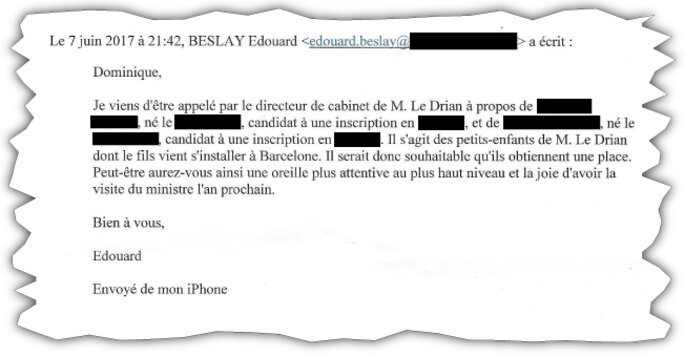
Meanwhile, however, France's diplomatic service was busy in Barcelona on another case entirely. At around 10pm that night the French consul general in Barcelona, Édoaurd Beslay, was busily tapping away on his mobile phone. This diplomat, in post since 2013 and who had attended the prestigious École Centrale Paris and the elite École Nationale d'Administration, had just received a phone call from the Ministry of Foreign Affairs in Paris. The call was sufficiently important for him to pass on the information immediately to Dominique Duthel, the director of the Lycée Français de Barcelone, the favoured school for French expatriates in the city.
“Dominique, I've just been called by the head of Mr Le Drian's office about Paul ...and Jacques,” he told him, providing the teenagers' dates of birth. “They're Mr Le Drian's grandchildren,” the diplomat immediately made clear. Their father – a member of the family via the minister's second partner Maria Vadillo – was moving to Barcelona for professional reasons. The French consul general for the city was explicit: “It would therefore be desirable that they [the children] get a place.” Édoaurd Beslay then offered something in exchange: “Perhaps you'll thus have a more attentive ear at the highest level and the pleasure of having a visit from the minister next year.”
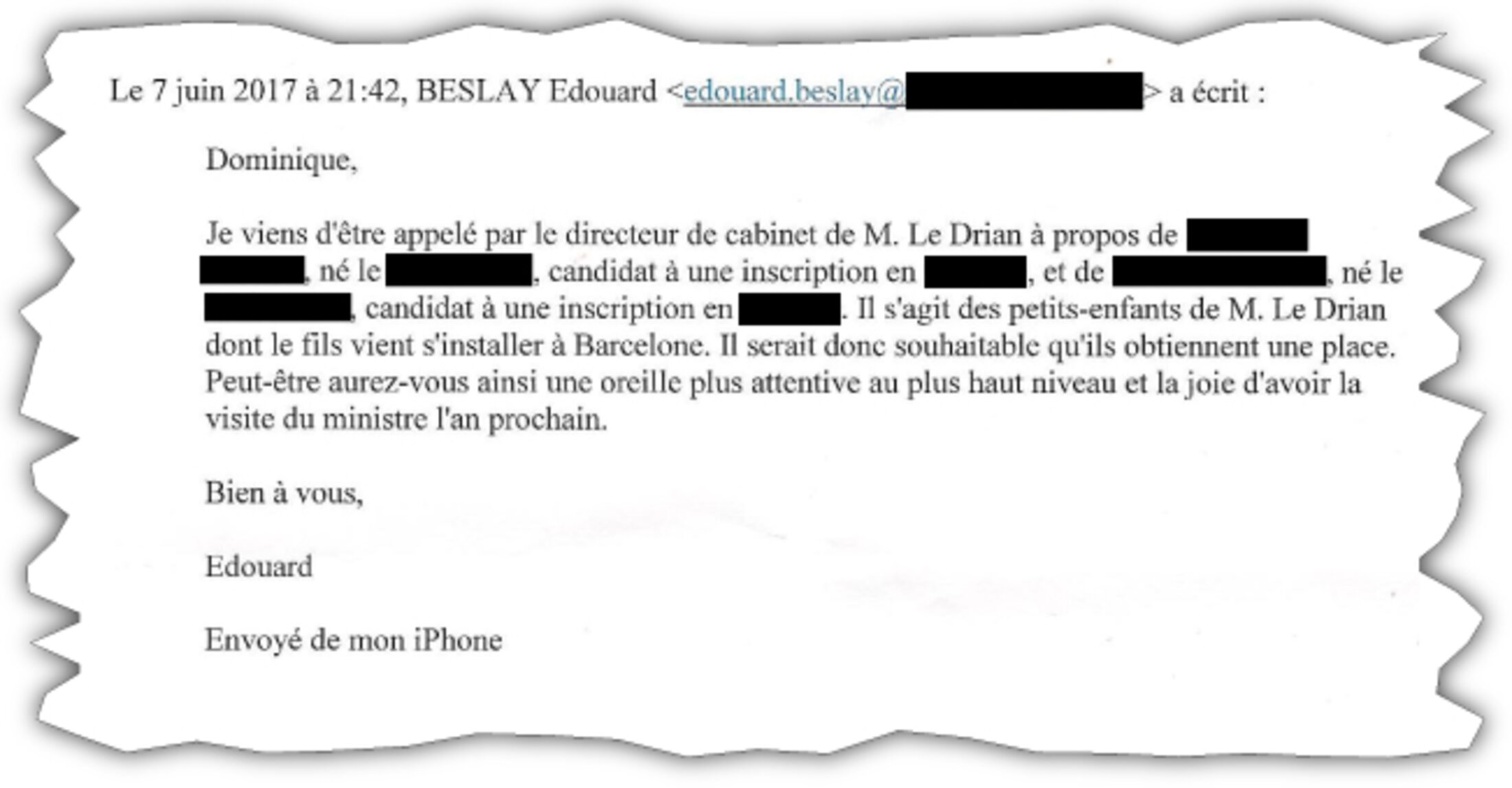
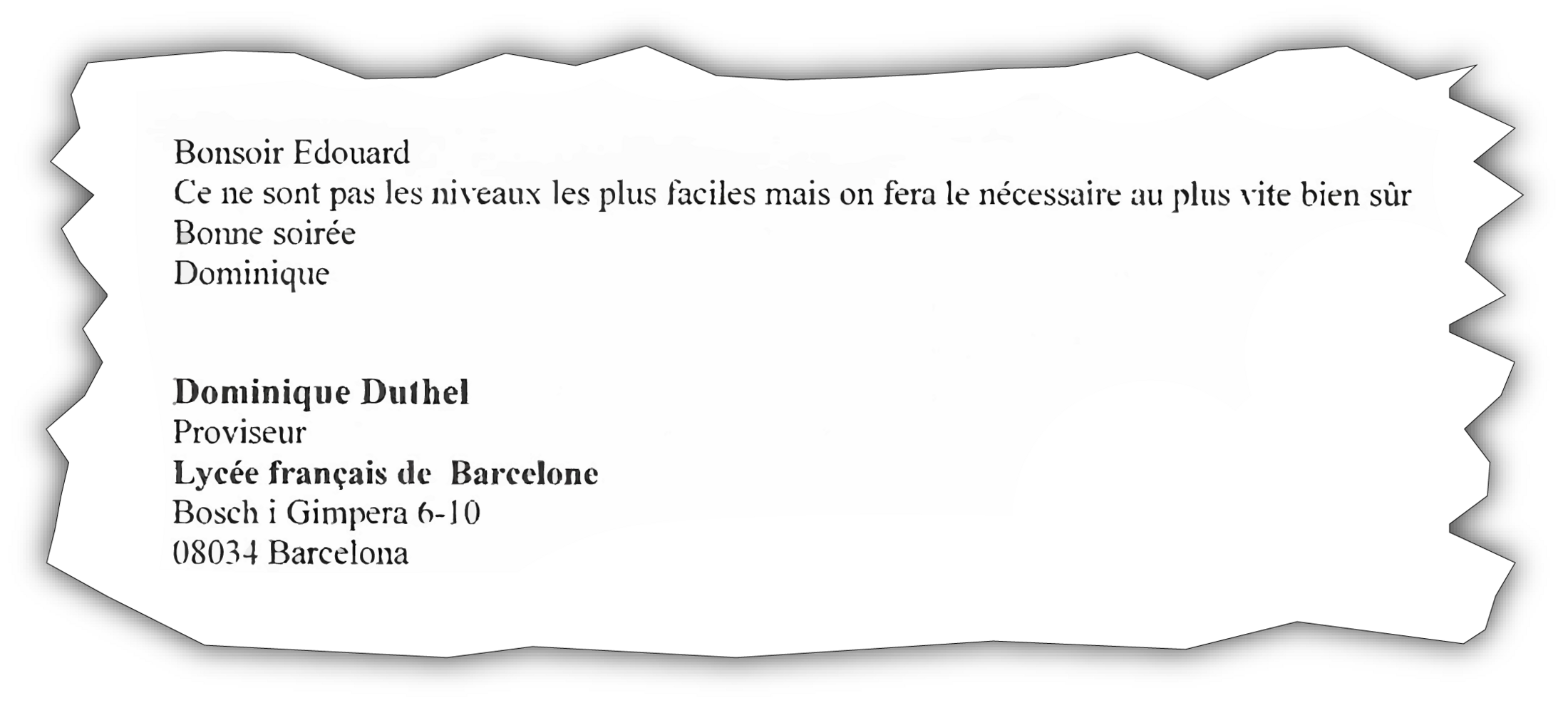
Despite the late hour Dominique Duthel took less than ten minutes to respond. It was something the school could do. “Good evening Édoaurd, they're not the easiest levels [editor's note, meaning years in which to find a place] but of course we'll do the necessary as quickly as possible.”
However, the lycée has an application procedure in place, at least in theory. For the new academic year starting in 2017 there were two admission processes for anyone applying for classes in the secondary section of the school, which takes pupils from nursery age. The first admission round was scheduled for March 23rd, 2017, and the second for “remaining places” was set for June 8th. This was the day after the request by the minister's private office and the nocturnal conversation in Barcelona.
Enlargement : Illustration 2
Enlargement : Illustration 3
The school's rules as set out are quite clear. There is a good reason for that, as the lycée, which has 3,000 pupils from nursery age right through to the final year of secondary school, has been a victim of its own success. According to a report on the local French-speaking radio station equinox, describing the problems of a French expatriate trying to get their son into the school, it turned down “300 children” for the start of the 2017 academic year. A school official also told local media: “There were 700 application requests this year, we could only satisfy 400 … we can't do any more, the lycée is full to bursting, there are already some classes of more than 30 pupils at certain levels .. the situation is very tight.”
Priority is given to applications from children of French nationality and one of whose parents at least has moved job with their employer. But to “separate candidates on equal criteria” the school will take into account the “arrival date of the completed 'paper application form',” it says. For 2017 the deadline for the “receipt of the full application”, including a signed form and accompanying documents, was set for Thursday June 1st, 2017. This date was even highlighted in red in the documents sent out to interested families.
Yet according to Mediapart's information, the applications sent by the parents of 'Paul' and 'Jacques' were still incomplete by this deadline. The teenagers' father had not yet supplied the formal confirmation from his employer showing that his job had been transferred. He did so on June 7th, by sending a “collaboration proposal” from his new company dating from the end of May 2017.

Enlargement : Illustration 4

When questioned by Mediapart, the school's director Dominique Duthel was less than clear about the Ministry of Foreign Affairs' intervention. First of all he denied that any requests were made by the ministry. “To my knowledge Le Drian never intervened,” he said. But the school director was less categoric when asked if the consul general Édoaurd Beslay – who left Barcelona in July 2017 – had relayed a message from the minister's private office. “It's possible, I've no idea, in any case I didn't need that,' he responded.
On the crucial part of the affair Duthel, who has been in charge of the French lycée in Barcelona since February 2015, formally denied that any special favours were given, insisting that the classes involving those two applications were not full. “We tried to find places for French people,” he said. “Well, we found places for this man who is, perhaps, from the Le Drian family but who is above all a Frenchman who found work here, who was thus changing his job, and who was thus a priority as a result of that … We're not here to have string-pulling, tricks and stuff.”
But what about pupils on the waiting list? “At certain times the waiting lists are absorbed into another [waiting list],” Dominique Duthel said. “From memory there could have been waiting lists for CM1 [editor's note, equivalent to year 5 in the UK and fourth grade in the US], something like that.” But he insisted that there “weren't any” for the classes involving the foreign minister's grandchildren. In other words, on the face of it it would appear that France's diplomatic service got involved late one June evening in 2017 for no reason at all.
Édoaurd Beslay, who after Barcelona moved on to “other duties”, did not respond to Mediapart's requests for a comment.
In December 2013 Mediapart revealed the controversial appointment of Jean-Yves Le Drain's son Thomas to the social housing group the Société Nationale Immobilière (SNI), which is a subsidiary of the public sector financial institution the Caisse des Dépôts. Jean-Yves Le Drian, who was defence minister at the time, did not comment on the affair but his entourage insisted that the appointment was not a cause of concern for him.
UPDATE:
After the publication of this article in French and English Jean-Yves Le Drian spoke to Cnews television about the affair and denied any wrong doing. He told the programme that his son-in-law had taken up a job in Barcelona at the end of May 2017. “I thought it was useful for my office to forewarn France's consul general … that part of my family was going to reside in Barcelona,” said Le Drian, who denied seeking any favouritism because of his position. “I didn't intervene over the admission of my grandsons. There are rules about getting into a French lycée...my grandsons met all the criteria so I don't see what the issue is.” Talking to Quest-France newspaper he said he had other things to do rather than react to such “stupidities”.
However, the foreign minister made no mention of the fact that the application from his grandsons was late – and thus against those lycée “rules” - the fact that the diplomatic service was used for a personal matter, the particular timing of the intervention by the consul general or the fact that 300 other children saw their application rejected that year.
Mediapart has subsequently been contacted by a father who also changed job and moved to Barcelona and whose application for his son in the same year as one of Le Drian's grandsons was made well before the deadline. Yet he was told in June 2017 there was no space for the boy because not enough pupils had left the school and freed up places. Meanwhile Jean-Yves Le Drian's grandsons – whose application missed the deadline – were accepted. “I don't want to criticise or attack anyone, I simply want to explain a way of working [by the school] that seems unusual to me,” says the father, who has asked to remain anonymous. Eventually, after a summer of complaining to the school about the admissions process, his son was admitted in time for the new academic year.
------------------------------------------------------------------------------
- The French version of this article can be found here.
English version by Michael Streeter