


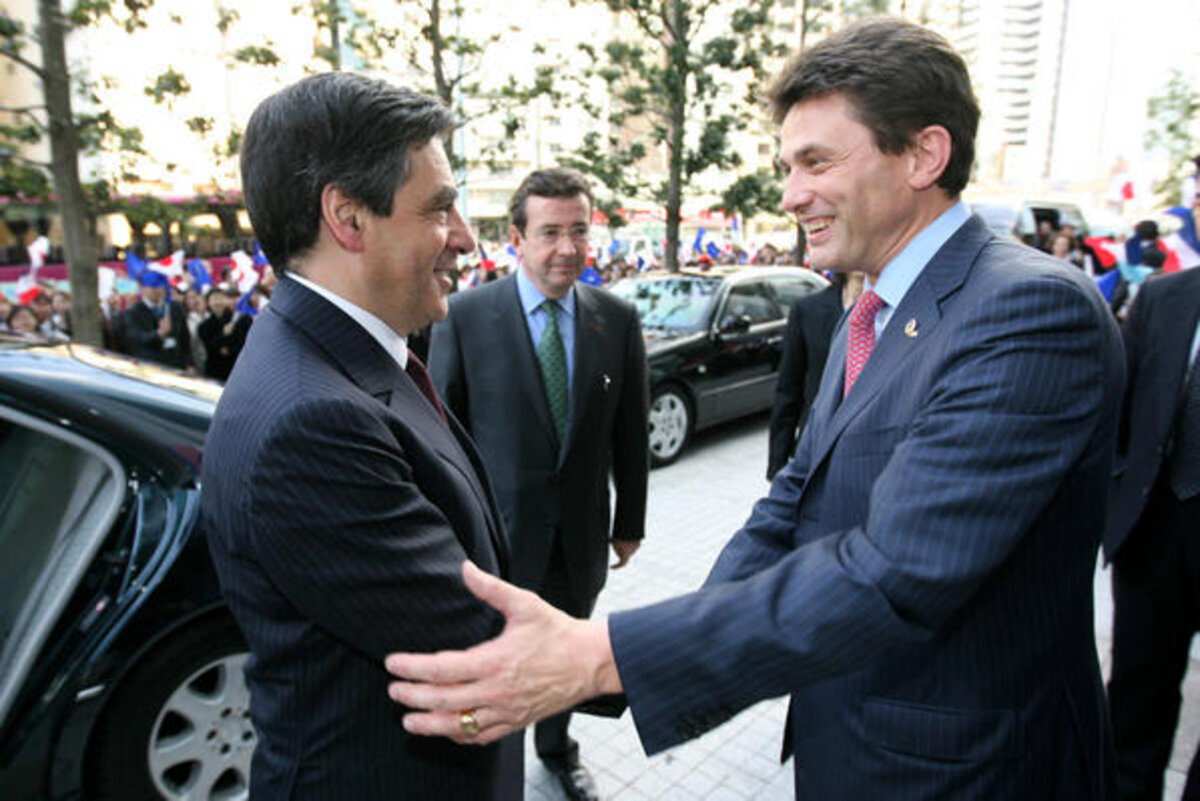
Doubtless through a sense of discretion, François Fillon does not like to broadcast his friendships and contacts in the world of business. Even less so when it comes to the French insurance group AXA. It was only when he was forced to do it that the right-wing candidate for the presidential election cast aside his normal reticence and admitted in December to his ties to with the group's former chief executive officer Henri de Castries. At the time, Fillon's plans to privatise a section of the French social security system were causing a major controversy. The former prime minister insisted that while Castries was his friend, he was in no way behind the plan that would break up the social security system to the benefit of insurance companies.
This public admission of friendship by Fillon then encouraged the ex-AXA boss to proclaim his public support for the candidate. “My commitment is a long-standing one,” Henri de Castries told the right-wing Le Figaro on January 17th. He, too, insisted he had had nothing to do with drawing up his friend's plans for the French social security system. “I am asking for nothing, I am not expecting anything,” he said. At that time it was being rumoured that Henri de Castries was being promised a top job in a future Fillon government, perhaps as finance minister or even as prime minister.
What the former AXA CEO did not say in his interview was that he appreciated François Fillon's advice and views so much that his group had used the politician's consultancy company 2F Conseil between 2012 and 2014. Again, it was only when forced to do so that Fillon – his campaign blighted by the 'fake job' row involving his wife Penelope - admitted at a press conference on February 6th that AXA had been among his clients. As, too, were credit ratings firm FIMALAC, the bank Oddo and the accountancy firm run by accountant René Ricol, as Mediapart has revealed.
The advice that Fillon gave was apparently of some value, as AXA paid him 200,000 euros for work carried out between mid-2012 and mid-2014, according to business news TV channel BFM Business. It was the same amount that Ricol's accountancy practice paid the former prime minister's consultancy.
The question arises as to how one can justify such financial rewards for activities carried out at the same time as being a Member of Parliament, as Fillon was at the time. Many MPs consider the payments unjustifiable, as the situation inevitably leads to a conflict of interests. “How can you not suspect peddling of influence?” asked centrist politician François Bayrou, who is still considering whether to stand as a candidate himself. “Financial powers are in the process of monopolising politics. Very large multinational companies are buying politicians, hiring them, giving money to politicians to help them to open doors, to make use of their contacts for their interests,” he said. The green candidate in the presidential election, Yannick Jadot, said: “You can't intervene as a lobbyist for a private interest at the same time as being a legislator who's meant to defend the general interest.”
On February 9th a dozen MPs from the Left and the Greens raised the issues of François Fillon's consulting activities with the National Assembly's Ethics Commissioner Ferdinand Mélin-Soucramanien. “Could the activities that he has carried out in relation to a client that we know about [AXA] constitute a conflict of interest and a clear failure of a Parliamentarian's ethical code?” they asked in a letter whose signatories included former green minister Cécile Duflot and Socialist Party MP Pouria Amirshahi.
Since the revelations about his consultation work at AXA, Fillon has done all he can to bury this new row. These disclosures may be the most embarrassing for the candidate because they raise questions about how close he is to the world of finance and the possible swapping of favours. For the world of business, and especially the world of finance, is not know for its selflessness. When it commits money it always expects a return on its investment. What are they getting in return? A ministerial position? A policy that is drawn up for the benefit of the world of finance, even though this sector has had little to complain about in this respect in recent years?
As is his wont, the former prime minister may well plead that he is being hounded, as he has acted in complete legality. In principle the electoral law forbids Parliamentarians from this kind of consultancy business, which is judged incompatible with Parliamentary activity because it can clearly give rise to conflicts of interest. However, the law does allow Parliamentarians to continue this business activity if they carried it out before they joined Parliament. This measure was not changed during the debates on the new law on political transparency that was adopted in 2013, with most Parliamentarians on the Right and also many on the Left backing the existing situation. François Fillon is well-informed and someone who respect the rules: he registered his consultancy company in June 2012, just eight days before taking up his Parliamentary duties as an MP, after leaving his position as prime minister under President Nicolas Sarkozy's old government. Thus according to the letter of the law he had indeed been carrying out the role of consultant before entering Parliament.
For AXA, however, the issue is a little more complicated. How could it justify such a contract with François Fillon? What advice could he add to the insurance group? Does AXA run the risk of legal action for misappropriation of company funds or even illegal political funding for having paid the former prime minister? As soon as the revelations emerged the insurance group sprang into action. In a statement to the insurance publication L’Argus de l’assurance the group said that Fillon had “in particular worked between mid-2012 and mid-2014 on the negotiations in course at the time on the European directive Solvency II, which came into force on January 1st, 2016”. It said that the former French prime minister was able to “open doors in Brussels and Berlin”. The group declined Mediapart's request for more details on the exact nature of Fillon's role.
Solvency II is a European Union directive that aims to reinforce prudential regulations in the insurance industry. The general framework for this was adopted in 2009 after the financial crisis. But the precise measures to fix the regulatory framework were rolled out in stages up to 2014. The legislation was transposed into French law at the end of 2014 and came into force from January 1st, 2016.
The looming presence of AXA
Insurance companies and the European Commission had been at loggerheads for years in discussions about the new regulations. The industry did all it could to get the least posisble regulation, or even no regulations at all. This was done, of course, in the name of saving the insurance sector from being “at a disadvantage faced with world competition”. Every issue became a controversy: the required levels of capital stock, asset risks and so on.
The mere mention of François Fillon being an advisor to AXA on Solvency II is enough to provoke laughter from insurance industry experts. “It's a joke,” says one financier, a former director at an insurance group, who suspects that the former prime minister has never read the balance sheet of this kind of business group. It is an understandable suspicion as the insurance world is even more complicated and technical than that of banking.
Enlargement : Illustration 2
Nor does socialist MP Karine Berger, who has been active on these issues since the start of this Parliament in 2012, recall seeing François Fillon getting worked up about banking and financial regulations. Fillon is not a member of the finance committee in the National Assembly and has never intervened in debates. “It was Jérôme Chartier [editor's note, who is today a special advisor to Fillon] who intervened during the whole discussion on transposing the Solvency II directive into French law,” she said.
Given that many lobbyists were active in the corridors of Brussels during the years spent rewriting the legislation, it is fair to wonder what François Fillon could have added to the process. What does the role of “opening doors in Brussels and Berlin” in fact mean? It gives the impression that the former French prime minister sold his contacts book to AXA. One person in particular may well have been of interest to AXA: Michel Barnier. The former French minister was at the time the EU Commissioner in charge of internal markets and services. As such it was his job to write all the financial regulation directives. He displayed some very firm positions on these issues but often had to back-pedal in the face of governments, in particular the French government, which were bent on supporting their own financial sectors.
François Fillon has known Michel Barnier for a long time. Both are historically from the Gaullist wing of the Right. Both belonged to the young group on the Right who made a name for themselves against the Left when the latter was in power in the 1980s, at a time when the mainstream right and centre-right parties the RPR and UDF seemed unable to get over the shock of losing power. Later Barnier was agriculture minister when Fillon was prime minister. Nothing could have been simpler for Fillon than to have put a good word in for AXA with Barnier. MPs and Senators do this on a daily basis to defend companies based in their constituency.
Enlargement : Illustration 3
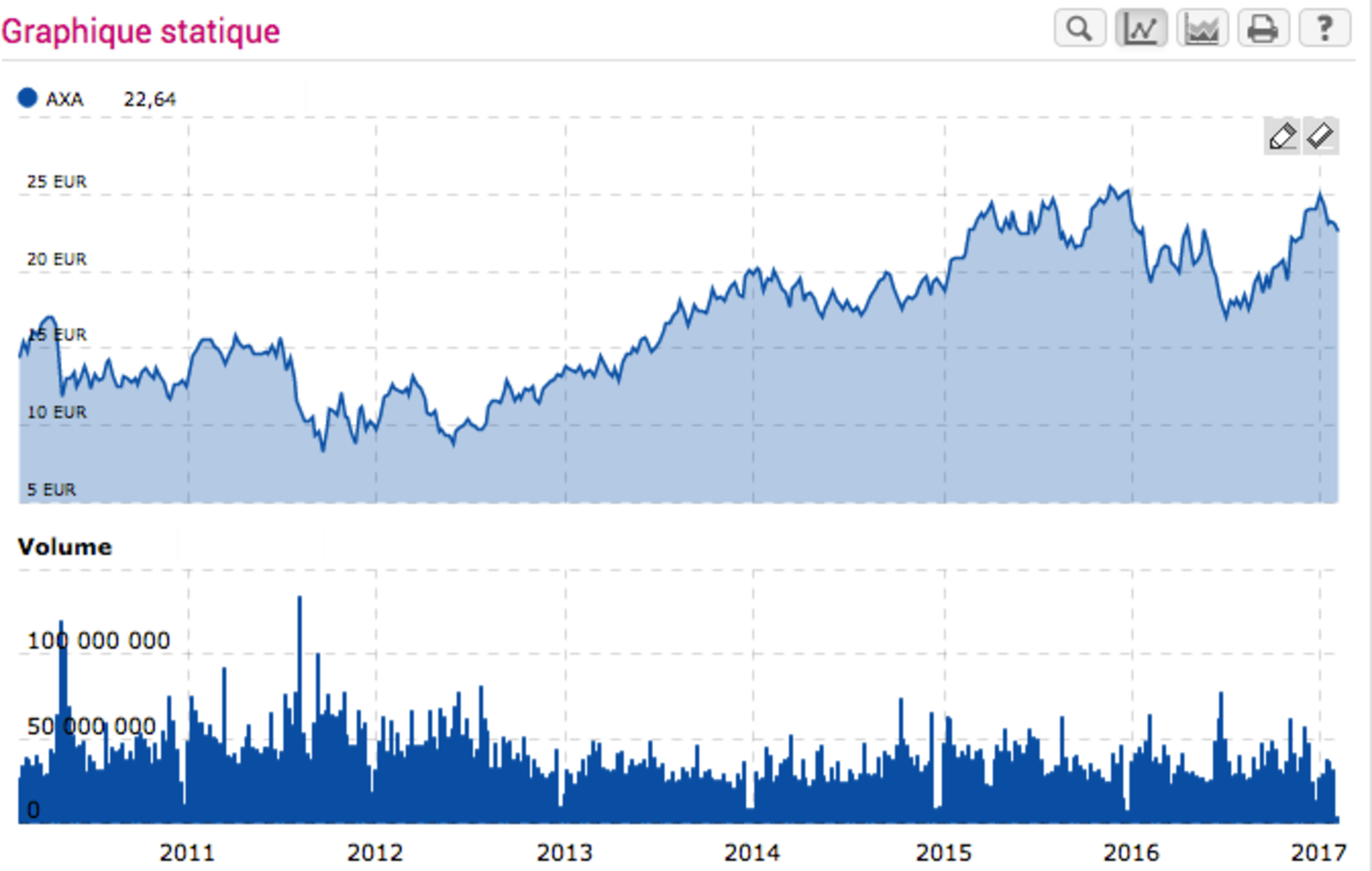
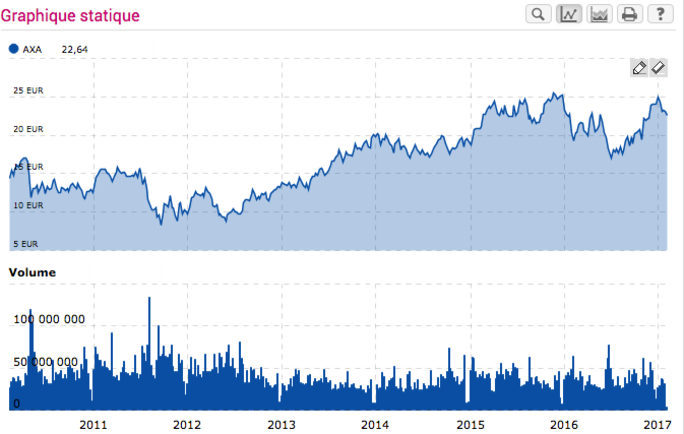
But did AXA really need François Fillon to defend its cause? In addition to its many lobbyists, the insurance group has its supporters in the French Treasury and right up to the highest levels of the state. This was especially so at this time, for the insurer was a concern for French finance ministers as it had been weakened in the financial world. Rumours about it were flying around. It was said that it was the European insurance group that would have the greatest problems fulfilling its prudential obligations. In any case its share price showed there were some problems: it was then at an historic low, fluctuating for two years between 8 and 10 euros.
The European Commission did not respond to Mediapart's questions as to whether a meeting with François Fillon at this period featured in Michel Barnier's official diary. In any case, a simple phone could would have been enough. Did he make such a call? Would making such a call have justified a payment of 200,000 euros? Just asking the question provides the answer. And especially as Fillon was later called on to vote on this legislation as an MP.
In any case, François Fillon's position is untenable. Either he provided no real advice to AXA, in which case his exorbitant pay appears to be illegal support on the part of financiers. Or he was paid by the insurance group to make some introductions and relay the group's wish-list and demands to influential people, at the same time as voting on the legislation to transpose the text into French law – thus giving rise to a clear conflict of interests.
--------------------------------------------------------------------------
- The French version of this text can be found here.
English version by Michael Streeter