


François Fillon, the former prime minister and conservative party candidate for the French presidential elections this spring, appeared on television on Thursday evening for an interview in which he attempted to limit a scandal that has severely dented the campaign of a man who just one month ago was tipped to become France’s next president.
Fillon’s bid for the presidency hit the ropes earlier this week when the investigative and satirical weekly Le Canard Enchaîné revealed that his British-born wife Penelope was employed by him as a parliamentary assistant and paid a total of 500,000 euros over ten-year period from public funds for work which the weekly suggested she did not fulfil.
The report also disclosed that she had also received, between 2012 and 2013, about 100,000 euros by a monthly review, La Revue des Deux Mondes, owned by Marc Ladreit de La Charrière, a wealthy businessman close to François Fillon. The payments were apparently for writing book reviews, of which at least two, totalling about 600 words, were published.
Following the report in Le Canard Enchaîné, the Paris public prosecutor’s office opened a preliminary investigation on Wednesday into suspected “misappropriation of public funds” and “receiving” the proceeds. It is also investigating “misuse of company assets” and “receiving” the proceeds.
The disclosures, whatever the final outcome of the investigation, already represent a severe blow to Fillon’s image as an upright politician with strong political and personal morals. For beyond the allegations that he was involved in arranging fraudulent payments for his wife, the fact that he employed his family from public funds allocated to his political activities, which in itself is perfectly legal in France, contrasts sharply with his denunciations of those who milk the public purse. It also sits uncomfortably with his manifesto pledges to introduce harsh austerity measures if elected, including a plan to cut 500,000 jobs in the public sector.
“I would like to say that I cannot find the words to express my disgust at the abject nature of these accusations,” Fillon, 62, told the TF1 channel news anchor during the studio interview on Thursday.
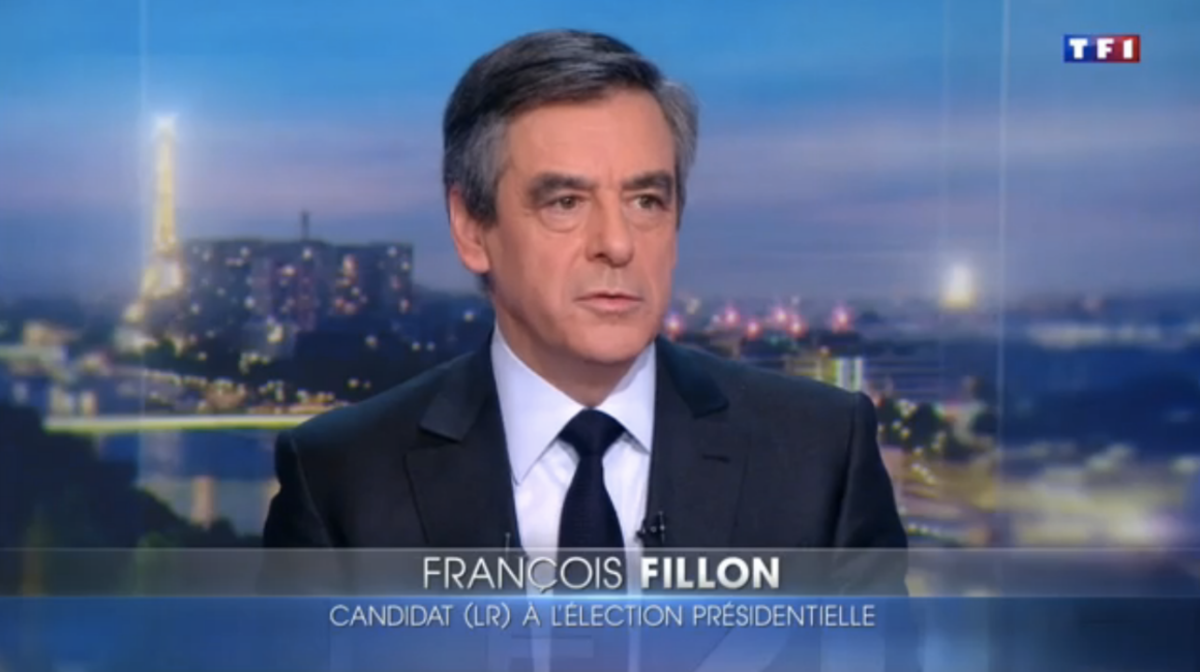
Enlargement : Illustration 1
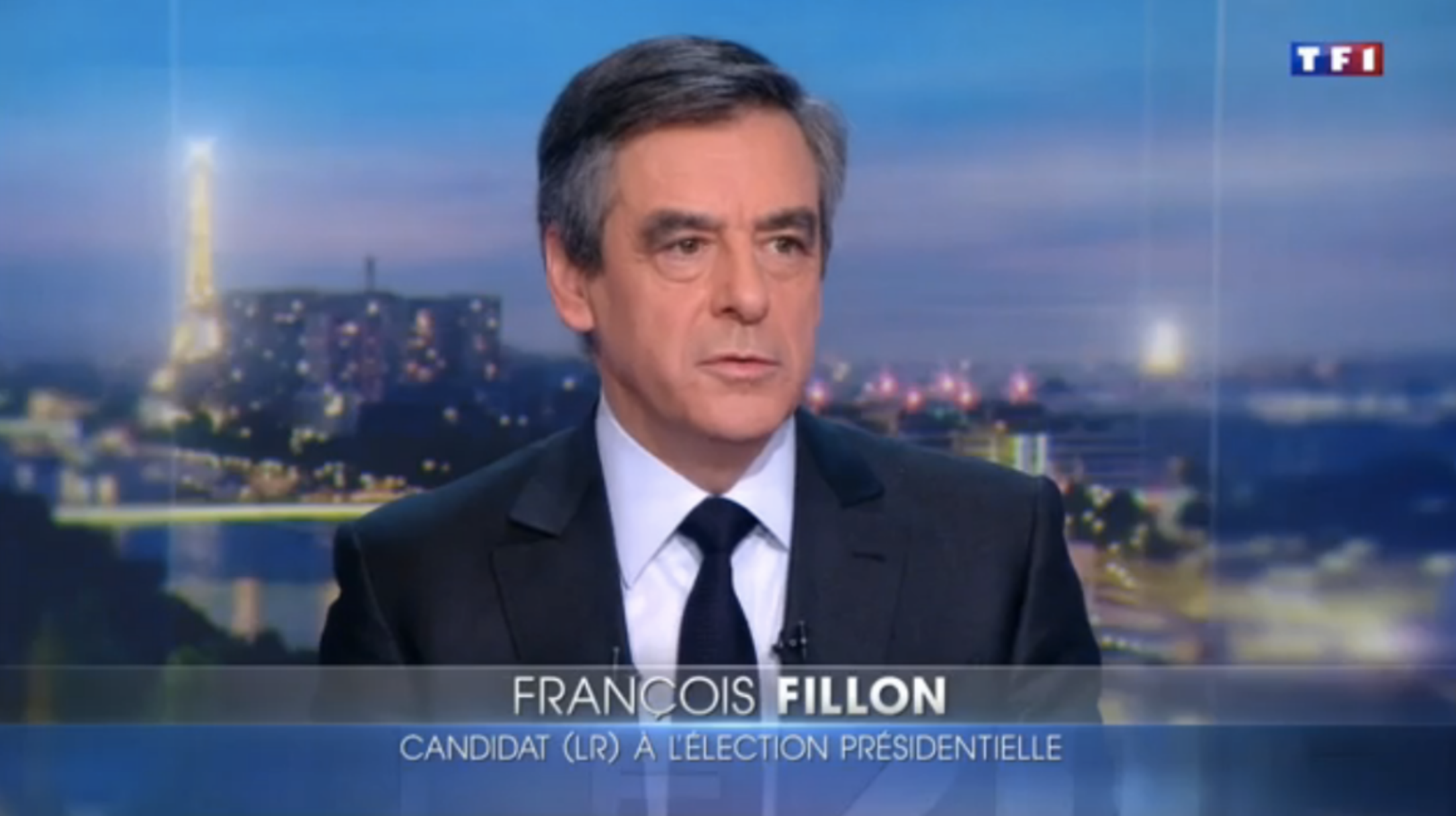
“My wife is remarkable, she is exceptional,” he said. “You don’t imagine to what degree she suffers that one could think that she did not respect the rules. So, I say tonight, I will defend her, I love her, I will protect her. And I say to all those who are out after her that they will find me to face.”
Fillon said “I have a thick skin”, adding that the revelations this week “reinforce the idea that there is something rotten in our democracies”, echoing previous reactions by former president Nicolas Sarkozy, under whom Fillon served as prime minister between 2007 and 2012, regarding the multiple corruption cases Sarkozy became – and, for a large part, remains – implicated in.
It was an ironic moment for Fillon who, in a speech last August in his political fiefdom of Sablé-sur-Sarthe in north-west France, launched a clear attack on the corruption scandals surrounding Sarkozy who was then a principal rival for the nomination of their conservative Les Républicains party’s presidential candidate, which Fillon finally won in November. “To have a high opinion of politics signifies that those who seek the confidence of the French people must be worthy,” he said in August. “Those who don’t respect the laws of the [French] republic should not be able to present themselves before the electorate. It serves no purpose to talk of authority when one is not oneself irreproachable. Who could imagine General de Gaulle placed under investigation?”
The Thursday appearance on TF1 was a high-stakes moment for Fillon, just days before he is due to hold a major meeting in Paris this weekend to kickstart his floundering presidential campaign, and despite complimentary comments about his performance on the social media made by his allies, in reality it was unconvincing. For apart from insisting that there could be no doubt about the “legal”, “real” and perfectly transparent” nature of his wife’s work, Fillon failed to address the many questions raised by the revelations in the Canard Enchaîné and subsequent additional disclosures on the subject in the press.
“My wife has worked for me since forever, since 1981, since my first election,” he said. “She has always accompanied me in my political life and elsewhere. I think I would not have led the path that I have without her support and her help. She has corrected my speeches, she has met innumerable people who wanted to see me and who I couldn’t see. She has represented me in meetings, in associations, she did press summaries for me, and above all she – because everybody would tell you in the Sarthe that Penelope Fillon is simple, ready to listen to people and available – she informed me of what people wanted, she informed me about the evolutions in our society. She did that for years benevolently. In 1997, I had a parliamentary collaborator who left, I replaced him with Penelope.”
But he produced no material evidence to prove that his wife completed the work she was paid for as his parliamentary assistant, announcing instead that he would “provide all the necessary justificatory documents” to the investigation opened by the public prosecutor’s office on Wednesday.
His lawyer Antonin Levy met with magistrates from the financial crime department of the public prosecution services on Wednesday, to hand over evidence on behalf of Fillon. On Friday, the magistrates questioned several people, including Christine Kelly, the author of the first biography of Fillon, published in 2007, and Michel Crépu, who was editorial director of La Revue des Deux Mondes when the publication, which has a modest circulation, paid Penelope Fillon a total of about 100,000 euros between 2012 and 2013.
During the television interview on Thursday, François Fillon said Marc Ladreit de Lacharrière, the billionaire owner of the review and a friend of Fillon’s, “will be given the opportunity to explain himself”. Of his wife’s contributions to Ladreit de Lacharrière’s review, Fillon said: “She was his advisor, I saw the work she did. My wife is as [academically] qualified as me. She perfectly well had the competence to do this work.”
Fillon revealed that he had also paid two of his five children for work in connection with his position as senator, between September 2005 and May 2007, consisting of what he described as “precise missions” and “because of their competence” as lawyers. But press reports on Friday contested his statement, disclosing that neither of the two were qualified lawyers at the time, but were in fact students. Fillon said that in 2013 he put an end to employing his family from public funds provided for his political activities because he became aware that public opinion had “evolved over these issues, that there were suspicions, that there was this different form of requirement”.
While Fillon’s performance (the complete interview can be seen here, in French only) received wide support in public from representatives of his Républicains party, several, speaking off the record, were less enthusiastic. “He’s done the job, but he didn’t say anything on the fundamentals,” said one Républicains party Member of Parliament, speaking to Mediapart on condition his name was withheld. “It comes up a bit short as a defence.”
Fillon has said that he will only pull out of the presidential race if he is placed under investigation – a French legal status one step short of being charged but which implies that “serious and concordant” evidence of criminal activity has been established. By announcing that condition, the former prime minister has hinged his political future on the decisions of the public prosecutor’s office, upping pressure on it to reach a rapid conclusion to its preliminary investigation.
But even before that point is reached, there are many in the conservative opposition who are now concerned by the possibly disastrous consequences for their party from the events this week, for a significant part of Fillon’s appeal to the rightwing electorate was his image of probity in a political class mired by corruption scandals.
-------------------------
- The French version of this report can be found here.
English version by Graham Tearse