


There are many good reasons why a biography of Raymond Barre makes for a fascinating read. He was a university professor with an idiosyncratic political profile, a man who found himself holding the reins of power without really having sought such a position, in effect the polar opposite of all those who have thought of nothing but power while shaving [1] ever since the first down appeared on their juvenile faces.
He was open to the world and had an international reputation, while the princes who govern us in these opening decades of the 21st century can barely enunciate three words in English, like Nicolas Sarkozy, or knew nothing of Asia beyond the beaches in Thailand until they were elected, like François Hollande. Barre was steeped in economic culture, while the aforementioned range from illiteracy to superficiality.
He refused sectarianism, while our present political class functions by fighting what could be dubbed a cold civil war, and also closes ranks to defend its privileges. And finally, perhaps above all, there was his legendary outspokenness. "Raymond la Science" as he was nicknamed – a way of saying he was a know-it-all – was continually putting a spoke in the wheel of Citizen Barre’s political endeavours. In politics in general, the bigger the lie, the more it will be believed.
His heyday came in the 1970s, which were marked by a major break with post-war stability and prosperity. Bretton Woods - the system of monetary and exchange rate regulation adopted by the Allied powers in 1944, came to an end - there were two oil crises, while the paradigm of strong growth coupled with welfare states, the underpinning of post-war reconstruction and development in advanced Western countries, fell out of synch. Few political figures really understood the extent of this shift at the time, and 40 years later some have still not registered its significance. Yet it is highly relevant in our world post the 2008 financial crisis.
"One day in 1973, the world changed,” Barre said in 1978. “The French must adapt to it, willingly or unwillingly." It was a diagnosis that has, unfortunately, hardly changed. "Governing means, in a country like France, changing mentalities,” he continued. “These are, at the present time, complex. They bear the signs of centralist and protectionist traditions, of an egalitarianism that kindles ever-increasing demands, of a pronounced taste for privileges expressed in a visceral attachment to acquired rights, of a certain aversion to competition, be it economic or social, and of a tendency to facility favoured by 20 years of rapid economic growth and by the drug of inflation."
This directness brought Professor Barre solid unpopularity at the time. Today it would have had him catalogued in the reviled neoliberal camp, although the reality is much more subtle. Barre's independent brand of Gaullism – he would never hold a party card – did not fit well with the anti-government positions of the then-British and US leaders Margaret Thatcher and Ronald Reagan.
French historian Christiane Rimbaud explains in her biography that it was Barre's government that invented the idea of aiding the unemployed both financially and to find another job, introducing the first ever measures aimed at promoting youth employment. He could not know that a similar mechanism, and all the others that followed, would still be part of the panoply of public policy today, one which remains powerless to cure France of the blight of under-employment and bad employment. An advisor to Barre at the time, Raymond Soubie, who would become known later as an advisor to Sarkozy, went on to write that "all the employment policies adopted in France over the past 30 years are essentially contained in the programme for youth employment of April 1977."
Barre can be called a liberal economist by dint of those who inspired him, including French economist François Perroux, French thinker Raymond Aron and Joseph Schumpeter, the influential American economist. It is a shame this biography gives less prominence to how Barre's economic approach evolved, particularly given its longevity, than to some purely political anecdotes – less space for the history of thought than for trivial stories. The two volumes of his Économie Politique have been repeatedly re-published and have had a far from negligible influence on generations of students who would go on to become France's top administrative and economic officials. Barre never had time to write the third volume.
1: In a 2003 television interview, when Nicolas Sarkozy was interior minister, he was asked if he thought about becoming president while shaving every morning. He replied: "Not only when I shave." He was president from 2007 to 2012.
Father of competitive deflation and monetary union
This liberal economic approach would provide the basis for introducing something that was a real jolt, the total freeing up of fixed prices [2] It was a total break with the administered, regulated, planned economy à la française, and there would be nothing like it until the arrival of Pierre Bérégovoy as finance minister in 1984 (a post he held until-1986 and again from 1988 to 1992, when he became prime minister). Bérégovoy was also an atypical figure in the French political landscape, and it is certainly no accident that before writing her biography of Raymond Barre, Rimbaud penned a book on the life of Bérégovoy, who was the last socialist prime minister to serve under presidency of the late François Mitterrand before the 'cohabitation' [3] with the Right. Indeed, between Barre and Bérégovoy was a reciprocal appreciation and a certain intellectual complicity.
Barre's aim was to push back the hydra of inflation in both the medium and the long term. Surging inflation had been accompanied during this decisive decade by a collapse in growth, known as stagflation. The counterpart of deregulating prices was obviously opening up to competition, something a large swathe of French employers rejected. Barre then faced the traditional coalition of inflationism and protectionism that rears its head every time the going gets tough. He was the inventor of 'competitive deflation', a concept advocated tirelessly by Jean-Claude Trichet when he was Treasury Director and later Governor of the Bank of France – for which he suffered the same virulent criticism from the same interest groups as had Barre.
Barre even introduced the term 'competitiveness' into French political vocabulary, and it would remain. His push to make the national apparatus of production competitive, his refusal of ‘facility’, can only be explained in the context of European construction, in which Barre would also play a pioneering role regarding its monetary dimension. Rimbaud recalls that before the Werner Plan, the distant precursor of economic and monetary union, there were two Barre Reports adopted by European institutions, in 1968 and 1969. Barre was then vice-president of the European Commission in charge of economy and finance, a position to which he had been nominated by General de Gaulle in 1967.
And he would successfully use all his weight from Brussels to prevent the devaluation of the French franc that supposedly informed sources predicted was in the offing in November 1968, a tribute to be paid for the cost of the 'events' of May 1968. It was only a temporary success. Georges Pompidou, who succeeded de Gaule as president, converted to the dubious but popular theory of arbitration between inflation and unemployment, devalued the franc soon after he became president in 1969.
This tendency to advocate a weak currency is still nowadays part of the vernacular of those who favour the end of the euro and the return of the franc, from the far-right to the radical-left. From his vantage point in Brussels, Barre would not be the first, or the last, to adopt a different viewpoint of 'the country he knows the best', as Eurocrats are wont to say, from those who have never been anywhere besides the Parisian goldfish bowl. "Every time we do something we feel the need to be Franco-centric. In Brussels I saw that we were not the centre of the world and that our national pride, when it was not legitimate, was very injurious to us," he said.
Barre would cultivate this global vision in circles where the economist and professor that he was felt at home. So he would make a major contribution to establishing the reputation of the Davos World Economic Forum, which he would chair from 1983 to 1985. He was also the forum's rapporteur for many years, allocated the task of ensuring its intellectual coherence – something that would be hard to find today in the banalities that emanate from this gathering of the masters of the universe.
And even worse for his reputation among the troglodytes of Frenchness, he participated over a long period in the work of the Trilateral Commission where, according to Rimbaud, he met Stéphane Hessel, who would become the prophet of indignation with his book Indignez-Vous! (Time for Outrage!), published in 2010. An ideal profile for conspiracy theorists of all colours.
2: Under the second government he formed from 1978, Barre removed fixed prices across the French economy, some of which, like the price of bread, had been set by the government for nearly 200 years.
3: Under the French system, if parliamentary elections return a majority other than the president's, there is 'cohabitation' between a president of one colour and a prime minister of another colour. This has happened three times: Mitterrand/Jacques Chirac from 1986 to 1988, Mitterrand/Edouard Balladur from 1993 to 1995, and Chirac/Lionel Jospin from 1997 to 2002.
'In the name of politics, people sometimes say anything'
That unusual profile gave rise to an unusual attitude towards day-to-day politics. Much later, when he had been persuaded to stand for the post of mayor of Lyon, Barre regretted that campaign rules meant there could be no meeting organised by his friend and former US Secretary of State, George Schulz. He did not dissimulate how little he sought to pander to voters. "Certainly I had no illusions but I am very struck that in the name of politics, people will sometimes say anything, will sometimes go back on it or in any case, often put forward what is accessory before what is essential,” he once said. “It was fashionable to say that I was a professor who wandered into politics and was unable to understand politics. If they meant the kind of politics I have just referred to, I am glad."
This would be demonstrated during the 1988 presidential election campaign in which Barre lost the contest to represent the Right to the smooth-talking Jacques Chirac,and who himself lost against socialist Mitterrand who was easily re-elected for a second, disastrous seven-year term. Barre certainly paid the price for his too distant commitment to the daily grind of elections, but above all, for defections from his own liberal, pro-European camp, recruitments into the Chirac camp, and the fact that the wily Mitterrand had effectively manoeuvred for the opponent he could defeat most easily in the second round of the election.
Recounting this episode is of only mediocre intellectual interest, but it confirms the astonishing propensity of French voters to choose people who excel in winning power, but who are then revealed to be incapable of doing anything useful for the country – Mitterrand's second mandate, Chirac, Sarkozy, Hollande, and who knows what will come next. These political profiles are the polar opposite of Barre's. The economist Jean-Claude Casanova, who was Barre's advisor when he was prime minister, wrote that Barre had "the qualities necessary to exercise power...but perhaps not the qualities required to get elected."
In terms of the institutions of the French Republic, what distinguishes careerists of all sorts, those whose credo is to stay put once they are elected, is their attitude to political ‘cohabitation’. Barre, who in this followed de Gaulle, would constantly condemn its contradictions. ‘Cohabitation’ is something the French love because it guarantees a certain immobility, and the Soviet-style rigidity of the Chirac years would be a perfect example of this. Similarly, Barre opposed a five-year presidential mandate, which he saw as threatening to weaken the presidency.
But his refusal to mix up institutions should not be confused with sectarianism, which is the prerogative of political parties. As mayor of Lyon, an electoral mandate where this solitary individual could blossom in a role akin to a captain of industry – and even end up being popular – he practiced a form of pluralism in relation to the opposition. Rimbaud says this went as far as preferring the socialist candidate Gérard Collomb, as his successor over someone from his own camp.
Barre's tenure in Lyon brought the city an international dimension – the G7 group of industrialised nations would hold their summit there in 1996 – as well as major urbanisation and investment in culture well before the arrival of the age of the metropolis. Incidentally this trend is one which, true to form, France is still hesitating to fully join, witness the pathetic regional reform introduced by Hollande. "I have become the head of a very large enterprise, with its economic, financial, social and cultural problems," Barre said at the time.
-------------------------
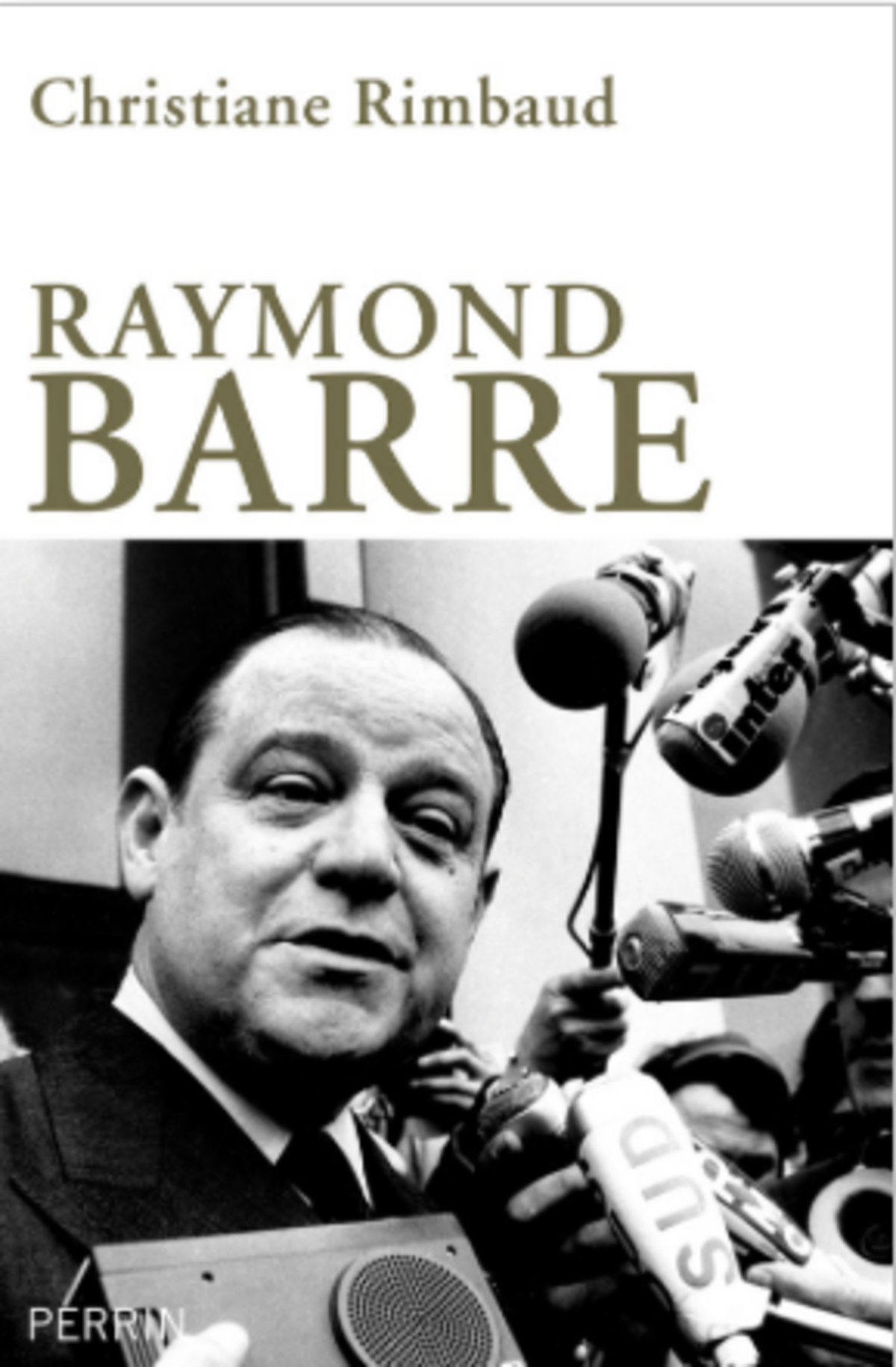
Raymond Barre, by Christiane Rimbaud, is published by Éditions Perrin, priced 25 euros (digital version 17.99 euros).
- The French version of this article can be found here.
English version by Sue Landau and Michael Streeter
(Editing by Graham Tearse)