


It could have been just another story of a wealthy purchaser snapping up yet more farmland at an inflated price. But this time farming and rural protection groups decided to make it a political issue.
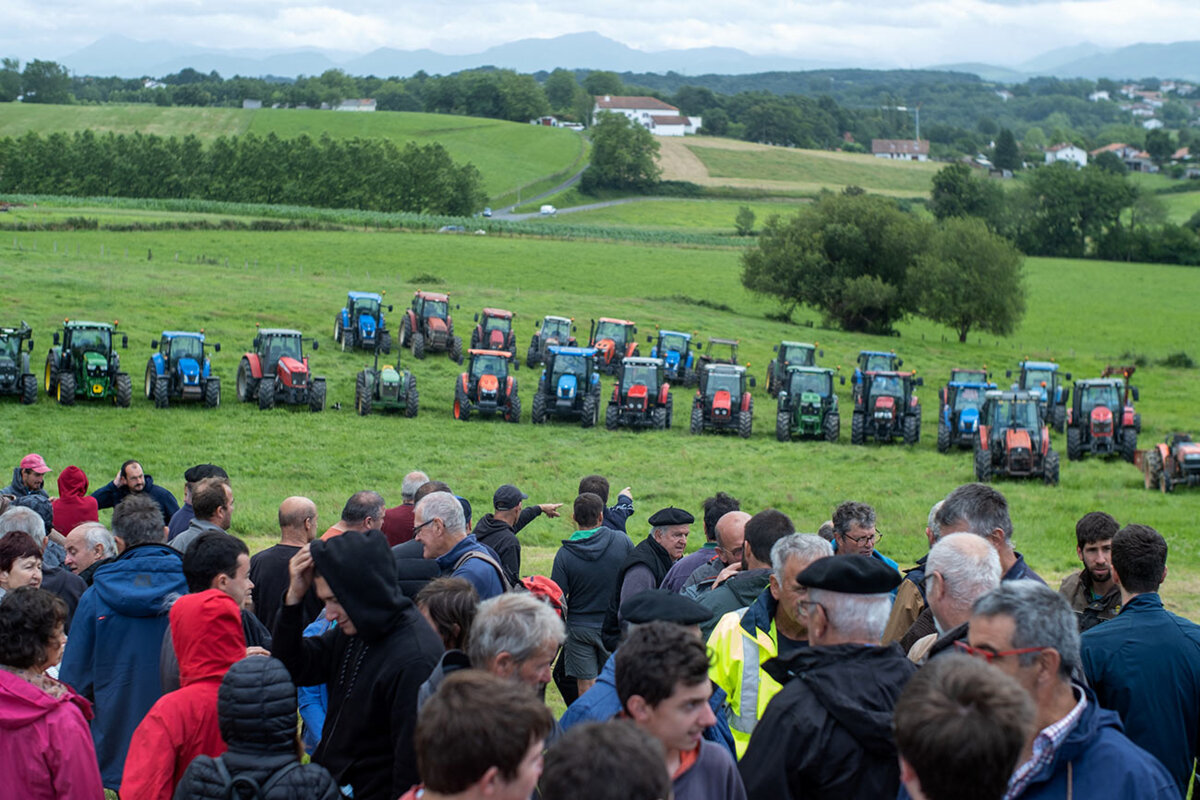
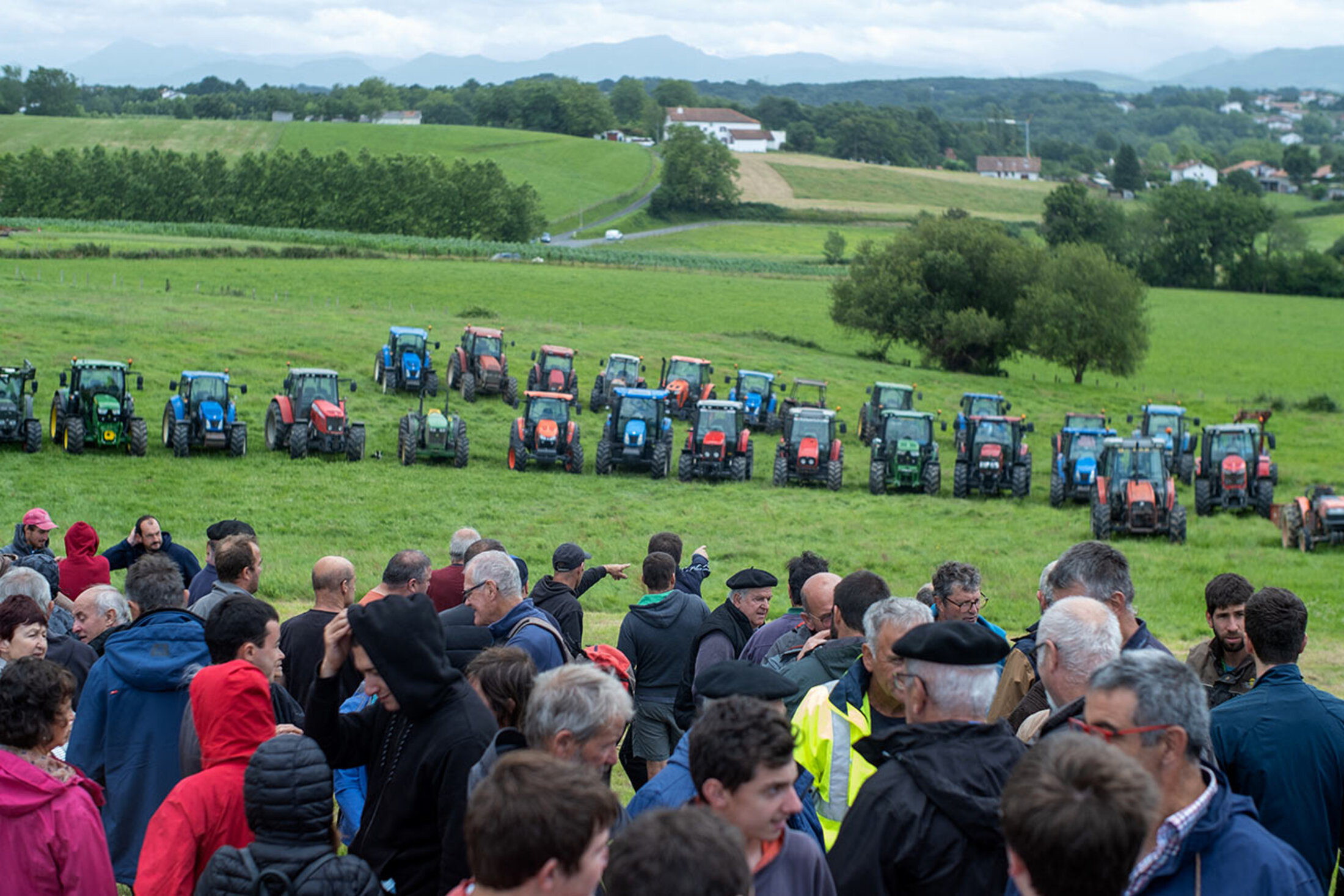
To ram home their point, earlier this summer the local farmers and activists occupied the 15 hectares – about 37 acres – of farmland near the upmarket resort of Biarritz in south-west France which has just been bought for the exorbitant sum of 3.2 million euros.
And they have remained on site since, refusing to move until the sale is annulled.
This land in the village of Arbonne, which also includes three buildings, one of them a large farmhouse, has been bought by a wealthy heiress from Paris whose main intention is to use the land to stable her racehorses. This is despite the fact that this area near the Basque coast in France is desperately short of land for arable farming and market gardening. Yet a legal loophole means the French agency that protects farmland from being taken out of circulation cannot stop the sale in this case.
Enlargement : Illustration 1
The issue first escalated when the ELB - the Basque branch of the Confédération Paysanne union for small farmers - and the Lurzaindia association, which campaigns to protect farmland, were notified of the sale on May 20th 2021. “We quickly decided to do something about it,” said Maryse Cachenaut, a farmer and member of Lurzaindia.
On June 23rd around 60 activists from the ELB and Lurzaindia went onto the land and started an indefinite occupation. There weeks later the militants decided to enter the main farmhouse, too, to step up the pressure. “We had the feeling that the owner and buyer were playing on the situation getting worse,” said Maryse Cachenaut.
Since late June the activists have staged a series of conferences, meals, concerts, produce markets and children's days on the site. The occupation has also allowed them to coordinate other protest actions: they temporarily occupied a firm of architects linked to the buyer and to a report for the notary who is overseeing the sale, organised a go-slow protest of 125 tractors around the outskirts of Biarritz and on August 3rd sent a delegation to visit the purchaser's home in Paris.
The protestors are angry about the purchase price, which they see as “purely speculative”, and the use to which the farm will be put - “land used for leisure to the detriment of food-producing agriculture”, as they describe it. But they are also unhappy that the agency charged with protecting agricultural land was unable to block the sale, and are seeking a change in the law.
In many cases this agency, SAFER the Société d’Aménagement Foncier et d’Etablissement rural, can prevent the sale of farmland to non farmers. Under the Rural Code it has the right to first refusal to buy agricultural land, which it can then re-sell to local farmers at normal market prices. However, in this case SAFER – who valued the property at 800,000 euros, a quarter of the actual sale price – was unable to exercise its right of first refusal for technical reasons. As the buildings on the land at Arbonne had not been used for agricultural purposes for at least five years, the Rural Code does not allow the agency the right to buy the whole property at its true market value.
Instead, all SAFER can do in this and similar cases is to apply for a 'partial' first right of refusal involving just the farmland, without the buildings. In such a case the seller of the property can accept but is then entitled to ask for compensation for the loss in value of that part of the property that has not been bought by SAFER. Or the seller can insist that SAFER buys the entire property at the already agreed price, in this instance 3.2 million euros. “In the Arbonne case it's impossible to buy everything because that would involve approving a speculative price,” said Maryse Cachenaut.
The seller certainly has the means to buy it for three million euros but she's not a farmer and so it's not justifiable for her to buy this property which should be used to enable new farmers to get established.
Nonetheless, at the end of July SAFER did apply for a right of partial first refusal on 11.2 of the 15 hectares of the land that is not attached to the buildings. They have valued this stand-alone land at 100,000 euros. The agency is apparently not hopeful of a positive response though it has not yet heard from the seller, who has two months to respond. “The seller accepts in only about 10% of cases in France,” said Maryse Cachenaut.
“Faced with this sale at an absolutely excessive price, SAFER doesn't have complete freedom of action,” added the local Member of Parliament for the centrist MoDem party Vincent Bru. He said that out of six requests for a partial right to refusal to buy that have been made in the Basque region in recent years, just two have ended up with an agreement.
“This case really illustrates the limits to mayors' powers and of planning documents. We're in an agricultural area but that isn't enough,” said Jean-René Etchegaray, mayor of the nearby city of Bayonne for the centrist UDI party and president of the association of communes in the Basque region which represents 158 towns and villages. He visited the farm on July 31st to signal his support for the occupation.
Since the protest started, 80 of the 158 local mayors have given it their official support, while an online petition has attracted 28,000 signatures. “We have to acknowledge that this is a political struggle, because the legal tools are not up to dealing with the issues at stake,” said Jean-René Etchegaray.
Maryse Cachenaut from Lurzaindia said that the woman buying the land at Arbonne, Diane de l’Espée, a descendant of the baron Albert de L'Espée, wants to keep a “view of La Rhune [editor's note, often written Larrun, La Rhune is a mountain at the western end of the Pyrénées that is visible from the property], doesn't want any encumbrances around her, no greenhouses, no market gardening”.
“She certainly has the means to buy it for three million euros, but she's not a farmer and so it's not justifiable for her to buy this property, which should be used to enable new farmers to get established,” said the activist, who takes little comfort from the promises made by the buyer's son. “We certainly don't intend for this land to be used for leisure but instead for farming, in particular with the two farmers who have worked there for 20 years,” her son Jean de Mareuil told France Bleu radio at the start of the conflict, without going into more detail.
When asked for an interview by Mediapart, Diane de l’Espée's lawyer did not respond. Nor was there any response from lawyers representing the seller, Yves Borotra. The latter, who is aged 89 and lives in Switzerland, is a member of a well-known family from the French Basque coast. His father Jean Borotra, who was born in the area, was a tennis champion – one of the famous 'Four Musketeers' who enabled the French team to win the Davis Cup every year from 1927 to 1932 – before becoming the first General Commissioner for Education and Sports under France's Vichy government in World War II. He was later arrested by the Gestapo and deported to a concentration camp but survived and died in 1994 at the age of 95 – and was buried at Arbonne.
So far neither Diane de l’Espée nor Yves Borotra has shown any desire to back down. This has led local elected representatives to explore other avenues in the face of a potential impasse. “We're working on three levels in terms of action,” said Frédérique Espagnac a senator from the Socialist Party. The first step is to sort out the issue at Arbonne, which even if there is a change in the law will not be resolved by that. “We're trying to get all parties around the table,” said the senator. The MP Vincent Bru added: “The best solution for everyone is that the sale doesn't take place.”
The stance adopted by the state is also being watched closely. It is noteworthy that in a region where agricultural protests have sometimes faced harsh crackdowns, up to now there has been no police intervention over the occupation of the farm. At the start of the dispute the prefecture for the Pyrénées-Atlantiques département or county described it as a “private matter” though the state office has since been following the matter closely.
The second area on which both local activists and elected representatives are working is a change in the law. A meeting was held in Bayonne on July 22nd with the aim of altering the legal rules on the right of first refusal, to give SAFER more room for manoeuvre to act in similar cases in the future. The parliamentarians have been discussing the issue with Jean-Bernard Sempastous, an MP for the ruling La République en Marche (LREM) party for the nearby Hautes-Pyrénées constituency, who drafted a bill on agricultural property that was given a first reading at the National Assembly in Paris in May this year.
That bill is due to be examined by the Senate this autumn and the working group on the Arbonne land sale case is now busy preparing a series of amendments. “It's the first window of opportunity,” said Frédérique Espagnac. However, there is the chance that these amendments might be rejected because their aim is too far removed from the original scope of that bill. Another bill, this one on decentralisation, is due to be introduced at the National Assembly and this could provide another opportunity for the amendments relating to SAFER. However, there is the same risk that they will also be declared to be too far removed from the bill's central aim.
It is now clear that the great property reform promised by President Emmanuel Macron will not take place before the presidential election next year. But, said the ruling LREM's Bernard Sempastous, there is “nothing stopping us from putting forward a very short bill on this precise issue … we have the legal experts and if there is pressure from trade unions that can help”. Vincent Bru noted: “We are at the end of this presidency, time is pressing.”
We talk about food miles, of food sovereignty and security, but the Basque region has a shortage of farmland, especially for market gardening, for which we are also responsible.
Thirdly, the situation at Arbonne has also highlighted the long-running debate over the future of agricultural land in France, with an already considerable demand for land and property having increased since the start of the Covid-19 crisis.
According to SAFER, between 2015 and 2018 the Basque region lost 2,450 hectares (just over 6,000 acres) of agricultural land, mostly to development. Farmer and activist Maryse Cachenaut points out that much of the remaining 169,000 hectares (around 417,600 acres) consists of mountain pasture. According to Lurzaindia's data, just 15% of the area is arable land. “We have a huge lack of market gardening and fruit farming,” said Maryse Cachenaut.
In February 2020 the association of towns and villages for the Basque region voted for a “Food Project” aimed at protecting food-producing land. But there remains huge differences between the various towns and villages when it comes to a willingness to take concrete action on the ground. “We talk about food miles, of food sovereignty and security, but the Basque region has a shortage of farmland, especially for market gardening, for which we are also responsible,” said Vincent Bru, who before becoming an MP was mayor of Cambo-les-Bains, about 12 miles from Bayonne, for 20 years. The centrist politician admitted: “We perhaps weren't sufficiently vigilant, but we're changing.”
------------------------------------------------------------------------
- The original French version of this article can be found here.
English version by Michael Streeter