


Official campaigning for next year's French presidential elections will begin later this autumn, when most of the candidates will finally be declared. Before the flurry of mass rallies and local meetings kick off across the country, Mediapart has been looking at the shadowy security force that polices gatherings by President Nicolas Sarkozy's ruling UMP party. Its members include ex-servicemen from elite army units and former police officers, whose missions apparently go well beyond crowd security alone. Marine Turchi reports.
-------------------------
Officials of President Nicolas Sarkozy's ruling UMP (1) party are unusually coy when it comes to talking about its shadowy internal security service called the ‘groupe de protection' (Protection Group), more commonly known simply as the GP. There is no mention of it in the party's organisation chart, its statutes or internal rules.
But, dressed in black suits, with ear pieces and security passes marked ‘GP', they are a regular sight at UMP meetings and they even join in official security operations for the president and his prime minister during official visits around the country.
Mediapart approached the UMP press office for an explanation of the role of the Protection Group. "Never heard of it" was the answer. We were asked to contact the office of UMP general director Eric Césari. "We don't speak of a ‘protection group'," said Césari's assistant. Pressed further, she replied: "I don't know. I can't answer your questions."
Jérôme Lavrilleux, chief advisor to UMP general secretary Jean-François Copé, eventually helped shed some light on the security corps. "The GP is run by someone employed by the UMP," he said. "He selects volunteers himself." Asked by Mediapart how many people were members of the GP, and how they were recruited, he replied: "I don't know. It's René Faure who takes care of that."
Enlargement : Illustration 1
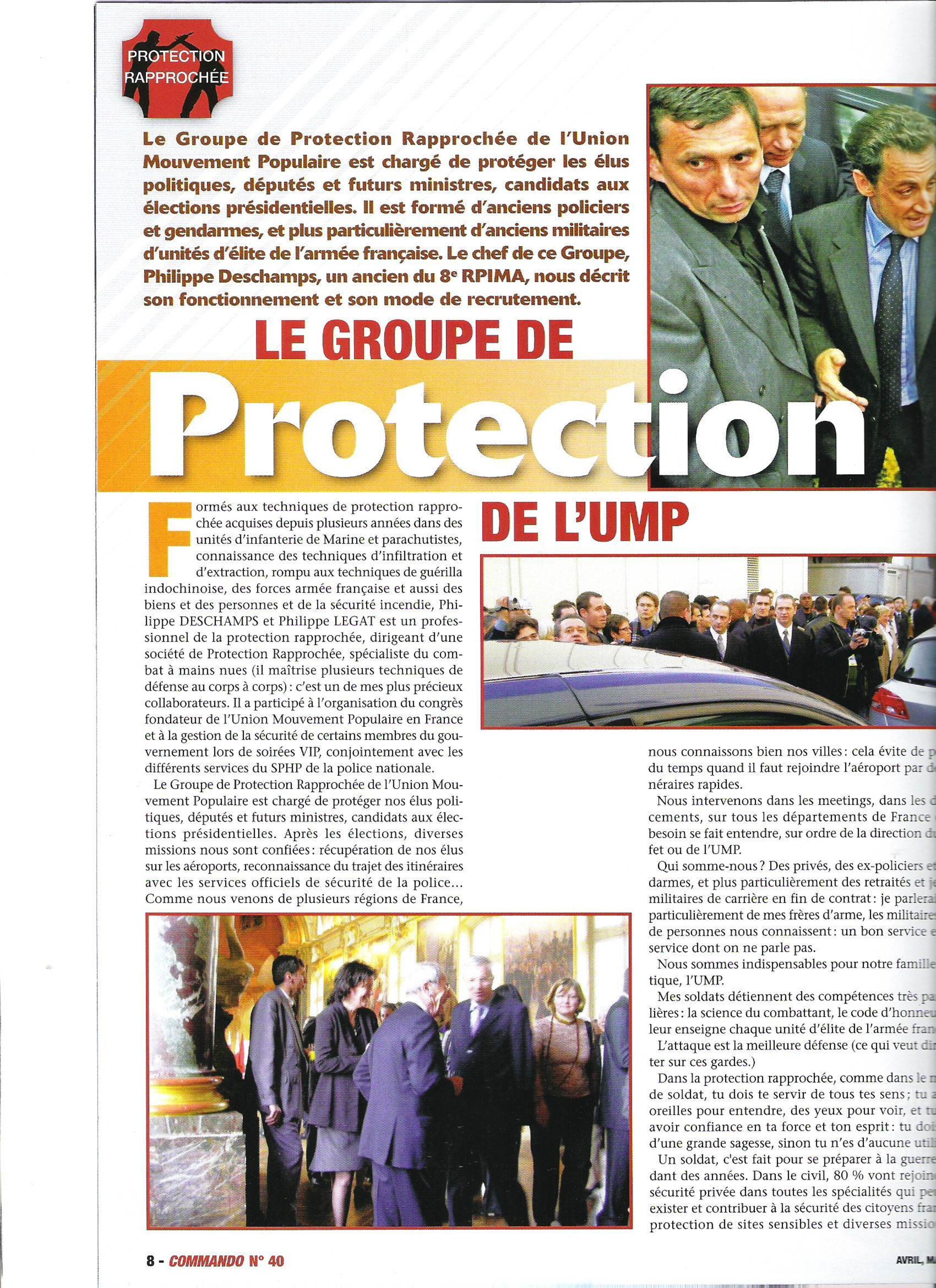
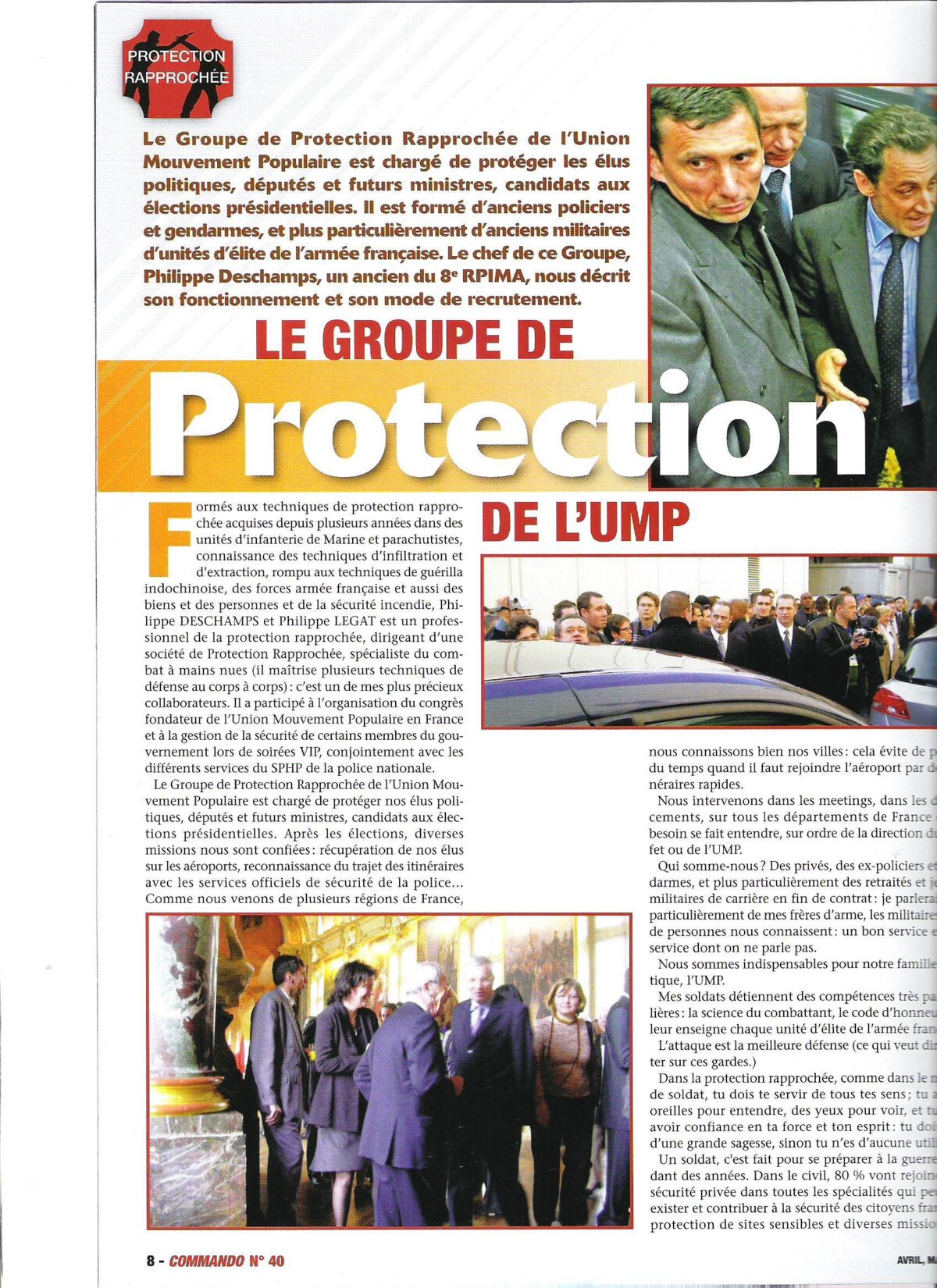
However, one of the GPs senior members, former parachutist Philippe Deschamps, was a lot more forthcoming in an interview published in April 2009 by French magazine Commando. His candid boasting to the magazine, specialized in reports about elite military forces, was to cost him his job.
"Who are we? Private contractors, ex-policemen and gendarmes, and more particularly retired and serving soldiers at the end of their careers," he told the magazine. "My soldiers have very particular skills, the science of combatants," he added. "Attack is the best form of defence."
Deschamps said in the interview that the choice of GP recruits was "not left to chance", with members coming from elite units of the French army and the rapid reaction force, amongst others.
He described himself as "trained in the techniques of close protection learnt over several years in marine infantry and parachute regiments" and said he was a "specialist in unarmed combat."
According to Deschamps, under Sarkozy, who was UMP president from 2004 until his election as French president in 2007, there had been a "a revolution at the UMP" regarding security. "Our President Nicolas Sarkozy took into account my reports, my requests to develop this job of [VIP] protection professionals within the GP."
Following the interview (click on 'Prolonger' tab top of page) and Deschamps' very public detailing of the GP, he was kicked out of the group by its leader, René Faure. In a SMS sent to Deschamps on June 5th 2009, Faure, who has headed the group since 2001, wrote: "Monsieur Deschamps, ever since the publication of the article of which you are the author in the magazine Commando, you are no longer a member of the Groupe de Protection, whose statutes reside above all on the confidentiality of our actions. Thank you for taking this decision into account."

Despite the official secrecy, former UMP general secretary, Xavier Bertrand received the group with open arms at a closed meeting (see video below) on October 16th 2010, at Port-Marly, west of Paris, in a ceremony to thank what he described as the "men of the shadows."
Xavier Bertrand at Port Marly October 2010 (click screen to play)
René Faure was also present at the meeting, where he spoke of the group's "preventive missions". Faure did not reply to Mediapart's request for an interview.
During his interview with Mediapart, the UMP's Jérôme Lavrilleux was asked whether the GP had become a military-style force. "That's fantasy, " he replied. "Some members have been soldiers or policemen, but they are not the essential element. I know one of them that is a company director, another one who is a workman."
-------------------------
1: Union pour un Mouvement Populaire, or Union for a Popular Movement, an alliance of the conservative- and centre-right.
'Some think they can do what they want'
Contacted by Mediapart, Deschamps, who is now boss of Toulouse-based security firm Sentinelle, said he went too far in his comments about the protection group published in Commando. "For the last two to three years, it's mostly hand-picked professionals [who serve] in the GP," he said. "It was me who recruited them from my military networks. I got told off when I talked about it."
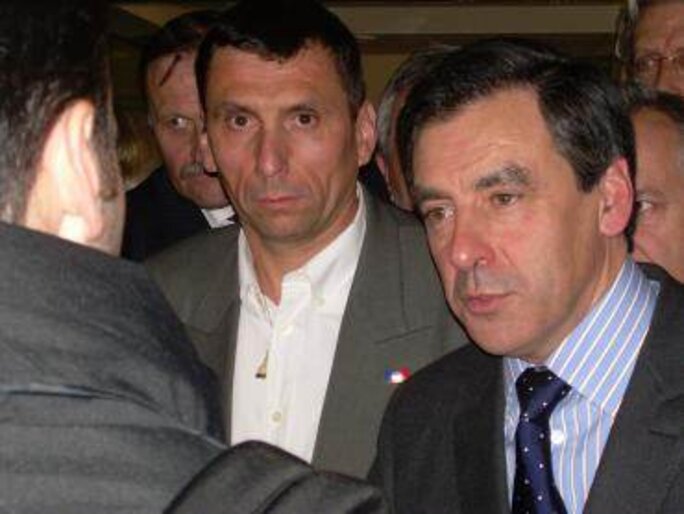
While UMP rejects any idea of an increasing militarisation of its security group, its members have been caught several times in recent years playing policemen.
During a visit by President Nicolas Sarkozy to the Doubs region of eastern France in March 2009, a very large security operation was put in place, with 20 police cordons accompanied by protection group members, wearing UMP and GP badges. Sarkozy was on an official trip to the region, which included visits to a manufacturing plant of the heavy engineering group Alstom, and to a construction site for a new high-speed train link.
During the event, members of the GP asked people for identification or prohibited their access without any valid mandate or reason. In an interview with local regional newspaper l'Est Republicain, CFDT trade union local representative Gérard Thibord said he had been stopped at one of the events by a UMP official who had asked him - illegally - to submit to an ID check.
The incident was described by local UMP senior official Michel Vienet as "a mistake by one of our members". He said GP members were there to check invitations to a UMP-organised reception during Sarkozy's visit.
But Thibord was not the only person who had complaints after the meeting. Local radio journalist Jérôme Bolard also protested at having being stopped at a police cordon when he was trying to meet employees of specialist car parts maker Rivex, who had come to lobby the president over their campaign for a raise in salaries.
"There were two gendarmes and someone with a UMP badge. He refused to let me past even though I showed my press card," Bolard told regional daily l'Est républicain.
"We weren't at the head of the party at the time," the UMP's Lavrilleux told Mediapart, referring to the arrival since of his boss, Jean-François Copé, as party leader. "We never intervene on a mission which is a matter for the police. We are extremely careful that they do not behave like policemen."
After the March 2009 incident, the opposition Socialist Party (PS) senator for the Doubs, Claude Jeanneot, wrote to the then-interior minister (and UMP member) Michèle Alliot-Marie, asking her to address the complaints and "to clarify if the UMP's GP was authorized be her services to take part in a public order mission and, if yes, at what level had this decision been taken."
Alliot-Marie replied that the GP had no official jurisdiction for security over the party meeting. "The UMP protection group [...] like any security service belonging to a party or association does not have the power to check people's identity", she wrote, adding that "no authorisation had been given to this group to allow it to carry out identity checks on people going to the site of the meeting presided over by the head of state."
"The mission was carried out by the national gendarmerie alone," ended Alliot-Marie.
"Sometimes it's a bit like anything goes," Philippe Deschamps told Mediapart. "Some of them think they can do what they want." He added that internal security groups among left-wing parties "don't function like us. On the right, there are more military servicemen."
Eric Plumer, for ten years head of the Socialist Party (PS) security service SO, agreed. "The UMP has a GP centred on ex-servicemen and the police, and calls on the services of security firms," he said." We don't. We have a few former policemen, but that's not how we recruit."
The PS's security group is made up of volunteers, while it is led by a party employee, just like at the UMP. "We divide our time between [protection of] the First Secretary and PS events," Plumer added. "For party conferences, we mobilise up to 300 militants. It's the heads of the federation who recruit. We test them first of all, we mustn't do things any old how."
-------------------------
English version: Jennifer Laidlaw(Editing by Graham Tearse)