


Update Monday December 14th (See official election results and on-the-night coverage below):
Despite a strong performance in the first round of France's regional elections, the far-right Front National Front failed to win control in a single one of France's new 13 'super regions' on Sunday. This was largely due to tactical voting by electors on the Left and mainstream Right and the decision by the Socialist Party to withdraw its candidate in two key regions where the Front National had scored dramatically well in the first round last Sunday: Nord-Pas-De-Calais-Picardie in the north and Provence-Alpes-Côte d’Azur (PACA) in the south. This left the far-right party's president Marine Le Pen and her niece Marion Maréchal-Le Pen in head-to-head contests with the conservative Right, with both losing by a significant margin.
Another important outcome was the performance of the Socialist Party and its allies, who did better than expected, managing to win in five of the new regions. However, it did lose control of the key Greater Paris region, where the president of the National Assembly Claude Bartolone lost in a tight and at times bitter contest with the conservative right's Valérie Pécresse. Despite that symbolic win in the Paris region, however, the conservative right party Les Républicains, led by Nicoals Sarkozy, and its centre-right allies did not perform as strongly as many had forecasted, winning seven of the 13 regions, two by very tight margins and two more where the Socialist Party candidates had stood aside. Inevitably there will be question marks raised over the former president's leadership, not least his decision to attend a football match on election night (see below).
But most eyes were on the failure of Marine Le Pen's far-right party to win control of a single region. “A very large majority of the electorate rejects this party and its ideas, on the Left much more than the Right,” Nonna Mayer, an academic from the Sciences Po institute in Paris and a specialist in right-wing extremist movements, told Mediapart. “The Front National remains a party 'outside the system' in the second round [of elections], it hasn't managed to form alliances and can't manage to form a majority in its favour.” She added: “This clearly highlights the paradox of this party, which all the same has made spectacular progress in the voting booths. It has a platform of 25%, it is present in all regions and will have hundreds of regional councillors.”
Sylvain Crépon, from the University of Tours in central France and a specialist on the Front National since 1995, told Mediapart: “For Marine le Pen it's a qualified success, because she wanted to demonstrate her ability to govern France, but the Front National is still not a second round party, it has reached a platform and hasn't managed to establish alliances.”
Nonetheless, on Sunday night the Front National beat its popular vote record from the first round of the last presidential election, picking up 6,601,128 votes (a 28.21% share of the votes cast), edging the 6,421,426 recorded in 2012. The far-right movement will now have 358 regional councillors, against 118 at the least elections in 2010 when it polled 9.17% of the votes.
Both Marine Le Pen and her niece Marion Maréchal-Le Pen were quick to dismiss the idea that the party had reached a “glass ceiling” of support. Talking about her own vote, Maréchal-Le Pen asked: “This so-called glass ceiling was 25% in 2010 and is 48% today, how much tomorrow?” Indeed, Nonna Mayer played down the idea of a glass ceiling in politics, noting that the Front National vote was “progressing slowly but surely”.
Despite its defeats, the party managed to increase the number of votes it received in the second round compared with the first round of voting. For example it picked up 172,000 more votes in Languedoc-Roussillon-Midi-Pyrénées, nearly 149,000 more in Alsace-Champagne-Ardenne-Lorraine; 68,500 in PACA and 73,759 in Burgundy-French Comté. The only exception was in the Greater Paris region, where the Front National candidate Wallerand de Saint-Just lost more than 59,000 votes between the rounds.
“It would be wrong to say that it is a rejection or a defeat,” said Sylvain Crépon. “Despite everything we see Marine Le Pen's strategy being vindicated. [Her father and former party president] Jean-Marie Le Pen never took the trouble to cultivate a network of local councillors, without which you cannot get into power. Marine Le Pen understood that this was a mistake and patiently but surely she is in the process of putting together this network, she's going to have councillors whom she is going to be able to pay, to give credibility, and in the medium and long term this will help the Front National. This strategy is paying off.”
As for President François Hollande and the ruling Socialist Party, they will look at Sunday's election results with mixed feelings. They can take comfort from the fact that, against some predictions, the Socialist Party and its allies won control of five of the 13 regions, and that the Front National won none. But the party did lose the contest for the coveted Greater Paris region to the Right, and in some regions it has effectively been wiped off the electoral map.
Prime Minister Manuel Valls was quick to point to the high turnout on Sunday, with 58.5% of the electorate voting on Sunday, compared with 50% in the first round. He praised voters who had “responded to the very clear appeal – from the Left – to block the extreme right”. A close ally of President Hollande added: “The French people showed that they wanted to vote. And that the idea, put forward by some, of postponing the elections because of the [terrorist] attacks was a very bad idea.”
Yet the government is well aware that the Front National was still able to attract new voters in the second round. “That's not good news, especially in rural areas. We're going to have to respond to these concerns,” said a presidential advisor. The president knows that the political landscape is now divided into three – the Left, Right and far-right – and that the level of the Front Nation's vote means that Marine Le Pen is likely to make it through to the second round of the Presidential elections in 2017. At the same time, support for his own party and the Left has dipped to the point where it is by no means certain that Hollande himself will qualify for that second round. In 2010 the Socialist party scored 46.60% in regional elections, this year their overall share of the vote was just 29%.
The French president is now going to have to choose between three options. One, represented by Manuel Valls, is to bring together the Left and centre-right around the idea of the Republic's values; the second is to move to the left as demanded by the radical left Front de Gauche, the Greens and a section of the Socialist Party itself; while the third option is not to choose either but try to reconcile them by portraying himself as the rational Father of the Nation.
There are some on the left of the Socialist Party who believe that the government could move and embrace some of the views of factions and parties to the left. On Sunday night the party's first secretary, Jean-Christophe Cambadélis, made a clear call for a “change” in policy to fight poverty and financial insecurity. Some ministers have also privately been calling for an “employment pact” to match the “security pact” announced in the wake of the November 13th attacks.
However Valls and his supporters reject such a move, while Hollande's aides – unsurprisingly – choose the middle way. Their three priorities, they say, are the fight against terrorism, the fight against unemployment and promoting the idea of one nation, to ensure that all sections of society feel that they belong.
On the Right, the president of the Republicans, Nicolas Sarkozy, has his own problems, even though he and his allies won seven regions, including the prize of Greater Paris. Much of the Republican's limited success was down to tactical voting and the fact that the Socialist Party withdrew candidates in two key regions to give the Right a chance to beat Marine Le Pen's party. Despite this, on Sunday Sarkozy failed to thank voters on the Left who had voted for his candidates, unlike Christian Estrosi and Xavier Bertrand, who won in the Provence-Alpes-Côte d’Azur (PACA) and Nord-Pas-De-Calais-Picardie regions respectively thanks to support from left-leaning voters.
Instead, Sarkozy and his allies in the party insist that the reason the party won a majority of regions was because of the former head of state's strategy of adopting a hard-line right-wing stance. “It's the validation of the line that Sarkozy wanted,” his close political ally Brice Hortefeux told TF1 television news. Indeed the battle lines for the Right's primary election in 2016 to choose a presidential candidate are already being drawn up. After the results were announced Sarkozy insisted that the “warnings” from the first round of voting – the strong Front National vote – would not be forgotten and promised an open debate. But such a debate, it seems, will be on his terms, on the issue of law and order and the “affirmation of our identity” - a key hard-right theme.
At the same time Sarkozy's main rival to be presidential candidate, Bordeaux mayor Alain Juppé, was also giving his verdict on the election results in which he repeatedly spoke of “My vision of France”. Meanwhile his campaign director Gilles Boyer fired a shot across the bows of the Sarkozy camp when he noted that though the party had done quite well to capture seven regions, it had come a poor second to the Front National in some regions in the first round of voting. “Sunday the 13th won't mean Sunday the 6th is forgotten,” he tweeted.
Another sign of the tensions within the Republicans as it prepares for its primary election was the news that the current number two in the party, former minister Nathalie Kosciusko-Morizet, is set to be removed from her position in the New Year when the organization's new structure is announced. NKM, as she is widely known, had publicly criticized Sarkozy's stance of refusing to allow his candidates to stand down from Sunday's second poll in those areas where socialists were better placed to beat the Front National. There was speculation that NKM is herself planning to stand as a candidate in the Right's primary election.
-----
Below are the official results and statistics of voting in the December 13th second round of France’s two-round regional elections, as released by the interior ministry on Monday December 14th. Les Républicains refers to the the conservative Republican party led by Nicolas Sarkozy, plus their centre-right allies. The Socialist Party/Left refers to the ruling party and its electoral allies. The Front National is the far-right movement headed by Marine Le Pen. (Scroll down for the election night coverage).
Alsace-Champagne-Ardenne-Lorraine
Les Républicains: 48.4% share of vote 104 seats
Front National: 36.08% 46 seats
Socialist Party/Left: 15.51% 19 seats
President elect: Philippe Richert
Aquitaine-Limousin-Poitou-Charentes
Socialist Party/Left: 44.27% 107 seats
Les Républicains: 34.06% 47 seats
Front National: 21.67% 29 seats
President elect: Alain Rousset
Auvergne-Rhône-Alpes
Les Républicains: 40.61% 113 seats
Socialist Party/Left: 36.84% 57 seats
Front National: 22.55% 34 seats
President elect: Laurent Wauquiez
Brittany
Socialist Party/Left: 51.4% 53 seats
Les Républicains: 29.72% 18 seats
Front National: 18.87% 12 seats
President elect: Jean-Yves Le Drian
Burgundy-France Comté
Socialist Party/Left: 34.68% 51 seats
Les Républicains: 32.89% 25 seats
Front National: 32.44% 24 seats
President elect: Marie-Guite Dufay
Centre-Loire Valley
Socialist Party/Left: 35.43% 40 seats
Les Républicains: 34.58% 20 seats
Front National: 30.00% 17 seats
President elect: François Bonneau
Corsica
Regionalists: 35.34% 24 seats
Socialist Party/Left: 28.49% 12 seats
Les Républicains: 27.07% 11 seats
Front National: 9.09% 4 seats
President elect: Gilles Simeoni
Ile-de-France (Greater Paris Region)
Les Républicains: 43.80% 121 seats
Socialist Party/Left: 42.18% 66 seats
Front National: 14.02% 22 seats
President elect: Valérie Pécresse
Languedoc-Roussillon-Midi-Pyrenées
Socialist Party/Left: 44.81% 93 seats
Front National: 33.87% 40 seats
Les Républicains: 21.32% 25 seats
President elect: Carole Delga
Nord-Pas-De-Calais-Picardie
Les Républicains: 57.77% 116 seats
Front National: 42.23% 54 seats
President elect: Xavier Bertrand
Normandy
Nouveau Centre*: 36.43% 54 seats
Socialist party/Left: 36.08% 27 seats
Front National: 27.05% 21 seats
President elect: Hervé Morin
*allied to Nicolas Sarkozy’s Republicans
Pays de la Loire
Les Républicains: 42.7% 54 seats
Socialist Party/Left: 37.56% 26 seats
Front National: 19.74% 13 seats
President elect: Bruno Retailleau
Provence-Alpes-Côtes d’Azur
Les Républicains: 54.78% 81 seats
Front National: 45.22% 42 seats
President elect: Christian Estrosi
-----
French regional election coverage: please refresh the page regularly to see latest updates, beginning 8p.m. local time (CET), and which are presented top of page. A brief guide to the elections appears at the bottom of the page.
Reporting by Michael Streeter and Graham Tearse.
----
That is it from us tonight. We will be updating full official results on Monday.
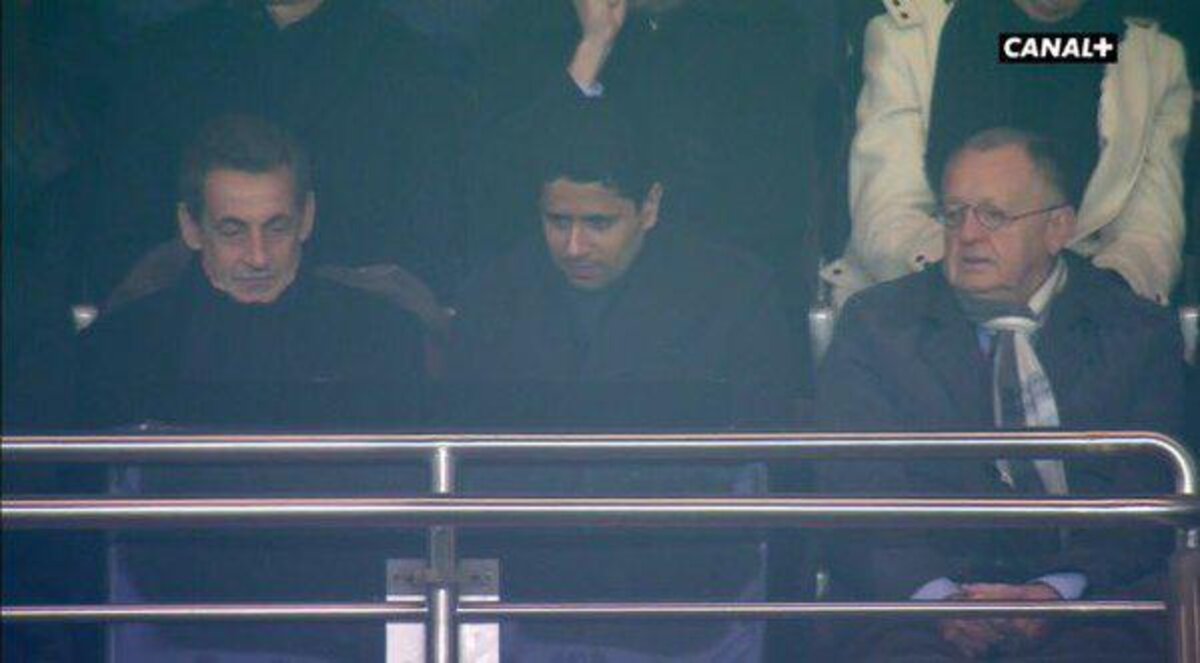
Has he lost it? We leave you with what might be described as a gob-smacking picture circulating on the social media Sunday night. It shows Nicolas Sarkozy, leader of the conservative Les Républicains party - the mainstream opposition party that narrowly escaped a potential annihilation at the hand of the far-right Front National party given the results of the first-round vote seven days ago – as captured by Canal Plus TV channel just an hour after the last polling booths closed.
Sarkozy was French president from 2007-2012, announced his retirement from politics after his defeat by socialist rival François Hollande in elections in 2012, and returned to active politics last year with his successful bid for leadership of the conservative opposition party. He hopes to become its presidential candidate, eyeing a return to office in elections due in 2017. Despite the far-right’s failure to win any regional councils on Sunday, it has won (considerable) seats on the many of them, and the relative success of Sarkozy’s party is, as avowed by most its candidates in regions where the far-right had its best chances of victory, down to the tactical votes given to it by the Left.
Back to the photo: with his party now seriously divided, following his tactical defeat in which he failed to give the ruling socialists, leading the most unpopular government in recent years, a clear hammering at the polls (see Mediapart’s mid-week analysis here) , where did he choose to spend Sunday evening? In deep conference at party HQ? No, here he is, minutes after the result on Sunday, in the VIP box at the Parc des Princes home stadium of Paris Saint-Germain (PSG) football club, to watch over the team’s 5-1 win against the Lyon team L’Olympique Lyonnais. Phew! Bonsoir.
-----
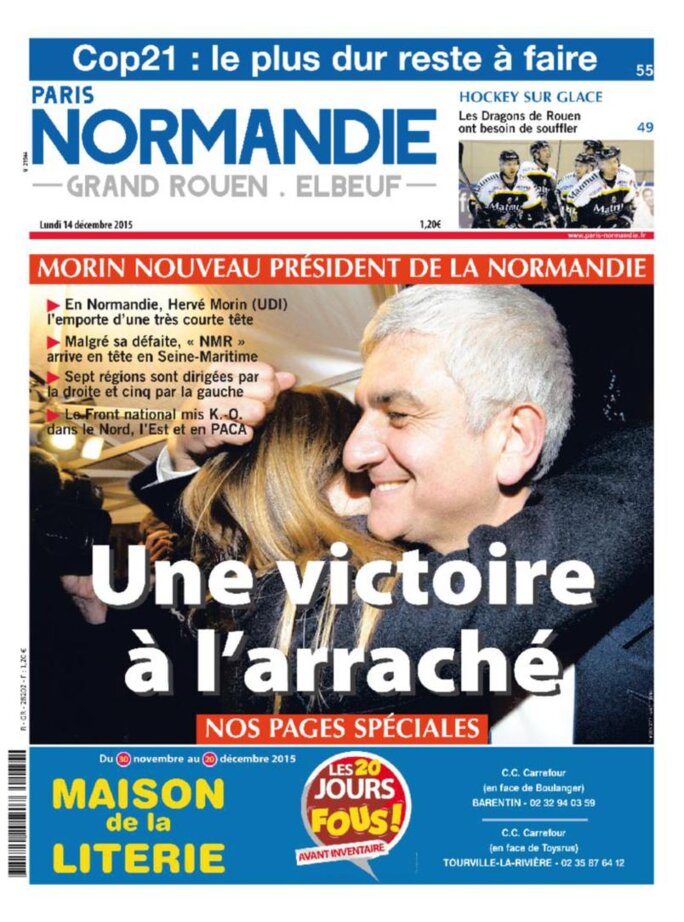
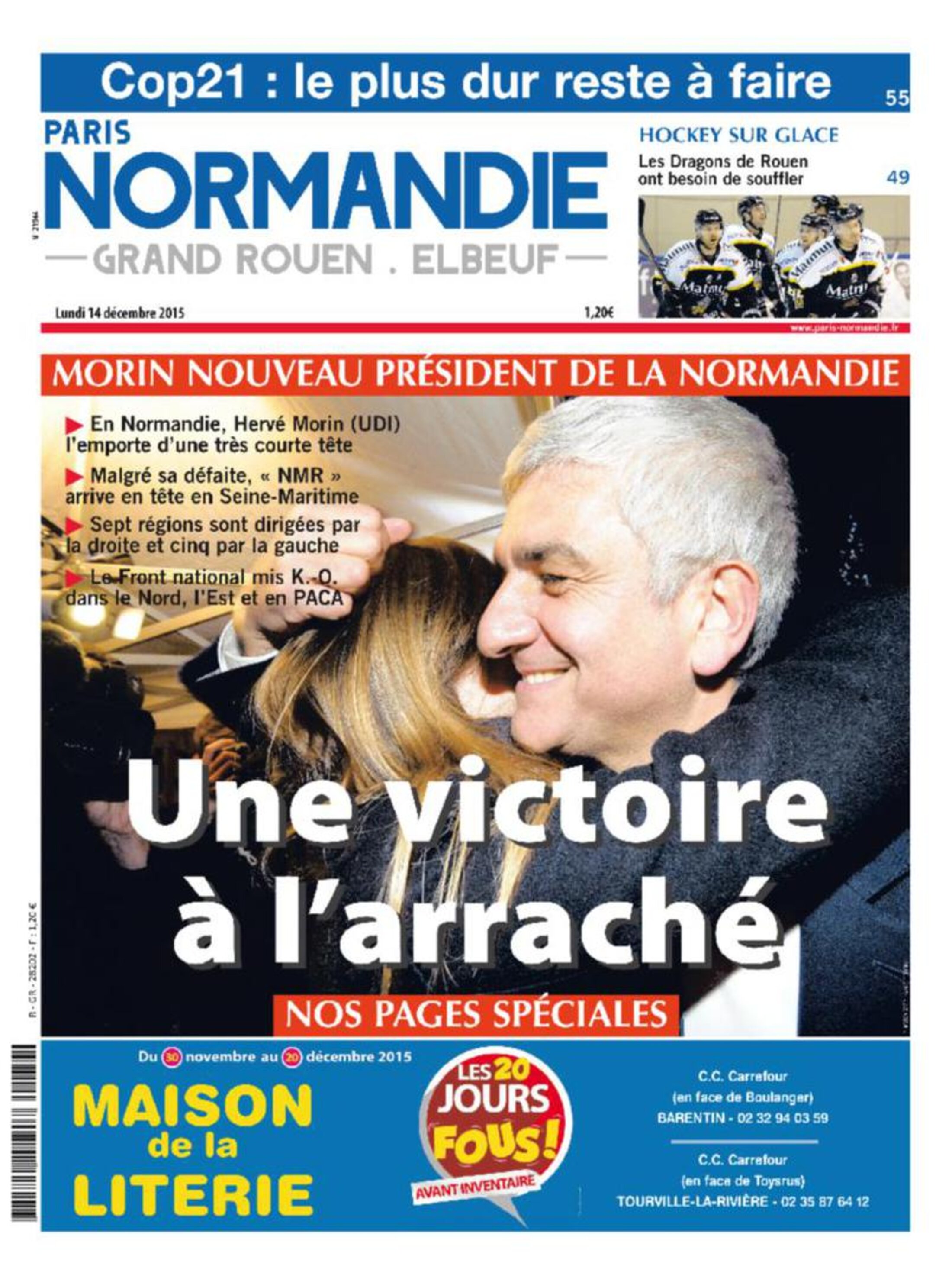
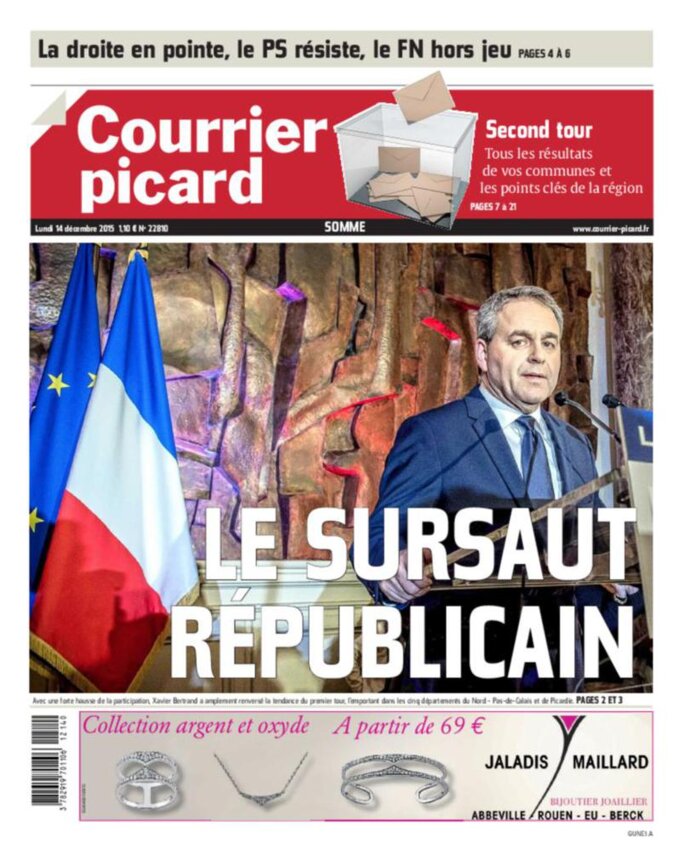
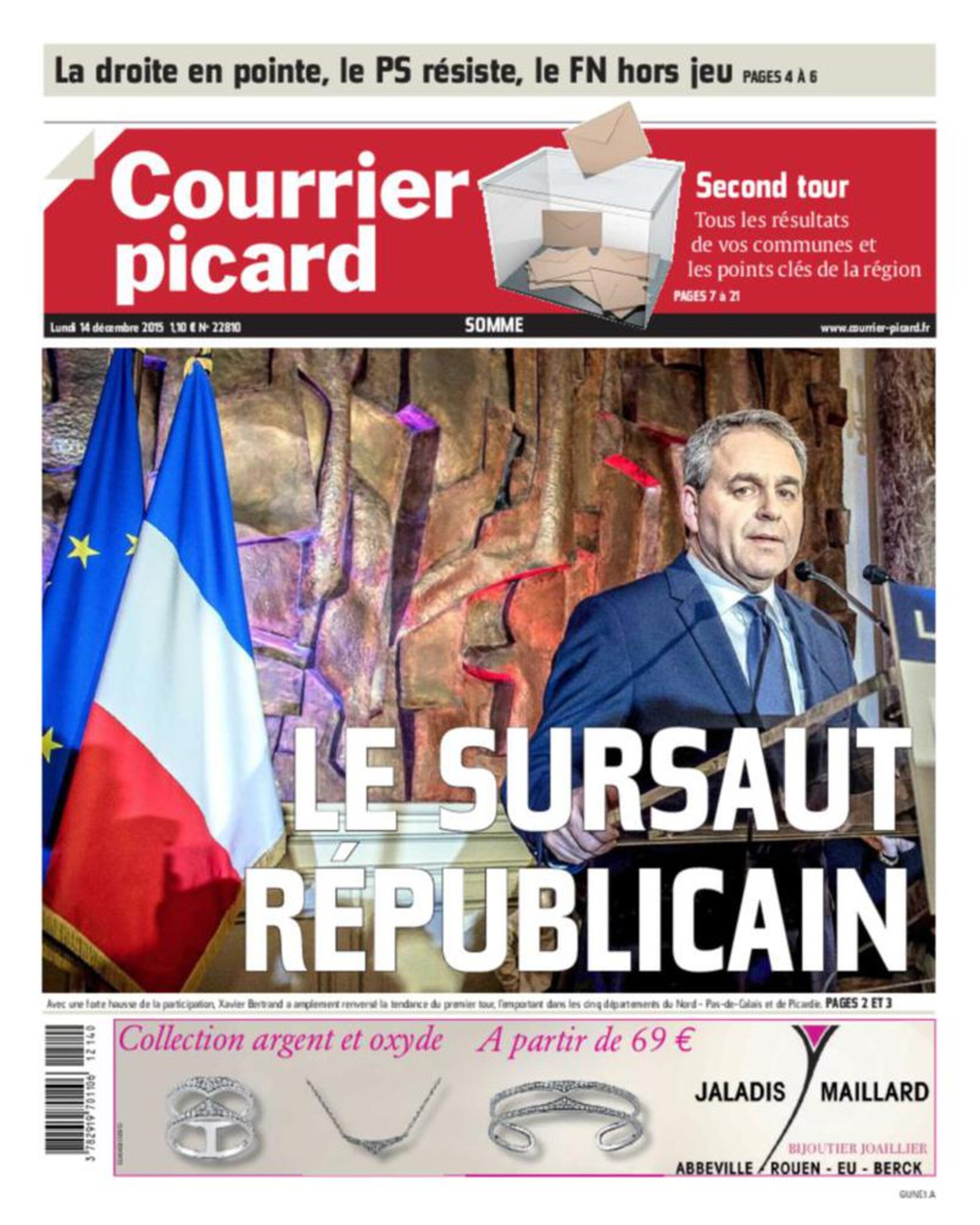
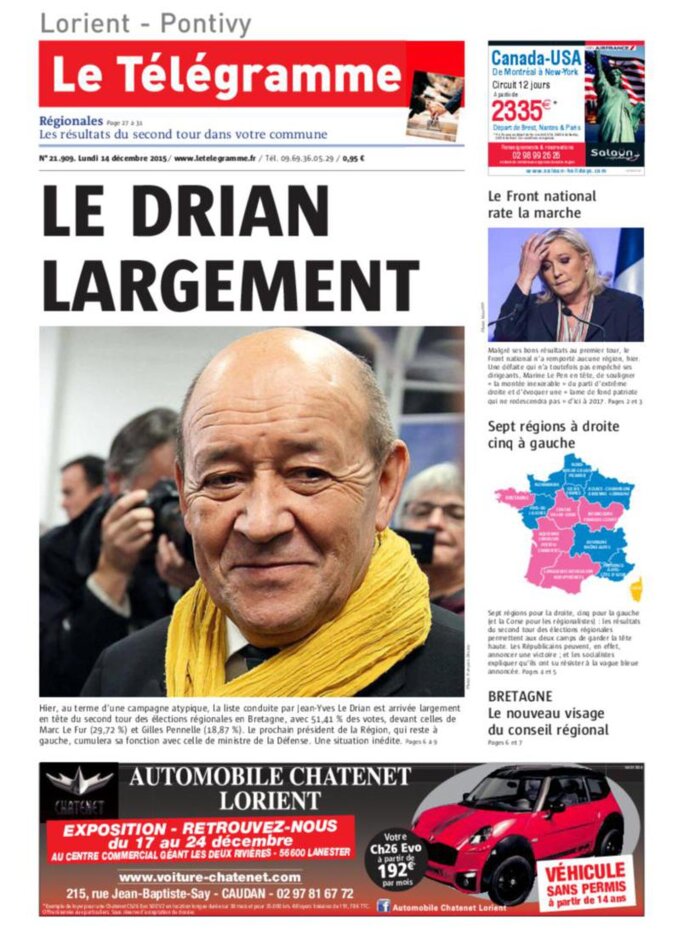
1.30 a.m.: As we here on Mediapart wind down for the evening, here are a few front pages of Monday morning editions of the regional French dailies:
Enlargement : Illustration 2
Then there's...
Enlargement : Illustration 3
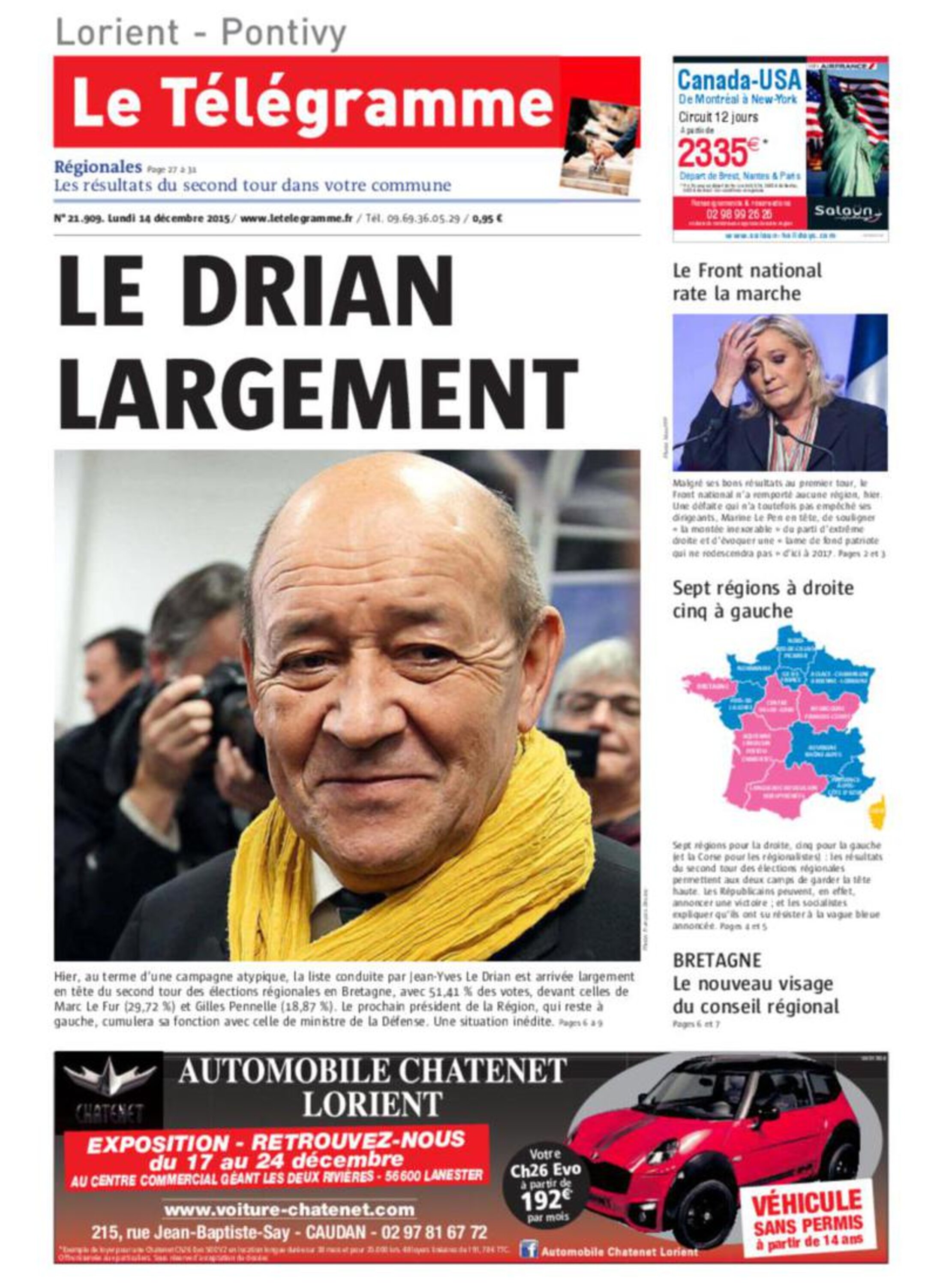
In Brittany...
Enlargement : Illustration 4
Meanwhile, the daily Var-Matin, which serves the south-east French Riviera, headlines:
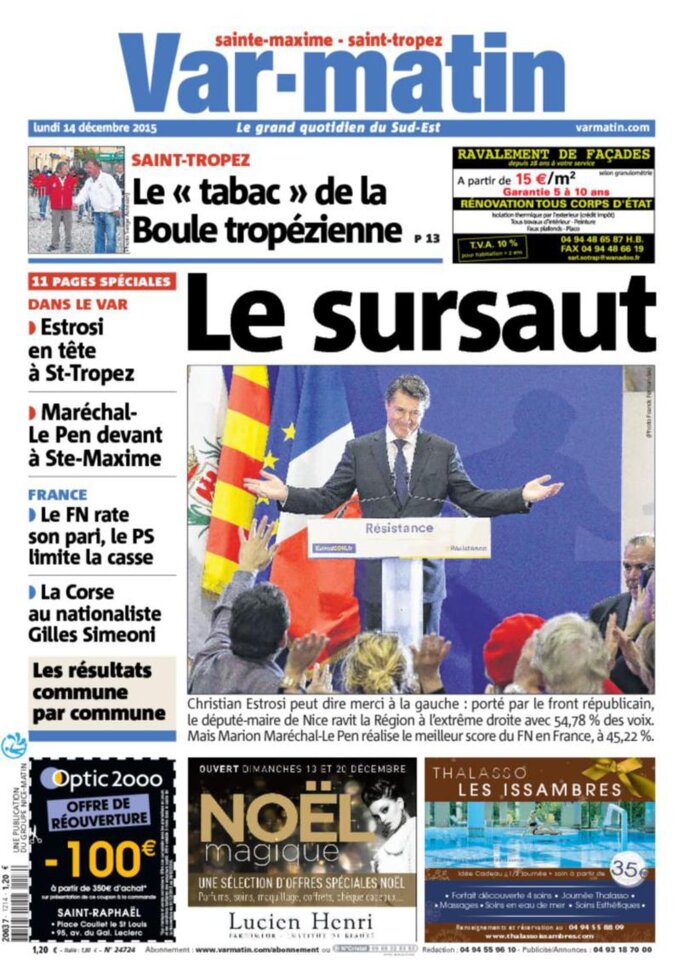
Enlargement : Illustration 5
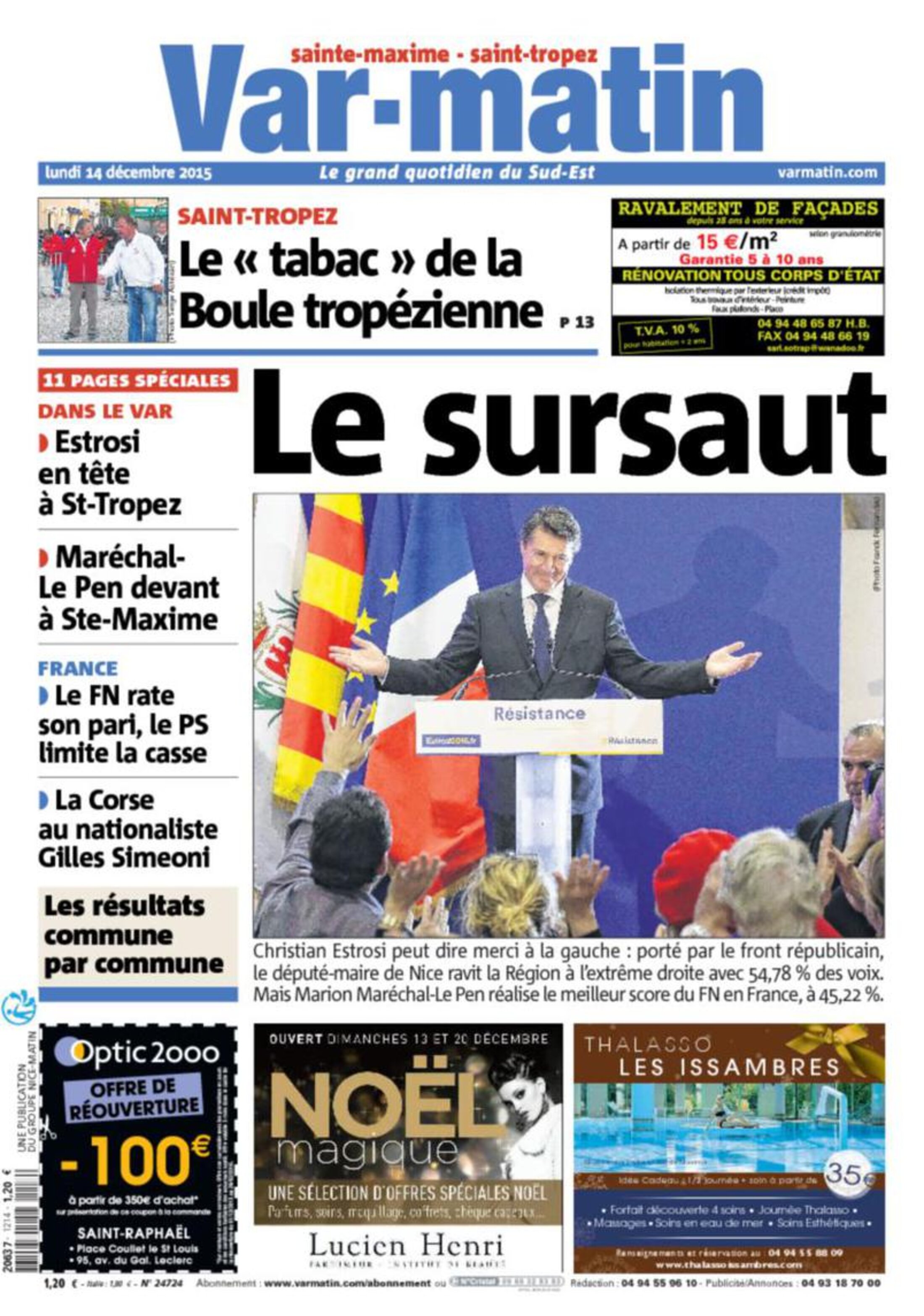
-----
1.15 a.m.: These are the official results released so far by the French interior ministry:
The conservative Republican party list in the east-central Auvergne-Rhône-Alpes region has won control of the ruling council with a 40.61% share of the vote, followed by the socialists with 36.84%. The Front national came in third with 22.55%. That gives the conservatives 113 seats, the socialists and its allies 57, and 34 for the Front National.
In the south-east Provence-Alpes-Côtes d’Azur region, the list led by the hardline Republican candidate Christian Estrosi, a Member of Parliament and mayor of Nice, came in first place with 53.78% of votes cast, ahead of the Front National candidate Marion Maréchal Le Pen with 46.22% of the vote (the socialists having withdrawn, in Estrosi’s favour, their candidates for the second-round vote – see more on this below).
In the Nord-Pas-De-Calais-Picardie region, the conservative Republican party candidate Xavier Bertrand recorded a clear victory with 57.77% share of the vote, against 42.23% for second-placed Marine Le Pen, leader of the Front National. The conservatives have therefore won 116 seats on the council, while the Front National has 54.
In the Alsace-Champagne-Ardenne-Lorraine region, the conservatives came first with 48.4% of the vote, ahead of the Front National list with 36.08%, while the renegade socialist list (whose leader refused to bow to the party order of withdrawing in favour of the conservatives in order to beat the far-right) came third with 15.51%. That leaves the conservatives with 104 seats on the council, the Front National with 46, and the Left with 19.
Official results also for Normandy show that, after a neck-and-neck contest, Hervé Morin, the leader of the centre-right Nouveau Centre party (allied to Nicolas Sarkozy’s Republicans) won with a 36.43% share of the vote, just ahead of the socialist list led by Nicolas Mayer-Rossignol with…36.08%! That is a difference of just 0.35%. In third place was the Front National with 27.5%.
In the Pays de la Loire region of west-central France, the conservatives garnered 42.7% of the vote, ahead of the socialist-led list which include Greens and centre-left and which drew 37.56% of votes cast, while the Front National scored 19.74%. The conservatives have therefore won 54 seats on the council, the socialists and allies 26, and the Front National 13.
In the Languedoc-Roussillon-Midi-Pyrenées region, the socialists came in first place with 44.81% of the vote, followed by the Front National (whose lis twas led by Fthe party’s co-deputy leader Louis Aliot) with 33.87%, and the conservative Republican party with 21.32% .
In Brittany, the socialist list led by defence minster Jean-Yves Le Drian drew 51.4% of votes cast, with the conservatives obtaining 29.72, and the Front national 18.87%. That means the socialist will obtain 53 seats on the north-west region’s council, while 18 go to the Right and 12 to the far-right.
Burgundy-France Comté was won by the socialists with a 34.68% share of the vote. The conservative Republican party came second with 32.89%, while the Front National came in third with 32.44%. How much closer could that have been? All of which gives the socialists 51 seats on the council, the conservatives 25, and the far right 24.
In Corsica, the official result gives the nationalists (independence movement) a 35.34% share of the vote, followed by the socialists (who last Sunday led the poll) with 28.49%, and the conservative alliance with 27.07%. That means the nationalists have 24 seats on the council, followed by the socialists with 12 and the conservatives with 11.
-----
00.35 a.m.: More (confusing) data: The socialists, despite the fact that they have won two fewer regions than the conservatives and centre-right, have, at this moment in time, gained a higher number of councillors overall among the regional councils.
Why? Because the regions vary in population size, from the smallest, Corsica, to the largest, the Greater Paris region (Ile-de-France). The number of council seats is dependent upon the population figures. So, despite the fact that the winning party in each region receives a bonus number of seats – 25% of the total number – the Left has done well enough in the most populated regions to reach the highest number.
But these are far from final results. Stay tuned for our update of definitive figures on Monday.
-----
00.26 a.m.: December 14th: The (confusing) data so far: with the definitive share of the vote due in official results released by the interior ministry on Monday morning – but which will not change the picture of seven regions controlled by the mainstream Right, five by the mainstream Left and one (Corsica) by the nationalists – what we know now is:
The far-right Front National, which has won none of the six regions where it attracted a majority of the votes last Sunday in the first-round vote, has nevertheless – in terms of the percentage of all votes cast nationwide – garnered a bigger share of the vote, and at least 200,000 more – than in the first round of voting in the 2012 presidential elections.
-----
00.12 a.m.: December 14th: Official results confirm that Les Républicains, the conservative opposition party, and its centre-right allies have won a majority of seven regions out of the total 13 in mainland France. The ruling Socialist Party and its allies (Greens and radical-left) have wone five, and the nationalist party has won in Corsica.
-----
10.20 p.m.: A summary of results so far: The conservative Republican party (former UMP) and its centre-right allies have won seven of the 13 mainland regions, according to several official results now in (see below) and polling institute estimations (which have proved earlier to be accurate). These are Nord-Pas-de-Calais-Picardie, Provence-Alpes-Côte d'Azur, Alsace-Champagne-Ardenne-Lorraine, Auvergne-Rhône-Alpes, Normandy, Pays de la Loire the Greater Paris region, the Ile-de-France.
The socialists and their allies have won five regions : Aquitaine-Limousin-Poitou-Charentes, Brittany, the Languedoc-Roussillon-Midi-Pyrénées, the Centre-Val de Loire and Bourgogne-Franche-Comté.
In Corsica, the nationalists (independence movement) have won a majority.
This page will next be updated at about 11.45 p.m. CET (local time).
-----
10.20 p.m.: Official results are now in for the tight contest (another) in Burgundy-France Comté, which is won by the socialists with a 34.68% share of the vote. The conservative Republican party came second with 32.89%, while the Front National came in third with 32.44%. How much closer could that have been? All of which gives the socialists 51 seats on the council, the conservatives 25, and the far right 24.
Normandy, in northern France, and Burgundy-Franche-Comté (see below) in the centre-east are quite separate, and yet in both regions the far-right has succeeded in gaining between 20% and 25% of council seats. While much of the reporting of this evening’s results will naturally be about the collapse of the Front National’s bid to lead in at least three regions, this is not otherwise a defeat for a party that just a few years ago played a marginal role in French politics.
-----
10.10 p.m.: Just before 10pm Paris time, former government minister Valérie Pécresse finally claimed victory for the Republicans in the Greater Paris region after her close and at times bitter contest against the socialist president of the National Assembly Claude Bartolone. Clearly delighted – and relieved – Pécresse said: “I am aware that I have received votes from all directions. I want Greater Paris to become Europe's leading region.” She acknowledged that her win gave her “no blank cheque” and that the voters were expecting her to act. She added: “Law and order and employment will be my top priorities.”
Shortly afterwards her defeated rival, Claude Bartolone, formally congratulated Valérie Pécresse for her victory. He noted: “The people of Greater Paris should know that I gave everything to try to ensure the Left won.” Bartolone also revealed that he would leave it to socialist Members of Parliament to decide whether he should remain in his post as president of the National Assembly.
-----
10.09 p.m.: Official results are now in for Normandy, where, in a neck-and-neck contest, Hervé Morin, the leader of the centre-right Nouveau Centre party (allied to Nicolas Sarkozy’s Republicans) has won with a 36.43% share of the vote, just ahead of the socialist list led by Nicolas Mayer-Rossignol with…36.08%! That is a difference of just 0.35%. In third place was the Front National with 27.5%.
That gives the Morin-led list of centre-right and conservative candidates 54 seats on the Norman regional council, while 27 go to the socialists and 21 to the far-right. That will be a very bitter pill to swallow for the Left.
-----
10 p.m.: In Corsica, the official result now in gives the nationalists (independence movement) a 35.34% share of the vote, followed by the socialists (who last Sunday led the poll) with 28.49%, and the conservative alliance with 27.07%. That means the nationalists have 24 seats on the council, followed by the socialists with 12 and the conservatives with 11.
Once again, the reason for the disproportionate number of seats handed to the socialists is that in each region, the winning party is given a bonus of 25% of the total number of seats on the council (see our brief guide to the elections bottom of page).
-----
9.54 p.m.: The interior ministry has now released the definitive results for Brittany and Corsica., and which confirm exit poll predictions.
In Brittany, socialist defence minister Jean-Yves Le Drian’s list won 51.4% of the vote, ahead of the conservative Republicans with 29.72% and the far-right Front National with 18.87%. That produces a regional council on which the socialists have a commanding 53 seats against 18 for the Republicans and 12 for the Front national.
The reason for the disproportionate number of seats handed to the socialists is that in each region, the winning party is given a bonus of 25% of the total number of seats on the council.
-----
9.51 p.m.: The successful candidate for the Republicans in Provence-Alpes-Côte d’Azur (PACA), Christian Estrosi, who had created something of a stir in the last week by suggesting that he was battling against the Front National as a “Resistant”, continued with the war-like theme as he celebrated his win over Marion Maréchal-Le Pen. Thanking the “people of the Left” who voted for him and showed their “spirit of Resistance”, Estrosi said: “It's the victory of a great people who have shown their ability to topple an impostor. The PACA region and France have won a great victory. Our people have won against the opinion polls and established political observers.”
-----
9.47 p.m.: All estimations now put list led by conservative Valérie Pécresse as having won control of the Greater Paris region, with a share of the vote at between 43.2% and 44%. The socialist-led list, which includes candidates from the Green party and the radical-left Front de Gauche, is credited with between 41.8% and 42.9%. In third place, the Front National is given between 13.9% and 14.2%.
-----
9.31 p.m.: Socialist Party first secretary Jean-Christophe Cambadélis said the results justified the party's decision to withdraw its candidates in two regions to ensure that the far-right Front National did not win. Cambadélis hailed what he called the “civic effort” by voters which for him proved that the so-called 'Republican Front' – an unofficial coalition of mainstream parties to stop the far-right from winning elections – still worked.
The head of the Socialist Party also insisted that the “unity of the Left” still existed. “The Left will not see the crushing defeat that was predicted, and the Right will not have a clean sweep,” he added.
But Cambadélis admitted: “It's an evening without joy because the abstention rate is too high, without joy because the far-right are riding too high, without joy because some Socialist Party candidates withdrew. We must rediscover the road to unity, together we must represent a better society, yes we must come together and go further.”
-----
9.28 p.m.: The region-by-region results update at 9.15p.m. did not include Corsica, which is estimated to have been won by the independence party.
-----
9.24 p.m.: First (courageous) estimation for the Greater Paris region (Ile-de-France). The conservative list led by Valérie Pécresse is in the lead with a 44% share of the vote, ahead of the socialist list led by Claude Bartolone with 41.8%, and the third-placed Front National bid led by Wallerand de Saint-Just with 14.2%, according to polling agencies Ipsos Sopra-Steria.
-----
9.15 p.m.: Though his leadership has been widely criticised, the president of the Republicans, Nicolas Sarkozy, claimed his party's victories in a number of regions were due to “the unity in the Republican family, the union with the centre, the refusal of any compromise with the extremes”. He also referred to the fact that the Socialist Party had withdrawn its candidates in two regions, allowing the Right to beat the Front National, noting that “millions of electors, whatever their political allegiances, have transferred their votes to the Republicans' candidates”.
-----
9.15p.m.: A summary of estimations so far among mainland France regions:
The socialists and their allies are credited with having won control of five regions, although one of these, Burgundy-Franche Comté, is a tight three-way battle with the conservatives and far-right, and with just 1% separating the socialists and conservatives.
The conservative Republican party is also credited with winning control of five regions.
In Normandy and the Greater Paris region (Ile-de-France) the result is too close, at 9.15p.m., to call.
-----
9.05 p.m.: The apparent victory of the conservative Republican party in the north-east region of Nord-pas-de-Calais-Picardie and the Provence region PACA in the south-east is undoubtedly the result of the socialists’ decision to withdraw their candidates in both and urging their electorate to vote conservative to keep out the far-right. That, in any case, is the view of Nathalie Kosciusko-Morizet, the deputy leader of the Republican party who, speaking tonight, publicly recognised that without the support of the socialist electorate “our candidates would have been beaten”.
But that comment is also a sharp jab in the ribs for party leader Nicolas Sarkozy, who refused to do any similar ‘give-way’deals with the socialists, and which Kosciusko-Morizet was in favour of. Sarkozy, whose inept electoral campaign performance, including blatant attempts to attract far-right voters with hardline speeches, faces a tough time ahead as his party rivals, including Kosciusko-Morizet, make most of his discomfort.
-----
8.55 p.m.: The president of the Front National, Marine Le Pen, sought to put a brave face on her own failure to win in the Nord-Pas-De-Calais-Picardie region in the north-east, and of her party's inability to win control of any of France's 13 regions.
Le Pen described the overall result as a “great success”, noting that the Front National had attracted its largest ever number of votes in these elections. “I want to express my gratitude to the six million who voted [for us] in the first round. It confirms the inexorable rise of the national movement. In tripling the number of regional councillors the Front National will be France's main opposition party.”
Marine Le Pen also said that this election had clarified the political lines in France. “We have certainly down reverted to bi-partisanism, between globalists and patriots. This distinction will be the big issue. For our country it will be a major choice.”
------
8.46 p.m.: Estimations of the result in the Greater Paris region are still not through. This is clearly a close-fought contest, essentially between the socialist list led by Claude Bartolone, outgoing speaker of the lower house, the National Assembly, and Valérie Pécresse, a former higher education minister during Nicolas Sarkozy’s presidency. The socialists need a strong turnout to win the day – and crucially the support of the radical-left as well as the Greens who have rallied to Bartelone – and the bad news for them is that turnout in Paris was below the national average.
-----
8.43 p.m.: In his reaction to the results, Prime Minister Manuel Valls referred to the decision of his Socialist Party to withdraw its candidates in the Nord-Pas-De-Calais-Picardie region in the north and Provence-Alpes-Côte d’Azur (PACA) in the south where they trailed in third position in the first round of voting last Sunday, allowing the right-wing Republicans to defeat the far-right Front National. “The majorities elected in the regions where the Left withdrew have a responsibility,” said Valls.
He continued: “But there is no triumphalism this evening. The message of the far-right has not been forgotten. The results of the first round oblige us to listen to the message from the French people. For those who no longer believe in it, we must show that we're capable of giving people back the desire to vote for, rather than against.” The prime minister said his priority would be the “fight against unemployment”.
-----
8.40 p.m.: The exit polls give the following region-by-region results:
The conservative Republican party has won control of Nord-pas-de-Calais-Picardie, PACA, Alsace-Champagne-Ardenne-Lorraine, Auvergne-Rhône-Alpesand the Pays de la Loire.
The socialists and their allies have won control of the Languedoc-Roussillon-Midi-Pyrénées, Aquitaine-Limousin-Poitou-Charentes and Brittany regions.
In Corsica, the list led by the independence party candidate Gilles Simeoni has won the majority on its council.
-----
8.32 p.m.: An almost 10% lead is given to the conservatives in the PACA region of south-east France, where the front national lead candidate Merion Maréchal-Le Pen came first last Sunday with more than a 40% share of the vote. This is where the third-placed socialists withdrew from fighting the second round, calling on their supporters to switch to a tactical vote for second-placed conservative list led by Christian Estrosi.
The exit poll result released tonight gives Estrosi a comfortable 54.8% share of the vote against Maréchal-Le Pen’s 45.2%. Estrosi is a hardline conservative who has caused much controversy – and revulsion from many on the Left - with comments targeting the Muslim population, effectively poaching on the electoral land of the far-right. But despite that, he has clearly benefited from a tactical vote from the Left to block the Front National.
However, that will certainly not be anywhere near the last that is heard from Maréchal Le Pen, niece of party leader Marine Le Pen and who turned 26 last week.
-----
8.28 p.m.: Former health minister Xavier Bertrand, who appeared to have been comfortably elected for the right-wing Republicains and their centre-right allies in Nord-Pas-De-Calais-Picardie over far-right Front National president Marine Le Pen, picking up an estimated 57% of the vote, said: “This was not a victory for political parties, not a victory for me. It was a victory for the people of the north, for the men and women of Nord-Pas-De-Calais-Picardie. I thank the voters for having protected this beautiful region. People have given a lesson in coming together, in courage and honour...”
However Bertrand, who said he had not forgotten the lessons of the first round in which Le Pen had finished comfortably on top, called on all political parties, the prime minister and the president to bring in reforms immediately to give people hope and change people's lives. “It will be our last chance,” he warned, referring to the threat of the Front National in future elections.
-----
8.18 p.m.: The exit polls last Sunday proved to be quite accurate (in overall results if not in precise percentage share of votes), and can be expected to be so tonight except in close calls. So, that means that the conservative republican party list in the north-east Nord-Pas-De-Calais-Picardie region has beaten that of Front National party leader Marine Le Pen. The lead conservative candidate (i.e. he who would become regional council president) for the region, Xavier Bertrand, commented: “History will retain that it is here that we stopped the progress of the Front National.”
-----
8.14 p.m.: The higher turnout in this second round compared to last Sunday (see below) represents, in real numbers, more than four million extra voters who turned up at the urns.
-----
8.08 p.m.: The Front National has failed to take control of any region, while the conservatives have won at least five and the socialists and their allies control three, according to exit poll results from Ispos/Sopra/Steria.
-----
8.05p.m.: The French interior ministry reports that at 5p.m. the nationwide turnout rate (until then) was 50.54%, which is 7% more than at the same time last Sunday in the first round (43.01%). It is also more than at the same time in the second round of voting during the last regional elections in 2010 (43.47%), but less than the regional elections in 2004 (51.24%).
-----
8p.m.: At stake today is whether the far-right Front National can transform its impressive lead of last Sunday’s vote into clear-cut wins, notably in three regions where it scored particularly well. These are the Nord-Pas-De-Calais-Picardie in north-east France where party leader Marine Le Pen is in a two-horse race against the conservative Les Républicains party, in the Provence-Alpes-Côte d’Azur (PACA) region in the south-east, where Le Pen’s niece Marion Maréchal-Le Pen is also fighting a two-horse race with the conservatives, and in the Alsace-Champagne-Ardenne-Lorraine region of eastern France.
The result in the latter will be significant, because the Front National is fighting chiefly a conservative lead candidate but also a socialist lead candidate who refused his party’s order to pull out of the election. The socialists decided last week that wherever the Front National came in first place, followed by a conservative, the socialist candidate should desist from the second round in order to favour a tactical vote for the conservatives in order to block the Front National. That was what happened in the Nord-Pas-De-Calais-Picardie and PACA regions (see this Mediapart report from PACA in the runnup to the first-round vote). The Republicans’ party leader Nicolas Sarkozy refused to enter into a similar arrangement where the socialist candidate was best placed to counter the Front National.
The Greater Paris Region (Ile-de-France) is a two-horse race between the socialists, who have held a majority on the council for 17 years, and the conservatives, although the Front National, which came in third place last Sunday, will be hoping to improve on its 18.41 percent share of the vote.
At stake alongside the test of the Front National is the test of Sarkozy’s leadership of the Republican party. Its failure last Sunday to take advantage of the unpopularity of the ruling socialist government, and its relegation behind the Front National in the nationwide vote, has left him vulnerable to party rivals who hope to beat him in next year’s primary elections to elect the party’s candidate for the 2017 presidential elections (see Mediapart’s analysis of Sarkozy’s woes here).
-----
Quick guide to the French regional elections:
France is electing the 1,757 members and leaders of the councils that are to govern the country’s 13 new ‘super’ regions, created earlier this year in a reform of the previous 22. The two rounds of voting on December 6th and December 13th are the first regional elections to be held since 2010.
The total number of registered voters is 44.6 million, and only French nationals aged 18 and over can take part in the regional elections.
The regional councils have a number of important powers. These include deciding the region’s economic development strategy, the granting of public aide to businesses, and the allocation of European Union grants (which total more than 20 billion euros for all of France’s regions over the period 2014-2020). The councils are in charge of the building of lycée secondary schools, of professional training programmes, of policies in support of sport and cultural activities, and aides for social action associations. They also oversee the organization of railway services and inter-urban transport systems, and the development of airports and waterways.
The regional candidates are fielded in separate party lists in each département (county) that make up a region. Each party list has a lead candidate who will become, if his or her party’s list win a majority, the president of the council concerned.
Under the two-round system, only those parties which garner 50% or more of the vote in the first round can be elected outright, and none were on December 6th. Whichever party gains less than that, but at least 10%, can go through for a second and final knockout round.
Whilst this decides which party will hold the majority on a council, a proportionate number of seats will go to the strongest runners up. Whichever party comes first in a region, it will automatically be given a bonus number of extra seats (25%) which will ensure, in the case of a close result, a working majority.
The regional elections on mainland France are in parallel with elections are also being held to decide the general councils of France’s two Caribbean island départements, Martinique and Guadeloupe, and territorial councils in French Guyana and the Indian Ocean island of La Réunion.