


After ten days of tense talks behind closed doors at a hotel in a western Paris suburb, representatives of the pro- and anti-independence blocks of France’s strife-torn Pacific Ocean territory of New Caledonia on Saturday announced they had reached an agreement for a package of institutional and economic reforms aimed at defusing a volatile situation on the archipelago, where 14 people died in a separatist revolt last year.
The 13-page document setting out the terms of the deal, entitled Le pari de la confiance (roughly translatable as ‘Betting on trust’), speaks of creating a unique “institutional organisation” of “the state of New Caledonia within the national ensemble, written into the constitution of the French republic”. In other terms, they propose that New Caledonia becomes a state within a state.
That and all the other propositions in the agreement (see the full text, in French, here) will be put before both houses of the French parliament for approval this autumn, and will subsequently be the subject of a referendum vote in New Caledonia in February 2026. “We’ve given work to jurists for the next twenty years,” said one negotiator jokingly.
The deal was met with relief and congratulations from many quarters, beginning with French President Emmanuel Macron and his prime minister, François Bayrou, who both described it as “historic”. Manuel Valls, the former socialist prime minister now the minister responsible for France’s overseas territories, and who had been chasing the outcome announced on Saturday since the beginning of the year, said it was “a major engagement, the fruit of lengthy negotiations during which the Caledonian partners made the choice of courage and responsibility”. Even the militant, anti-independence “loyalist” camp, applauded a “historic agreement”.
Decades of strife
Until now, such an agreement appeared almost impossible to reach following the unrest that erupted on the archipelago, situated some 17,000 kilometres from Paris, last May. That was when the then French interior and overseas territories minister, Gérald Darmanin, announced a constitutional reform which aimed to undo one of the most important measures introduced in the long and tense process of the decolonisation of New Caledonia, namely the freezing of the electoral register.
That resulted from the terms of the so-called 1998 Nouméa Accord, negotiated principally between the French government and representatives of New Caledonia’s indigenous Kanak population. It stipulated that those entitled to vote in elections for the provincial assemblies were restricted to adults who were resident in 1998, and to their children when they reached voting age. This was to give a greater political representation to the Kanak people, who have become a minority of the total population – which today numbers around 271,000 – with the constant arrival since 1853 of settlers of European (and mostly French) origin (nick-named “Caldoches”). The proposed reform was finally abandoned after the Kanak revolts last year, since when tensions have remained high.

Enlargement : Illustration 1
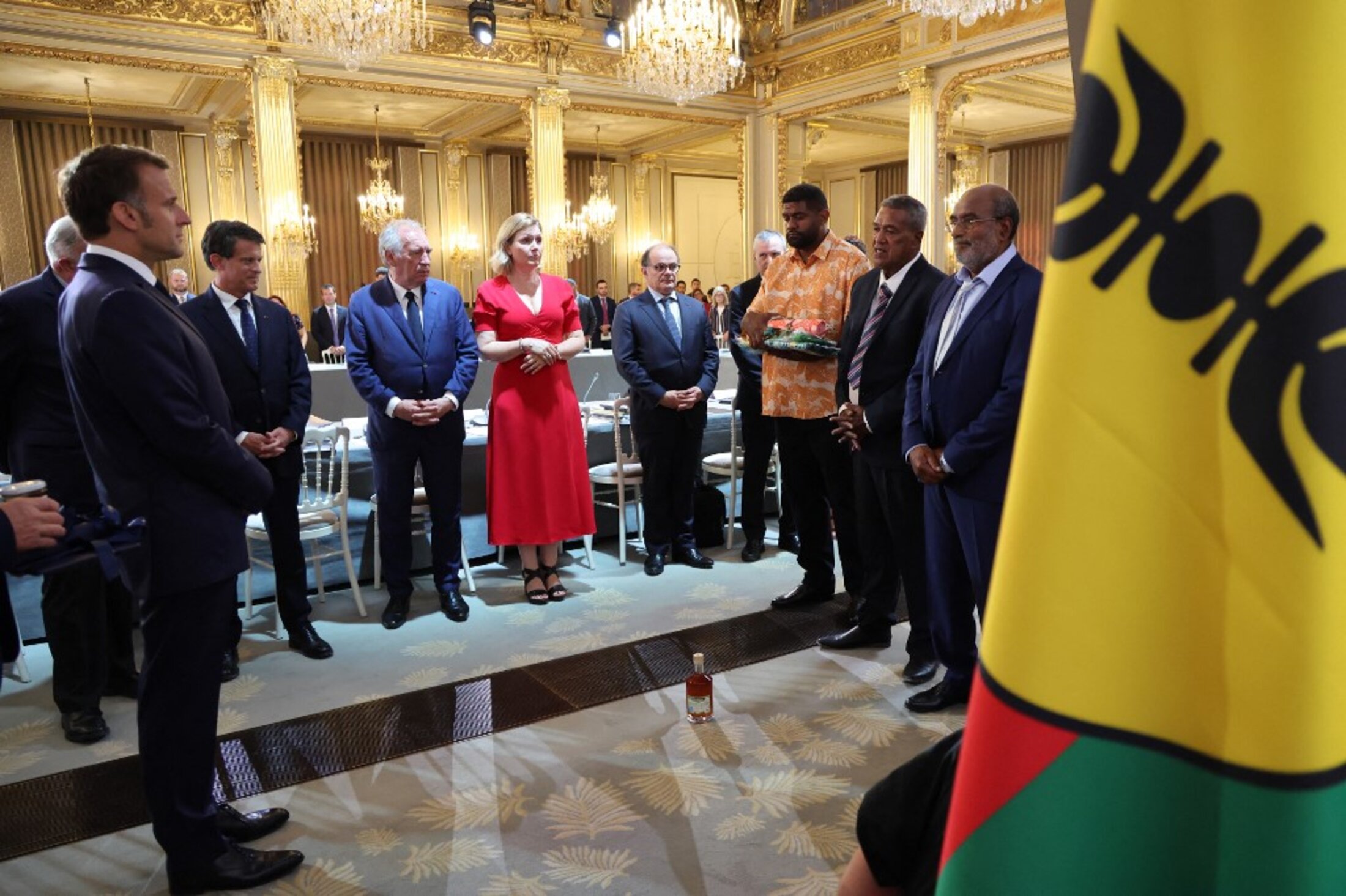
The Nouméa Accord was the ultimate result of a bitter and bloody campaign for independence in the 1980s, and which reached a climax in 1988 in a hostage-taking of French gendarmes by Kanak rebels. That siege, in a cave on the local island of Ouvéa, ended with the deaths of 19 of the rebels, and two gendarmes.
Today, the Kanaks represent 41% of the population, although they are a majority in the poorer northern province of Grande Terre, the largest island, and the Loyalty Island province. The “Caldoches” are concentrated in the economically dominant “South Province” on Grande-Terre, in which the New Caledonian capital town, Nouméa, is situated. The Caldoches are largely made up of the so-called “loyalist” camp who support French rule of the territory (although a number of powers were devolved under the Nouméa Accord).
Three referendums on independence (held in 2018, 2020 and 2021) all resulted in a victory for the loyalists. After garnering 47% of the vote in 2020, the pro-independence (mostly Kanak) movement boycotted the third and last referendum in 2021 in protest over the refusal of the authorities to postpone the date of the ballot to allow for the period of Kanak mourning following the worst of the Covid epidemic.
An “embryo of a Caledonian constitution”
The text of the deal announced on Saturday says it “fixes the conditions in which a Caledonian nationality is created”, and which would allow the islanders to “benefit from double nationality, French and Caledonian” while “they will retain European citizenship”. The “state of New Caledonia”, it projects, could be given international recognition.
Apart from handing more power over international relations to the political authorities in New Caledonia, allowing a newly declared Caledonian state to gain recognition on the world stage, the deal specifies that Paris retains ultimate control over other key areas of activity. These include defence, the justice system, and monetary affairs, and also security and law and order. The latter will however see greater input from local institutions.
For under the agreement announced early on Saturday, a “Caledonian High Council for Security” will be created, which would bring together representatives of the French state, of the local government of New Caledonia, the assemblies of the archipelago’s three provinces, and also mayors and customary authorities.
The outward identity of New Caledonia will be decided by what one person close to the negotiations over the deal called an “embryo of a Caledonian constitution”, including the state’s name, flag, anthem and motto. There could also emerge a “code of citizenship” and a “charter of values” to be shared by the whole of the population, made up of Kanaks, Caledoches and Oceanians.
The agreement proposes the adoption of an organic law that would define the conditions in which its propositions are established. Along with this is a necessary reform of France's constitution, planned for autumn, but all depends on whether the government of Prime Minister François Bayrou will survive when, before then, it presents its draft legislation for the 2026 budget before France’s hung parliament.
Since the country’s president, Emmanuel Macron, dissolved parliament in June last year, the ensuing snap legislative elections returned a fractured lower house in which no one party holds an absolute majority. This led to the fall, last December after a no-confidence vote, of the first prime minister appointed by Macron, the conservative former European Commissioner and Brexit negotiator Michel Barnier. The centre-right Bayrou, appointed soon after, is himself walking a political tightrope, amid diverse backroom deals and negotiations between parties to either bring down or save his government.
It’s a balanced text. No-one can say they have won or lost. That’s important for what is to come.
The deal announced on Saturday naturally included the explosive issue of those allowed – or not – to vote in local elections in the three provinces. The polls, which have been postponed several times due to the tensions, are now due to be held in May and June 2026. The electoral register will now include people who have settled on the archipelago since ten years or more.
“This agreement constitutes a new stage on the path to decolonisation and emancipation, respecting democratic principles and the constitutional state,” the 13-page document, the result of long negotiations between local political parties and also the French government, says in its introduction. It underlines the consensus reached “towards a perennial solution”.
Sonia Backès, the conservative party leader of the South Province regional assembly, a militant figure among the “loyalist” anti-independence camp, who in May criticised overseas territories minister Manuel Valls as being “disqualified” from overseeing the talks, gave a reluctant approval of the outcome. “This compromise will not fully satisfy anyone,” she said. “But I am full convinced that it will allow for Caledonia to escape the spiral of violence, uncertainty and destruction […]. I know the concessions that we have made can cause concern, but things must be seen for what they are – Caledonian nationality does not make New Caledonia an independent state.”
The negotiators from all sides were unanimous in agreeing that each camp had made concessions towards the others to reach the final agreement. That was in no small part because none rejoiced at the prospect presented by Emmanual Macron who suggested that if no deal was possible in the short-term there could be an agreement for a referendum in 15-20 years’ time on the future of the territory. The idea was opposed by the loyalists, who had no wish to wait for so long only to face yet another referendum on auto-determination, while the pro-independence representatives saw advantage in agreeing to a more consensual path other than that of previously unsuccessful referendums on immediate, total independence.
“The ones and the others found a way to choose intelligence over our convictions, our positions and stands,” commented Victor Tutugoro, one of the negotiators and a member of the Kanak pro-independence party, the National Union for Independence. He added that a compromise could not, by its very definition, totally satisfy. “But it is a balanced compromise […] which allows us to build New Caledonia together, a Caledonian citizenship, and above all to build a common destiny that we have all been calling for over many years.”
One of the negotiators, speaking on condition his name was withheld, commented: “It’s a balanced text. No-one can say they have won or lost. That’s important for what is to come.” Now the negotiators must return to their grass-roots base on the archipelago and convince them to support the agreement, which could well prove an uphill challenge given initial opposition by some in both the pro-independence and loyalist camps.
“It’s an essential step, but it’s far from over,” Valls said of the agreement. “Violence is still present [on New Caledonia], the economic and social situation remains tense. But we can succeed with this bet. The work must continue and nothing must be abandoned.”
-------------------------
- The original French version of this report can be found here.
English version by Graham Tearse