


About 3,000 bovines have been slaughtered in France this year since the first case of a highly infectious condition called Lumpy Skin Disease (LSD) was discovered in June among cattle in an Alpine region in the east of the country. The disease, which can be fatal, causes a fall in the infected cows’ milk production, along with causing chronic fatigue and infertility.
The French authorities’ strategy of culling whole herds where even as few as one amongst them is found to be infected has been met with vigorous protests from the farming community, which have heightened over recent days after several culls in south-west France. Vets arriving on the farms to put down cattle have been met with blockades mounted by groups of farmers and have had to be escorted by gendarmerie anti-riot units.
The scenes of clashes between protesting farmers and gendarmes are reminiscent of the nationwide militant action by farmers including roadblocks, attacks on government buildings and a brief siege of Paris which erupted in early 2024. Just as that unrest was rooted in a multitude of long-simmering grievances, the now growing crisis over the culling of cattle threatens to spill over into the wider unrest of a profession struggling on low incomes, frustrated over what many see as suffocating bureaucracy, while also, for some branches, seeing their market share shrink because of cheap imports.
The veterinary authorities argue the culls are the best adapted strategy to contain the virus which causes the disease, even as soon as just one case of LSD is found amongst a herd. The disease, which is not transmissible to humans, is spread by blood-sucking insects like certain types of flies, by ticks and fleas. The symptoms, including the appearance of multiple nodules on the skin, appear between one and three weeks after infection. The vaccine against LSD takes around three weeks to be effective.
The authorities believe that LSD has geographically jumped from the east of France to the south-west, with some areas in between unaffected, because infected cattle, have been transported there, probably before showing signs of the disease.
On Saturday, less than 24 hours after the slaughter of a herd of 207 cows close to the village of Bordes-sur-Arize after LSD was discovered among them, another herd of 35 bovines, similarly affected, were slaughtered on Saturday near the village of Touilles, about 45 kilometres away, fuelling further protests by farmers and their unions.
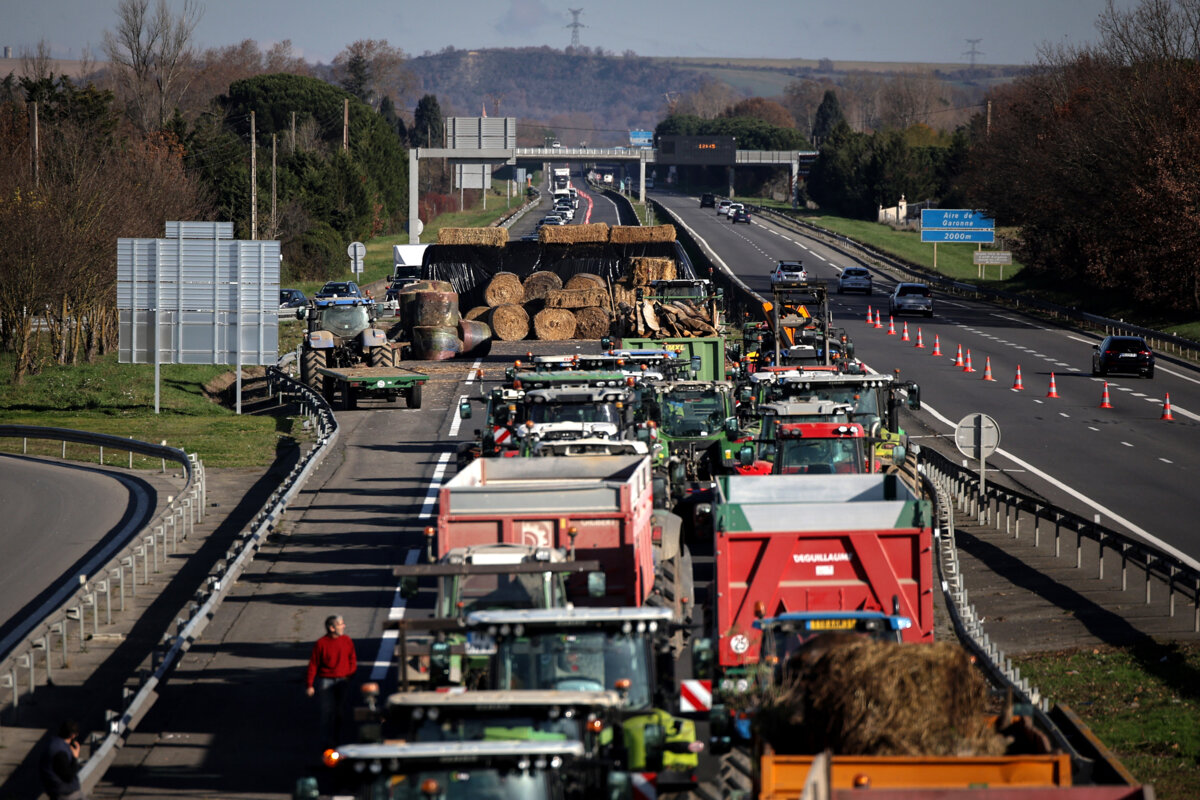
About 200 farmers turned out on Saturday to mount a roadblock on the principal motorway running through the region where the culls took place, which lies close to the foothills of the Pyrenees mountains and the border with Spain. It was already from here, one of the financially poorest agricultural regions in France, that the farmers’ revolt in January last year began, before soon snowballing across the country.
Enlargement : Illustration 1

On Saturday morning, 38 tractors arrived to block the motorway near the small town of Carbonne, setting up a camp with a brazier to warm up with, a coffee and hot chocolate dispensing point, and a Christmas tree placed on a trailer – sign of their determination to stay put. Blocking the motorway’s two lanes, the farmers had placed haystacks in front of the vehicles, on which hung a plastic sheeting daubed with the words: “Here the country of agricultural resistance continues”.
The word “continues” is fitting for the gatherings this weekend, although sparked by the culls ordered by the authorities. That strategy, ultimately defined by those on high in Paris, 650 kilometres away, has caused exasperation and outrage. “Today, if one case of LSD is detected, all the animals who were in contact are slaughtered on the basis that it’s a very contagious disease,” said Bertrand Loup, a cattle farmer who has a herd of around 50 Limousin cows. “That might have been effective right at the beginning, in June, when it [LSD] was just in one village, but now the disease is advancing faster than the protocol.” He called for massive vaccination, during which “no animals are transported” before the vaccine becomes effective, and even then “only case by case for slaughter”.
Also speaking to Mediapart was Guillaume (last name withheld), 47, who has a farm of around 20 Aubrac cows, 230 sheep, around 30 pigs and some ten goats. “Animals who are not ill and which are comestible are being slaughtered,” he objected. “They can be treated, we have the vaccines,” he added. “They should be rolled out, like was the case with epizootic haemorrhagic disease and bluetongue disease, that’s all.”
In theory, LSD affects only bovines but, like many of his colleagues, Guillaume does not believe the authorities have fully understood how the virus spreads. “They say it’s the gnat that spreads it, but what do we really know? It’s like Covid or the flu for us, where does it come from?”
Cédric Baron, 46, is a both a cereal and cattle farmer, with 60 Limousin cows. “When you find a case, it must of course be put down, but from there to slaughtering the whole herd…” he said, leaving the conclusion hanging. “The herd should be placed in quarantine – we’re not going to decimate the whole French livestock population! The state was not sufficiently reactive in this case, the vaccines were too late in coming.”
All of those cattle farmers questioned by Mediapart agreed that the compensation payments offered by the authorities are fair, but “money doesn’t account for everything” said Bertrand Loup. “It’s a fair payment, it can make it possible to reconstitute a herd. But each time it’s a dramatic affair for families.”
“The estimation [of the monetary value] of a cow can vary from one sum to triple that amount, even more,” said Cédric Baron. “There is the aspect of genetics, and everything that went before, which has been lost. I must admit that if it happens to me, I’ll ask myself the question as to whether I’ll stop rearing cattle.”
Behind the issue of LSD, it is the deep malaise in France’s farming world which re-emerged with the violent repression, including the use of teargas, of the farmers who gathered in protest at the cull on Friday in Bordes-sur-Arize.
On his smartphone, Cédric Baron brought up the text listing the demands of a local farmers’ union called the “Ultras de l’A64”, of which he is a member. Two of the demands are for an alternative solution to be found to the mass culls, and a moratorium on what are officially designated as “vulnerable zones” for the disease. But five others have nothing to do with LSD, including the lowering of taxes on fertilizers, the facilitation of building the controversial artificial reservoirs for irrigation, and a rejection of the trade agreement between the EU and the South American nations' trade bloc Mercosur. “We’re asking for seven in order to have three or four [demands accepted],” said Baron.
In February this year, in nationwide elections of members of France’s agricultural chambers, which have a local regulatory role, the Ultras de l’A64 became the majority group at the chamber of the Haute-Garonne département, where Bertrand Loup occupies the post of first vice-chairman. The Ultras de l’A64, a movement which is independent of the three principal farming unions (the Confédération Paysanne, the FNSEA and the Coordination Rurale), came onto the scene during the protests of January 2024.
François Purseigle is a sociologist specialised in research into agricultural issues (and those surrounding farmers’ unions in particular), and who in January will take up the post of head of the National Polytechnic Institute of Toulouse. He contributed to the writing of Rural, a film about the cattle farmer and co-founder of the Ultras de l’A64, Jérôme Bayle. “All along the [river] Garonne, in the Nouvelle-Aquitaine and Occitanie [regions], the agriculture is not ‘sexy’, not ‘alter’, and there are no large farms either,” he told Mediapart. “The Ultras de l’A64 propose a type of existential resistance. They draw all the farmers who don’t agree with the violent methods of the Coordination Rurale, nor in the Confédération Paysanne’s vision of a global transformation, and nor in the entrepreneurial version of the FNSEA.”
At a time when many cattle farmers suffer from what Purseigle called “drained” finances, those who have “reassembled herds, relaunched local [bovine] races, invested in genetics” see little, if any, payment in return for their efforts. The sentiment of injustice that creates, he argues, is brought to its highest point by the culling programme.
Mathilde, 35, (last name withheld) was present at the blockade of the A64 motorway on Saturday. She runs a small public relations business, based in Montesquieu-Volvestre, a town just south of Carbonne in the rural valleys below the Pyrenees. “I am surrounded by farmers,” she told Mediapart. “Cattle rearing is a daily task – loving one’s animals, pampering them, giving life to handed-down values.”
“I’m here today to support people who have often been bled dry, who have had more and more standards and constraints to meet, more and more investments to make. And who, in the end, see their herd bumped off while meat is imported from abroad,” she continued. “Medical, social and educational things are essential to agriculture, without which one cannot build a future. If one wants to get better, one must eat well and have a healthcare system where you’re properly taken care of. That’s all. I’m not a mum yet, but I’m not OK for leaving a world like this one for those who follow.”
-------------------------
- The original French version of this report can be found here.
English version, with added reporting, by Graham Tearse