


The subject of water, or rather the lack of it, has become a major issue in France, like in many European countries previously used to taking its ready supply for granted. The dry winter and falling levels of water tables and water courses across much of the country are now of widespread concern amid fears of an impending record summer drought.
In reality, the depletion of the resource, so vital for life and production activity – energy, industry, and agriculture – has been largely documented by the scientific community for many years now, while numerous institutional and political reports, and those of environmentalists and technologists, sound the same alarm: climate change and the effects of human activity on the natural habitat reduce, at a daily rhythm, the quantity of water supply.
“The drought that affected Europe, and particularly France, in 2022 is probably the most severe since at least a half-century, combining a deficit in rainfall and record temperatures,” noted a French inter-ministerial report into the management of the 2022 drought crisis, and which was published on April 12th. The study, made by a panel of expert inspectors from various public agencies concerned with water management, and was commissioned jointly by the ministries of ecological transition (environment), health, agriculture and the interior, warned that “the perspectives of climate change demand strong measures in the medium- and long-term”. The report’s findings echoed those of others, published in 2019 and 2011, which advised greater restraint on water usage in face of the crisis.
This time, the inspectors gave a stark warning: “In the very short-term, the period at the beginning of 2023 of more than a month without rain, and the organisation of exceptional events which are likely to affect the peak of drinking water consumption in several large towns at the same period, like the rugby world cup in the summer of 2023 and then, in 2024, the Olympic and Paralympic games, demand particular vigilance regarding the risk of a rupture in the supply of drinking water.”
On a more general note, the report called for a “radical change in practices” and for the urgent respect of the objectives adopted in 2019 at the end of a series of national consultations over the water crisis – called “Les assises de l’eau” – which brought together local authorities, environmentalist organisations, farmers’ federations, water management professionals and consumer groups. These included a 10% reduction in the then overall extraction of water by 2024, and a 25% reduction in water extraction by 2034. That was a minimum goal to compensate for the diminishing supplies of the resource, which would in effect simply maintain the problem at the current levelin ten years’ time.
The April report underlined that last summer in France “the worst” was narrowly avoided, explaining that this was, “On the one hand thanks to the exceptional mobilisation of all the actors, and on the other because the water tables and reservoirs were filled to a high level at the end of the winter of 2021-2022. Such conditions may no longer be in place if a similar phenomenon happened again in the coming years, even as of 2023.”
Already by this month, that second condition – water tables and reservoirs filled to a high level at the end of the winter – has not occurred. The level of water tables is worrying, according to the latest report by France’s national Geological and Mining Bureau (BRGM), which warned of an “established risk of drought in numerous sectors”.
The consequences of drought periods are always significant. Last summer, when “the worst” was avoided, hydroelectric production in France fell by 20% below normal output. Agricultural yields fell variously year-on-year by between 10% and 30%, while on August 1st, around 1,200 watercourses were recorded as totally dry. Supplies of running water were interrupted in almost 1,000 municipalities, necessitating deliveries of water by tanker trucks and even in the form of bottled water. This month, some municipalities have already run out of tap water, notably in the Pyrénées-Orientales département (equivalent to a county) in south-west France.
Enlargement : Illustration 1
On March 30th, to the backdrop of an Alpine lake at Savines-le-Lac, in south-east France, President Emmanuel Macron announced before the press the launching of a “Water Plan” to address the crisis which, he said, had made water “a strategic issue for all of the nation”. The plan contains 53 measures which, as explained in the presentation by the Ministry for Ecological Transition, are aimed at establishing “a resilient and concerted management of water”.
But the political objectives are vague. “It is a document without a timetable, without a budget and without a territory, whereas France has 12 hydrographic basins with very diverse problematics,” commented Antoine Gatet, vice-chairman of France Nature Environnement (FNE), a federation of environmentalist associations, and which has for many years been involved in water management projects. Above all, and despite all the recommendations to the contrary, the plan reduces the objective set out four years ago by the Assises de l’eau for a 25% reduction in water extraction by 2034. Instead, it fixes the goal of a 10% reduction by 2030.
“This plan ignores two thirds of the issues, divides by two the ambitions for restraining consumption, and adds nothing to what was already in place or [what featured] in the roadmap of the Assises de l’eau,” said the FNE, denouncing it as an exercise in PR communications. “The problem today is not a lack of tools or laws or measures. The problem is that the solutions are not put in place, that malpractices are not punished, and that the heart of the problem – systemic – is the failure to place in question the dominant model of conventional agriculture.”
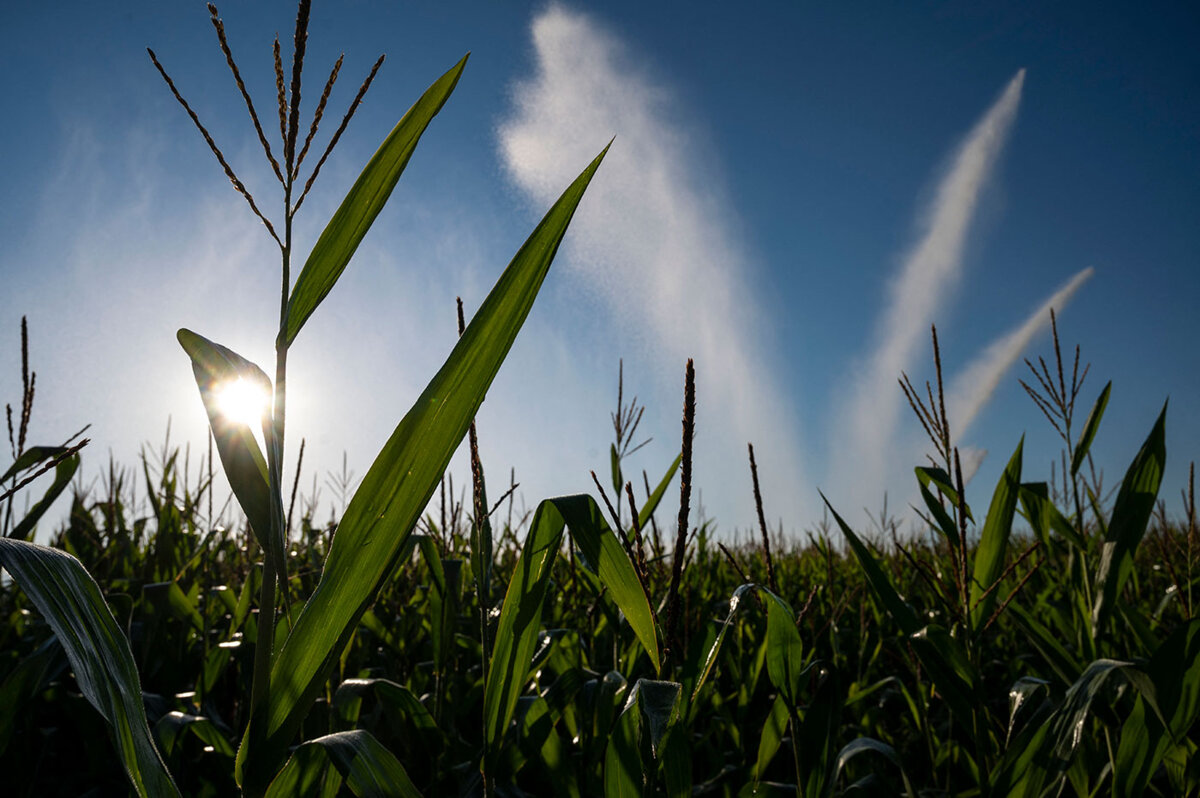
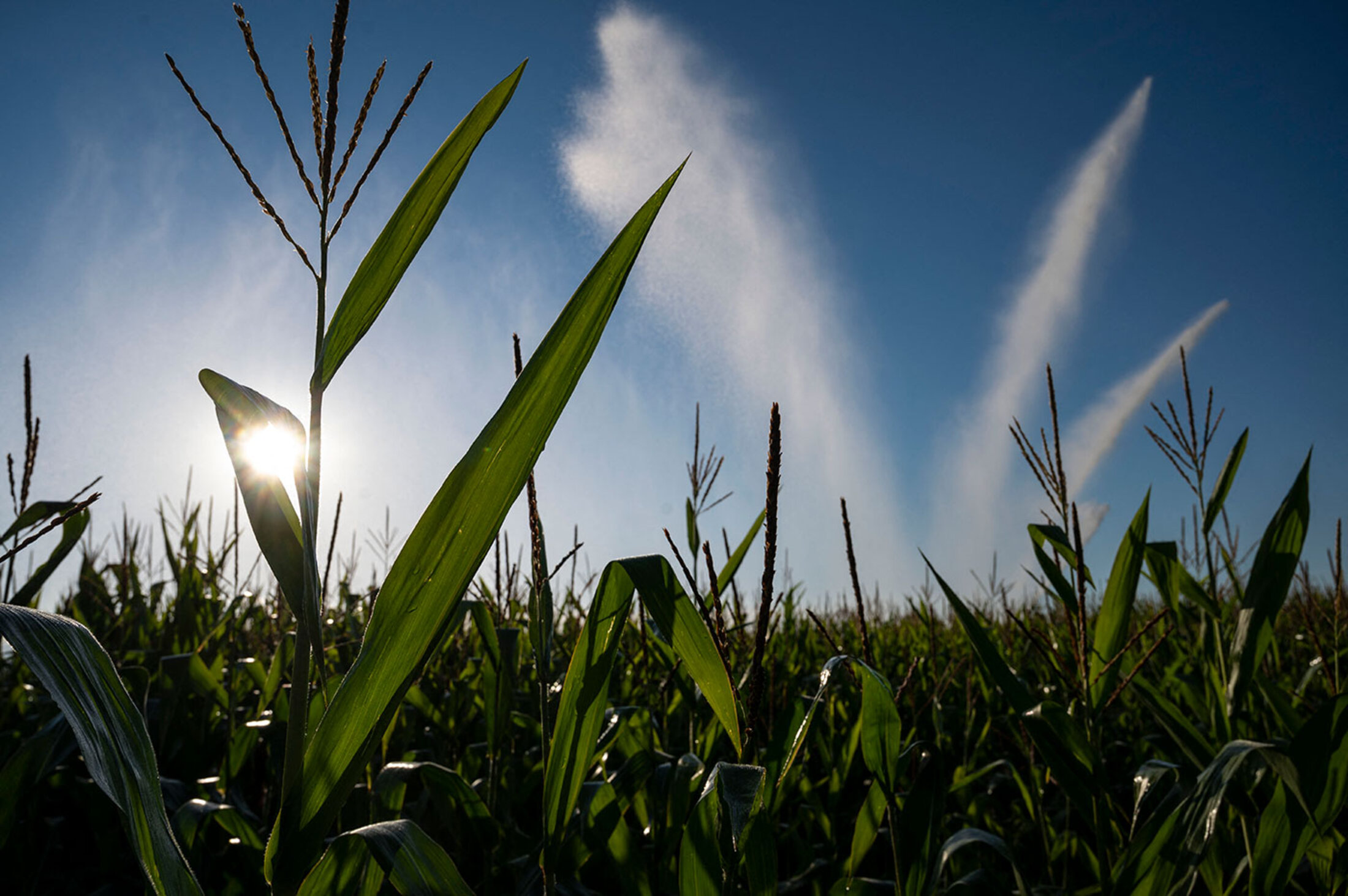
In mainland France, about 10 % of all extracted water is used for agricultural purposes, mostly for irrigation. This benefits a minority of farming businesses as just 8% of the country’s agricultural surface area, according to latest figures, is irrigated, and which essentially concerns cultures of maize and cereals, which are largely exported and used for animal feed. A report by the FNE federation found that the irrigated surface area of agricultural land rose overall by 14% between 2010 and 2020, while in some regions this increase reached record spikes, such is in the northern Hauts-de-France region where it rose by 77.7%.
Behind the figure of 10% of extracted water used for agriculture, and essentially for irrigation, lies a more complex situation. It is water which is consumed – that is, withdrawn and not returned to the aquatic environment – unlike for much of the remainder of extracted water. In this context, irrigation accounts for close to half of all the water which is consumed every year in France. Furthermore, agricultural irrigation activity is mostly concentrated on the summer months, when water supplies are at their lowest, and in some areas during that period it can represent more than 90% of water consumption.
But while agricultural irrigation constitutes a major issue amid the water crisis, it does not feature in the government’s “Water Plan” announced last month by the French president. While the plan calls for greater restraint in water consumption by “all actors”, which includes agricultural usage, agriculture minister Marc Fesneau has said that farmers are not to be asked to make “additional efforts”. The strategy appears to be a perilous one: it is difficult to see how water consumption can fall in a sector where the trend is towards greater irrigation, all the more so without additional efforts being made. “There is no solution for the real problem that is agricultural irrigation, but people who take showers are made to feel guilty,” said the FNE’s Antoine Gatet.
Indeed, in Macron’s presentation of the “water plan”, the ambition of restraining water consumption concerns public consumption above all. The president announced that to encourage people to limit their consumption, a system of progressive pricing would be introduced. “The first cubic metres [will be] billed for at a modest price, close to cost price,” he said at Savines-le-Lac. “Then, above a certain amount, the charge per cubic metre will be higher, and that’s right for what I would call ‘comfort’ [usage].”
The Association of French Mayors pointed out in a statement issued on April 1st that just such a tiered system of charges for water “is already largely in place”, adding that the pricing is “decided locally, it is within local competence”. Water charges, the AMF said, are “decided locally according to each local specificity and the structure of users, in order to avoid effects that could be counter-productive both socially (for example, large families) as much as ecologically”.
The progressive pricing of water consumption announced by Macron is not only far from novel, but it also does not address the principal issue. The funding of water management policies is entirely the concern of the public water agencies that separately oversee its usage and protection in the different hydrographic basins they have responsibility for, and 85% of the budget is funded by households. For the AMF, “a rebalancing of contributions and an enlargement of contributors would allow a greater approach along the lines of ‘polluter-payer’”.
The “Water Plan” is filled with technologist Newspeak, including talk of intelligent meters, “EcoWatt” water applications, resource optimisation, and rupture innovation, and which reflect Macron’s vision of water management: namely, irrigate more using less water thanks to innovation, the closed-circuit cooling of nuclear energy reactors, the construction of agricultural reservoirs to cope with summer droughts, and the recycling of waste water to irrigate fields and gardens.
The latter, which goes by the acronym REUT for réutilisation des eaux usées traitées (re-use of treated waste water), is an idea which the water industry has been promoting for around 20 years. A key measure of the “Water Plan”, with foresees the launching of some one thousand REUT sites over the next five years, the French president said they will compensate for millions of cubic metres of water otherwise extracted, representing the yearly equivalent of “Three Olympic swimming pools per municipality, or 3,500 bottles of water per French person”. But it is also water that will not return to the aquatic environment in a natural cycle, with uncertain consequences as a result, while the process also demands heavy investment for an uncertain result.
“Behind this is the idea that one can tame water,” said the FNE’s Antoine Gatet. “It is a mal-adaptation of a profound modification of aquatic environments and ecological balances. The [real] objective, on the contrary, is a recovery of nature and for the capacity of water to manage itself alone.”
-------------------------
- The original French version of this report can be found here.