


An openly Islamophobic polemicist, previously convicted for provoking racial hatred, has now been recruited by a French television channel to pour out more of his venom against Muslims; a woman wearing a headscarf was humiliated by a member of the far-right Rassemblement National party in front of her son and his schoolmates at a meeting of the Bourgogne-Franche-Comté regional council; an education minister calls for the reporting of little boys who refuse, in the playground, to take the hand of little girls, which he sees as the sign of future jihadists; France's interior minister designates “the regular and ostentatious practice of prayers” and the “intensified practice of religion during the Ramadan” as problematic behaviour; a university detailed a list of instructions, before finally withdrawing them, aimed at identifying supposed forms of “radicalisation”, such as the “apparition of the headscarf”, a change in appearance with “the wearing of a beard without a moustache”, “change in clothing” like the “wearing of the djellaba”, “recurrent absenteeism during the hours of prayer”, the refusal to “recognise the authority of women”, and a “halt in the consumption of alcoholic drinks”.
Please, no more!
What is it that lies behind this pile of ignominy in France under the government of a supposedly progressist president engaged in combat against the dreadful illiberals of this world?
From the media, to the penpushers of the public administration, and on to the country’s political leaders, the poison of hate has spread these past few weeks at a quite stunning speed, deeply wounding those placed in question – French citizens of Muslim faith and, beyond them, all those who do not consider Muslims to be enemies or a threat, but compatriots like any others. The bile is no longer limited to just few agitators who are only too happy to bask in their provocations, but, rather, it has been made commonplace.
Polluting the public arena, this succession of Islamophobic [1] words and gestures is deeply sickening. It is remindful of sombre times which, without even going back as far as WWII, constitute the recurrent symptoms of our country’s incapacity to accept itself in all plurality.
Back in early 2010, Mediapart ran a series of reports which detailed how then French president Nicolas Sarkozy had created the conditions of a racist drift of his own political party, then called the UMP, opening up the path for a total permeability between the conservative Right and the far-right (see here, in French). By creating a ministry for Immigration and National Identity, which he handed to the Parti Socialiste renegade Éric Besson, Sarkozy gave the green light to the worst of unbridled hostility towards both foreigners and French Muslims. Another stage was reached with his speech in Grenoble in July 2010, when he argued for the stripping of French nationality from “every person of foreign origin” who had voluntarily endangered the life of a representative of the authorities of law and order.
By adopting this distinction between “them” and “us”, seeping into the rhetoric of officials in an effort to get closer to ‘the people’, he legitimised a series of nauseating comments. Examples included a notable incident involving Brice Hortefeux, when he was Sarkozy’s interior minister, during a summer conference of their conservative UMP party in 2009. As he was photographed alongside a UMP militant of North African origin, he commented: “When there’s one, its OK. It’s when there are a lot that there are problems.”
Then there was the UMP mayor of Marseille, Jean-Claude Gaudin, who, during a 2010 press conference, referring to the spontaneous celebrations on the Mediterranean port city’s main boulevard, the Canebière, of supporters of Algeria’s football team after it won a World Cup qualification match, announced: “We are pleased that the Muslims are happy with the match. Except when, afterwards, they flood, at 15,000 or 20,000, the Canebière, [and] there’s only the Algerian flag and there’s not the French flag, that doesn’t please us.”
Not forgetting the comments of Jean-François Copé who, addressing a political meeting in the southern town of Draguignan in 2012 at the start of his bid for election as president of the UMP, declared: “There are neighbourhoods where I can understand the exasperation of some of our compatriots, fathers or mothers coming home from work in the evening and who learn that their son had his chocolate roll snatched from his hand outside school by thugs who tell him that you don’t eat during the Ramadan.”
Under François Hollande’s five-year presidential term, from 2012 to 2017, it was principally Manuel Valls, Hollande’s interior minister who later became his prime minister, who crept into the sewers. At Mediapart, we regularly denounced the positions adopted by Valls who, after once declaring that the Roma had a “vocation” to return to their country of origin, argued that the “cultural and identity battle” was more important (perhaps, more truthfully, that it attracts more votes) than that of economic equality or the fight against unemployment. This paradigm change allowed a section of the so called “complex-free” Left to openly espouse a form of Islamophobia with the pretence of defending a French “republican” vision of secularism. During the debates in 2015 and 2016 over a government move to strip French nationality from those convicted of terrorist offences, we argued how the executive had, in the words of publishing editor Edwy Plenel’s op-ed at the time, created a mutant monstrosity that had led its supporters to lose all their political and historical bearings.
Enlargement : Illustration 1
Given that recent experience, we at Mediapart have always been sceptical towards the pledges made by Emmanuel Macron that he would not venture down that dark path, not because of an a priori mistrust of his statements but rather because of the obsessional recurrence of the problem in the history of France. It is true that, for a time, it appeared as if the waving of this red rag of “identity” issues was on the retreat, and that a certain restraint could be observed on high. But that did not last. The initial attacks were insidious, taking the form of what appeared as technical legislation to curb immigration (the distancing of foreigners generally serving as a laboratory for policies aimed at those turned to racism).
After that, the political tongue loosened up, or became “liberated” as Nicolas Sarkozy would have put it. After months during which his fiscal and social policies were challenged by the “yellow vest” movement, Emmanuel Macron sought an escape route by attempting to impose immigration onto the agenda of the so-called “Great Debate” series of national public consultations. In truth, the issue was largely limited to the sidelines of the yellow vest movement, which was centred principally on social inequalities and the role of the country’s institutions.
Sticking to his position after the summer recess, the French president, via his entourage in comments to the media, made known his interest in the quite rancid notion of “cultural insecurity”. This is championed by Laurent Bouvet, the cofounder of the movement Printemps républicain (or “Republican Spring, mostly made up of socialists and self-proclaimed as defending traditional French secularism against communitarianism, political Islamism and racism), whose position on secularism is quite opposed to that more open stand expressed by Macron at the beginning of his presidency.
In a move that was hardly a demonstration of democracy, the French president called a meeting with Members of Parliament (MPs) from his centre-right LREM party in mid-September, when he gave them the instruction that it was now time to surpass “divisions and taboos” and to look uncomfortable major issues “in the face”. Not contenting himself with the recycling of the past political strategy of Nicolas Sarkozy, he also adopted its rhetoric, alluding to a blindness of the isolated “bourgeois” towards immigration which, he said, is an everyday “reality” for the working class who had to live with it. This, he argued, had to be recognised in order to effectively combat the far-right.
Marine Le Pen, leader of the far-right Rassemblement National party (the former Front National) just as soon mocked Macron’s words, denouncing what she called an “electoral” speech (municipal elections are to be held across the country next March), adding that she had “seen others before him”, like Nicolas Sarkozy, harden their tone on ‘identity’ questions “because they are engaging in an electoral campaign”. Meanwhile, the success of that course is debatable, for adopting the style of the far-right has never allowed for challenging it over the substance of its policies. Indeed, the parliamentary debates on immigration, recently prompted by Macron, mechanically led to a spiralling one-upmanship on the issue between MPs from the conservative Les Républicains party (the former UMP) and those of the Rassemblement National.
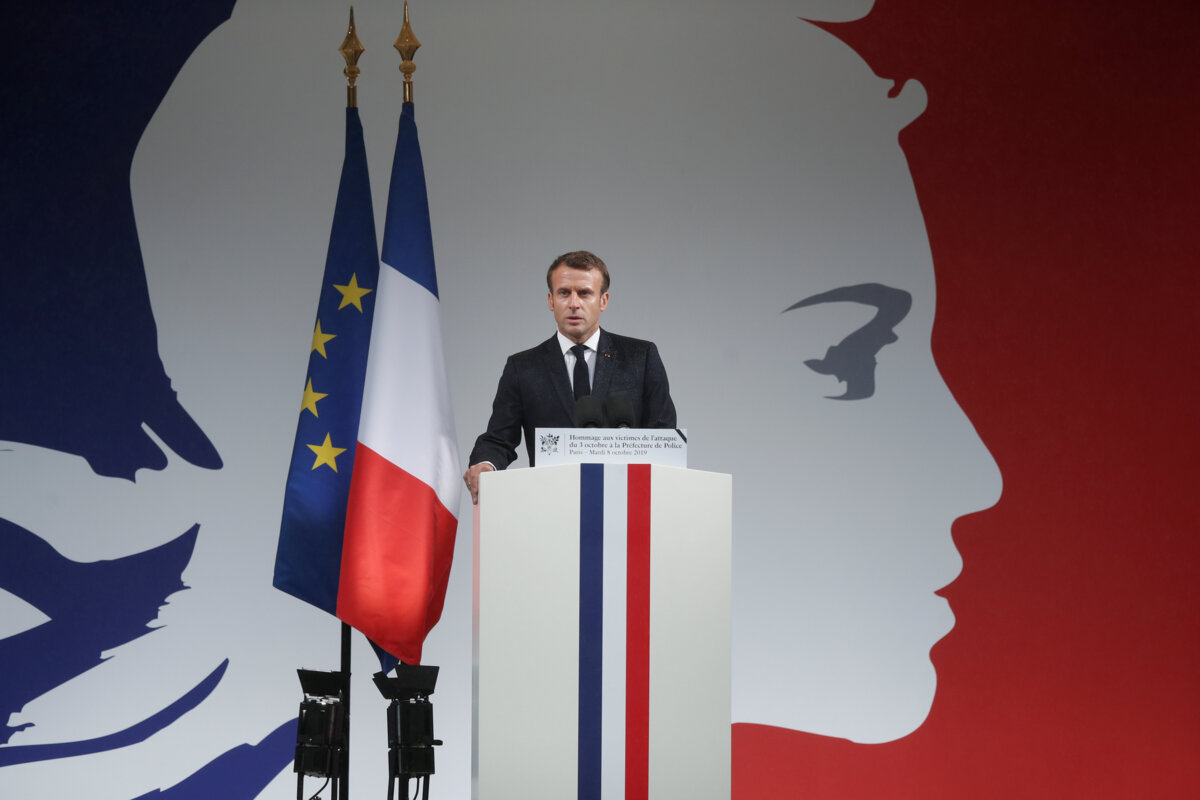
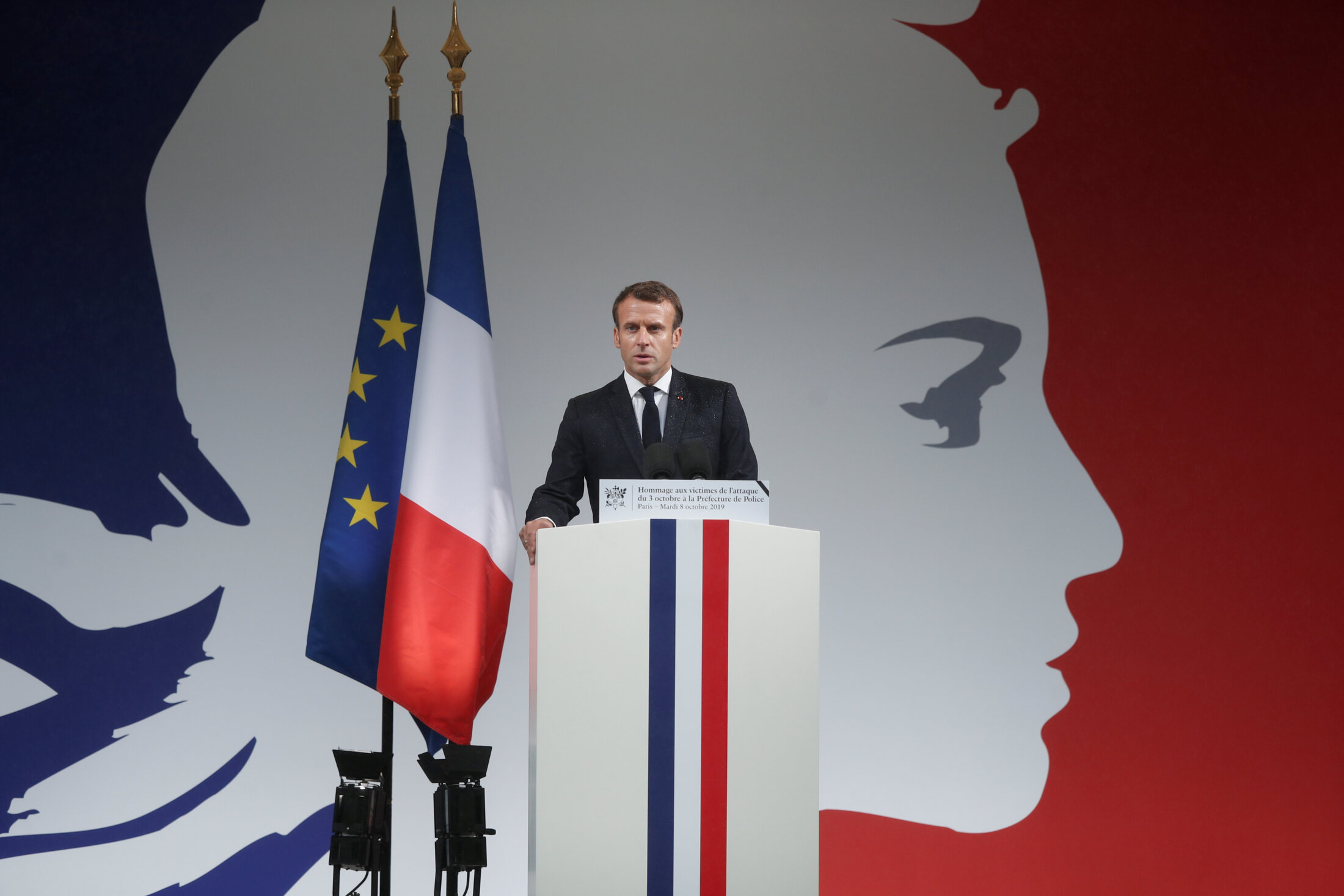
The latest salvo came after the deadly attack at the Paris police headquarters earlier this month, when four police staff were murdered by a colleague, a Muslim convert who the subsequent investigation found had become radicalised. In his speech during a ceremony of homage to the four victims in the courtyard of the Paris police buildings, the French president said that to defeat terrorism it was necessary “to build a society of vigilance” in face of the “Islamist hydra”.
“This is what is incumbent on us to build,” he said, addressing the gathering. “To know how to recognise at work, at school, a slackening [of behaviour], the deviations.”
This call for a generalised surveillance, which runs the risk of being transformed into a system to denounce Muslims, fell on the keen ears, at least symbolically, of a public employee at the Cergy-Pontoise university who felt himself authorised to establish a list of what Macron called “slight signs” in order to detect a terrorist threat within the establishment.
In such a context, no clear reaction to such excessive behaviour came from the president or his prime minister. Nor in defence of the Muslim mother humiliated by the far-right regional councillor – worse still in that case, education minister Jean-Michel Blanquer fanned the fire by declaring that “the headscarf is not desirable in our society”, while calling for the law, which allows parents to wear religious dress or insignia when accompanying children on school trips, to be circumvented to avoid such situations. That was the height of cynicism coming from a member of government.
While it may not suit the education minister, the rules of secularism such as they are currently defined and applied in France include the neutrality of the state, local authorities and public services. This regards those working in these institutions, not the public who are in contact with them. Jean-Michel Blanquer would like to confine religions to the private environment. In that respect, his views are aligned with those of MP Émile Combes who, in 1905 during the preparation of the law passed that year for the separation of the churches and the state, lost his battle with Aristide Briand, then MP and rapporteur of the draft legislation, for whom the respect of the freedom of conscience should prevail.
In his book Révolution, published in 2016 as he launched his bid for the presidency, Emmanuel Macron wrote: “In our country, each individual is free to believe or to not believe. Each individual is free to practice or not a religion, at a level of intensity that they desire within themselves. Secularism is a liberty before being a prohibition. It is made to allow each individual to integrate within life in common and not to lead a battle against one particular religion or another, and still less to exclude and point fingers.” The president would do well to remember those lines. At a time when the so-called “replacement theory” is making headway in society, those in government hold in their hands the responsibility, more than ever, of maintaining the barriers against hatred. Within a public arena that is highly inflammable, they must guarantee respectful debate, however conflictual it may be.
Those who are supposed to govern us and protect us against terrorist attacks must take care not to turn themselves against France itself, its unity and its diversity.
-------------------------
1: For the definition of Islamophobia, Mediapart uses as its reference that of France’s National Consultative Commission on Human Rights, which is as follows: an attitude of systematic hostility towards Muslims, people perceived as such, and towards Islam.
- The original French text of this op-ed can be found here.