


Like a phoenix from the ashes, prime minister Jean-Marc Ayrault was supposed to rise to the occasion as the government faced its first parliamentary motion of censure from the right-wing UMP opposition.
It didn't quite happen like that. The reality was that Ayrault was not able to produce any miracles, though the government rebuffed Wednesday's motion easily enough. The mood was a sombre one on the government side, with the resignation of budget minister Jérôme Cahuzac casting a pall over proceedings. Cahuzac resigned on Tuesday evening after it was announced hours earlier that a full-blown independent judicial investigation has been opened into evidence he held an undisclosed bank account in Switzerland, following revelations made by Mediapart back in December.

Enlargement : Illustration 1
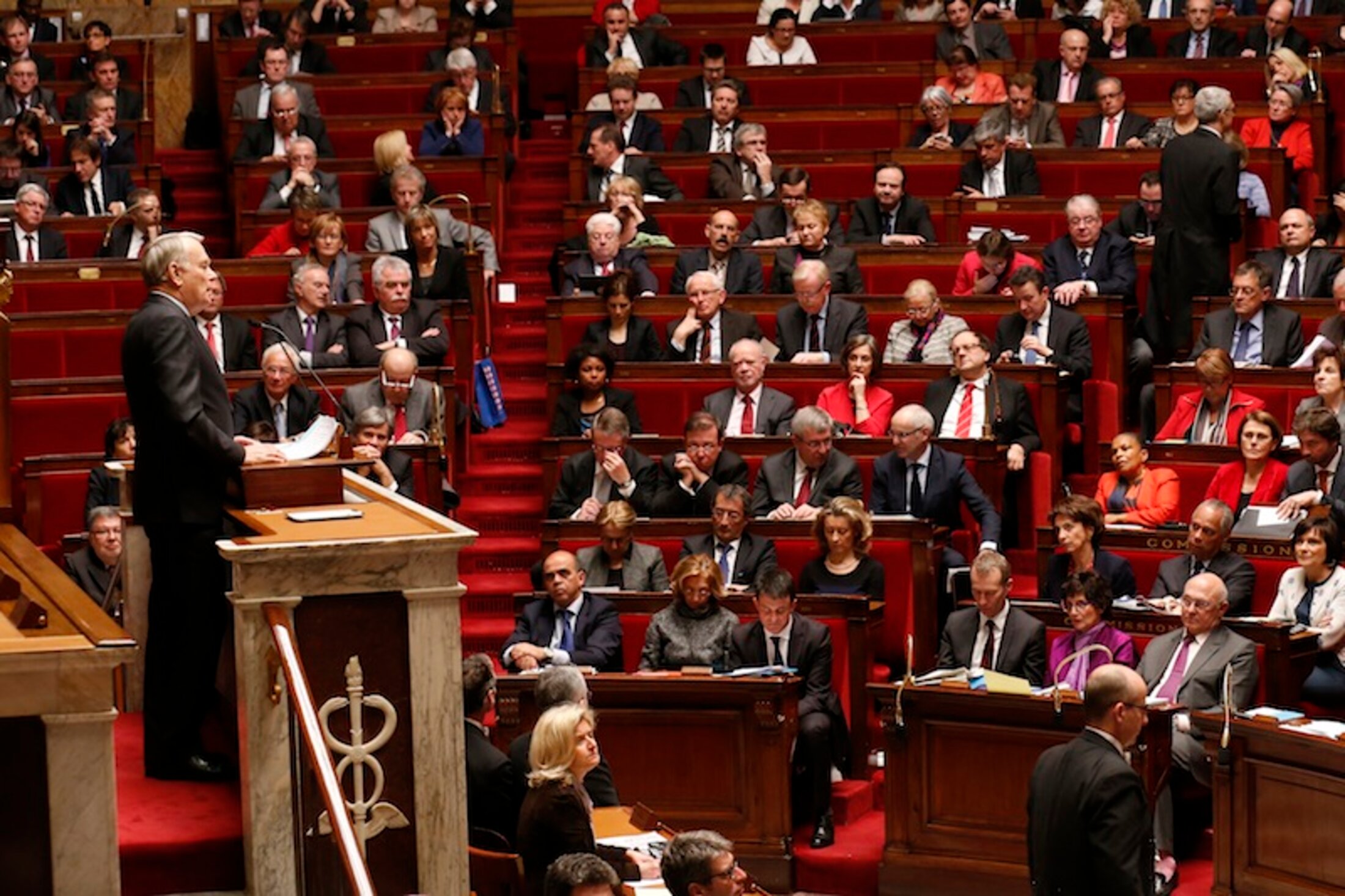
Cahuzac's replacement as budget minister Bernard Cazeneuve spoke three times during the censure debate without mentioning his predecessor's name, and there was little mention of him, too, from among the opposition ranks who ever since the scandal broke have been curiously reluctant to capitalise on it. There was no escaping the Cahuzac affair however. On MPs' lecterns lay the front pages of daily newspapers with Cahuzac's image plastered all over them. “Did he lie to the president?” Le Monde asked on its front page. And in the corridors of the French Parliament’s lower house, the National Assembly, there was no other topic of conversation.
In his closing speech the UMP president Jean-François Copé also referred to the Cahuzac affair, though in more cautious language than he used in attacking the government over the “economic and moral decline of our country”. It was left to the prime minister to tackle the subject head on, lavishing praise upon the former budget minister.
“I pay tribute to Jérôme Cahuzac who showed dignity and responsibility in handing in...his resignation,” Jean-Marc Ayrault told MPs. “And I want to thank him here for his remarkable and brave work in the government, for he was an excellent budget minister serving France.” When Cahuzac's name was mentioned the majority of Socialist Party MPs applauded. A few, however, kept their gaze firmly fixed on their tablet computer or mobile phone.
Since Tuesday evening and the announcement of Cahuzac's resignation the executive has been full of praise for the former budget minister, who had been a key figure in the government for the past ten months. There has been no question of the Elysée or the prime minister's office keeping their distance. All swear that their views have not altered. “Cahuzac gave his word. He told the president of the Republic and the prime minister that he did not have an account in Switzerland. At this stage nothing has changed,” says an adviser. At the prime minister's official residence Matignon a source adds: “The prime minister regrets his departure.”
One MP confirms that Tuesday's resignation sent something of a “shock wave” through the corridors of power. Hit by the sudden departure of a minister and in some cases a friend, the PS hierarchy in Parliament remain doubtful about the allegations. Claude Bartolone, president of the National Assembly, continues to disbelieve the claims. The president of the parliamentary law committee Jean-Jacques Urvoas, deeply moved by the resignation, paid homage to “someone who is respected and respectable”. He cannot bring himself to imagine that Jérôme Cahuzac could have lied. “I cannot believe that someone who is such a fine person could use such a basic defence,” he said. “Otherwise, power really would have destroyed intelligence...”
MP Annick Lepetit said that Cahuzac had not been finished politically but that he had been under pressure. “If he is innocent he will come back,” she said. “If he had not resigned he'd have found himself in an [Éric] Woerth-like (1) situation, with a Sword of Damocles hanging over his head. That era is now over, you can no longer remain a minister faced with such suspicions.”
On the left of the PS Jérôme Guedj said he “wondered about the progressive drift of political jurisprudence as far as these affairs are concerned. If every mayor or local councillor had to resign as soon as any judicial investigation was opened...This dictatorship of the emotion is a problem.” However he added: “On the other hand, the good news is that when it comes to the independence of the legal system we don't need any more lessons from anybody.”
---------------------------------------
1: In 2010 the budget and later labour minister Éric Woerth faced allegations of both receiving illegal party donations linked to the Bettencourt affair and over the illegal sale of land to a horse-racing company. Despite calls for him to quit or be sacked, Woerth stayed in office during most of 2010, though he lost his place during a government reshuffle in November 2010.
'We're losing five-nil'
Not everyone is of the same, view, however. “That's one thing out of the way!” said one figure at the National Assembly who had begun to find the Cahuzac affair interminable. A number of MPs meanwhile started to say what they had been thinking for some weeks. “As a lawyer I soon said to myself that a client who defends himself like that, that raises doubts!” said one MP from the ruling socialist majority.
On Tuesday evening a group of 20 young MPs were dining with Claude Bartolone soon after the news of Cahuzac's resignation broke. “We all said, I hope he has not betrayed us,” recalls one of those present. The atmosphere was sombre. Bartolone told his allies: “I don't want us to start writing the story of a predicted defeat.”
In the corridors of the Assembly one MP was particularly worked up. He had defended Cahuzac “to the hilt” against the revelations made by Mediapart. Now he had doubts. “I need clarification,” he said. “The official line was 'nothing to report', the Elysée had heavily implicated itself to defend him...and there you go, Cahuzac resigns in a few hours! It's clearly because there are matters that need to be addressed.”
Enlargement : Illustration 3

On Wednesday morning during the weekly meeting of the PS group of MPs, their boss Bruno Le Roux reaffirmed his “solidarity” and his “affection” for the outgoing minister. Not everyone applauded. In reality a number of MPs are beginning to ask questions.
“How can you not ask questions over a possible link to pharmaceutical laboratories?” asked one MP, referring to the fact that in its public announcement of the investigation the prosecution authorities in Paris referred to claims that the Swiss bank account in question may have been used for payments from such laboratories. In its statement the prosecution also referred to the “receipt by a member of a medical profession of advantages procured from a company whose services or products are covered by the Social Security system”. [Editor's note, in France those medical products or services whose cost is reimbursed by the social security system are placed on a special list.].
An MP close to the government notes: “The statement from the prosecution is very detailed and puts forward quite a powerful collection of clues.” The same MP added, though, that he could not imagine “for an instant” that Cahuzac, who is also a plastic surgeon and who worked for the François Mitterrand government as advisor on medicines and medical equipment, could have lied. He added: “These rumours about money from laboratories, we've been hearing them for ten years.”
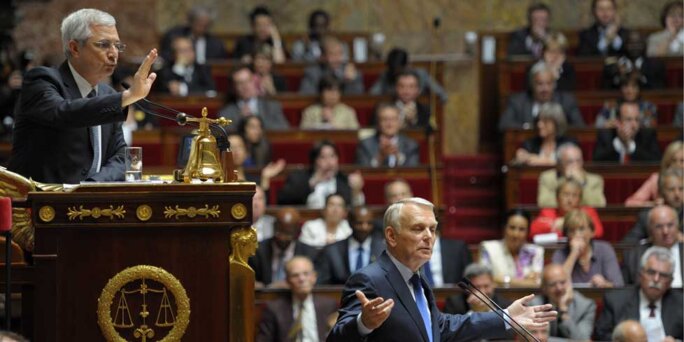
In this context the parliamentary performance of Jean-Marc Ayrault did not rouse the troops. Only once did the government side become enlivened, when he announced that a law banning politicians from holding more than one political office at a time would come before MPs “before the summer”. Its absence from the parliamentary timetable so far has caused considerable dismay on the Left.
The prime minister also stated that French troops would be withdrawn from Mali from the end of April, announced a law on preventing conflicts of interest for people in public office and promised a new law on limiting the pay of bosses in the private sector. This would involve bosses' pay being decided at annual general meetings in front of shareholders rather than in the privacy of the boardroom.
For the rest, Jean-Marc Ayrault laid out the general themes of what the government describes as the “new French model”, whose key words are “recovery” and justice. Expressing his determination to press ahead with reforms and to continue with a rigorous approach to the “great battle for employment”, the prime minister hit back at critics who suggested he and the government had lost their sense of direction. “I know where I am going!” he insisted.
Thierry Mandon, the spokesman for the PS group in the Assembly, said they had hoped for a “prime minister who, with his back against the wall, stands up and changes style”. MPs did not really believe it would happen. “If, one day, being plodding comes into fashion then Jean-Marc [Ayrault] will be very popular,” said socialist MP Philippe Martin from the Gers in south-west France. “Plodding is not pejorative,” the MP insisted. “It means that he does his work, with no grandiloquence, no flights of fancy...”
In any case, after the resignation of Jérôme Cahuzac the prime minister faced an impossible task. “We're no longer audible,” says one socialist MP. “The situation in the country is such that we're losing five-nil. So even if we score a goal, that's won't be enough!” A colleague adds: “We've touched the bottom of the pool. Unless we haven't quite got there yet...”
Meanwhile the MP for the Hérault in the south of France Christian Assaf said: “We need to start capitalising on intermediate victories to support the [longer-term] structural reforms.” He wants to see tough new legislation on politicians not being able to hold more than one office, on so-called “stock exchange redundancies” ('licenciements boursiers' in French) in which staff are laid off simply to cut costs and please shareholders, and on financial abuses.
Not far away, in the salle des Quatre-Colonnes, one MP from another party was already “capitalising” on the current situation. At the start of the Cahuzac affair some in her party had taken sides with the budget minister. But this MP was no longer thinking about that. In front of the cameras, she was now happily denouncing the “scandal” and attacking the “benevolent” attitude of the Right towards Cahuzac. The politician concerned was Marion Maréchal-Le Pen, one of two MPs from the far-right Front National who sits in the National Assembly.
See also:
The French budget minister and his secret Swiss bank account
French budget minister caught on tape discussing his secret Swiss account
Revealed: the man who handles the budget minister's own personal fortune
The budget minister and his Swiss bank account – the unanswered questions
Swiss bank account affair - the budget minister's lies
The French budget minister, the Swiss account and the judicial inertia that begs major reform
French budget minister and Swiss bank account affair: police open investigation
French fiscal authorities query budget minister's tax returns
French budget minister's tape recording about Swiss bank account genuine, say investigators
Swiss bank account investigation forces French budget minister's resignation
-------------------------
English version by Michael Streeter