


In his 2021 book Résister en Corse (To resist in Corsica), French journalist Jean-Michel Verne presented examples of the brazen tactics of intimidation employed by the infamous organised crime gangs on the island, an underworld active in a broad range of sectors, including property development, fraudulently syphoning off EU farming subsidies, gambling and racketeering.
Verne cited the case of the mayor of a village in the eastern plaine orientale region of Corsica, who became the target of intimidation from one mob. He began receiving threatening phone calls, then shotguns fired close to his home, escalating to the killings of his small herd of cows, who were one after the other shot in the head. Another, more anecdotal case involved the owner of a bar in the centre of the island’s capital town, Ajaccio, on the western coast. Three men turned up unannounced one day to deliver one-armed bandit machines in the basement of his establishment, which he would eventually advertise he was leaving with an announcement posted at the entrance to his bar: “Bistro for sale owing to racketeering”.
There are hundreds of day-to-day examples of the sort, far from the postcard image of the picturesque Mediterranean island, a popular tourist destination, and the folkloric, romanticised tales of the criminal clans and their codes of honour. For tens of thousands among Corsica’s population of 355,000, their daily lives are weighed down, Verne writes, “by what should truly be called a ‘mafia-like grip’, along with its corollary, the legendary omerta”.
David Brugioni is a former mayor of the small coastal village of Centuri, situated on Corsica’s northern peninsula, who is now a representative on the island for the French anti-corruption NGO Anticor. “You are discovering the phenomenon with what’s happening in Marseille, but for us here it’s been going on for years,” he told Mediapart. He was referring to the fatal shooting in November in Marseille of Mehdi Kessaci, the younger brother of Amine Kessaci, a high-profile, anti-drugs trafficking activist, in what was reportedly a warning to the latter to end his campaigning.
“The mafia system rots people’s lives here, we’re facing a scourge [but one] that we can treat collectively,” commented Léo Battesti, the co-founder of a collective called, in Corsican dialect, Maffia Nò, a Vita Ié, meaning “No to The Mafia, Yes to Life”.
In Corsica, which is closer to the Italian peninsular than it is to the French mainland, and which was Italian-speaking until its annexation by France in 1769, organised crime gangs are described under the generic term “mafia”, with a small “m”, (as, to a lesser degree, they are also on the mainland). The term is pertinent given that the historic, hillside village fiefdoms of the island’s criminal clans resemble those of Sicily, the Italian island, further south, that is regarded as the cradle of the Mafia (with a capital “M”).
Several Corsican anti-mafia associations joined their forces in an alliance sealed in September. They include the Massimu Susini collective, named after a 36-year-old beach bar manager and active campaigner against the local arrival of drugs traffickers, who was shot dead in 2019. There is also the farmers’ union Via Campagnola, whose leader Pierre Alessandri, well-known for his activism against organised EU subsidies fraud, was fatally shot in the back in March this year, and the environmental protection association U Levante.
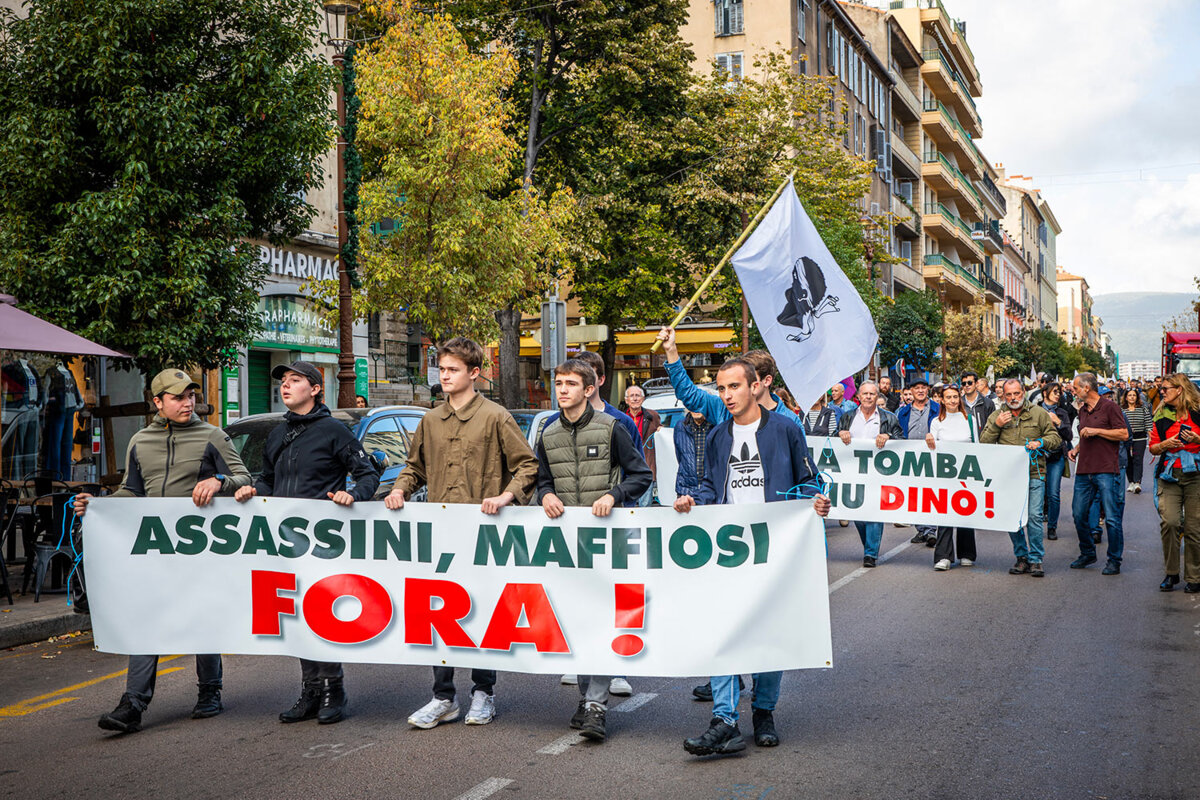
Two months after its creation in September, the anti-mafia alliance organised demonstrations in Ajaccio and Bastia on November 15th to demand “justice and security” in a rare public protest against the criminal gangs. Some local politicians, from across the political divide, joined with the marchers, including Gilles Simeoni, the pro-autonomy chairman of Corsica’s executive council, but others were notably absent.
Enlargement : Illustration 1

If no-one publicly commented on the relatively small turnout given Corsica’s total population of around 355,000 – total turnout, according to the organisers, reached 3,000, while the police estimations was 1,700 – the fact that a probable 2,000 or more people openly joined the protest marches was in itself quite a feat. “It’s a success given the pressures and intimidation,” proclaimed David Brugioni.
“It’s the beginning of the battle, the threads of conscience must be woven,” commented, for his part, Séverin Medori, the pro-autonomy mayor of the eastern coastal village of Linguizzetta. “It will take time, but I’m optimistic.”
Mendori has publicly denounced local connivances in business dealings involving politicians and criminals. He is the mayor cited by Verne, who was targeted by threatening phone calls, menacing visits by a gunman close to his home, and the shooting dead of eight of his cows. He braved the intimidation and filed a formal complaint with police, a rare move. “To speak out was the best defence,” he told Mediapart, while also recognising that “there are sometimes things that one cannot talk about”. A man with known links to organised crime, with convictions for armed robbery and kidnapping, was eventually arrested and, after a court found him guilty of the intimidation, he received a six-month suspended jail sentence.
Mendori, 67, is standing again for the mayorship of Linguizzetta in France’s nationwide municipal elections due in March next year. While heartily involved in the anti-mafia movement, he said he will not be making it an issue in his own election campaign manifesto. “I want to be recognised for what I’ve done as mayor,” he said.
Everyone who was interviewed in preparation for this report, whether they be politicians like Mendori or simply members of the alliance of anti-mafia associations, agreed that while the activities of organised crime impact the daily lives of Corsicans, it would probably not become an issue in the municipal elections.
For Jean-Toussaint Plasenzotti, 66, spokesperson for the Massimu Susini collective (Susini was his nephew), “the anti-mafia [movement] won’t at all weigh on the municipal elections, for several reasons. The most important of these is that it [the movement] hasn’t got the means, and therefore the will. Anti-mafia is an idea that cuts across Corsican society without any party political considerations.”
“We don’t want to intervene on the political stage because we don’t want to choose between the ones or the others,” said Dominique Yvon, a founding member of a civil rights association, the Plateforme citoyenne de Corse (Corsican Citizens’ Platform), that is part of the anti-mafia alliance.
Meanwhile, Léo Battesti, from the Maffia Nò, a Vita Ié collective, said he cannot imagine many politicians who would “make the anti-mafia battle a campaign subject”. A former leader of the separatist, paramilitary Corsica National Liberation Front (FLNC), he said of the political candidates in the elections: “They’re caught up in a system where everything is distorted. To isolate oneself is dangerous.”
However, the associations are pleased with the progress made in the Corsican Assembly, the regional parliament which has administrative powers. These include a unanimous vote in February 2025 for making the combat against organised crime “a priority for public action”, and the creation in October of an anti-mafia commission largely made up of members of the Assembly and representatives from civil society, including the collectives within the anti-mafia alliance.
Gilles Simeoni, 58, the pro-autonomy chairman of Corsica’s executive council, also praised the moves. “It’s a unique initiative in Europe,” he told Mediapart, underlining his “political, institutional and personal commitment” towards what he called a “powerful societal issue”.
“There are multiple forms of daily pressure,” he told Mediapart. “The mafiosi activities are dangerous for the functioning of society. One perceives a strong concern, people ask for guaranties, perspectives, and that must be answered.”

Enlargement : Illustration 2

Simeoni, who is standing for the office of mayor of Bastia for a second time (his first, brief term was between 2014-2016), also does not see the anti-mafia cause high on the election agenda. “It will obviously be mentioned with the questions of transparency, the regulations on public contract tenders, and urbanism, but I don’t thing it constitutes a programme in itself.”
Laurent Marcangeli, a former minister and ex-mayor of Ajaccio, now a Member of Parliament for France’s centre-right Horizons party, agreed. “Each programme will mention transparency in public contracts, but it won’t go further than that.”
Dominique Yvon, from the Plateforme citoyenne de Corse, said it was “absolutely impossible that a candidate makes a priority of the anti-mafia struggle”, adding that “We have not taken measure of the mithridatism of society with regard to the mafia system”. But he was encouraged that some politicians joined in the marches organised on November 15th, unlike their total absence from similar demonstrations held in March. “That gives us comfort surrounding our action, they’ve come along part of the distance,” he said.
“The collectives have come about from a salutary citizens’ reaction,” added Simeoni. “There can be disagreements, but it’s necessary to know how to get beyond them.”
Alexandre Farina is the current principal deputy mayor of Ajaccio. He was critical of the anti-mafia collectives when justifying his absence from the demonstration in the town on November 15th. “The combat [of the] collectives is a noble one, legitimate and respectable […] It’s the cantankerous and suspicious talk they have chosen which displeases me,” he told a local media outlet. “I have detested this Manichean talk aimed at pouring guilt on politicians who are supposedly accomplices in collusion with a supposed mafia.”
That produced an angry response from Jean-Toussaint Plasenzotti. “Seventeen elected politicians assassinated over the past 20 years, 12 heads of companies assassinated over the past ten years, hundreds of people assassinated, for most of whom justice was not served,” he said in an interview with Corse Net Infos. “We are right to be a little bit suspicious, because we see a long wayward drift in Corsican society. Mr Farina doesn’t appear to be aware of this. Worse still, he attacks those who denounce it.”
Most of those in Corsica holding elected positions of authority who Mediapart questioned displayed irritation at allegations of corruption. “To say there is not one elected representative who hasn’t suffered from pressure from the mafia is very exaggerated,” said Pierre Savelli, the pro-autonomy mayor of Bastia, the island’s second largest town. “That question in no way weighs on our manner of functioning. To awaken consciences is a good thing, but then you have to apply nuance to things, above all in Corsica.”
The collectives regard such statements as a means of discrediting their action.
Despite that context, Léo Battesti, co-founder of the Maffia Nò, a Vita Ié collective, remains optimist, underling that in Corsica, “99 percent of people aren’t thugs”.
“What we have succeeded in doing with the anti-mafia initiative is a revolution,” he argued. “Our aim now is to heighten awareness among the greatest number, including the mayors. Many tell me off the record that they were for a long time paralysed [by fear]. But the citizens’ approach proves to them that they are no longer alone.”
-------------------------
- The original French version of this article can be found here.
English version by Graham Tearse