


France "may have entered a short, shallow recession", announced the Organization for Economic Cooperation and Development on Monday, the same day when the latest official French unemployment figures were also released revealing the total number of jobless of all categories had reached 4.8 million for the first time since 1999. Mediapart co-founder Laurent Mauduit argues here that this sad state of affairs is the result of economic policies that feed speculation rather than fight it, part of a vicious circle that sees the multiplication of austerity measures that are strangling the economy, worsening rather than improving public deficits, and which have already created an exceptional level of social misery.
-------------------------
A trap is closing in on France, as upon a number of its neighbours. Because European nations continue to refuse to take the least measure to halt speculation, speculators continue to run riot, bringing one country after another to its knees.
Each time, it is the same vicious circle; speculation increases the cost of re-financing the national debt; which increases the debt itself; which leads to fresh austerity measures, and which in turn increases the deficits. So it is, and continues to be, all the way to a final triumph of the markets and the asphyxia of those countries they have targeted.
France is the latest country to be subjected to this bitter process, as illustrated by all the available economic and social indicators. Regarding growth, statistics published on Monday by the Organization for Economic Cooperation and Development, the OECD, economic activity in France is undergoing a sharp slowdown, to the extent that, suggests the OECD, the country "may have entered a short, shallow recession".
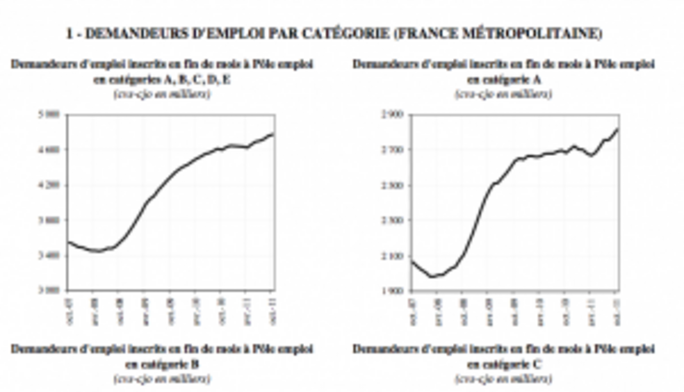
Also on Monday, the French government released the latest unemployment figures, which showed that 34, 400 more people became jobless in October alone, pushing the total number of job-seekers to 2.814 million - a level never seen since December 1999.
In just a few weeks, the effects of the debt crisis sweeping across all of Europe - flattening Greece and then threatening Italy and now France and Germany - have turned the entire French economic environment upside down.
Right up until the end of this summer, President Nicolas Sarkozy continued to suggest that France was sheltered from the turbulence of the crisis and that, by introducing a few budgetary cuts, it would never lose its coveted Triple-A credit rating.
While constantly minimising the dangers, the government prepared its 2012 public finances bill on a totally unrealistic basis, notably a projected growth rate of 1.75%. What happened next is history: in early November the finance ministry was forced to admit that the forecast was far too optimistic, then reducing it to a projected 1% in 2012. In the wake of this, the government had to take corrective measures and, on November 7th, a second austerity plan was announced. This came just two and a half months after the first, presented on August 24th, and centred on reining in 18.6 billion euros through unpopular measures like tax increases and an acceleration in the pension reform calendar.
Under this new plan, the government's aim was to guarantee its undertaking to reduce the public deficit to 4.5% of Gross Domestic Product (GDP) in 2012, to 3% of GDP in 2013 and to zero by 2016.
This is the very essence of the vicious circle. This second austerity plan had not even been put into practice before the OECD announced that even the downwardly revised economic growth rate of 1% was inaccurate. Indeed, the same conclusion is reached by most of the institutions that monitor economic activity.
See Scribd box below for the OECD Economic Outlook editorial and summary, released 28/11/2011, and click here for the full report and country summaries.
OECD sees French unemployment at 10.4% in 2012
This was bad news for Nicolas Sarkozy, for the OECD said aloud what everyone knew. If France is to continue to follow this same path of economic policy, it will be forced into continually announcing new cuts, and which each time will further weigh down economic activity.
Concretely, the OECD experts foresee growth in the French economy in 2012 limited to 0.3%, far less than the government's forecast of 1%. They even used the dreaded R-word, recession. "Given the sharp slowdown triggered by unresolved European sovereign-debt problems, France may have entered a short, shallow recession," reads the introduction to the experts' report, published this Monday.
The OECD highlights the vicious circle in which France has begun to spin. It noted that the strong exposure of French banks to the current financial crisis was a source of growing uncertainty, and had contributed to an increase in the gap of borrowing rates on French and German government bonds. This spread on 10-year bonds has jumped over recent months, from around 40 basis points at the end of June, rising to 80 basis points at the beginning of October, and now sitting at 150 basis points - after hitting just more than 200 points earlier this month.
"With the contagion having spread to France, higher borrowing costs will affect the whole economy," the OECD warned. While they did not bring into question the French government's engagements to reduce the public deficit, the OECD forecasts that it will be forced to enforce supplementary savings measures worth 0.4% of GDP - about 8 billion euros - to maintain deficit targets.
Along with this brutal degradation of the French economic environment is a predicted leap in the unemployment rate, which the OECD forecast could reach the historic peak of 10.4% by the end of 2012. The latest jobless figures released Monday by the French government employment agency, Pôle emploi, confirm France's probable slip into recession.
The Pôle emploi figures (in French only):
A vicious circle spinning social misery
Taking into account only those who make up what Pôle emploi describes as ‘Category A', (which excludes even those who have even a minimal working activity), there were 34,400 people who joined the jobless list in October, representing an immediate rise of 1.2% and a year-on-year increase of 4.9%.
If one takes into account all the categories of the unemployed (A,B,C,D and E), the total numbers of jobless now amount to 4,775,400, representing a year-on-year rise of 3.9%. It must be noted that this figure concerns mainland France only, to the exclusion of French overseas territories, and does therefore not represent the real figure of all the jobless of France.
It should also be clearly understood that these indicators offer but a small picture of the social suffering that the slowdown in the economy is causing. For misery is gaining ground, in equal measure. According to the latest figures released by the French national statistics and economic studies institute, l'Insée, there were 8.2 million people living below the poverty line in France in 2010. This figure will inevitably see a strong rise for 2011, as so many associations involved in supporting those in need predict. The charity Les Restos du cœur, a long-established association that provides mobile canteens for the needy across France, have estimated they will need 15% more resources this winter than last to cope with demand.
All of these figures follow the same pattern. By refusing to take the necessary measures to limit and reduce market speculation, every government finds itself caught in the same trap. Will France, which is now into its second austerity programme, but which still cannot respect its deficit reduction engagements, be forced to introduce a third austerity plan?
This spiral could be called the Laval spiral, after Pierre Laval, President of the Council of Ministers of the French Third Republic and later a wartime collaborator, who's government in 1935 introduced deflationist policies which, already back then, were imposed for the cause of a return to budgetary equilibrium. There are common points between Laval's approach and the recessive policies imposed today by Nicolas Sarkozy.
The saddest, most pathetic thing about the course of current French economic policies is that the worst outcome is the most likely. Will the country reach a point where the number of unemployed will hit the five million mark? It is certainly heading there.
-------------------------
Laurent Mauduit is one of Mediapart's specialist writers on economics, finance and social affairs. Previously economics editor of French daily Libération, and a senior economics journalist and editorialist with Le Monde, he is a co-founder of Mediapart.
-------------------------
English version: Graham Tearse