


Widowed, and a mother of ten, Mama Zola sits behind her crate of “made in Angola” beer. She is the doyenne of the Kinshasa port street traders and has worked the same spot since 1989. In those days, she recalls, there would be ships arriving every day: merchandise coming from Angola, or even farther afield, via the ports of Matadi and Boma, then on by train before being loaded on to the boat for Brazzaville, on the opposite side of the river.
It’s easy to believe. One of the biggest rivers in the world, the Congo links southern-hemisphere Africa to the Atlantic, forms a border with the Republic of the Congo (formerly French Congo) as well as Angola, and runs through urban areas where some 12 million inhabitants in total reside.
The Belgians, the country’s colonial masters, used it to transport rubber, then former president Joseph-Désiré Mobutu made use of its deep waters to ship minerals. The Congo could feasibly supply the whole of central Africa with water and energy. “The river will be the source of our prosperity,” boasts an old sign on the quayside. Back then, of course, both the river and the country were called Zaïre. The river was renamed in 1997 at the same time as the country became the Democratic Republic of the Congo (DRC).

Enlargement : Illustration 1
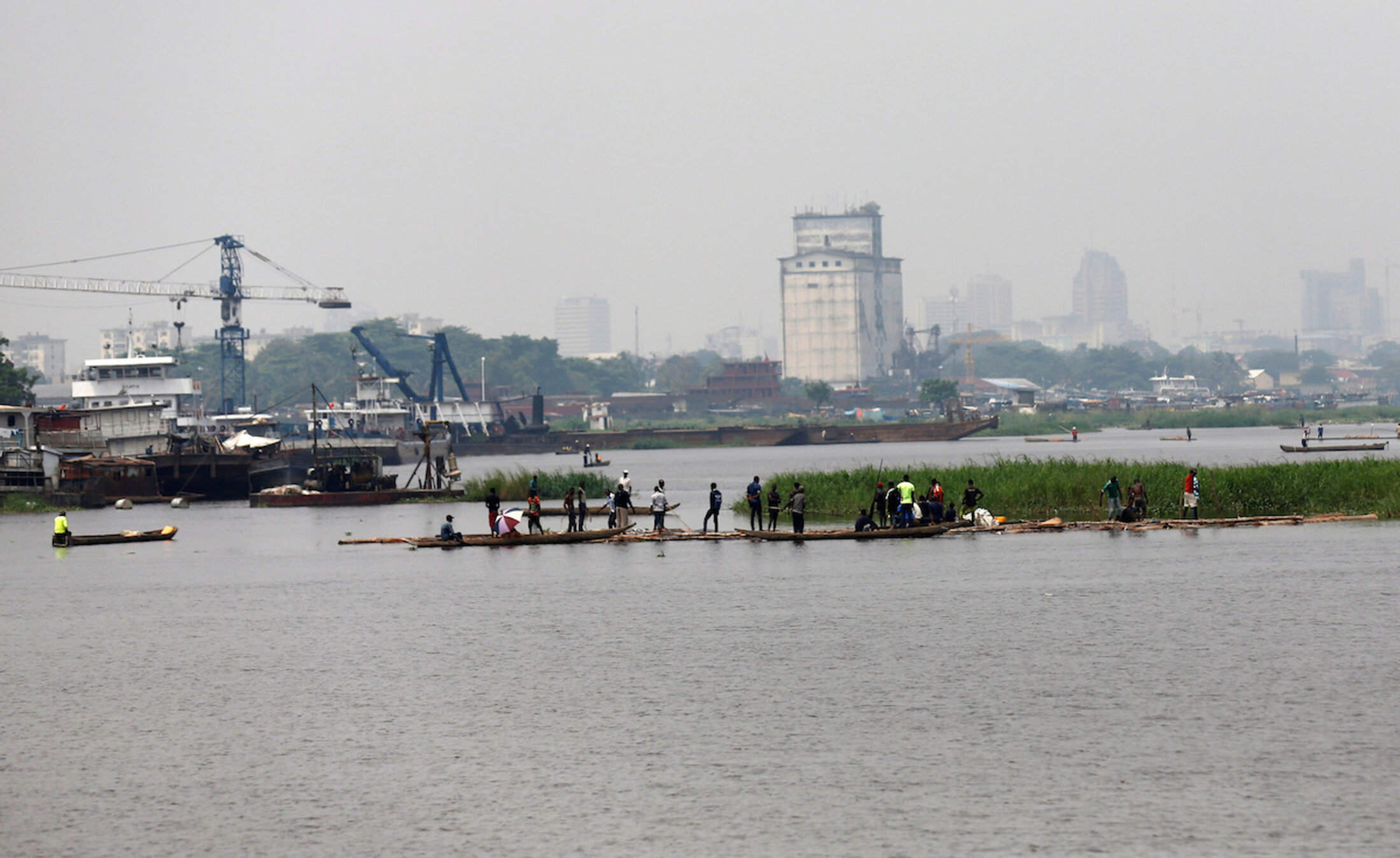
Who knows what plans former president Laurent-Désiré Kabila, assassinated in 2001, had for the river, or indeed his son Joseph who succeeded him and who is still president? For now, however, only an old policeman comes to buy Mama Zola’s beer and she is lucky to see three boats a week. The railway is overgrown and large parts of Kinshasa do not even have clean water or electricity. The old sign, now rusty, flaps on its nail like a broken promise.
Kinshasa has turned its back on its river – you can go for weeks without really noticing it. Even when you search it out, all you find is a stretch of sluggish green water meandering past barren islands. If you hang around for a bit you might see a couple of fishermen in their dugout canoes but the “river fish” on sale in Kinshasa are more likely to be frozen and imported. On the quayside, boys dripping with sweat unload sacks of rice which are taken by lorry straight to the central market. Outside a downbeat café, three women sell printed “African cotton” - made in Thailand. And that’s it.
“The Congo is both under and over-exploited,” says economist Tom De Herdt, specialist in central Africa at Antwerp University. “Under-exploited as a transport hub, as a tourist destination and as a natural reserve, as well as a source of water and energy. But over-exploited in terms of over-fishing so that reproduction levels are falling.”
Warehouses belonging to the Chinese, Indian and Lebanese traders who supply the city’s grocery and hardware shops by air, are packed to the gills. In contrast, state-controlled Las Port, run by the Congo Association of Transports and Ports (SCTP), is a ghost port where everything is rusting away: broken down cranes, abandoned containers, wrecks of old steamers crumbling into the water, their decks, bridges, chimneys and gangways giving the Congo a whiff of the Mississippi.
The amount of merchandise arriving or transiting Las continues to fall. Official commercial tonnage, which the state taxes at 16%, fell from 202,399 in 2014 to 173,549 in 2015. Freight has also dropped. “The under-exploitation reflects the general problem of governance in the DRC,” says De Herdt. “One of the obstacles to maximising potential is that there is no consensus on how to distribute the returns. Contrary to mining returns, 'river returns' require significant investment which is out of the question under the current set-up.”
Today is pay day. Well into December, SCTP employees are about to get their September salaries. Some of them have been demonstrating outside company headquarters, a huge colonial-era edifice which is still referred to as the “ex-Onatra Tower” after the National Transport Office set up by Mobutu in 1971 to replace the previous Colonial Transport Office. (It was then renamed the Congo Transports Office after independence.) The company’s pensioners are also waiting for their money which is up to eighteen months late in some cases, prompting the dismissal of SCTP director Kimbembe Mazunga, a presidential appointee and former governor of Kinshasa.
Anyone trying to visit the “ex-Onatra” and the port is constantly rebuffed. “The buildings are unsafe,” a deputy director finally sighed. “It’s getting harder and harder to bring goods in – by road, train or boat. Once upon a time Kinshasa was a gateway to Africa, now everything goes by Dar es Salaam in Tanzania.”
A Bolloré Transport & Logistics calendar hangs on his office wall. Already handling a large slice of freight in the DRC, this French industrial giant, owned by billionaire Vincent Bolloré's group and which has bought up all the dry ports along the west African coast, is eyeing up deals with Matadi, Boma and Kinshasa. “The DRC is primarily a global economy, relying more on economic powerhouses such as the United States, Europe and China than its neighbours,” says De Herdt. “Still, a more 'African' growth would certainly be a possibility if, among other things, the Congo was exploited properly.”
Daily protection rackets
In October, however, the SCTP’s general assembly roundly rejected government plans for privatisation. “Bolloré are just adventurers, we’ll hold out!” says a port official. His colleagues, massing around the entrance to the port, form a crowd of black berets and mustard-yellow uniforms. To get past them, you need the correct documents and an infinite supply of patience. Their technique for deterring visitors is impressive: each office tells you to go to another office and that office sends you back to the first one. Plus, you need to apply in writing to the director - who hasn’t been replaced yet - and, most importantly, you need to offer a little something to each of the seven state security organisations represented at the port. An enormous man with a gold watch and bracelet, who introduces himself as “Max, customs officer”, runs an invisible check point from his plastic chair.
Members of the presidential guard, recognisable by their plum-coloured berets, pour onto the quayside. The presidential residence is not far away. They are also guarding the M.S. Gungu, a luxury yacht recently refurbished after fifteen years of neglect. “Let’s board, we can do the checks later!” shouts a soldier in Swahili. Police approach. “Everything’s in order,” interjects a plain clothes man, showing his ID card from the National Intelligence Agency (ANR) - a rival to military intelligence.
“Each service in this port is terrified of the others,” he explains later in his office. “Every border has its problems, there’s always corruption, especially when there are delayed payments. But 'difficulties' - never.”
“Difficulties” – tracasseries in French – is one of Congo’s many euphemisms for the daily rackets run by security agents and their allies. More prevalent than anywhere in a port, where transiting merchandise can easily be “taxed”, these “difficulties” are destroying trade, exasperating the population and contributing to the collapse of the state. Sacks of rice are piled up in the ANR office. “They didn’t pay their taxes,” shrugs the official.
Some traders, however, have found a way round official taxes and racketeering. Kinshasa’s port is full of the handicapped propelling their wheelchairs back and forth. Exempt from paying tax at the full rate, they are employed to unload cargo. When there’s a boat.
Further east along the quay is Ngobila Beach, the passenger port. To cross from here to Brazzaville, just a few minutes over the water, you have to pay around fifty dollars for a “quick canoe”. Since Brazzaville expelled all DRC citizens in 2014, the popular daily ferry has been suspended. Today, even though the DRC depends on it neighbour for oil, trading between the two Congos has virtually ground to a halt. Officially, that is.
In fact it happens at night, via more discreet tributaries which are nevertheless subject to controls. A small-time trader who has lived in Brazzaville for the past 14 years admits “it’s not legal, but it goes on”. Despite the ferry being out of action, he still sells groceries from the DRC in Brazzaville – the Brazzaville franc being worth a great deal more than the plummeting DRC franc. He, too, is subject to the daily protection rackets. “As well as paying the boatman, you have to grease the palm of all the security officials you meet and you never know how many there are going to be…”.
Kinshasa’s second trading port is in the village of Kinkole which is some distance from the capital and therefore not run by the ex-Onatra. It’s a huge marketplace where a busy crowd bustles about to the rumblings of generators and in a cloud of cassava flour - the principal product traded here. Workers mill the flour under the watchful eyes of the Directorate for Migration (DGM), yet another security agency apparently essential to the DRC. It is almost impossible to move without one of their agents sidling up behind you.
A dozen or so whaleboats - the long boats that navigate the Congo - are pulled up on the riverbank. Laden with cassava flour, the vessel L'Arche de Noé ('Noah's Ark') has just make the seven-hour journey from Bandundu province, driven by a 22 horsepower Chinese motor according to skipper Ntaro Ntama as he climbs down from his cabin, fake Ray-Bans perched on the end of his nose. On the return journey he will be carrying soap, clothes, sandals – anything you can’t get hold of in the DRC hinterlands. “Business is OK,” he says, “although it could be better. The country’s in decline. People are jealous of me because I make a buck or two.” For each trip he makes, Ntama pays 65 dollars (about 61 euros) for his travel permit and a further 30 dollars to the crew. On top of that there are the inevitable bribes to the naval authorities who swarm the river.
Kinkole Port attracts anyone who wants to do a bit of trading on the side or just has something to sell. None of this appears in official statistics. In amongst the crowd, Jean-Darius sells his phone to a man who works in cassava flour mills. He gets 6,000 francs - around 5 euros - for it. “It means I’ll eat tonight,” he says. Jean-Darius is 51 – the average life expectancy in the DRC.
The river has burst its banks and the village is flooded. At a “checkpoint” made from a dugout canoe a child asks for a 100 franc “tax” - no-one knows who it will be passed on to. Behind him, on a strip of dry land strewn with rubbish and banana leaves, a group of men are building whaleboats that will be good for ten years’ use. “Everyone finds a way of just getting by,” says a man sitting under a mango tree, trying to sell bread rolls which nobody seems to want to buy. He came here with his brother, a machinist, from Equateur province, hoping to make a living trading on the river, he explains. They’re thinking of returning home.
Back at the port in Kinshasa, the only people along the quayside are three women selling charcoal, laid out on a blanket in front of them. They have come from Kisangani, the last navigable point on the Congo. They got here two months ago and the journey itself took a month. “There’s no work, neither in Kisangani nor here,” says one. So what are they going to do? They’re waiting for the boat to come back on its return journey. They’ve no idea when that will be.
-------------------------------------------------------------------------
- The French version of this article can be found here.
English version by Michael Streeter