


True to past form, the European Parliament was up in arms when the so-called “Selmayrgate” scandal broke in February, before a majority finally chose to step back from the brink in order to save the European Union’s institutions from a political crisis that threatened to further weaken the Brussels edifice.
On Wednesday this week, the members of the European Parliament (MEPs) voted to approve a motion which plainly condemns the promotion in highly questionable conditions of Martin Selmayr, longstanding aide to European Commission president Jean-Claude Juncker, to the post of secretary-general of the commission, effectively making the 47-year-old German lawyer and conservative the EU’s top civil servant at the head of about 32,000 staff. But the MEPs held back from voting for Selmayr’s resignation.
In February, Juncker reportedly gathered together other commission members to approve Selmayr’s appointment within the space of just a few minutes, and without having notified them beforehand. The procedure during the February 21st meeting involved what may be the fastest promotion of a senior EU civil servant, first making the German deputy to the outgoing secretary-general, Dutchman Alexander Italianer, and just as promptly promoting him to secretary-general, with effect from March 1st.
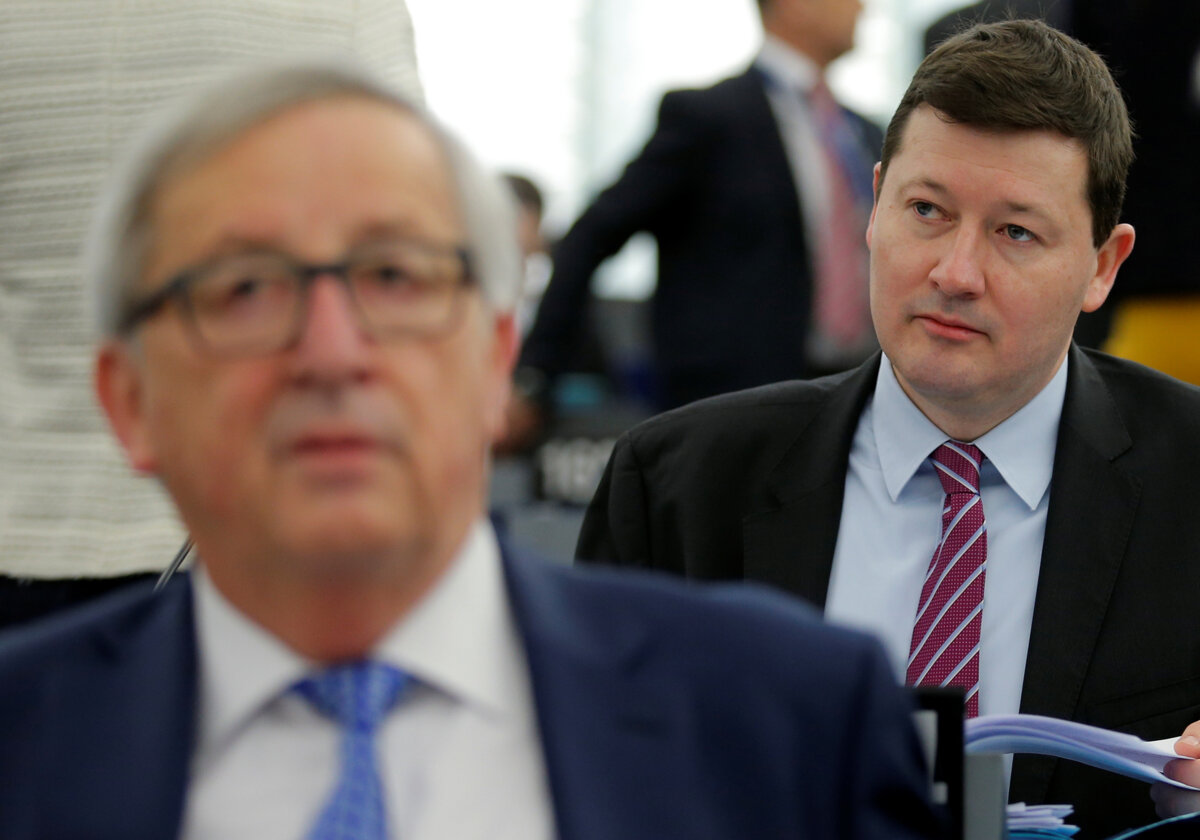
Enlargement : Illustration 1
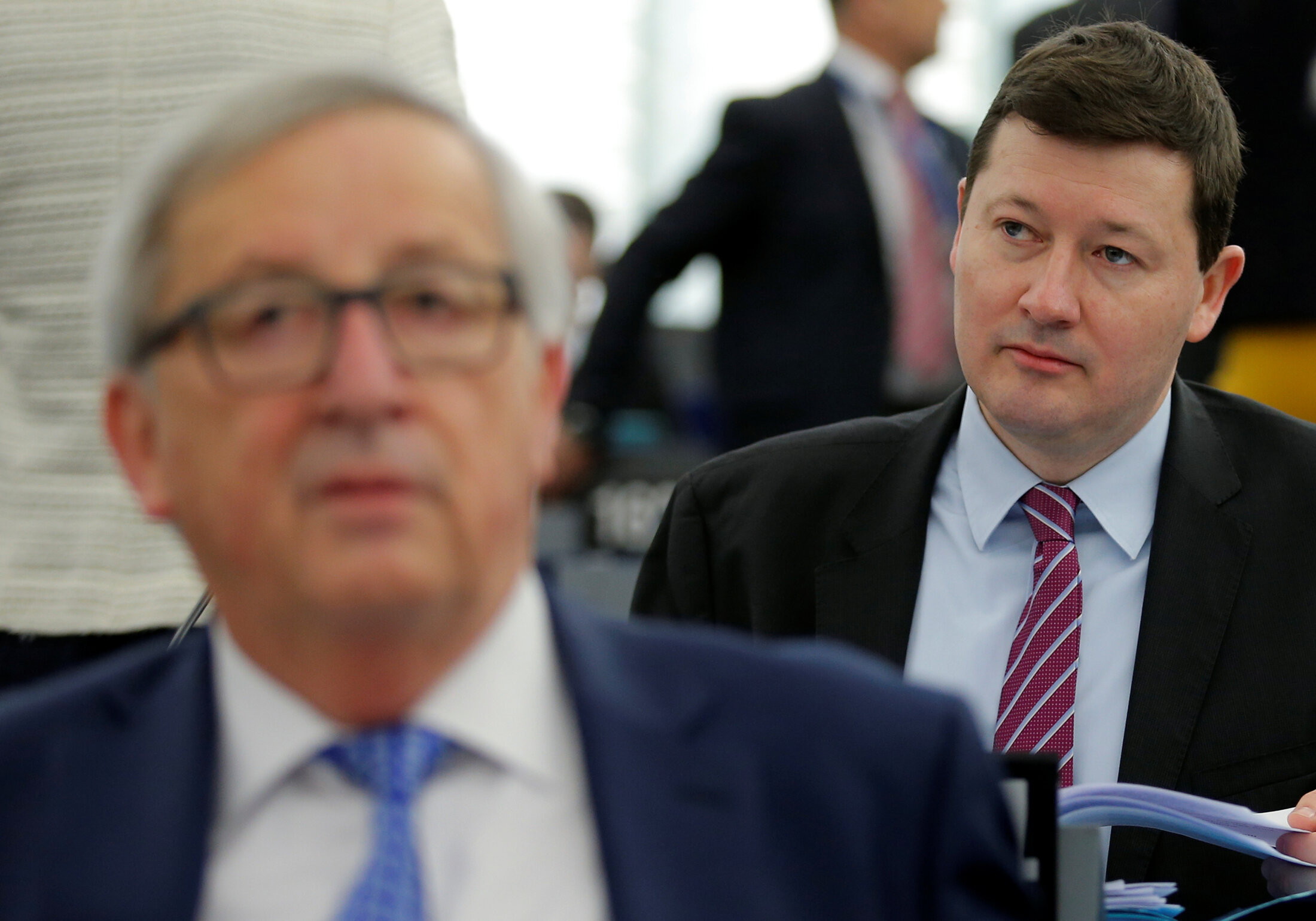
The European Commission has insisted that the appointment was made in accordance with all required officially required procedure.
The text of the European Parliament motion, which was adopted by an overwhelming majority of MEPs, denounced the conditions of Selmayr’s appointment, which it said "could be viewed as a coup-like action which stretched and possibly even overstretched the limits of the law". The MEPs called on the commission to "reassess" the procedure employed in Selmayr’s promotion "in order to give other civil servants the possibility to apply", and to put an end to such practices across the EU’s institutions.
Unsurprisingly, the conservative European People’s Party (EEP) group, which is Juncker’s political camp, voted against the motion, but so did also a large number of the socialist group, the Progressive Alliance of Socialists and Democrats (S&D).
But the majority rejected an amendment to the motion tabled jointly by the Greens and the European United Left–Nordic Green Left far-left (GUE/NGL) groups calling for Selmayr’s immediate resignation “until the reassessment of the appointment procedure has been completed”.
After the vote, one of the leading conservative figures in the Strasbourg-based parliament, Françoise Grossetête of France’s Les Républicains party, commented that “it would not have been responsible in the current climate” to demand that Selmayr to step down. “It is wise not to light fires that we would no longer know how to put out,” she said.
But a French Green MEP, Pascal Durand, argued not only that Selmayr should go, but had also unsuccessfully called, along with a number of other leftwing MEPs, for parliament’s validation of the European Commission’s budget to be postponed as a retaliatory move. “The European Commission should have the decency to cancel this nomination and re-open [applications for] the post of secretary-general.
In 2014, following European Parliament elections May that year when the conservative EPP party emerged as the largest group, Juncker, a former prime minister of Luxembourg, ran for the post of commission president, appointing Selmayr as his campaign director. After he was appointed as commission president in November 2014, Juncker made Selmayr his chief of staff (Head of Cabinet), and was soon regarded as one of the commission’s most influential figures, nicknamed by some in Brussels as “Rasputin”.
What some are calling Selmayrgate has raised further questions over secret manoeuvring within the corridors of Brussels, about the extent of a perceived German-leaning political network within the EU, and also in parallel the political shaping of the union’s administration. Only adding to such speculation, Juncker in March reportedly told senior members of his EPP party, who he felt offered Selmayr insufficient support amid the growing scandal, that “if he goes I go”.
Following the European Parliament vote on Wednesday, Günther Oettinger, the commissioner for budget and human resources issued a statement on behalf of the entire commission saying it stood firmly behind Selmayr, whose appointment “cannot be revoked and we will not do so”.
“When appointing its new secretary-general, the commission has followed all the rules both in spirit and to the letter, as laid down in the staff regulations that apply to all institutions,” said Oettinger, who already last month steadfastly refused to accept any criticism of the appointment when he appeared before MEPs in session in Strasbourg. That prompted Dutch socialist MEP Dennis de Jong to comment that, “The commission, arrogant, is burying its head in the sand”.
The commission’s only concession, detailed by Oettinger in his statement on Monday, is “to reassess, together with Parliament and the other Institutions, how the application of the current rules and procedures can be improved in the future” adding that he proposes “to organise an inter-institutional round table as soon as possible” to that effect.
Meanwhile, during the debates on Wednesday, MEPs refused to adopt an amendment proposed by Bulgarian and Spanish socialist members amongst them which called for parliament to re-examine the conditions in which a number of its own senior civil servants obtained recent promotions. The questionable circumstances in which the nine were given their new top posts was revealed by Politico on March 29th.
The Selmayr scandal has been devastating for the public image of Juncker and his commission, which has appeared to have walled itself in behind a shield of untruths since the appointment was revealed in February. While it will be hoping that the vote on Wednesday will put an end to the controversy, its intransigence since – which some of the outraged MEPs regard more as contempt – may well serve to prolong the test of strength. Emily O’Reilly, the European Ombudsman, a position she was elected to by the parliament, has announced she has launched an enquiry into the conditions of Selmayr’s promotion, and which is due to be completed before next year’s European elections.
-------------------------
- The French version of this article can be found here.
English version by Graham Tearse