


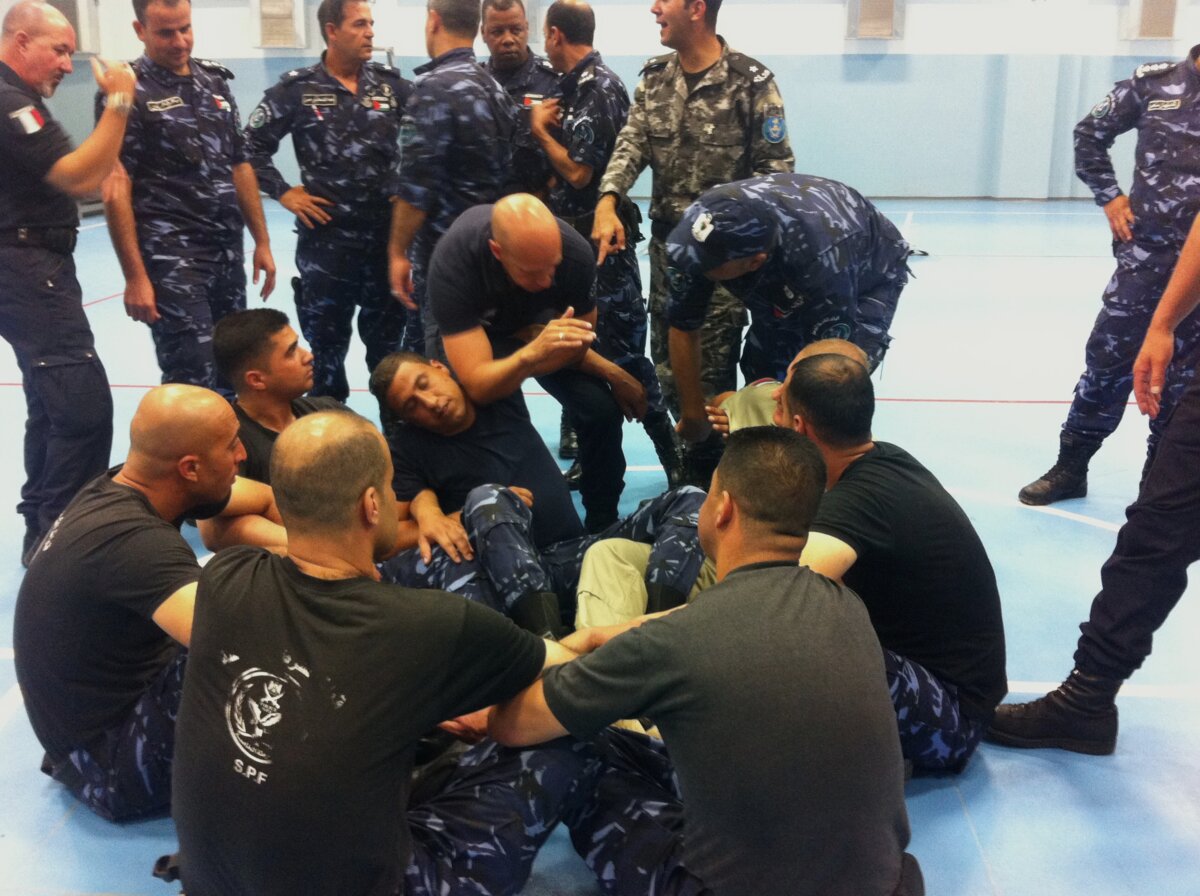
“Your work must serve to defuse the situation, no tear gas, no truncheons,” said Philippe Le Marre, a member of the French CRS crowd control police, addressing an audience of Palestinian police officers in the gym of their police academy in the West Bank city of Jericho. “The best weapon that you have is your brain,” he added.
Listening to him were 25 officers of the Palestinian police’s Special Forces who have come from different districts of the West Bank and who will subsequently impart to other colleagues what they have learned from that day’s lesson on how to disperse a peaceful sit-in.
“If you stick your knee into the back of a demonstrator, if you hurt him, he’s going to immediately become violent,” advised another CRS officer, Emmanuel Merlin.
Unlike Brittany-based Le Marre, who was in the West Bank for only a few days as part of a bilateral cooperation agreement, Merlin was there for several months as part of the European Union police mission for the Palestinian Territories, called EUPOL COPPS (EU Co-ordinating Office for Palestinian Police Support), whose local headquarters is based in Ramallah. Launched in 2006, the EU programme is aimed at building an effective police force for a future Palestinian state. It provides diverse training, from self-defence courses to English-language lessons, to methods of tackling corruption.
Enlargement : Illustration 1
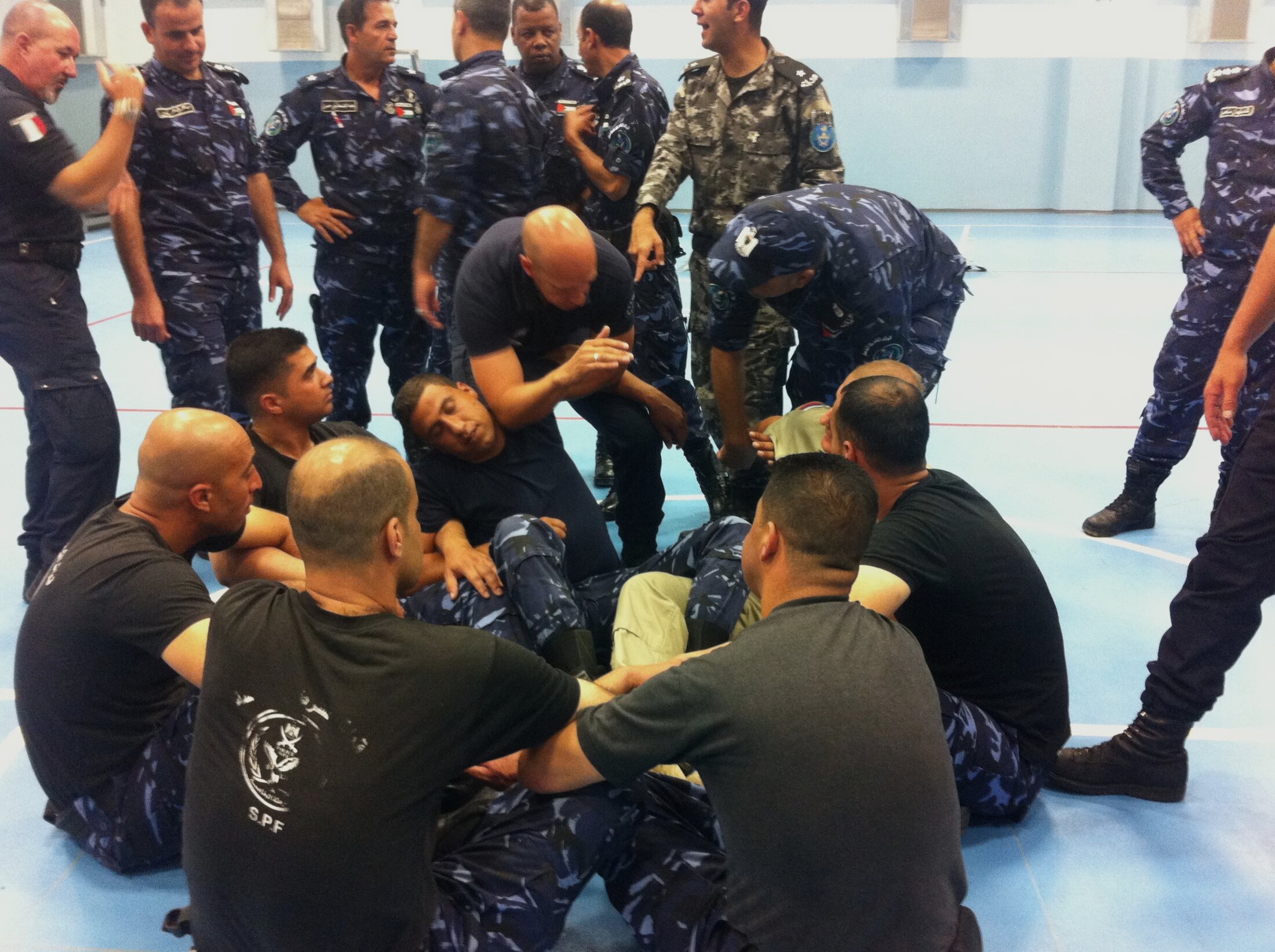
Until now, 8,500 Palestinian police officers have received training under the programme, to which 23 member states contribute, as illustrated by the presence of Slovenian and Italian police in Jericho. Many of these specialised instructors have previously been engaged in Afghanistan, Bosnia or Kosovo as part of EU projects to help with the transformation towards democratic institutions.
The EUPOL COPPS mission has an annual budget of almost 9 million euros, most of which is spent on funding infrastructures. The Jericho police academy is situated in the desert, at the foot of the Mount of Temptation close to the Dead Sea. The academy, with a mock-up of a police station, a vast gymnasium, and a shooting simulator, is a modern construction entirely financed by the EU. The EUPOL COPPS programme also helps fund the modernization of Palestinian police stations, such as the recent creation of interrogation rooms adapted for the questioning of minors, allowing a psychologist and parents to assist.
The Palestinian police was created in 1994 following the Oslo 1 Accord signed between Israel and Palestine. Originally steeped in a military culture, it has since “considerably improved in professionalism and maturity” according to Rodolphe Mauguet, the French head of the EUPOL COPPS mission.
“You know, our police force is still young,” commented police colonel Zaher Sabbah, the Palestinian director of the academy. “And criminals are always one step ahead. So it is important that we continue to be trained.” The recruitment and training of the police represents a rare opportunity for jobless Palestinians. “When I was a child, with the occupation, we never thought that one day a Palestinian authority would control the area,” said major Khalid Arar, the academy’s pedagogic coordinator, who was raised in a refugee camp in Bethlehem. “Most Palestinians don’t join the police because they like the [Palestinian] Authority, but because of unemployment.”
“When we open up 500 jobs, more than 50,000 Palestinians are candidates,” said lieutenant-colonel Ismaël Hanaysheh, who is in charge of the training of the Palestinian police’s Special Forces. “But we become a policeman above all because we want to serve our people,” he adds. “When we walk around the town, children ask for selfies, they respect us.”
But the real results are less flattering. The biggest problem is the dire lack of equipment. Stéphane Vidal is a French police officer in charge of the academy’s firearms training branch. “It’s not rare that an officer has shot only about 20 real bullets in the course of his career,” he said. “Bullets that were perhaps around since ten years ago.” Both the Israeli authorities and EUPOL COPPS own regulations prohibit the importation of live arms for the academy, which is why Vidal uses a simulator for firearms training. When Mediapart visited the academy the simulator was broken, and the repair work would have to wait for the arrival of spare parts from Germany, notably Kalashnikov breeches and small bottles of compressed air.
The logistical 'nightmare' created by Oslo Accords
The importation of equipment into the West Bank is complicated, even concerning the chemicals used to study a crime scene. “Even for the [replica firearms] blue guns, we have difficulty in getting them across check-points,” said Vidal, who was expecting the arrival of spare parts for the simulator to take several months. “The COGAT makes us sweat,” he added, referring to the Israeli defence ministry body that coordinates the application of Israeli policies in the Palestinian Territories.
“COGAT is not engaged in systematic obstruction, but they are pernickety,” said the EU mission’s head, Rodolphe Mauget. “They want to be sure that the equipment will not be used for more than one purpose.”
Another problem is that since the Oslo Accords, finalised and signed in 1995, Palestinian police officers are allowed to intervene in what is known as “Area A” – made up of the principle towns including Jericho, Ramallah and Bethlehem – and “Area B” – comprised of villages and refugee camps, which in all represent only 40% of the surface area of the West Bank. The two areas have a solely Palestinian population of about 2.8 million people. The remaining “Area C” which contains both Palestinians and Israeli settlers, is controlled by Israel, and Palestinian police are rquired to apply for authorisation to cross it when travelling between areas A and B.
“The Palestinian police officers are motivated, they want to show that they are professional,” said Emmanuel Merlin, the French CRS crowd control police officer serving with the mission. “But in practice, they are limited. If they chase a criminal into an urban area, or even if they are transporting a road accident victim, they sometimes have to wait five hours to receive authorization to cross a check point. It’s humiliating for them.”
Mission leader Mauget agreed: “It completely impedes the continuity of police intervention. The negotiators who put together the Oslo Accords were certainly unaware that these ‘areas’ would constitute a logistical nightmare, even for the Israelis.”
What are bureaucratic delays for some, and which are deliberate administrative obstacles for others, result in a daily reality that saps the Palestinian police’s effectiveness. “When a football match in Ramallah gets out of hand, the town’s police force has to apply for authorisation and wait for it to be accepted in the hope of seeing a unit of reinforcements from Nablus, for example,” said Mauget. This recurrent problem of required authorisation to move between ‘areas’ is not only detrimental for law and order missions, it also affects the justice system. “The delays are sometimes so long that some prisoners don’t arrive on time for their trials,” added Mauget.
But there are other challenges in developing the police force, notably cultural ones. “Palestinian society is reticent about the idea of a woman joining the police,” said Lena Larsson, the Swedish deputy head of the EUPOL COPPS mission. “And supposing that her family authorises her to do so, there is a strong chance that she will end up in an office.” Just 3% of the Palestinian police payroll is made up of women. “It’s true, there is a large margin for improvement in this field but the women we train are very determined,” said the police academy’s firearms training head, Stéphane Vidal. “And their masculine colleagues have great respect towards them.” The cultural and societal particularities can demand adaptation: one of the fictional scenarios used on the shooting simulator included images of a woman who appears from a shower cubicle with a towel around her, a scene that the cadets found so embarrassing that it had to be abandoned.
The EUPOL COPPS mission is not intended to be permanent, and after ten years of existence its mandate was recently renewed for a further year. “The size of the operation risks being reduced in a few years’ time,” said Mauget. But there are already signs of the downsizing. “Funding of certain courses requires scratching around, it’s apparently more complicated than it was ten years’ ago,” said CRS officer-on-loan Emmanuel Merlin. "With the migrant crisis in Europe, they’re robbing Peter to pay Paul,” said, less cautiously, fellow CRS officer Philippe Le Marre, who was with the mission for only a few days.
“The risk of destabilisation has never been greater in the region since the Lebanese war of 1982,” tempered Mauget. “Europe has nothing to gain from divesting.” However, according to an internal source, a similar EU mission, EU BAM Rafah, set up to train Palestinian police in border control tasks after the Israeli withdrawal from the West Bank in 2005, is under threat. According to the source, some of the EU member states participating in the mission want to bring home their border police instructors to help deal with the migrant crisis.
-------------------------
- The French version of this article can be found here.
English version by Graham Tearse