


Walls, posters, wooden doors, you name it: Alexandre Farto aka Vhils will pry the urban surface open and make his mark. With acid, lasers, explosives or a powerdrill. Along with his three bearded and tattooed accomplices. “I create something by destroying it,” he says in a nutshell. So whilst passing through Paris earlier this summer for his first solo show at the Magda Danysz Gallery, the street artist went right ahead and carved his signature portraits into a few Parisian walls. With smashing results, as you can see:
“History is ghosts banging on the wall,” said Nobel laureate Gao Xingjian. An understanding of Portuguese history helps explain why Vhils, born in 1987 in Lisbon, goes around dissecting palimpsest walls to discover the ghosts buried behind: dictatorship, the Carnation Revolution (1974), EU accession (1986), economic recession – all that history is inked and pasted up on Lisbon’s walls. Walls of propaganda – walls of resistance, free speech, walls of consumer ads, and walls in ruins.
Vhils grew up in Lisbon at the end of Portugal’s turbulent political transition from dictatorship to democracy, a period of political and social turmoil visually expressed in the flashy new ad posters covering the vestiges of faded left-wing utopias painted on the walls. That graphic clash was later besieged by the parasitical growth of the graffiti scene spoiling for a fight.
Enlargement : Illustration 2
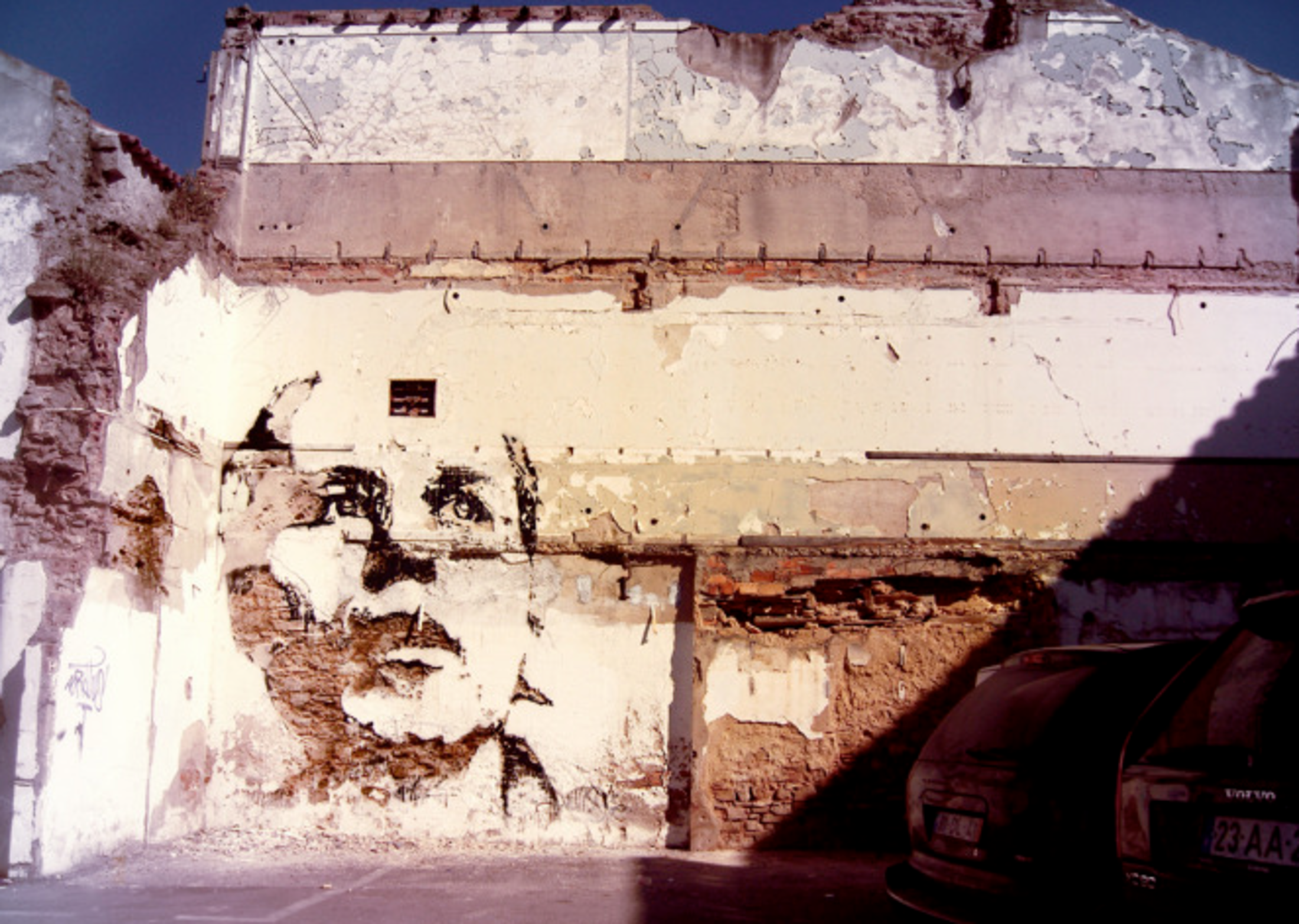
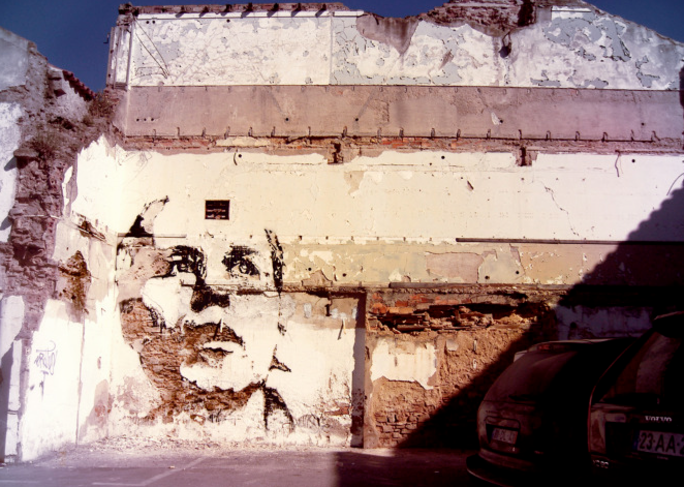
“This is a country that was closed for 60 years, culturally, economically, everything. And suddenly people started to use the public space to communicate,” recounts Vhils. As the walls grew thicker with each added layer of posters and paint, he started thinking: “Why should I add one more layer? Why shouldn’t I dig into it and play with these layers of history, expose them and make them a reflection of our identity, of what makes us who we are? [...] I started going into the walls and showing the insides of the city through the outside by carving the city itself, in the same way the city carves you and you carve the city. And at the same time humanizing the city by giving a face to the wall.” An approach to urban architecture and memory that calls to mind Gordon Matta-Clark’s deconstructions.
The trap of fame
Before attending Central Saint Martins College of Art and Design in London, this quondam train tagger learned his trade in the streets and the depots, at the school of urgency, street smarts, and breaking and entering. This radical and precarious aesthetic stayed with him even when he broke free from the highly coded canons of the hardcore graffiti scene. It was then that Vhils’ first works were chiselled into the walls of brownfield sites and urban wastelands, and relayed by a handful of specialist blogs.
His initially conceptual typographic series questioned our often truncated representations of reality. Eventually, the punchlines gave way to anonymous silent and imposing human faces. These works, unprecedented in the street art scene, soon gained fame outside insider circles, and in his early 20s Vhils was invited to Banksy's Cans Festival in London.
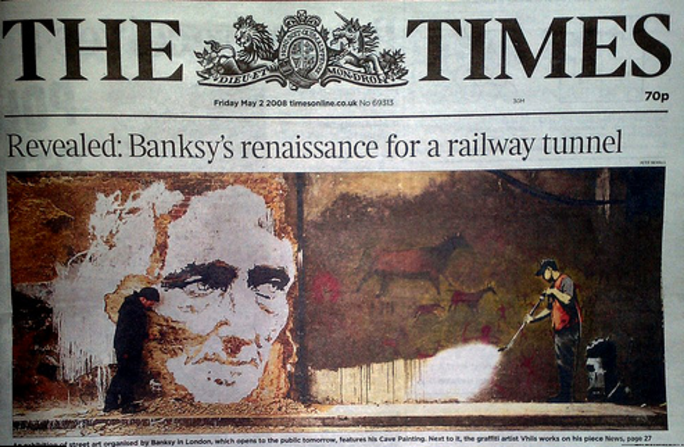
Their joint wall made the cover of venerable British daily The Times: Vhils’ massive face next to Banksy’s trompe-l’oeil of Lascaux cave paintings being whitewashed away, a graphic protest against anti-graffiti policies and the ruthless destruction of a major art movement. The very next year, Steve Lazaridès, Banksy’s ex-art dealer, opened his gallery doors for Vhils’ first exhibition. Vhils later collaborated with JR, a French self-styled ‘photograffeur/urban artivist’, on this stunning mural in LA (pictured below), and his reputation has been on a roll ever since.

Unlike art scene heavies who’ve evolved far from the limelight, far from the art institutions and art market that turned their backs on them, young street artists like Vhils are nowadays spotted, bought up and exhibited very early on. The inherent danger is that fame might stymie this up-and-coming generation’s creativity and lure them into simply replicating their winning formulas.
Despite their depth, some of Vhils’ works give a hollow impression, gagged by the repetition of a technique that is an integral part of his art. His screen prints using acid, in which the artist superimposes screened photographs of faces and cities on white paper or rusty metal plates, look rather harmless next to, say, Miquel Barceló’s bleach-painted portraits of albino Africans.

Digging for gold
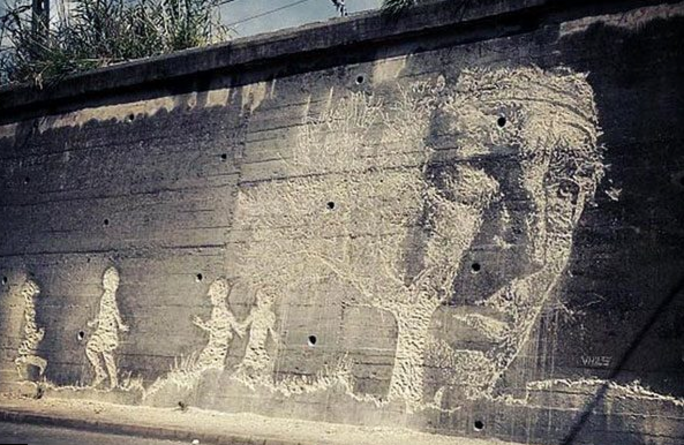
Narrative and illustrational elements sometimes crop up in Vhils’ works when they’d be better off without them. Witness this recent composition (pictured below) on a Spanish wall: the very distinct silhouettes of the tree trunk and children running somehow undercut the profundity of the finely carved face amid the chiaroscuro foliage and make it all fall flat.
Vhils’ potency bursts forth, however, from many of his sometimes explosive portraits in situ,or his slant-eyed faces gazing skywards, as if looking away from the rapidly urbanizing cityscapes of Shanghai. Meanwhile, his works in posters have gained in thickness to form a compact block, assembled out of a dozen delicate laser-cut layers. Tattered white faces emerge out of a glut of logos, ads, quasi-pornographic posters, newspaper headlines about the crisis, faces drowning in a play of lettering and forceful geometrics.
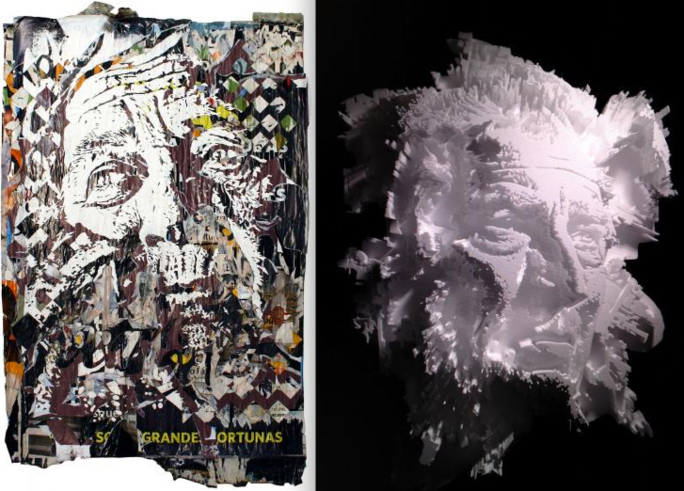
Enlargement : Illustration 6
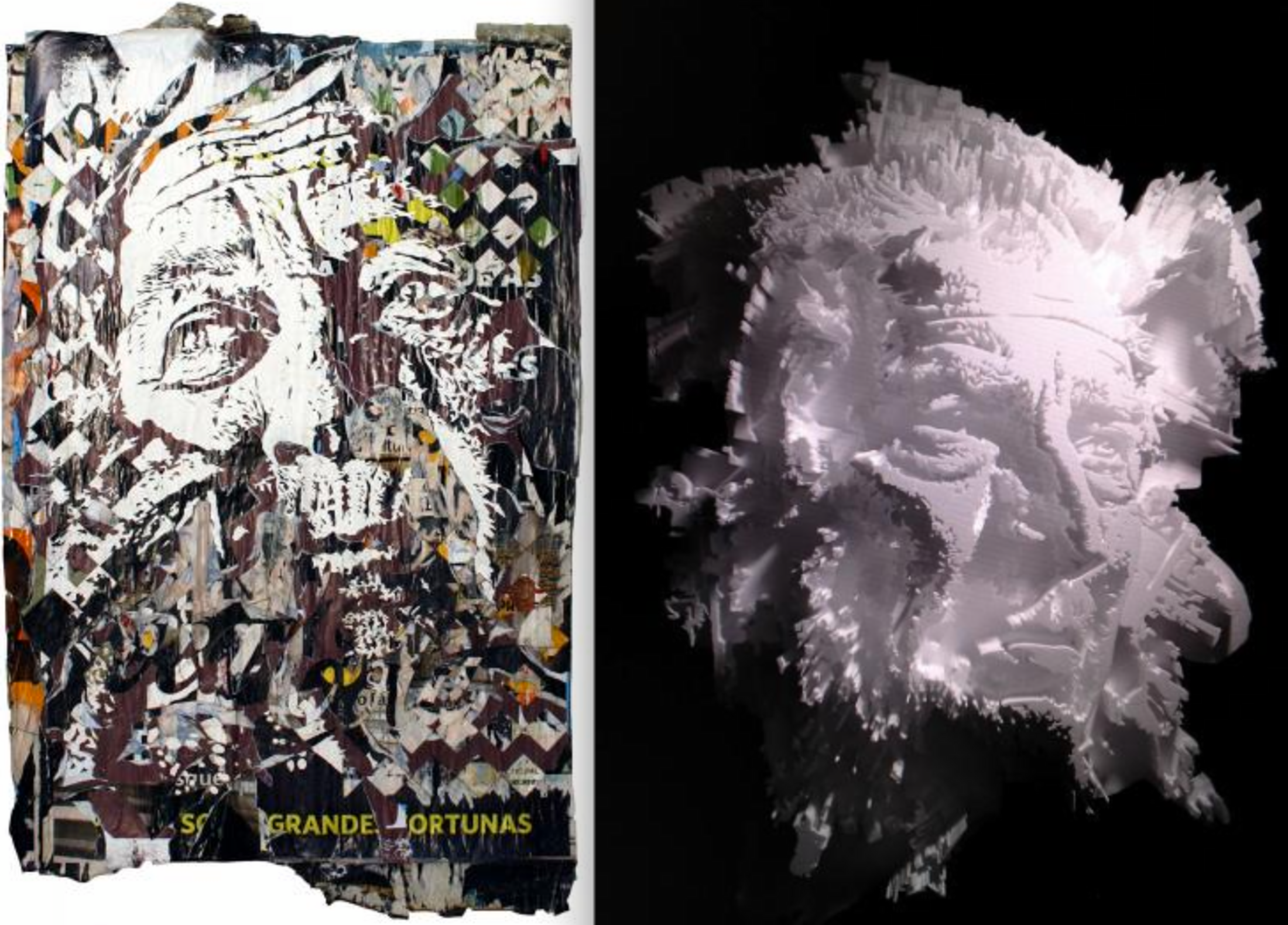
In an effort to explore new approaches, Vhils has presented a new series of urban portraits. Each is a bipolar haut relief: viewed full on, a human face; viewed from the side, an XXL scale model of an urban skyline in polystyrene.
And Vhils is now digging for art in America. Two months ago, he was in Detroit with JR, and a couple of “followgrams” of the trip are posted on their Instagram profiles. Like archaeologists of the present age, they ransacked abandoned bank strongrooms, churches and other recently deserted buildings.
What they were looking for won’t be divulged till they’re done with the project in a few years. At any rate, they probably went to the right place. Detroit is urban art’s new wall of fame. America’s best street artists have been pouring in to bring some colour back to this future ghost town, while exposing the seamy side of our global crisis-stricken world (click here for Detroit Beautification Project video).
-------------------------
- Where you can see Vhils street art in Paris: Corner of the rue Pajol / rue Riquet (75018) , 85 rue Philippe Girard (75018), 177 rue du Chateau des Rentiers (75013), 11 rue Chardon Lagache (75016).
-------------------------
English version: Eric Rosencrantz
(Editing by Graham Tearse)