


Dripping with sweat, 22-year-old Mohamed grinned broadly as he asked: “Would you like something to eat?” He whipped out a damp rag to wipe down the last free table and dusted off the chairs around it. It was lunchtime, and the Maquis de l’Amitié ('The Friendship Café') in the heart of Burkina Faso’s capital, Ouagadougou, was packed.
Spaghetti seasoned with soumbala, a condiment made from fermented néré seeds, and poulet-bicyclette, a type of free-range chicken, are among the dishes on offer in this large concrete building painted with palm trees that sits on sun-baked red soil. From 10 in the morning, Mohamed serves endless Brakina beers, sends orders to the kitchen, settles up with customers, washes metal plates, chats up the regulars, and, when he gets the chance, wolfs down a spicy egg. A whirl of beers, food orders, rags, plates, and bills, 12 hours a day without a break, six days a week.
A big hit with the local girls thanks to his gift of the gab, Mohamed puts his all into his job to distract him from his worries.
“I haven’t taken my army tests,” he said, between serving two customers. “My mother didn’t want me to. She told me, ‘I don’t want you to die over there!’”
In October, Mohamed began the school year at a grade more generally attended by children almost a decade younger than him, “because I’ve missed a lot of classes.” He had hoped to join a military unit instead. “When school doesn’t work out, it’s better to find something else,” he said, with evident disappointment.

Enlargement : Illustration 1

On August 29th, a day after 24 soldiers were killed in an attack on a northern military camp (an operation attributed by Islamic State to its West African affiliate, ISWAP), defence minister Moumina Chériff Sy announced a further 500 volunteers would be recruited into the army, bringing to 2,000 the number of new troops this year. Of these, 143 of are destined to join regiments supporting “the specific needs of the national armed forces.” In other words, counter-terrorism.
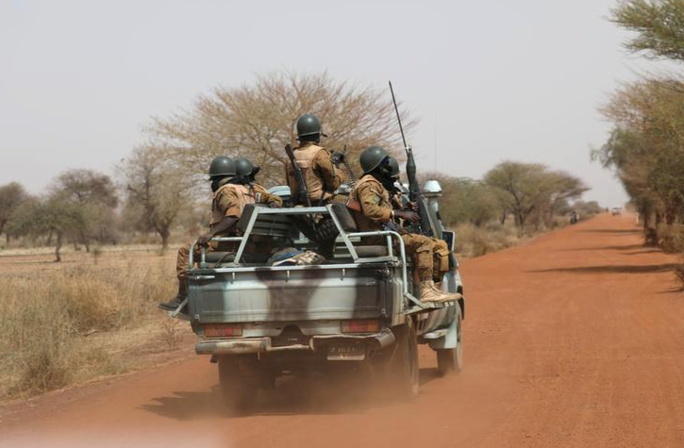
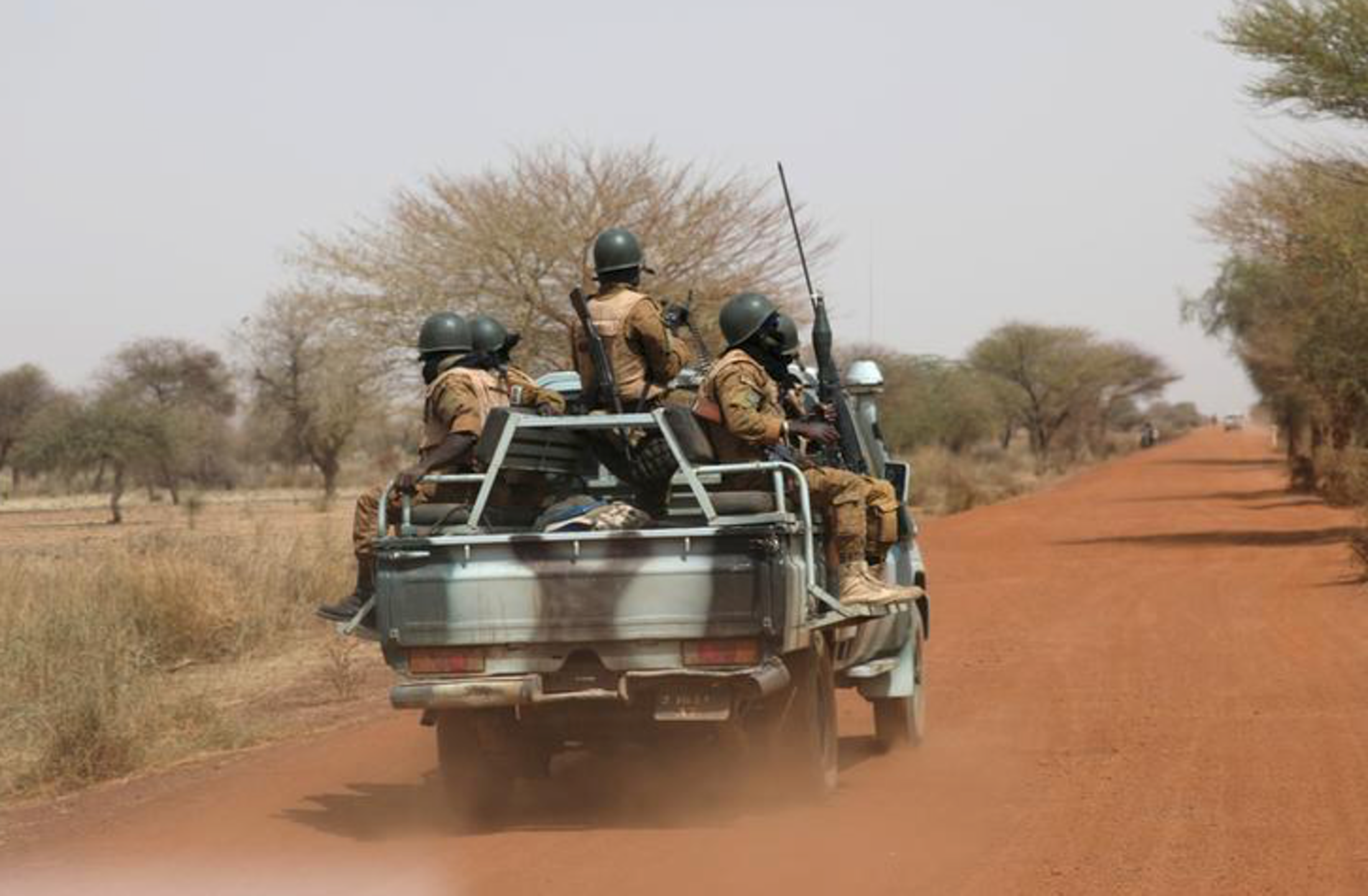
Since 2015, Burkina Faso has faced a jihadist insurgency. Over the last four years, more than 700 people have been killed in numerous attacks. Between January and August 2019, 680 terrorist incidents took place. In September, five attacks in the Nord, Sahel and Centre-Nord provinces left 44 people dead. A dozen groups have been blamed for this violence, the regionally best-known of which are the Group to Support Islam and Muslims (GSIM, also known as JNIM), Ansarul Islam, and Islamic State in the Greater Sahara (ISIS-GS). On November 6th, 38 civilians were killed when a mining company convoy was ambushed in the east of the country. It was the deadliest incident since the start of the violence. On December 1st, a dozen armed assailants attacked a protestant church, again in the east, killing 14 congregants.
Burkina Faso’s division-ridden, under-trained, poorly-equipped army, which is barely capable of gathering intelligence, is not up to the challenge posed by this rapidly escalating threat, despite the support of 4,500 French troops deployed in neighbouring Mali under Operation Barkhane and of around 100 French Task Force Sabre special forces discreetly stationed on the outskirts of Ouagadougou.
Enlargement : Illustration 2
It was not so much military enthusiasm or patriotism that prompted Mohamed to try to join up; he saw the army more as a chance to kick-start his career and ensure a regular monthly salary. “I heard that in the army, they take care of everything: you get fed and housed. I mean, a guy’s got to live,” he said, admitting he didn’t even know how much soldiers are paid every month.
A native of the north-eastern town of Dori, in Sahel province, which shares borders with Mali and Niger, Mohamed is a Fula, the country’s second largest ethnic group after the Mossi. He fled his home town as soon as the jihadists started their attacks in the region.
“I was terrified they would take me,” he said.
Being young, fit, Fula, and Muslim, Mohammed is the ideal recruit for armed groups which capitalise on the hardships of Burkina Faso’s impoverished remoter regions.
“They’re smart, they know we have nothing. They seduce you with money, they give out motorbikes. Then they want you to do things for them. At first, they are small things, little favours, and you can’t really refuse. But at the same time, they brainwash you, gradually so you don’t notice anything… That’s why I don’t want to stay there,” he explained, swatting flies away from his face. “If you stay, you’ll die.”
Long marginalised by the central state, Burkina Faso’s north became the favourite entry point for insurgent groups. Soum and Sahel provinces, where the Fula make up most of the population, now form the epicentre of the conflict. Fighters initially crossed into Burkina Faso from Mali to take a break between operations but have now grown in number and have branched out into different factions. For local populations, they are both a threat and a calculated source of solace: sometimes they commit massacres, on other occasions they try to win people over by providing the basic services that the government fails to sufficiently deliver.
“We see that the terrorist groups are active where the absence of the state is starkest, in regions with the most injustice, the most frustration,” explained Mahamadou Sawadogo, a researcher specialising in violent extremism in the Sahel.
“I’d even go so far to say that we were dealing with a local armed insurrection rather than terrorist groups,” he added.
Dicko, a 24-year-old man from Baraboulé, a district in Soum region close to the Malian border that has suffered the brunt of the attacks, fled his home well before armed men ordered his parents and siblings to leave if they wanted to survive. He has a nuanced view of who is responsible for all the violence.
“It’s true that it was the Fula who started this, but not all the terrorists are Fula and not all Fula are terrorists,” he said. “It’s difficult, it’s very difficult.”
He also narrowly avoided being recruited. “There were threats, anonymous people who contacted me on the internet, phone calls… I don’t know where they came from. One person said, ‘salam aleykoum’ [editor's note, ‘peace be upon you’ in Arabic]. She talked and talked, but I wasn’t interested. She asked me to call her back. I didn’t, so there were threats. I was afraid because they also need people who have been to school to help them integrate, because that’s what makes them strong,” he recalled.
Dicko said he faced another danger, which to his eyes was even greater: the regular army. Like many people, he accuses the army of killing civilians in the name of counter-terrorism.
“They come and take men just like that, and kill them, with no proof of their involvement [in terrorism], no trial, nothing. They just kill you, saying you are a terrorist. Not to mention all the relatives are who put in high-security prisons. They detain people with impunity without establishing their involvement. It’s frustrating for a lot of young people, so the sons join groups like that, to avenge their parents who have been humiliated and killed. They are right to do so,” said Dicko.
'The death squads must be dismantled'
Last March the non-governmental organisation Human Rights Watch published a report condemning “atrocities committed by security forces in at least 32 regions of the Sahel” that claimed at least 116 lives “during counter-terrorism operations amid a climate of generalised fear.”
“Now the Fula have their backs against the wall,” said Daouda Diallo, the spokesman for an NGO working to counter impunity and the stigmatisation of communities. “There was a time when people confused Muslims and terrorists, then Tuaregs and terrorists, and now we confuse Fula and terrorists. It’s really dangerous to be Fula in the current context.”
Such conflation is bolstered by the origins of the two radical preachers behind the country’s destabilisation: Amadou Koufa, the Malian founder of the Front de Libération du Macina, and Ibrahim Malam Dicko, the Burkinabe founder of Ansarul Islam. That both men are Fula has led authorities and many citizens to scapegoat the already-marginalised Fula community, accusing its members of belonging to or at least protecting these radical organisations.
The climate of permanent suspicion has also exacerbated intercommunal tensions marked by competition over access to resources such as water, pasture, and migration corridors. Violence reached a peak after unidentified gunmen attacked the central village of Yirgou on New Year’s Eve, killing the chief and five others, all of them Mossi. This prompted self-defence units known as 'Koglweogo', most of whose members are Mossi and which are seen as forming an unofficial armed wing of the state, to mount punitive operations against Fula citizens.
“These militia went out against members of a single community simply because of suspicion. They combed a score of villages, systematically eliminating all males,” said Diallo. His organisation put the number of dead at 210. The government said 49 people were killed.
“Between January 1st and 4th, they were able to kill on a large scale without interruption,” he added.
Since then, tensions have heightened. Diallo’s NGO accuses the government of covering up the violence of the “barbarian and ethinicist” Koglweogos and of turning a blind eye to the massacres.
“We risk descending into an intercommunal and inter-ethnic war, like in the Central African Republic,” warned Sawadogo, the researcher. “We are calling for the outright dismantling of these death squads and an end to targeted and mass killings, because they only make things worse,” said Diallo.
For young Fula like Dicko, 2019 has brought increased harassment. Speaking sotto voce, he explains that he has to put up with endless police checks, the whispers of other passengers when he takes the bus, a deluge of vitriol on social media, and a feeling of being perceived as a threat.
All this feels particularly unfair to those who have rejected the jihadists’ call to arms. “Our main concern now is to get back to the Burkina Faso we all loved,” said Babili Mansa, whose family fled the now-empty village of Dotoka, in Soum province.
Among the first in his province to graduate from high school and go to university, Mansa frequently travels back and forth between Soum and the capital to encourage children to go back to school, even though most schools are closed because of the violence. He also organises meetings so that young people in the region can get to grips with current challenges.
“Our values must guide us through all this evil,” he insisted, noting that he himself had seen abuses carried out by both sides. “I went to school, my brother didn’t, and I know he doesn’t have the same level of analysis as me. Not everyone can grasp other people’s reality,” he said.
There’s a price for his commitment: “People aren’t interested in who I am; I am just seen as someone to eliminate.”
---------------------------------------------------------------------------
- The French version of this article can be found here.
English version by Anthony Morland