


The tiny principality of Andorra, one of the smallest states in Europe, is wedged between France and Spain in the Pyrenees mountain range, with a population of just less than 80,000.
A tax haven, it has the lowest VAT rate of any European state and, according to official figures before the outbreak of the coronavirus pandemic, attracts more than 10 million tourists per year.
Lying just within its eastern border with France is the town of El Pas de la Casa, which means “the pass of the house” in Catalan, a throwback to when it was a sparsely populated mountain pass. Today, Le Pas de la Case, as it is called in French, is both a popular ski resort and shopping centre. The road leading down to it from Ax-les-Thermes in south-west France is followed daily by hundreds of vehicles – the southern French city of Toulouse is about a two-hour drive away – whose occupants come looking for its year-round bargains.
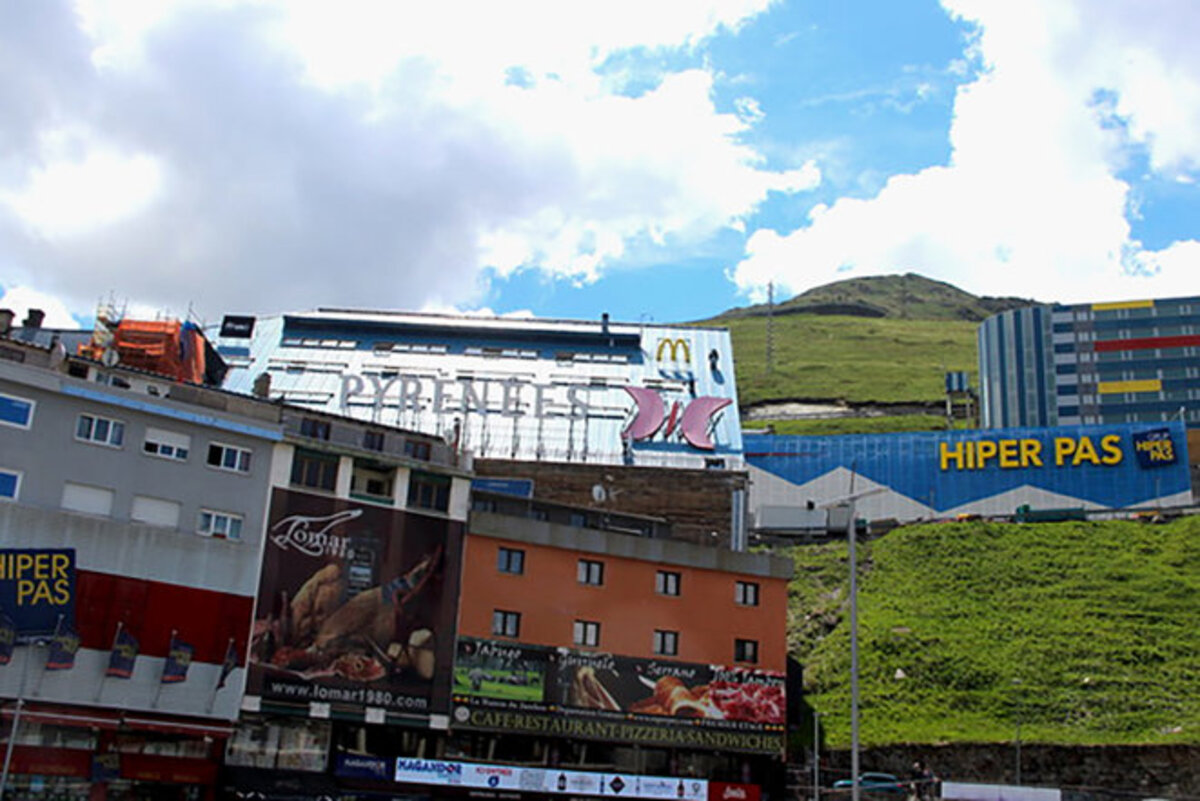
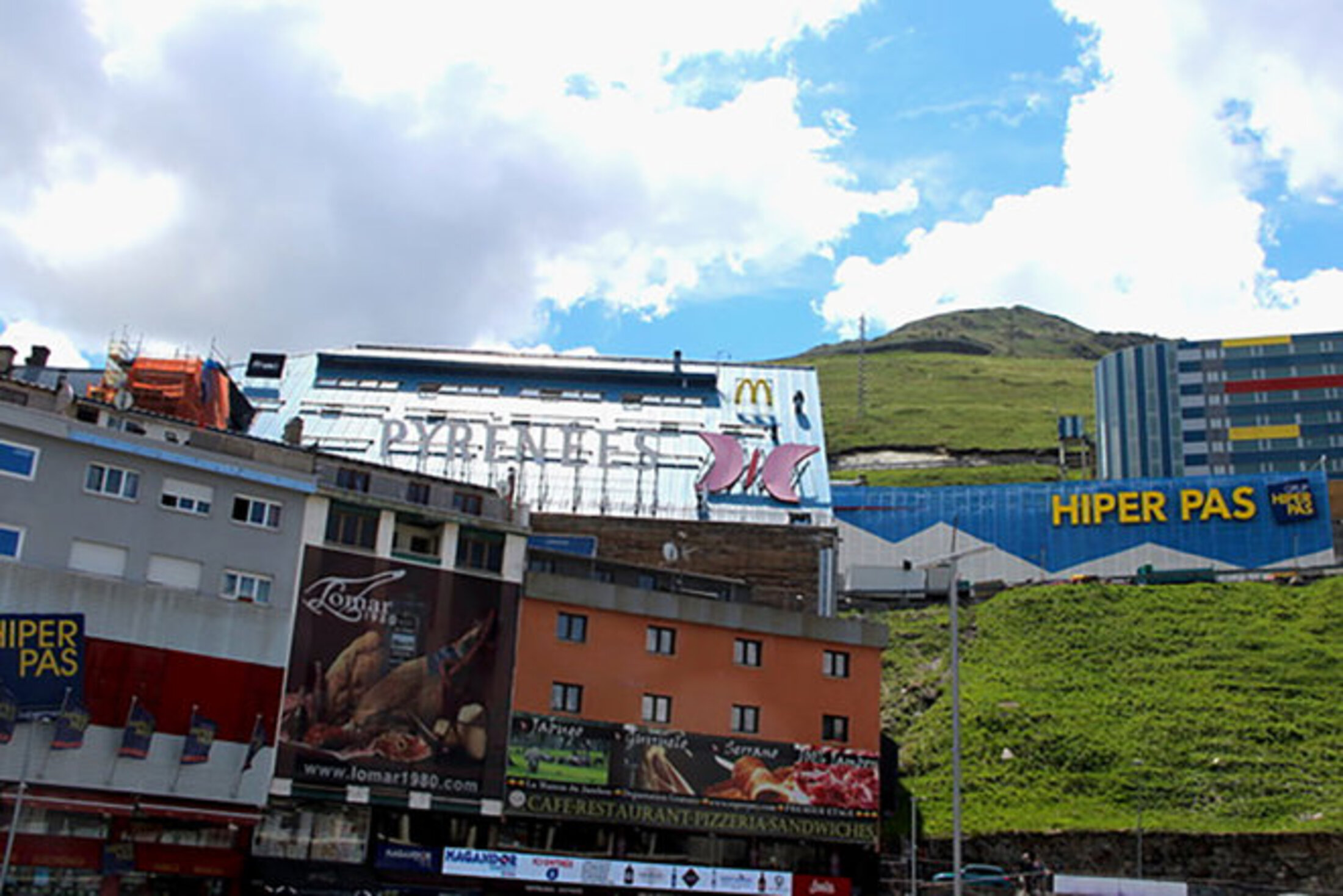
In the summer, standing proud of the snow-free mountainous slopes behind El Pas de la Casa are pylons linked by sagging cables, the landmarks of its industrialised “winter sports” business, while below them the town’s shops, with windows stuffed full of items, continue their brisk trading.
The diverse wares spilling over in the boutiques include watches, shoes, sunglasses, overgarments, alarm clocks, perfumes, washing powder and olives. There are special offers, like that for 22 packets of Camel cigarettes (two cartons and two packets on top) together with two disposable lighters selling at 68.9 euros. For 6.9 euros more, you could have a half-litrel bottle of the liquorice-flavoured aperitive Ricard in place of the lighters. In the narrow streets police cars pass pedestrians hauling around large carrier bags.
Enlargement : Illustration 1
Occasionally, corpses are discovered up in the folds of the mountains, lying beside cartons of cigarettes that were destined for the black market. One found in August last year was a 38-year-old man who had fallen down the hillside beside a lake in the north of the microstate, close to the French border. French regional daily La Dépêche du Midi reported that, according to the official investigation, the man, “of African origin” was involved in smuggling tobacco products between Andorra and France.
In October 2018, a 20-year-old Algerian man was found in the mountains less than three kilometres from El Pas de la Casa in a state of severe hypothermia, and died by the time he was taken to hospital. According to a report in another French regional daily, Sud-Ouest, no cigarettes were discovered at the site. “But we know very well that it’s a crossing point for smugglers and the manner in which he was equipped showed that he belonged to a trafficking network,” French prosecutor Jean-Jacques Fagni was quoted as saying.
“The mountain paths are crossing points regularly used by the smugglers, who transport on their backs bundles of tobacco [products],” according to the French gendarmerie services, in notes passed on to Mediapart by the Occitanie (Occitania) regional prefecture (government administration services), adding that “most of those involved are from the Toulouse region”.
A large proportion of black-market sales of cigarettes in Toulouse are smuggled in from Andorra. Smuggled tobacco products represent more than half of tobacco bought in the city, according to estimations by tobacco producer Seita Imperial Tobacco, cited by website Fenêtre sur rue (produced by students and teachers of the Toulouse political sciences faculty). Typically, a packet of smuggled cigarettes has a street price of seven euros, compared to 10.5 euros at a tobacconist. At El Pas de la Casa they can be bought for little more than three euros.
But tobacco is far from being the only contraband that crosses the Pyrenees into France. According to the French gendarmerie, Toulouse and its surrounds, and to a lesser extent Perpignan and the city of Montpellier, lying further east along the Mediterranean seaboard region, “are the principal destinations for cross-Pyrenees narcotics trafficking”.
With the measures of lockdown on public movement and overnight curfews introduced to contain the coronavirus pandemic, beginning in the spring of 2020, drugs smuggling by air – using passenger couriers, or “drugs mules” – and by road – using so-called “go-fast” car convoys – have seen smugglers turning more to concealing drugs in international transport trucks, the gendarmerie added.
In February this year, during a gendarmerie traffic spot-check to enforce the overnight curfew then in place, a vehicle crossing into France from Spain via the Aragnouet-Bielsa tunnel through the north-central Pyrenees was found to be carrying 132 kilos of marijuana, representing a street value of around 500,000 euros. The previous month, a convoy of cars was intercepted on its way to Toulouse from Spain carrying 418 kilos of cannabis resin. More recently, in May, suspected members of a Spain-to-France drugs smuggling ring were arrested by gendarmes from the Tarn département (county) just north of Toulouse, when 6 kilos of cocaine, representing an estimated street value of 700,000 euros, was discovered. One of those arrested was described by the gendarmerie as being involved “since 2008” in smuggling cocaine into France from Barcelona.
The gendarmerie says it cooperates “each time that this is possible” in investigations into cross-Pyrenees smuggling with the Spanish guardia civil and police, including the Catalan region’s Mossos d’esquadra, and also the Andorran authorities.
While it gave no figures of amounts involved, the gendarmerie said the cross-Pyrenees contraband also includes “trafficking in anabolic products” and the purchase of these for use by French athletes “in Andorran chemist’s shops”.
But perhaps the most surprising black-market traffic across the mountains is that of elvers, the baby eels called angulas in Spanish. European eels are an endangered and protected species, and since 2010 the European Union has imposed limits on their commercialisation and banned imports and exports of them between member countries. Elvers are a sought-after delicacy in Spain, notably in the Basque country, but particularly so in the Far East where the tiny wormlike creatures can fetch between 3,000-4,000 euros per kilo on the black market.
French customs services estimate that smugglers can make a tenfold profit in the contraband of baby eels. In the notes passed to Mediapart by the French regional prefecture, the customs services reported how a recent investigation revealed how “elvers collected by French wholesale fish merchants were transported to Spain […] then dispatched to [South-East] Asian countries notably via logistical platforms set up in Eastern [European] countries.”
“This illegal transport and exportation of a total of 46 tonnes of elvers was hidden by the use of false documents suggesting the dispatch of other species,” the customs investigation found.
There have been several recent interceptions of smuggled elvers crossing south across the Pyrenees, illustrating the importance of the route for the contraband of the precious delicacy.
A smuggling route today of tobacco, narcotics, alcohol, performance-enhancing drugs and eels, and previously of food and vital commodities, the Pyrenees have never represented the rigid border between France and Spain as imagined by some. On the contrary, the mountain range has rather always been the theatre of passage and exchanges between the inhabitants on both sides, like the shepherds who for centuries have led their animals to roam willy-nilly across the range.
It was with a treaty signed on Pheasant Island between France and Spain on November 7th 1659, putting an end to a 24-year war between the two countries, that the notion of a “border” was first introduced to the Pyrenees. Signed by French king Louis XIV and his Spanish counterpart Felipe IV, the treaty states, in its Article 42, that “the Pyrenees mountains, which anciently divided the Gauls from the Spains, will also henceforth be the division of the two same kingdoms”.
The treaty punctuated a process, which had begun before its signature and which continued afterwards, of negotiations and exchanges of small valleys and zones; one year later, the town of Llívia, situated in French Cerdanya, was handed by France to the Spanish. Situated less than two kilometres north of the border, a short distance east of Andorra, Llívia remains a Spanish enclave in France today, joined to the mother country by a road which France and Spain take turns in administrating.
It was not until the 19th century that the current 623-kilometre-long official border (not counting the 56 kilometres of the French-Andorran border which interrupts it) was definitively established. It was set out in three separate treaties signed by France and Spain between 1856 and 1866; the first designated the border running through the Basque country and Navarre, then of Aragon in 1862, and finally Catalonia in 1866.
In an article published in 2004 by Pyrénées Magazine, Jean-François Soulet, emeritus professor of history at Toulouse university, underlined that well before the border was finally mapped, “the inhabitants of the valleys on the two sides of the Pyrenees had, by necessity, knotted close links”.
Similarly, the late Romain Plandé, a Toulouse public education inspector and published local historian, in a 1938 essay for the Revue géographique des Pyrénées et du Sud-Ouest on the political and social history of the Pyrenees border regions, wrote: “It is above all the small famer and the shepherd who dictated the path of the border, and not the soldier; their oeuvre finally resisted all ambitions, all projects for conquest.” The oldest known formal agreements between the communities on either side of the mountains date from the 12th century. These set out the coexistence at the scale of a valley, detailing what were called lies (alliances) and passeries (peace), and notably regulated questions of pasturage and trade.
“Written in Occitan, in Gascon and Béarnaise, as well as in Aragonese, these documents constitute true ‘peace charters’, taking no notice of the French and Spanish central states,” wrote Alem Surre-Garcia, an Occitan-language writer and playwright from the Toulouse region, in an essay on the “Convivéncia” (Occitan for "living with the other") of exchanges between the local communities. Relics of these local agreements survive today in the regulatory texts of some valleys and areas in the Béarn and Basque regions.
In reality, the Pyrenees are quite the contrary of a geographic barrier. “We must envisage these frontier zones, today most often deserted, as a humanised ensemble, coloured, of mixed origins, where meet together shepherds, pilgrims, travellers, mule drivers, tradespeople, smugglers, customs officers, brigands, the ones and the others coming from both mountain sides,” wrote historian Jean-François Soulet.
“All these towns, before and beyond [the Pyrenees], Bayonne like San Sebastián, Oloron like Tolosa, are nothing but mixed territories. One senses there the bustle of peoples who intertwine,” wrote French novelist, playwright and essayist Victor Hugo, penning an entry to his Voyage vers les Pyrénées (Voyage towards the Pyrenees), in August 1843.
Maite Etcheverry is a staff member of the Cimade, a French NGO principally dedicated to the defence of the rights of migrants. She notably intervenes on their behalf at the state migrant detention centre (CRA) in Hendaye, the French coastal town in the Basque country and the principal point of passage between Spain and France in the western Pyrenees. “We’re in a cross-border zone here, where there is circulation in all directions,” she said. “The closing of the passage points during the first lockdown [in the spring of 2020] truly left a mark on [people’s] minds. People aren’t used to it, it was very hard. The border is administrative, but it’s not [present] in living habits.”
-------------------------
- The original French version of this report can be found here.
It is one of a five-part series by Emmanuel Riondé on the long history of migration movements in and around the Pyrenees, beginning in the 8th century and including the story of the internment camps for Republican refugees of the Spanish civil war and the victims of France’s wartime collaborationist regime of Vichy. They can all be found, in French, here.
English version by Graham Tearse