


Making off with goods that belong to someone else is usually regarded as theft. Except, it seems, when those goods belong to someone living on the streets. Mediapart has obtained a video (see below) showing three police officers taking away, with no apparent justification, a mattress belonging to a Roma family living rough on a Paris street.
The video, filmed on April 2nd, 2014 by people who do not want their identities revealed, shows three officers with the word 'Police' on the backs of their blue uniforms circling the family at the corner of the place de la République and rue du Faubourg-du-Temple. At their feet is a large mattress on which are placed some clothes, a teddy bear, some pillows and an acrylic bed cover.
A young boy, hat pulled firmly down on his head, is crouching and appears to be either tying his shoelaces or gathering up some belongings. Next to him a man, a woman and a young girl are bending down as they hurriedly pack up what is on the ground and on the mattress itself. Their baggage consists of four suitcases and a shopping bag. The boy then gets up, takes hold of his scooter and moves away, while the three others continue their packing.
The mattress has scarcely been cleared of belongings when one of the police officers grabs it, wearing black rubber or leather gloves to ensure his hands do not come into contact with the object. The woman appears to try to hold on to the mattress but the officer does not let go. He sets off, dragging his haul with him. One of his colleagues, also wearing gloves, gives the officer a hand in taking it to an unmarked white van. Meanwhile the third officer keeps his hands behind his back during the entire proceedings, as he keeps watch around them. One of the final images in the video is of two officers shaking hands before going their separate ways, one of them getting into the van, the other heading off in a police car.
Exactly which police unit the three officers, who all have slightly different uniforms, were working for is unclear. They could belong to the Brigade d'assistance aux personnes sans abri (BAPSA) whose job it is to provide help for homeless people. However, the police authorities in the capital, the Préfecture de police de Paris, refused to identify them to Mediapart or say which service was involved. Nor did they respond to questions about the reasons behind the taking of the mattress and its justification in law.
In total the incident lasted under two minutes, during which time no passer-by stopped. Some watched the scene and a number turned round to see more, but no one asked the officers what they were doing. It is certainly true that the incident, which took place near an exit for the République metro station near where a young man was handing out free newspapers, seems to have passed off peacefully. The family who had just had their mattress taken reacted calmly. The police officers themselves did not use violence, and did not shout, threaten or jostle anyone. Indeed, at no point did they touch anyone. The woman carried on packing up and did not turn her head to see where the mattress was being taken. Meanwhile the man, the young girl and the little boy watched in stupefaction as their bed disappeared, as if resigned to losing it. The family was not expelled from the area, and the cup used to collect coins from passers-by was left where it was. But the mattress was gone.
The calm manner in which the incident took place might suggest it was an ordinary, unremarkable kind of occurrence. But in fact the actions of the police officers in the video are on the edge of legality. The forces of law and order are not authorised to take away someone's property without a reason. The mattress, situated in a spot where the pavement is several metres wide, was not causing an obstruction. Public order was clearly not being threatened. The people sitting on the mattress were not in danger either, even if the fact that they live on the streets is a sign they live in extremely vulnerable circumstances. Sometimes in such cases action follows complaints from neighbours about nuisances such as noise or unhealthy conditions. However, there are no flats in the surrounding area. The family's bags were placed at the rear of official buildings with no entrance on that side, and opposite shops that are closed in the evening.
Two principles come into collision here; property rights and the right to occupy public spaces. Lionel Crusoé, a lawyer specialising in administrative law, who has defended people living in shanty towns, disputes the legal basis of the police's intervention in this case. He refers to the principle of freedom to use the public way, while also underlining that people who use such spaces must do so “in a manner that conforms to the purpose of the structure”. A pavement is principally there for people to move on. To occupy a part of it might therefore, in law, be seen as an attempt to privatise a public space. But Crusoé says that allowances are made for the homeless, an approach which has been confirmed in administrative law, particularly where the occupation of that public space is carried out peacefully and does not affect people's right of passage.
In such a case the 'occupant' of the pavement still has the right to have their property respected. So the confiscation of the mattress outlined above appears, on the face of it, to go beyond the law. “In this case there seems no legal basis to authorise this seizure [of property],” says Lionel Crusoé. Moreover, a mattress in this context could constitute a particular category of object. “On top of property rights there is also the right to private life and normal family life: unfortunately for many people the street is a living place and, through this seizure, their family life is affected,” says the lawyer. There is also the question of human dignity. “To take belongings away from individuals who possess virtually nothing is indefensible, especially when you take from them a bed without offering them help with a view to giving them shelter or accommodation,” says Crusoé.
Sylvie Lhost, president of Entraides Citoyennes, a charity for homeless people, also highlights the law protecting a person's right to respect for their private and family life under article 8 of the European Convention on Human Rights and article 9 of the French civil code, a protection which is applied with even greater emphasis when the person concerned is vulnerable. Lhost notes that the home is also protected under articles 226-4 and 432-8 of the French criminal law code. Moreover, both French and European law have a broad approach to the concept of a home, which is defined as the place where a person has chosen to live, whatever the legality of their occupation of that site. However, says Sylvie Lhost, in most cases the forces of law and order do not go into the niceties of this legal argument; to justify taking property they usually rely on laws relating to obstruction of the highway and litter.
Yet, says legal expert Lionel Crusoé, this use of the law is incorrect in cases where the items in question have not been abandoned and are still being used by their owners. “The phenomenon of seizing [property] is not a rare one,” he says. “According to the circumstances, you could be close to theft here. The seizure of property without reason, without authorisation and in abusing the weakness of the owner enters into the domain of the criminal law heading of theft.”
An unofficial campaign of 'harassment'
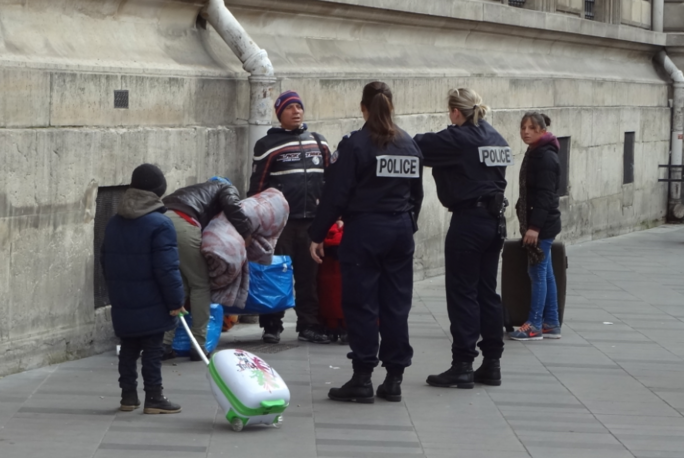
Enlargement : Illustration 2
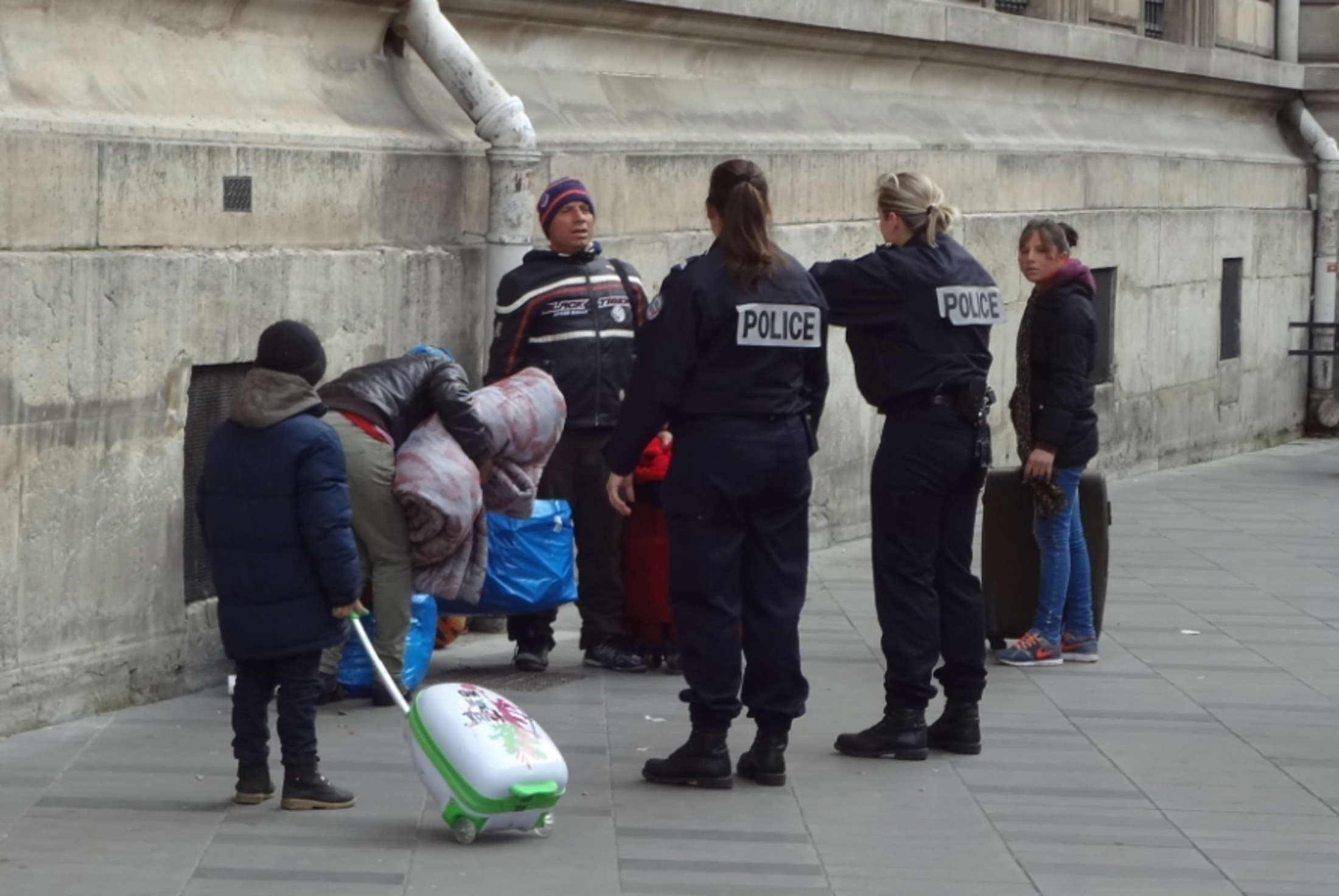
As the video shows, the family involved was not at the time asked to “move on”. But a photo (see above) taken near the same spot, on April 27th, 2014, shows that the family was later moved from their makeshift home on the pavement. Here again the legal basis for this eviction looks shaky. Such cases should be referred to and sanctioned by an administrative judge, except for cases involving “serious disturbance” to public safety, public order or public health, under article L. 2212-2 of the local government code.
In France begging is not a criminal offence, having been abolished as a crime in 1994, apart from in certain areas covered by municipal by-laws – which is not the case with the place de la République. Or where there is what is termed “aggressive” begging. But as the video shows, the family's cup used for collecting the coins of passers-by was left in place by the police officers, proving that this was not an issue in this case. It is also true that under article 227-17 of the criminal law code, introduced by Nicolas Sarkozy in 2003, it is illegal for a child under the age of six to be on a public highway “with the aim of appealing to the generosity of passers-by” when that compromises the child's health. But here again this seems not to have been the issue, as in taking the mattress the police removed the sole means of enabling the child to sit on something other than the ground.
Whatever the intended aim of the police officers' actions were, such practices have consequences. In further undermining the already fragile lifestyle of the family concerned, the removal of the mattress was encouraging them to leave. Thus a policy of dissuasion and inciting people to leave has been put in place without it ever being formally stated. Or only rarely so, as in the case of the internal note to employees of the police precinct in the nearby 6th arrondissement urging that officers should “evict systematically” the “Roma families” in the area. The memo was “corrected” after a public row.
The Roma get the message that they are not wanted. But where can they go? With state-run emergency shelter already overwhelmed by demand, the best such families can hope for is a few nights in an hotel before finding themselves on the streets once more. And the police are aware of this. Is it an attempt to get them to return to their country of origin? As European Union citizens Romanian and Bulgarian Roma can be expelled from France if they stay longer than three months “without adequate resources”. But there is nothing to stop them returning a few weeks later. The result of all this is that the police simply deal with the most visible aspect of the problem. To show that they are taking action – particularly to local residents and shopkeepers – they resort to the kind of hassling seen in this video and in the photograph.
Indeed, some observers use the word harassment to describe such behaviour because it is by no means uncommon. In a series of interviews carried out by Mediapart in the autumn of 2013, several Roma families living around the place de la République spoke of the mixture of fear and anger they feel towards the forces of law and order who, they say, treat them badly. They spoke of morning patrols aimed at waking them up, of kicks aimed at their mattresses and of verbal abuse. One man living in the neighbourhood showed photos he had taken on his mobile phone of police officers picking up their bags and putting them in a municipal rubbish bin. Such tactics are not just reserved for people identified as Roma people; numerous homeless people of different nationalities and origins complain about the behaviour of the officers.
Claudia Charles from the immigrant information and support group GISTI complains that there is little case law on such issues. “The police don't have the right to take away personal belongings,” she says. “We're faced with the same problems during expulsions from camps, during which people's belongings are destroyed.” The Entraides citoyennes association has recently launched an appeal for witnesses in the hope that legal action can be brought against the authorities. Sylvie Lhost says such legal action could involve a number of different demands, ranging from the return of the goods that have been taken to the payment of money to replace the missing belongings or, where someone's living area has been destroyed, to a demand for emergency housing. “This could be very dissuasive for the state: all destruction of property would be followed by an injunction demanding housing,” she says.
The mattress in the video was removed from the family on April 2nd, just after the March end of the “winter truce” during which landlords cannot evict tenants for unpaid rent or other reasons during the cold winter months. The end of the truce coincides with a number of evictions, meaning that emergency accommodation and shelter is even harder to find, and is a time when even more people end up on the streets.
The role of the BAPSA police unit is to evaluate the needs of people on the street and to help them find a hostel or housing centre. The unit was set up in the wake of an appeal in 1954 by Catholic priest Abbé Pierre for French society to come to the help of the homeless. Until 1968 this team was known as the “vagrant collection team”. According to the police's own website its mission then was to “remove the destitute from the sight of citizens” and to take them, without consulting them, to a welcome centre.
----------------------------------------------------------------------
The French version of this article can be found here.
English version by Michael Streeter