


On the morning of January 3rd 2020, close to the Eiffel Tower in central Paris, deliveryman Cédric Chouviat was riding his motorbike when he was flagged down by police carrying out roadside checks.
A brief altercation ensued, when Chouviat, 42, was arrested and pinned to the ground face down. Police officers lay upon him, using a stranglehold, causing him to suffocate and suffer cardiac arrest, despite his pleas for them to let go. In a case reminiscent of that of George Floyd in the US in May last year, Chouviat was recorded repeatedly telling them “I’m suffocating”.
Chouviat, a father of five, was taken to hospital in a coma, where he died two days later. A postmortem examination found he had suffered a fractured larynx and asphyxia.
His family have repeatedly demanded in vain for the four police officers involved to be suspended while awaiting the result of an official investigation into the case. Despite compelling evidence that has emerged in the judicial probe demonstrating the excessive, brutal manhandling of Chouviat by the officers, three of whom have been placed under investigation in the case, French interior minister Gérald Darmanin recently wrote to Chouviat’s family confirming that the officers implicated in the events will remain unsuspended from duty.

Enlargement : Illustration 1

An investigation into Chouviat’s death was launched by the French police’s internal investigation services, the IGPN, under the authority of two independent investigating magistrates. Between July 7th and July 16th 2020, on the evidence gained by then, the magistrates formally placed three of the four implicated police officers under investigation (a legal step that can only be taken on the basis of "serious or concordant" evidence that a person has committed a crime) for “manslaughter” and banned the men from having any further contact between each other.
On July 10th 2020, the fourth officer, a woman, who had filmed the scene, was made an “assisted witness”, a legal status which implies less serious evidence against her had been found than against those placed under investigation.
On December 10th last year, lawyers acting for Cédric Chouviat’s family wrote to interior minister Gérald Darmanin requesting “very solemnly” that the officers be suspended from duty. They noted that “the presumption of innocence” – accorded by French law to all suspects who have not been tried and convicted – “is not considered to be an obstacle” to such a provisional move, which can be taken when the behaviour of police officers is regarded or suspected to have been “contrary to the principles which must govern their mission”.
In France, the suspension of a police officer on such grounds can last for four months, and can be renewed once. It can be ordered by the police administration before an internal inquiry is launched or concluded, and before an eventual decision to discipline the officer in question, and is applicable in parallel to an ongoing judicial investigation.
According to the French national police force’s press office, the SICOP, a decision to suspend an officer is not regarded as a disciplinary measure but is aimed at momentarily removing them from normal duty “in the interest of the public service and/or in the interest of the officer themselves, while awaiting a settlement of the situation”.
In the case of the death of Cédric Chouviat, one senior member of the police administration, whose name is withheld, told Mediapart: “It is in the interests of everyone to remove the police officers from the field. There is no question. Without predicting the subsequent judicial findings, the manner of this roadside check, their behaviour and the tragic outcome with the death of a man, leaves no place for questioning [that].”
However, that point of view is not shared by the French interior minister, as made clear in a letter he addressed to Cédric Chouviat’s family this summer. In his letter, dated June 21st, Darmanin began by saying that a decision to suspend an officer is decided on the basis of “protecting the [police] services from the consequences of one of its officers”.
“It even has precisely the aim of ‘avoiding the scandal or difficulty that can be caused by the effective presence in public employment of an officer suspected of a serious wrongdoing’,” he added, citing regulations.
Darmanin said “the initial elements in the investigation have not allowed to establish that the officers had committed, during the arrest of Mr Chouviat, a failure to meet their obligations which would be susceptible to justify removing them from their duty”.
Darmanin’s argument, in sum claiming that the death of a person during a simple roadside check does not justify suspending those who caused it, echoes what might be interpreted as a cynical, at best clumsy, statement he gave to the French parliament’s law commission on July 28th 2020, when he said: “When I hear talk of ‘police violence’, personally I choke.”
Darmanin, who had that month replaced Christophe Castaner as interior minister, was speaking after several months of street protests in France against police violence.
Castaner had ordered a halt to police use of the stranglehold, but it was soon after re-allowed after police unions led demonstrations demanding the ban be overturned. In July this year, it was announced that the practice was finally permanently prohibited.
Enlargement : Illustration 2
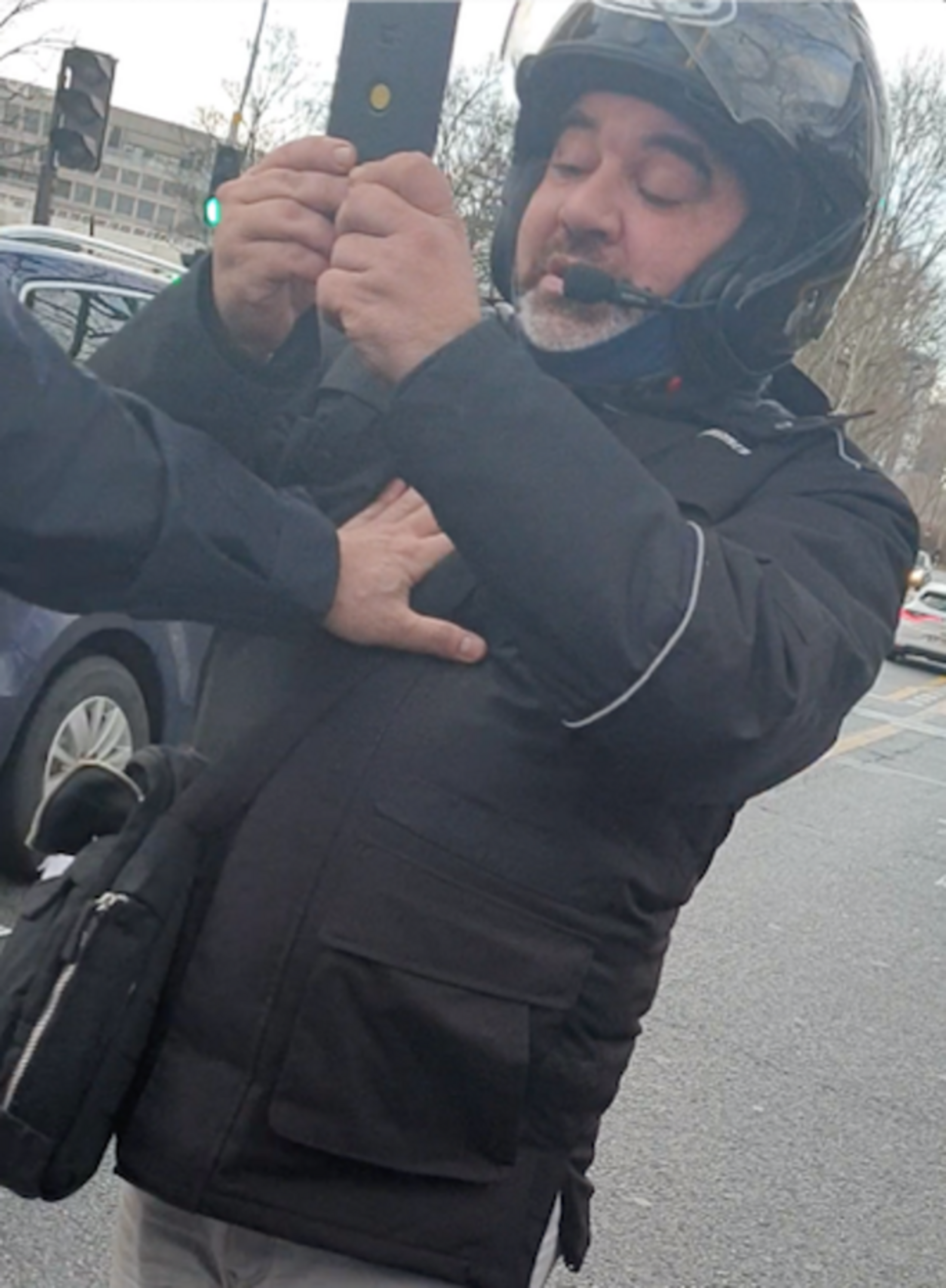
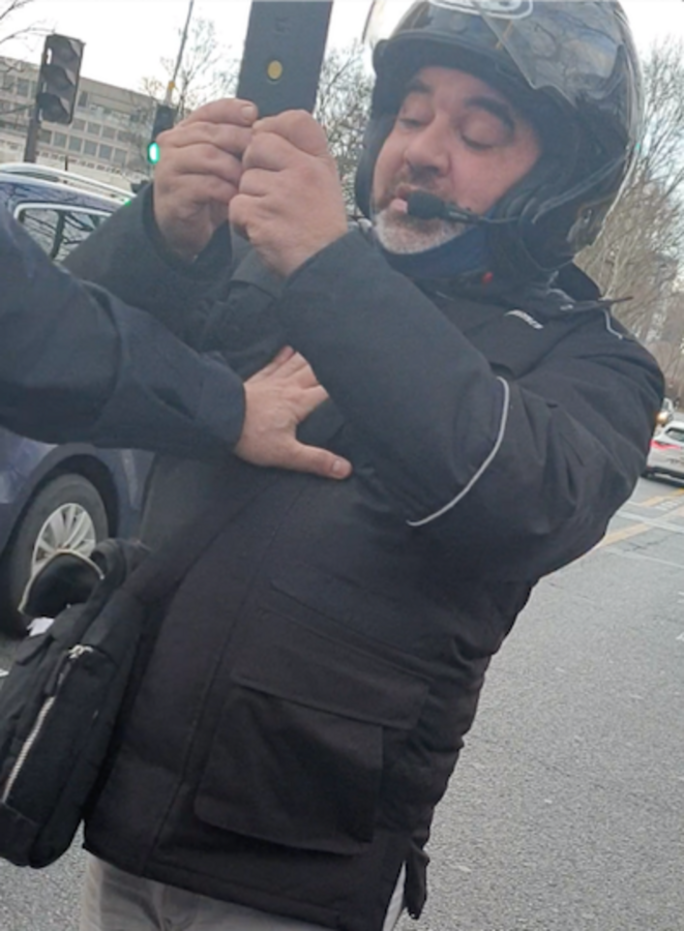
As Mediapart has previously reported, on June 18th 2020, one month before Darmanin's provocative statement, sound recordings later found on Chouviat’s mobile phone, and which were made via a microphone attached to the crash helmet he was wearing at the time of his arrest, provided key evidence about the circumstances of his death. Pinned to the ground under the weight of the officers, he can be heard telling them on seven occasions, “I’m suffocating”.
That and other evidence found to date in the investigation runs contrary to Darmanin’s claims. After Chouviat was first put into a stranglehold by the officers, they shoved him to the ground, face down and still wearing his helmet, and handcuffed him. The IGPN internal police investigation notes in one of its reports that while three of the officers kept up their pressure on his back, one of them “appears to practice upon him a rear naked choke hold during which he, at least on one occasion, exercised traction to [Cédric Chouviat’s] throat” which led to a “momentary compromise of the alignment of the head, neck and trunk”.
Chouviat, it added, “laid down on the stomach, very rapidly spoke of his respiratory distress”, repeating, “I’m suffocating”. Under questioning, the four officers involved in the arrest said they had not heard the words.
When Chouviat appealed for help, one of the officers can be heard on the recordings saying, “It's ok, it's ok, let go””, then addressing Chouviat with the word “Monsieur”.
But the three officers manhandling Chouviat continued to press down on his back. The IGPN investigation is also focussing on why it took three minutes before the police carried out a cardiac massage on the delivery driver.
Following the arrest, when Cédric Chouviat was taken, in a coma, to the George Pompidou hospital in west Paris, the four officers gathered for a 15-minute debriefing in the office of the deputy commissaire (a rank equivalent to superintendent, or police captain) of the Paris 7th arrondissement (district) police station where they were based. At the end of this, the woman officer among them drew up a report of the events, which included false claims.
According to the officers, they had arrested Chouviat after he had repeatedly insulted them. He allegedly resisted the arrest, “wrestling” while on the ground and, they said, continuing with his insults. Their version of events makes no mention of Chouviat’s appeals for help, nor the length of time before they decided to give him a cardiac massage. Nor was there any mention of the recorded comment by one of the officers who asked the delivery driver: “You think I'm going to get down on all fours and suck your dick too?”
None of the established evidence appears to have troubled the interior minister, who in his letter to the family added that “these [officers] have never in their careers been implicated in events of illegitimate violence”. That claim is false: the officer who is principally in question over Chouviat’s death, who can be identified only as Michaël P., was the subject of a report to the IGPN for undue violence during the arrest of a man in a Parisian hotel in January 2018, and for which a judicial investigation was opened three months later.
On July 29th, the family of Cédric Chouviat sent a reply to Darmanin’s letter of June, penned by their lawyers Arié Alimi, Vincent Brengarth and William Bourdon, in which they spoke of a “culture of denial” by the authorities towards “victims of police violence”, and said that the interior minister’s refusal to suspend the officers cannot be regarded as other than a “negation of the reality of this case and the aspirations of the family”.
They denounced a “will to protect the officers in question” and a “way of absolving them by denying the very existence of the wrongdoing committed”.
“It sounds like cruel disdain towards those who have lost a father, a husband, a son, a brother,” they continued. “A suspension will not bring back Mr Cédric Chouviat but, on the contrary, its absence makes his death all the more inexplicable and intolerable.”
“A suspension can have the aim of protecting the service against the behaviour of an officer, if only avoiding the scandal caused by their presence,” they added, pointedly citing the minister. “What more is needed than the death of a man?”
In a statement to Mediapart, lawyers Vincent Brengarth and William Bourdon underlined: “The principle of precaution should lead to the suspension of the officers, unless there is a will to trivialize the death of a citizen in such circumstances, in this case a roadside check. It is intolerable […] There cannot be an absence of wrongdoing, as declares the minister who refuses to recognise both the responsibility of the state and that of the officers […] The persistence of the administration in not suspending the officers in question reveals a policy of impunity that is totally incomprehensible for the family, on top of sending a very bad signal to all those who expect an exemplary police force.”
Meanwhile, the Chouviat family’s third lawyer, Arié Alimi, added: “The minister of the interior, as is his habit, pretends not to see the gravity of the events. That attitude frequently leads to new incidents of violence. That is exactly what characterizes systemic police violence.”
Contacted by Mediapart, Cédric Chouviat’s father, Christian Chouviat, said he was happy that the police use of the stranglehold has now been banned, but said he was concerned that the ban does not exculpate “the police who practiced it nor the state which authorised it”.
He said it was “scandalous” that Darmanin refuses to suspend the four officers. “Darmanin is not worthy of his position,” he said. “[Former interior minister, Christophe] Castener had called for the police officers to be suspended if there was new evidence. There is, in fact. So, the minister of the interior did not keep his promise. But we have confidence in the justice system.”
-------------------------
If you have information of public interest you would like to pass on to Mediapart for investigation you can contact us at this email address: enquete@mediapart.fr. If you wish to send us documents for our scrutiny via our highly secure platform please go to https://www.frenchleaks.fr/ which is presented in both English and French.
-------------------------
The original French version of this report can be found here.
English version by Graham Tearse