


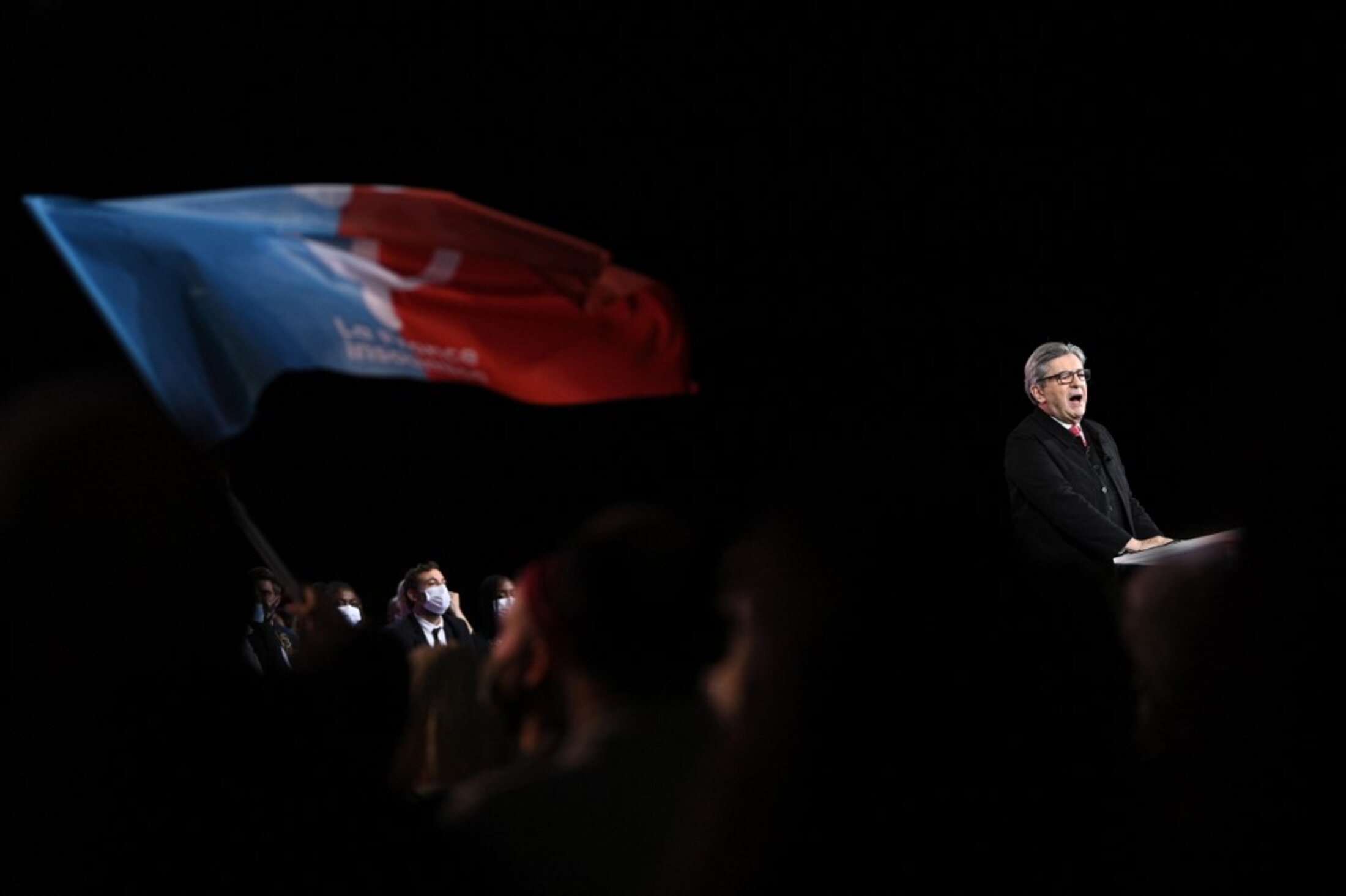
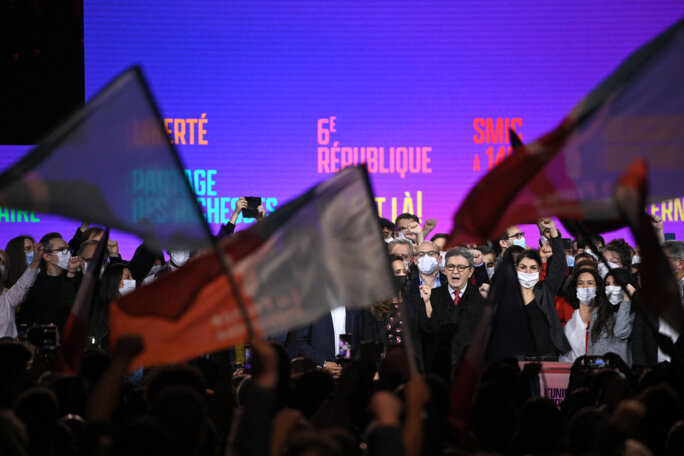
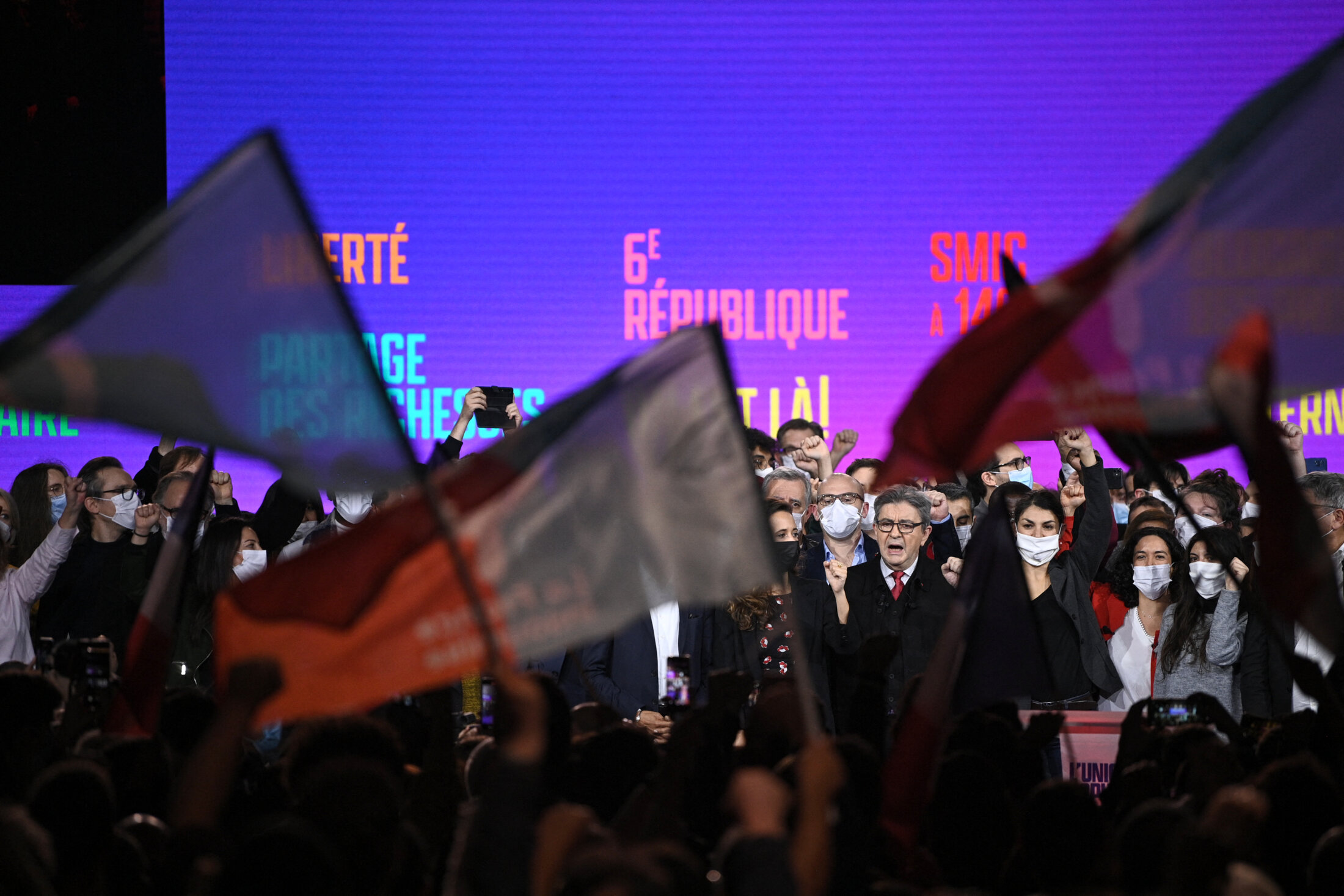
With his fist raised, French presidential candidate Jean-Luc Mélenchon waded through the crowd that was heaving with French flags and those of La France Insoumise, the radical-left party he founded. His first national political rally, held in Paris on Sunday December 5th, came a day after the right-wing Les Républicains announced their candidate for next April's presidential elections. And it took place at the same time as the far-right polemicist Éric Zemmour was staging a rally at Villepinte just north-east of the capital. In these circumstances, therefore, Mélenchon's meeting had one sole objective: to get noticed. “We need to stage a show of force, first and foremost to ourselves,” said the veteran politician at the meeting in a hall underneath La Grande Arche in the La Défense district of the city, to an audience of 3,000. Organisers said there were between 1,500 and 2,000 more people outside.
From behind his lectern, Jean-Luc Mélenchon sought to represent himself as something more than just La France Insoumise's presidential candidate. The country itself had to “get a grip and pluck up courage in itself” because, he pointed out, France was “not about the far right but about social welfare, public health, schools, research and sharing”. In doing so he depicted himself as a political compass for those worried about the far-right political atmosphere and for those who feel lost faced with a splintered French Left.
This was a speech to comfort and reassure the troops, and also for a wider audience. The Member of Parliament for Marseille reserved his choicest remarks for his opponents. With biting humour he dubbed the newly-designated right-wing candidate Valérie Pécresse as “two thirds [Emmanuel] Macron, one third Zemmour” and labelled her manifesto as “a reactionary celebration”. He also reminded his audience of her record as a minister under President Nicolas Sarkozy (she was behind the LRU loi, legislation that gave universities greater autonomy over their funding, with the effect of reducing government funding) and in her current role as president of the Paris regional council, where he said under her social benefits had been “cut by half”.

Enlargement : Illustration 1
With the line-up of candidates for next year's presidential election almost complete, the head of La France Insoumise is keen to take on his opponents. He was eager to “debate with Ms Pécresse” whom he said was nicknamed “Ma Dalton” during the primary election to choose the Right's candidate because she “managed to overcome Averell [Michel] Barnier and Joe [Éric] Ciotti,” he explained to laughter, referring to Ma, Averell and Joe Dalton, who are a fictional outlaw family in the popular comic book series Lucky Luke. But he said he also wanted to debate with current president Emmanuel Macron “the guy who is still not a candidate, which allows him to abuse his office to the maximum” said Mélenchon, a reference to the president's apparent electioneering in recent weeks even though he has not yet formally declared himself as a candidate.
In relation to Éric Zemmour, whom Jean-Luc Mélenchon has already debated on BFMTV news channel – a move that attracted some strong criticism – the radical left politician offered up a very different view of France from the far-right anti-immigration polemicist. This was a France where people loved couscous, pizzas and rap music, in other words the “creolisation” of France which, he said, was the “future of humanity”.
Mélenchon also found time to attack the government's health pass to combat the Covid pandemic, a measure he called “stupid”, and also to lambaste the “Inquisition” from those who claimed he had not made his position clear on vaccination policy. The founder of La France Insoumise also gave some details on his manifesto, including increases in the minimum wage and minimum social payments, and price freezes. There was mention, too, of the environment, of the need to be wary of human “predation” and to be in “harmony with nature”.
But that was not the core of the speech, which was about sending a political message. “We are stating that 'we're here, we're still here and we'll always be here!'” exclaimed Jean-Luc Mélenchon, who added that his strategy of a “popular union” was a “union at the bottom because it's impossible to have unity at the top”.
An enduring ability to bring people together
For the “show of force” intended in this meeting was not just aimed at the immediate audience, but at the rest of the Left too, where other presidential hopefuls are fighting to make an impact. The campaign by socialist candidate and Paris mayor Anne Hidalgo is struggling to take off, while the green candidate Yannick Jadot, who will stage his first high-profile rally this weekend in a modest-sized sports hall at Laon, north-east of Paris, is having to grapple with the fallout from recent allegations of rape and sexual assault against the environmental activist and former environment minister Nicolas Hulot. Meanwhile the communist candidate Fabien Roussel is limiting himself to several small-scale political meetings with party activists. So Jean-Luc Melenchon's aim is to show that, once again, he is the best-placed figure on the Left to do well in the presidential election in April. In the 2017 he was by far the best-performing candidate from the Left, attracting just under 20% of the vote in the first round of that year's election.
And the veteran campaigner is “not alone”, as La France Insoumise's Euro MP Manon Aubry was at pains to tell the audience. In other words, Jean-Luc Mélenchon has lost neither his ability to inject political momentum nor his capacity to bring people together. This is despite his strategic zigzags, his untimely outbursts and the disastrous scenes when he was filmed vehemently objecting to a search of the party's offices by police and prosecutors in 2018. All these had led to a dwindling of electoral support for the political leader.
That context explains Sunday's launch - amid great pomp - of the “Parliament of the Popular Union”, a body whose creation was described by La France Insoumise MP Éric Coquerel as “historic”. The new 'parliament' is intended as a vehicle to attract support from across the board for the La France Insoumise candidate.
So far the gamble looks to have paid off, given that some 200 supporters recruited via various networks have already signed up. They include Aurélie Trouvé, former president of the anti-globalisation organisation Attac as well as its founder Susan George, writer Annie Ernaux, painter and clinical psychoanalyst Sylvie Glissant, whose late husband Édouard Glissant was a poet and creator of the concept of 'creolisation', philosopher Barbara Stiegler, economists Cédric Durand and Stefano Palombarini, the man behind the puppet satire show 'Guignols de l’info', Bruno Gaccio, guitarist Yvan Le Bolloch, a former trade union official involved in the long-running dispute with Continental tyres, Xavier Mathieu, employment inspector Anthony Smith, Ignacio Ramonet, a journalist from Le Monde diplomatique, a prominent activist from Saint-Denis north of Paris, Diangou Traoré, and historian Jean-Marc Schiappa, who is the father of the junior government minister in charge of citizenship, Marlène Schiappa.
Enlargement : Illustration 2
Among those who have signed up are a few political 'recruits' from other groups or movements, including Thomas Portes, former spokesperson for the green politician Sandrine Rousseau, Huguette Bello, the new president of the regional council of La Réunion who came to support Jean-Luc Mélenchon at his party conference last summer, and in partcular Azzedine Taïbi, the communist mayor of Stains, north of Paris, who will clearly not now be campaigning for the communist presidential candidate Fabien Roussel.
“When it comes to unity there are those who talk about it and those who do it on the ground, with people who get involved in the struggle,” said Mélenchon's campaign director Manuel Bombard. He wants to make the parliamentary structure, which is due to be enlarged, one that enjoys a two-way flow with the rest of society.
The mission of the parliament's members is to take La France Insoumise's campaign to all corners and areas of France and become spokespeople on certain themes. But Aurélie Trouvé says that the members of what she calls a “political UFO” will also have a “consultative” role over the campaign strategy and manifesto.
As co-presidents of the new parliament, Aurélie Trouvé, who left Attac a few weeks ago to “preserve the independence of social movements in relation to the political arena”, and Azzedine Taïbi will attend the weekly Tuesday meeting between the new group and the party itself. Both say they intend to play an active role in this body which will sketch out part of the electoral strategy.
Trying to keep this small world united until the end of the presidential campaign in April and the Parliamentary elections that follow is a gamble that carries its own risks for La France Insoumise, whose approach to internal democracy has come under criticism. Meanwhile the party and its candidate intend to make the most of the parliament's initial success. “It's not the number which creates the justice of a cause but it's the justice of a cause that ends up creating the numbers,” Jean-Luc Mélenchon pronounced on stage. “So let's create unity at the bottom. Enough of the moaning, enough of the hesitations, and of the whining. Let's fight!”
----------------------------------------------------------------------------
- The original French version of this article can be found here.
English version by Michael Streeter