


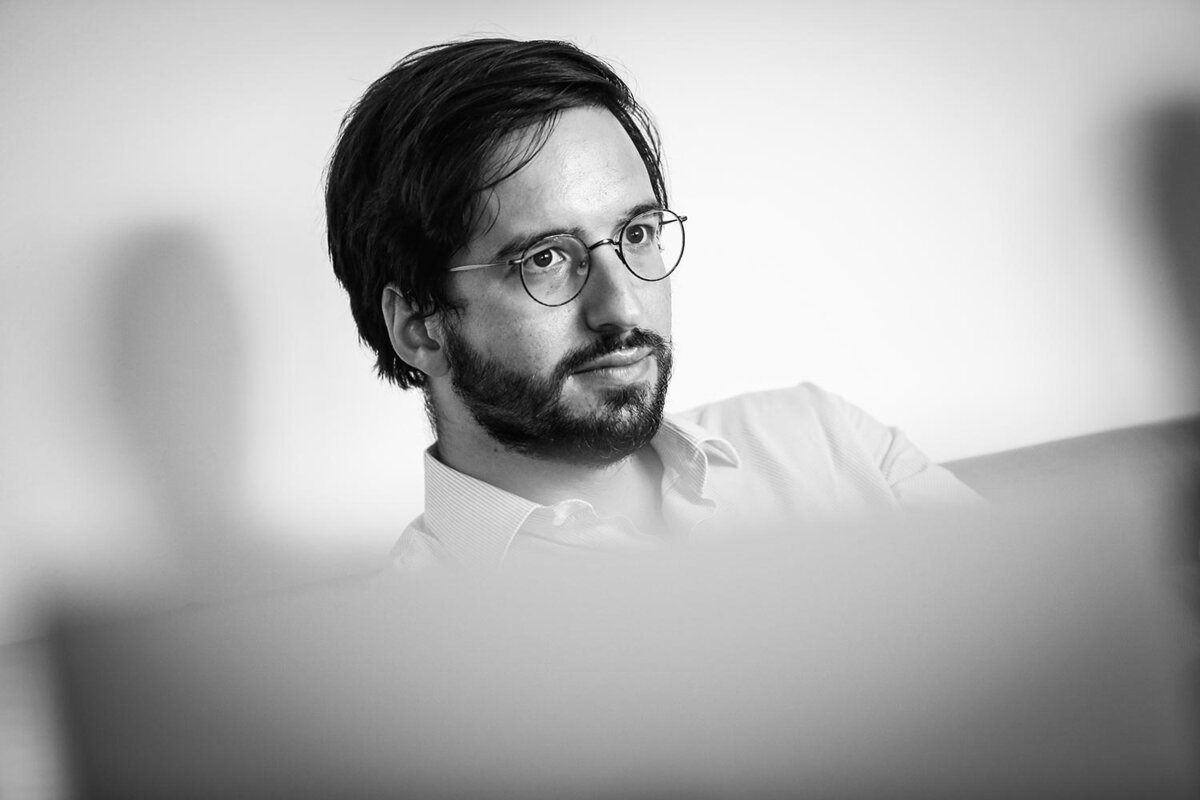
A survivor of the terrorist shooting massacre at the Bataclan music hall in Paris on the night of November 13th 2015, in which 92 people were murdered, Emmanuel Domenach, 38, a jurist by training, escaped without physical injury but suffers from what he calls “an invisible scar”.
The attack on the Bataclan, during a concert by the US band Eagles of Death, was part of a series of shootings and suicide bombings in and around the French capital by members of the so-called Islamic State group, which left 131 people dead, and some 350 others wounded.
Now married and a father, he writes here, on the tenth anniversary of the attacks, about the purpose and value of the collective remembrance of the events.
*
This text is not an account of events, but rather a personal reflection, ten years on, about our collective memory.
Every November 13th is for me a bad anniversary, one of those that one doesn’t want to talk about, but which others always talk to you about.
In reality, I do everything to hide this intimate injury. I was very lucky that night, and I don’t want to be seen through my life as the one “who was there”. I don’t want excuses to be found for me.
Yet this tenth anniversary leaves me with a bitter taste. You have to say that the media coverage is impressive. Similarly, the books and [TV] series are also present. That reawakens the pain, the recollections – but what hits me more than that are the silences.
The first of these concerns the memory. We can only be thankful towards the Paris municipal authorities and the associations representing the victims of November 13th 2015 for the creation of a memorial garden alongside the city hall. However, it is difficult for the garden to hide a certain malaise that one feels about the memorial approach to November 13th 2015 and the wave of terrorist attacks carried out in France at that period.
Enlargement : Illustration 1
One might have hoped that the museum and memorial of terrorism* would come to symbolically express this will to remember and commemorate. Unfortunately, that project has come to a standstill. The political pseudo-controversies, led by some ministers, about the location of its site serve only to hold up its realisation. For the tenth anniversary, there is no museum, just the promise of a new site. Unfortunately, the project is very fragile; only the [French] president backs it and it is to be feared that it will be shelved after 2027 [editor’s note, when Emmanuel Macron’s term in office ends].
This absence of a political will to present a strong message on the tenth anniversary of November-13th says one thing, namely that the memory of the terrorist attacks in not consensual. It is not rare to see interviews with high-profile figures in the media who mock the candles and flowers [of tributes to terrorism victims] as if they demonstrate our incapacity to fight terrorism.
In 2017, the French president, newly elected, had himself declared, in an interview about the fight against terrorism, that: “It must be explained that there are heroes in France, people who commit themselves on a daily basis. And, beyond that, that everyone can find a just place in our society. These new horizons, these new fields of conquest, these new forms of undertaking must be defined in order to exit the spirit of defeat which still today inhabits us too much, in order to finish with the approach of being victims. We are a country of conquest. Not one inch more must be given over to despondent spirits.”
Those words are symbolic of a political vision. We like heroes not victims, because the message is more evident, more appealing. For the victims of terrorism, it’s that well-known [call for] resilience, a silent demand but one which I think was heard by every victim of the November 13th terrorist attacks.
On that point, it is striking to see how the state wanted to recognise terrorism victims with a medal, a symbol more usually reserved for civilians and military personnel whose actions it wanted to celebrate.
I am among those most concerned, and writing here I reflect on my own attitude. Not that I am a hero of anything at all, I’m thinking more prosaically of this desire to hide the trauma, to not speak about it. This need to cover up the individual psychological injury is ultimately joined to the collective embarrassment in face of vulnerability.
Yet terrorism is above all about victims, and few heroes. Victims whose suffering endures over time. Victims who have diverse reactions.
This stupid – but I imagine, effective – sophism that consists of saying one cannot fight terrorism with candles and flowers is devastating for the victims but also for society. No-one has pretended that the commemorations are a tool for fighting terror. No, our tears, our candles and our flowers are those of remembrance, those of a human and fraternal society that remembers. It is also that which makes us oppose the model of society presented by those who attack us.
This first silence is intimately linked to a second. This lack of will towards establishing a lasting commemoration in reality marks a veritable problem about the way in which the November-13th attacks are remembered. It appears as if the state has made the maxim of [then prime minister] Manuel Valls its own: “There is no worthwhile explanation, because to explain is already to want, a bit, to excuse.” Ten years later, one can only note that the state has refused to heed the lessons of November 13th 2015.
Symbolic of this refusal is the fate of the general secretariat of the inter-ministerial committee for the prevention of delinquency and radicalisation, active since 2015. The revelations in 2023 surrounding the Fonds Marianne, followed in 2024 by a report by the national audit court, the Cour des Comptes, have shown that this tool was diverted from its initial purposes in order to allow questionable funding operations.
Globally, if the criminal justice system, through the trial and convictions of those accused of various roles in the November-13th attacks, has worked well, it is a constant that the state has regarded them only through a prism of security measuresn (and even so …). The conferences and debates animated by victims’ associations and specialised researchers include very few contributions from decision-makers – the sign that this is a field that has been abandoned.
We risk paying dearly for this refusal to understand what pushed young French and Belgian nationals to attack, in the name of a religious and violent ideology, innocent people close to a sports stadium, others sitting at café terraces and others at a concert. For if we continue to ignore the reasons behind the events of November 13th 2015 history may repeat itself in a dramatic manner, and we will have to find new heroes, and light up a few more candles.
On the recent [Radio France] podcast “Sigmaringen, le crépuscule des bourreaux”, the historian Henry Rousso – who ironically is also head of the prefiguration mission for the terrorism museum-memorial – spoke about the French collaborationists of the Vichy regime of the Second World War, and the issue of the memory of that period. But his words perfectly resonate, in parallel, on the tenth anniversary of the November 13th 2015 terrorist attacks.
“What purpose does memory serve?" he asked. "Without it, things would be worse. One cannot live without the sentiment of filiation […] For me memory is about trying to understand what from our past lives in our present, to what filiation we belong.”
Ten years on, the process of remembering is to try still to understand.
-------------------------
* The project to create a Museum and Memorial of Terrorism was first announced by President Emmanuel Macron in 2018. In 2024, the government led by Michel Barnier decided to axe the project, but Macron revived it after the fall of Barnier's government in December 2024. Originally planned to be located in the Paris suburb of Suresnes, it is now due to open in 2027 in the 13th arrondissement of Paris.
-------------------------
- The original French version of this article can be found here.
English version by Graham Tearse