


“Collaborators! Collaborators!” These shouts, from Éric Zemmour supporters at his first political rally at Villepinte near Paris on December 5th, were aimed at journalists they accuse of being hostile to the presidential candidate. The vileness of this insult, which stems from the wartime Collaboration of the Vichy regime with the occupying Germans, is rather surprising coming from the mouths of those backing a far-right candidate who has sought to rehabilitate the reputation of Marshal Philippe Pétain, the leader of that very regime.
However, this strange inversion of words is but the latest incarnation of a gradual process of undermining the language that has been attempted by the far-right in France for years. In particular this has led them to describing anti-fascist activists or 'antifas' as “fascists”, and more recently to label anti-racist militants as the “new racists”. What is even worse is that this attempt to subvert the meaning of words has now contaminated a section of the media and public debate itself.

Enlargement : Illustration 1

As a result, when antifas stopped far-right polemicist and presidential candidate Éric Zemmour from carrying out his recent visit to Marseille in peace and calm, his supporters took to social media to claim that the anti-fascists were using “fascist methods”. Indeed, this lexical inversion has been hammered home in the rightwing and far-right media for months. The far-right website Boulevard Voltaire, for example, told the story of a nun who had “chased off the antifas” who were tagging a Marseille restaurant where Éric Zemmour was lunching during his visit. The website recounted this “miracle” after hearing her anonymous testimony: “She asked them what they were doing. They tried to justify themselves by saying: 'He's a fascist!' But the uncompromising nun replied: 'It's you who are the fascists!'” the website reported.
A few weeks earlier the Canadian commentator Mathieu Bock-Côté had explained on the same website that the image of the antifas - the “militias of the far-left” - harassing the patriotic candidate Éric Zemmour was a reminder that “totalitarianism carries a red flag too”.
The day after the Villepinte meeting, at which activists from the anti-racist SOS Racisme were punched by Zemmour supporters, the lawyer Gilles-William Goldnadel used a comment article in the rightwing daily Le Figaro to rail against antifas whom he says want to silence the far-right polemicist through violence. “Which side of the political street does intolerant fascism live on?” he asked. The lawyer has just published 'Manuel de résistance au fascisme d’extrême gauche' ('Manual on resisting far-left fascism') published by Éditions de Passy, which he describes as a book that is “forbidden for all those who haven't yet understood that fascism is today situated on the far-left of the political and intellectual chessboard”.
“The rhetoric of the mirror allows you to throw back accusations of fascism or violence at your opponent, to pull the rug from under their feet and, most of all, to deaden the meaning of these expressions. In describing anybody – and in particular anti-fascists – as fascists, the idea is to discredit not only political opponents but the very notion of fascism as a system of thought and totalitarian political organisation,” said academic Cécile Alduy, whose book 'La Langue d'Éric Zemmour' ('The language of Éric Zemmour') will be published in February by Seuil.
“It devalues the accusations made against Éric Zemmour and the neo-Nazi groups who support him and who were at the meeting. If the anti-fascists are 'fascists' then no one is, and the word no longer has any meaning,” said Alduy, a professor at Stanford University.
Cécile Alduy said that calling journalists “collaborators” was part of this “semantic impoverishment”. She said: “'Collaborator' becomes just another insult, detached from its very precise historical meaning.”
After the Islamist terror attacks in France in 2015 the expression 'Islamo-collaborator' sprang up in the far-right media, in particular in the magazine Valeurs Actuelles, and was used to target figures involved in the fight against Islamophobia. This was a clever way to remove a label – 'collaborator' - which has clung to this political family since the Nazi occupation, and instead apply it to its opponents. In November 2019 the Le Figaro columnist Ivan Riofol also penned a piece in which he jeered at those calling for demonstrations against Islamophobia after shots were fired at a mosque in Bayonne in south-west France, calling them the “cream of Islamist collaborators”.
A purely rhetorical trick
It is the same for all the rhetoric that emanates from the far-right, and sections of the Left too, that tries to depict the new anti-racists as “racialists”.
“For some year's we've been witnessing a move towards semantic inversion that has a political aim,” said Cécile Alduy, an expert in semiotics. “It's about detaching words from the objects or groups that they normally designate in order to turn them against the very people whose political combat is to fight against certain forms of discrimination or violence, by accusing them of doing that which they condemn. In this way, by accusing the anti-racist activists of being 'racialist' the implication is, in the end, that they are 'racist'. The reasoning is appalling: the anti-racists speak about racism, so they use the idea of 'race', so they are 'racialist', and thus implicitly 'racists'. It's a purely rhetorical trick, word play.”
A historian of the far-right, Nicolas Lebourg says that this semantic battle has a long history inside the French far-right. In the 1960s the far-right ideologue Dominique Venner suggested that, in the post-war era, they had to “reinvent political vocabulary, impose their words and change those of their opponents”. This fitted with the approach of far-right European groups who were seeking ways to detoxify the image of National Socialism.
From the 1970s this became the main combat of a section of the Nouvelle Droite or 'New Right' movement – in reality it was the radical far-right - which began in France under philosopher Alain Benoist. In 1972 the passing of the 'Pleven law' outlawed racial discrimination, and this also forced the far-right to adapt its language. “You no longer now speak of 'race' but of 'identity',” was the refrain of the new rhetoric adopted by exponents of identity politics, an approach followed today by former Euro MP Jean-Yves Le Gallou, who was a prominent figure at Zemmour's rally at Villepinte.
“From 1982 Jean-Marie Le Pen [editor's note, founder of the far-right Front National] no longer used the label of far-right party, acknowledging that the expression had too many bad connotations,” said historian Nicolas Lebourg. Like Éric Zemmour, Marine Le Pen, the president of the Front National under its new name Rassemblement National, complains of stigmatisation whenever the media classifies her as belonging to that political family.
Enlargement : Illustration 2
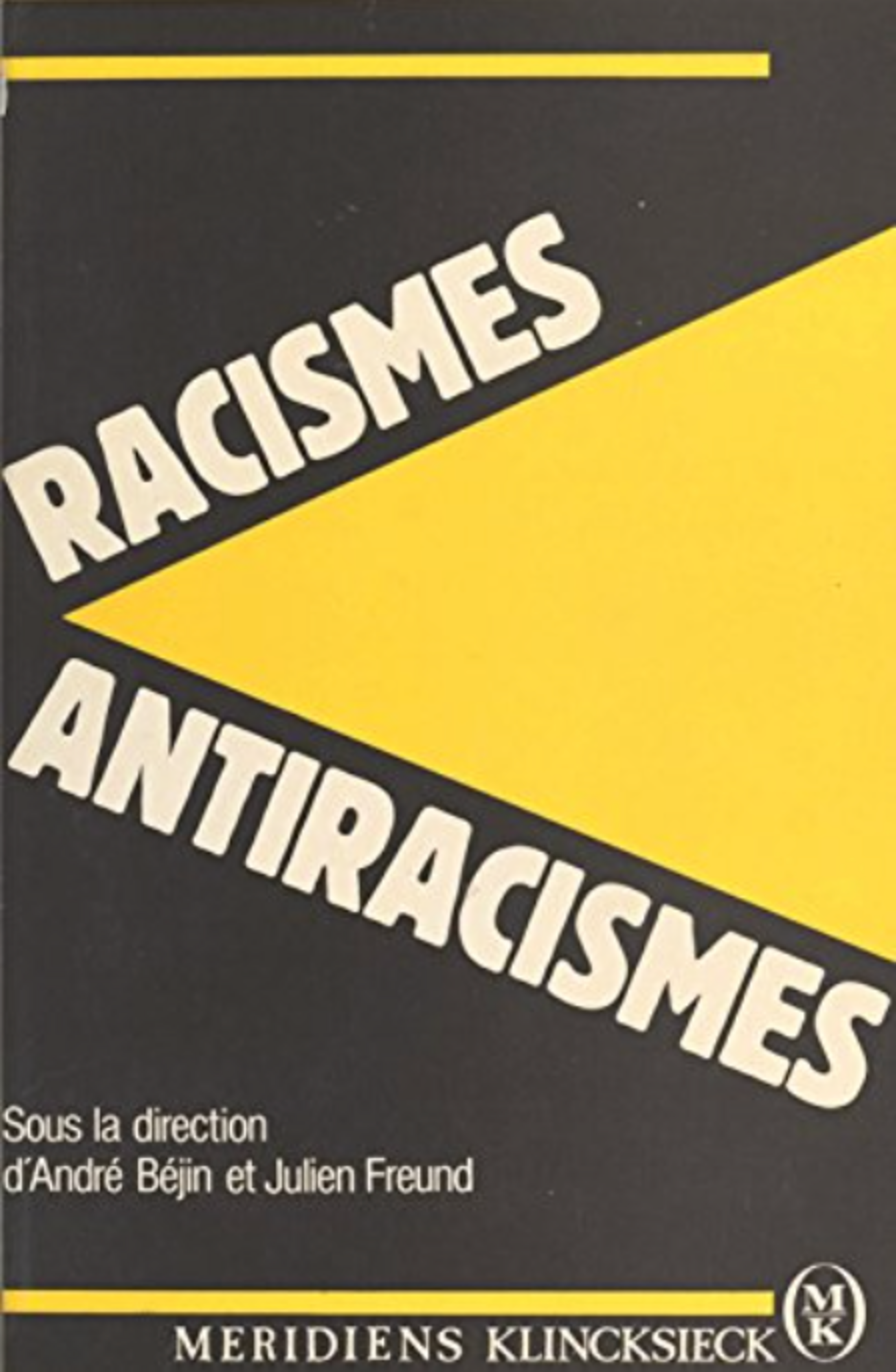
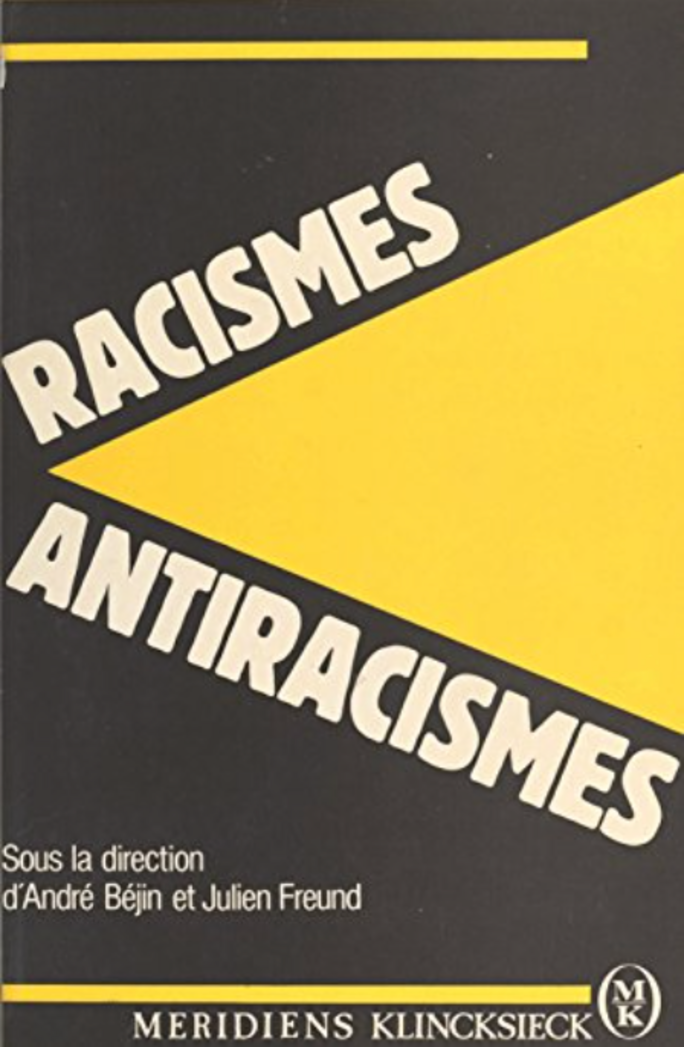
The role of prominent intellectual and philosopher Pierre-André Taguieff has been crucial to the far-right's mislabelling and criticism of its anti-fascist and anti-racist opponents. “Taguieff was to become a point of reference,” wrote Nicolas Lebourg in his book 'Les nazis ont-il survécu? Enquête sur les internationales fascistes et les croisés de la race blanche' ('Did the Nazis survive? Investigation into international fascists and white race crusaders') published by Seuil in 2019.
In an article published in 1986, in a collective work to which the Nouvelle Droite's Alain Benoist also contributed (see right), Taguieff drew a striking parallel between “anti-racists” and racists. In his article he criticised the “politicisation of anti-racism” which “conferred on it an instrumental role in an ideological war in which one of the aims is to paralyse the opponent.” The anti-racists are thus seen as censors motivated by a totalitarian ideology. This was a furrow he would go on to plough in book after book and an approach which was later emulated by others.
In 2007 Éric Zemmour laid claim to this legacy when he criticised the president of the anti-racist group SOS Racisme, Dominique Sopo, as journalist Sébastien Fontenelle has noted. “It's the result of a lengthy preparation of minds,” said the journalist, who works with the collective group Les Mots Sont Importants. In his book 'Les Éditocrates', published by La Découverte in 2018, Fontenelle quotes from an op-ed that Zemmour wrote in Le Monde in 2007: “Sopo doesn't know that one has read Pierre-André Taguieff; we've absolutely understood that anti-racist progressivism was simply the successor to communism, with the same totalitarian methods honed by Comintern in the 1930s. 'An anti-communist is a dog,' said [philosopher and writer Jean-Paul] Sartre. Any opponent of anti-racism is worse than a dog.”
So who, in Éric Zemmour's view, are the real fascists? There is no point in looking on the far-right of the political spectrum because in his view they are, and have been from the start, to be found at the other end. “Fascists are people from the Left,” he stated on CNews television channel in June 2021, as academic Jonathan Preda noted in an article for the website Fragments sur les temps présents. “What does it matter if it's not new in any way?” Preda writes, or that no one in fact contests the socialist origins of Mussolini. The important thing is to empty fascism of any meaning and hurl it back at the Left.
One again, Éric Zemmour has a few good teachers. For 'Socialism and fascism: the same family?' was the theme of a meeting of the Club de l’Horloge, a rightwing club in France that emerged from the Nouvelle Droite, held on November 22nd 1983. “Its members were invited to discuss this theme: discuss is in fact rather a grand word to use given that the suggested equivalence was affirmed and re-affirmed throughout the contributions,” wrote Preda. “The research by Zeev Sternhell [editor's note, the Polish-born Israeli historian] on the origins of fascism was recast and caricatured. From a blend between nationalism and socialism, fascism becomes national socialism … the campaign slogan used by socialist president [François] Mitterand, 'Changer la vie' ['Change life'], became the equivalent of a totalitarian desire to create a new man!” noted Jonathan Preda.
Éric Zemmour is thus the inheritor of this long tradition of semantic subversion conducted by disciples of the cultural wars. And so, too, is the media that has used such dangerous analogies in recent weeks.
----------------------------------------------------------------------
- The original French version of this article can be found here.
English version by Michael Streeter