


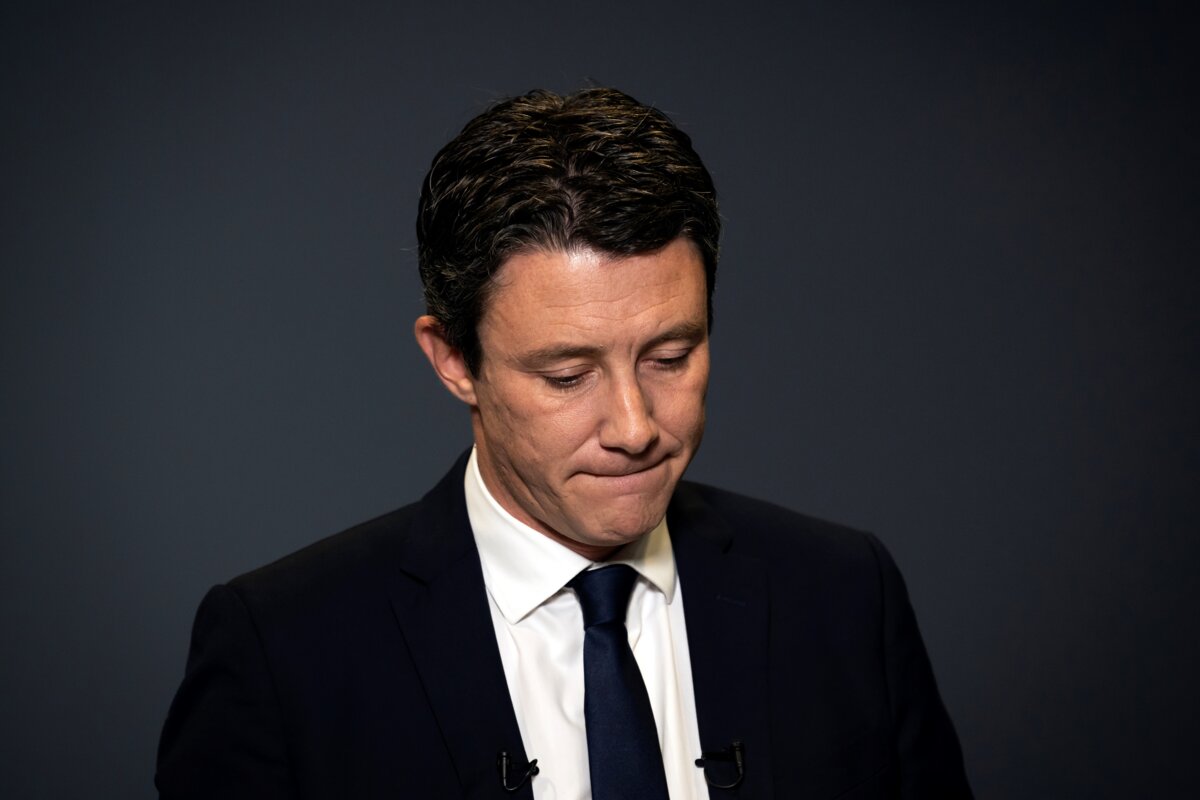
Benjamin Griveaux, a close ally of Emmanuel Macron who was running for election as mayor of Paris as official candidate of the president’s ruling centre-right LREM party, announced on Friday that he was stepping down from the race after the publication on the internet of compromising sex videos, and which began rapidly spreading on social media late Thursday.
The downfall of the 42-year-old Member of Parliament (MP), who joined Macron’s LREM party after jumping political ships from the Socialist Party, is a major embarrassment for the French president and his government, for whom Griveaux served as spokesman between 2017 and 2019, and who are now left struggling to find a replacement candidate barely four weeks before the voting for control of Paris city hall begins.
Meanwhile, a number of questions over the involvement of controversial Russian self-styled political artist and activist Petr Pavlensky, who posted the sexually explicit video footage online, remained unanswered late Friday, and notably how he gained possession of the footage.
Enlargement : Illustration 1
The mayoral election in Paris is the prize contest amid nationwide polling to elect municipal councils which are held in two rounds on March 15th and 22nd. Surveys of voter intentions suggest Macron’s LREM party will fair poorly in what will be its first local election test since arriving in power in 2017.
The party, which early last year had bright hopes of wrestling power in the capital from socialist mayor Anne Hidalgo, had already suffered embarrassment in the Paris campaign when its maverick MP, the acclaimed mathematician Cédric Villani, awarded the prestigious Fields Medal, announced he was running on an independent ticket after failing to be endorsed as the party’s official candidate. The dissident, whose standing in opinion polls had weakened Griveaux’s support, last month snubbed Macron’s personal intervention to convince him to stand down and was promptly excluded from the LREM.
Griveaux gave a solemn speech on Friday morning in which he said he was withdrawing as candidate in the March elections following “horrid attacks” concerning his private life. The married father of three said he and his family had already been hurt by a “torrent of mud” over the past year, marked, he said, by “defamatory comments, lies, rumours, anonymous attacks” and even death threats.
“My family doesn’t deserve that,” he said. “No-one, in the end, should ever suffer this violence. As far as I am concerned, I am not willing to further expose my family and myself, when every blow is now permitted. It goes too far.”
Later on Friday, Prime Minister Édouard Philippe, campaigning ahead of the March elections in the northern port town of Le Havre, his political fiefdom, posted on Twitter a message of support for Griveaux, who he said his thoughts were with and who had taken a decision according to his “conscience”.
“A difficult decision,” added Philippe. “For the present, it is urgent to leave the man and his family in peace.”
The video footage was first posted online on Wednesday by Petr Pavlensky, a controversial Russian self-styled political artist and activist opposed to President Vladimir Putin who obtained political asylum in France in May 2017. Pavlensky said he published the material in order to “denounce the hypocrisy” of Griveaux for featuring his family to promote his election campaign. The Russian said his “source” for the videos was a woman who “had a consenting relationship” with Griveaux.
Pavlenski, 35, had approached Mediapart and other media earlier this week with the videos and screenshots of messages all purportedly sent to the woman by Griveaux. After a meeting with Pavlenski on Tuesday, Mediapart declined to accept the videos and screenshots he proposed on the basis that no public interest was served by their publication.
Questions surround Pavlenski’s targeting of Benjamin Griveaux. “I was preparing the project since a while,” he told Mediapart, insisting that he acted alone. The website on which he exposed the video footage and screenshots, called pornopolitique.com, was registered outside of France on November 23rd last year. The publication of the videos was first accompanied by an explanation of his motives which he posted, in Russian, on his Facebook account, and this subsequently appeared translated on the website in French. Pavlenski speaks little French and cannot write in the language.
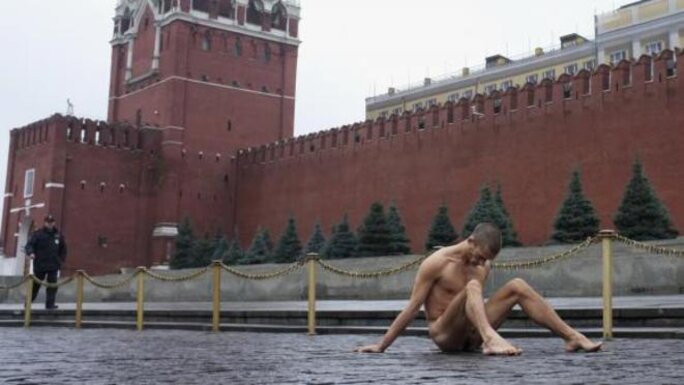
The Russian has a history of organising headline-grabbing stunts which he describes as political art. He attracted worldwide attention in 2013 when he nailed his scrotum to the ground in Moscow’s Red Square, and in October 2014 Pavlensky used a kitchen knife to cut off his earlobe while sitting naked on the roof of the infamous Soviet psychiatric Serbsky internment centre in a protest at abuse of psychiatry in Russia. He was subsequently interned himself and submitted to tests which finally concluded he had no mental disorder. Then in 2015 he set fire to the entrance of the Lubyanka building in Moscow which houses the Russian security services, the FSB.
Enlargement : Illustration 2
He and his personal partner, Oksana Shalygina, fled to Paris with their two children in January 2017 after the couple were jointly accused of sexual assault by a Russian actress. In October 2017, after gaining political asylum in France, he set fire to offices of the Bank of France situated on the Place de la Bastille in central Paris. He spent 11 months in preventive detention until he was sentenced, in January 2019, to three years in jail, two of them suspended.
Mediapart has learned that Pavlenski is wanted by Paris police for questioning over an alleged stabbing during a fight at a New Year’s Eve party in a Left Bank apartment. Pavlenski confirmed to Mediapart that he had been involved in a fight with a “group of provocateurs” at the party, but denied using a weapon.
“In Moscow, Petr acted in a cultural and political context which he obviously knew,” said a friend of Pavlenski’s, speaking to Mediapart on condition his name was withheld. “In France, he doesn’t really have the codes […] I was never aware in advance of what he was preparing and I have no idea about why he interests himself in French politics.”
Before the sex videos were posted online, Griveaux’s campaign for Paris city hall was already stuttering, and his once second place in opinion surveys of voting intentions was overtaken last December by conservative Les Républicains party candidate Rachida Dati. An opinion poll published by French daily Le Figaro late January subsequently confirmed his third place, crediting him with 16% of voting intentions, neck-and-neck with the Green party candidate and behind Dati on 20%, with incumbent mayor Anne Hidalgo, seeking re-election, in first place at 23%. Importantly, LREM dissident Cédric Villani was credited with 10% of voting intentions.
“If he [Griveaux] had been on 32% in the opinion polls, he could perhaps have attempted to overturn opinions,” commented an LREM MP, speaking to Mediapart on condition his name was withheld. “Given what people already think of him, it was [the release of the videos] guaranteed ruination. The decision to leave was unavoidable.”
LREM deputy leader Stanislas Guerini announced on Friday that an emergency meeting of senior party officials would be held “in the coming hours” to “rapidly” choose a replacement candidate for Griveaux.
Meanwhile, Griveaux’s lawyer, Richard Malka, told rolling news radio station France Info that he would launch legal action against “all publications which violate personal privacy”, in a clear warning against re-publication of the videos or screenshots. Under French law, the violation of personal privacy is punishable with a maximum sentence of two years imprisonment and a fine of 60,000 euros. French interior minister Christophe Castaner, who spoke of his “profound sadness” for Griveaux, said that those behind the publication of the videos “obviously” should be prosecuted.
The publication of the videos caused outrage across the political spectrum on Friday. “The publication of intimate images to destroy an adversary is odious,” tweeted Jean-Luc Mélenchon, the figurehead and parliamentary leader of the radical-left La France insoumise (LFI) party. “Refuse the voyeurist sinking of public life in the country.” LFI MP Alexis Corbière denounced what he called an “Americanisation” of French political behaviour.
Sébastien Chenu, spokesman for the conservative Les Républicains (LR) party, tweeted that, “The respect of private life should be something that is inviolable in our democracy”, while his party’s candidate in the Paris mayoral elections, Rachida Dati, speaking on rolling news radio station France Info said she held “a strong thought for the family of Benjamin Griveaux”.
EELV Green party Member of the European Parliament David Cormand said, “nothing justifies crass public humiliation”, adding “We all deserve better.”
“Private life should remain private as of the moment that there is no breach of legality or exemplarity,” commented Socialist Party leader Olivier Faure, while Communist Party general secretary Fabien Roussel said, “those who participate in this operation are disgusting individuals”.
-------------------------
- This report is compiled from three articles originally published by Mediapart in French, available here, here and here.
English version by Graham Tearse