


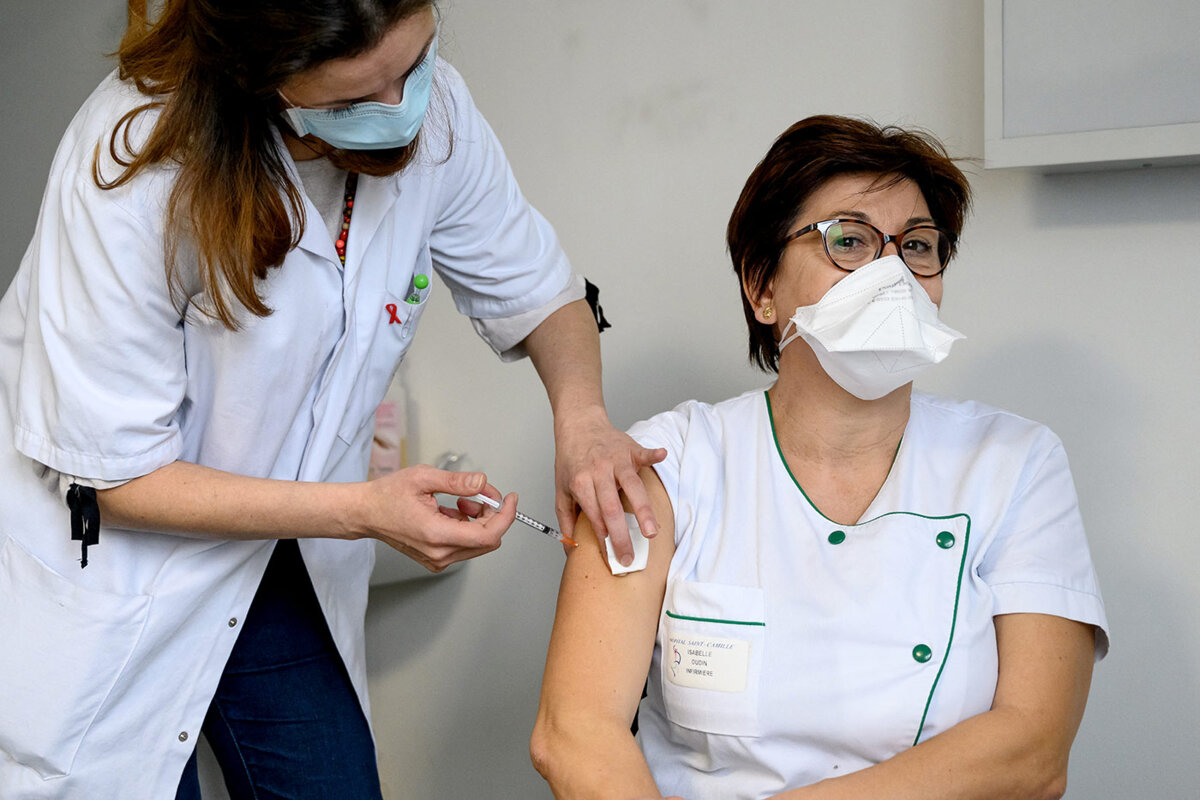
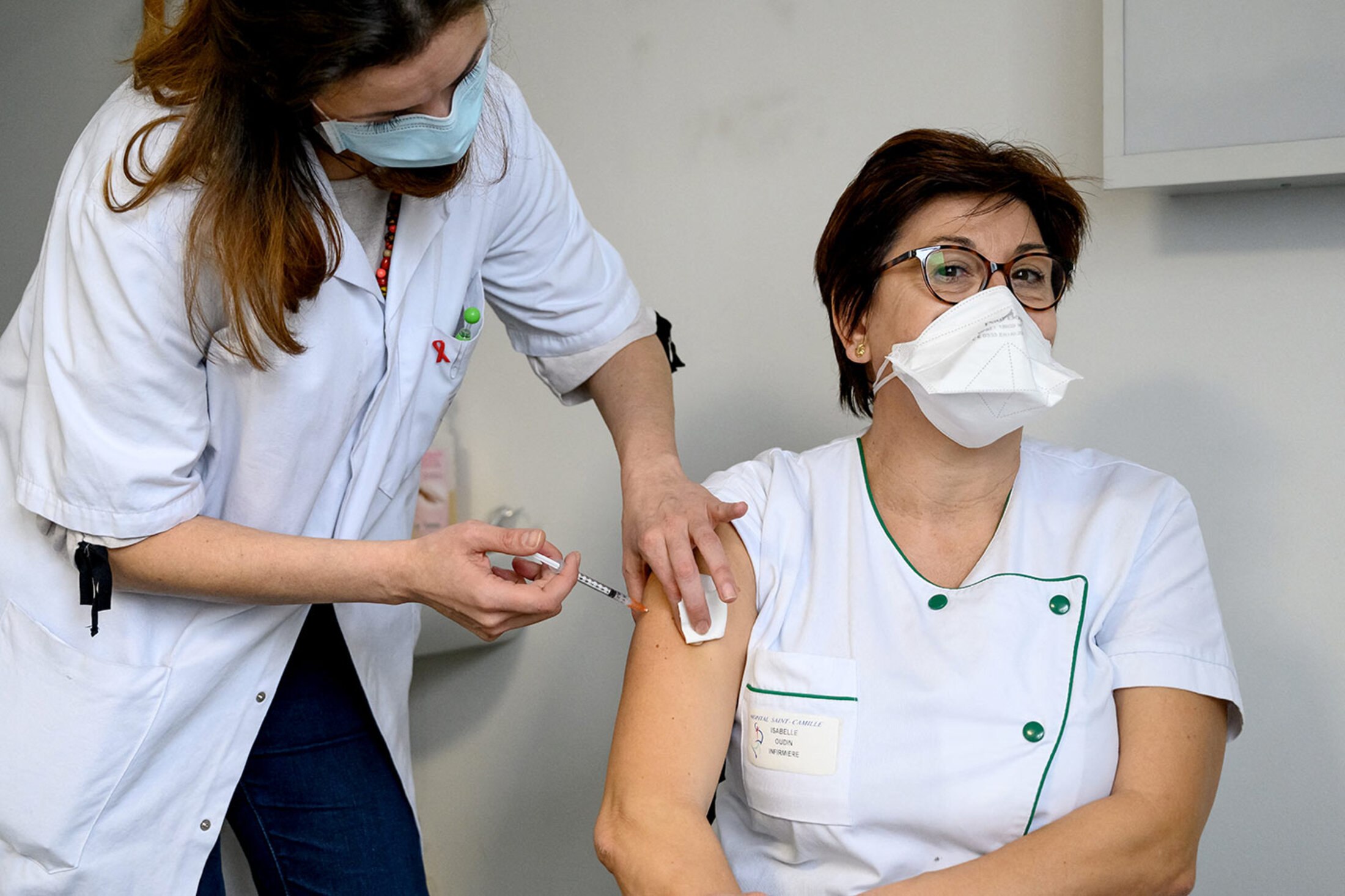
The deadline for medical professionals and many other workers to get fully vaccinated against Covid-19 was this Wednesday September 15th. This obligation, which applies to staff in retirement homes, medical administrative staff, gendarmes, firefighters, home carers and ambulance crews among others, as well as nurses and other medical staff, was announced by President Emmanuel Macron back in July. Those who have not complied with the obligation face being suspended from their jobs with no pay.
The latest figures from the public health body Santé Publique France suggest that a large majority of nurses and care home workers are now fully vaccinated. Yet while 84% of these workers are now double vaccinated and 88% have had at least one jab, that still means thousands of key workers could soon face suspension – potentially causing staffing problems in these critical services.
This explains why right to the last minute hospitals and other healthcare bodies have been trying to persuade their last remaining unvaccinated workers to get their injections. And why those who have not yet been vaccinated have been desperate to find out what fate lies in store for them at their workplace.
At the Nord hospital in the Mediterranean city of Marseille, for example, Karim Djebali's telephone keeps on ringing. The official at the Sud trade union has been taking calls from unvaccinated staff who are worried what will happen to them when the deadline arrives. There is little he can tell them other than what they already know: if they are still unvaccinated, from September 15th they will no longer be able to work and their pay will be stopped. “The tension has been mounting, managers have been going around the [hospital] units to look for the unvaccinated,” Karim Djebali told Mediapart a few days before the deadline. “Management has communicated very little, it's now using repression,” he said angrily. “I've had people on the phone in tears.” There was just one small glimmer of hope he said. “We're hoping our union will take legal action against mandatory vaccination.”
But even if that happens it seems highly unlikely to change anything. The government has been determined to apply article 14 of the new law that was passed on August 5th and which set the vaccine deadline for September 15th. Both the prime minister Jean Castex and the health minister Olivier Véran have constantly made this clear. Ministers have also sent out strict instructions to ensure that unvaccinated workers do not simply sign off sick to get round the rules. Employers in the public sector whose staff are stay off work due to illness will be expected to flag these cases to local social security offices so that checks can be carried out.
Before this Wednesday's deadline arrived, managers at medical establishments were busy finding out just which staff are still not fully vaccinated. “We have been sending out letters to staff whose vaccine status we don't know,” said Maxime Morin, deputy secretary-general of the health managers' union Syncass-CFDT and directer of Roubaix hospital in the north of France. “In my hospital, which has 3,100 staff, we have sent out 225 of these letters. Some of them have supplied their QR code [editor's note, to show they are vaccinated]. For the rest we have organised 150 individual interviews. So far around ten staff are still refusing the vaccine.”
They are eorcing consent from us, it's awful.
In Marseille one nursing assistant, who asked to remain anonymous, said she was determined to refuse the vaccine. “I'm going off on holiday, we'll see afterwards. But I'm ready to lose my salary and am thinking about changing profession,” she told Mediapart. “They want to vaccinate us like an assembly line, with no reflection to consider the side effects, I don't trust it at all. They are forcing consent from us, it's awful, pathetic. We should be free to decide what's right for us.”
Also in Marseille, Mediapart spoke with a hospital cleaner who had just decided to go to a vaccination centre. Off sick currently for depression, she had read the letter that the hospital sent to her home. It states that if she cannot provide proof she has been vaccinated her pay will be suspended from September 15th, as well as her holiday entitlement, her length of service and her promotion chances. “I'm forced to get vaccinated even though I take medicine for my heart problems,” she said. “I think about it a lot, I cry a lot, I get unbelievably anxious. I hear a lot of things about the side effects of the vaccines. And I've never seen the [Covid] sick in intensive care.”
Enlargement : Illustration 1
Pierre Pinzelli, who is secretary-general of the major hospital centre Assistance Publique-Hôpitaux de Marseille (AP-HM), said that they had carried out a “communications campaign about the vaccine” and that he wanted to use dialogue right through to the end. “We are sending letters, then we're organising at least two interviews with the people who are refusing the vaccine. We're not taking an aggressive approach.” But he also made clear their firm stance on the issue. “Before the vaccine was legally obligatory, the vaccine was a moral obligation in the hospital,” he said.
There are no official figures for vaccination rates for all health professionals. However, hospital managers said that in the run-up to the deadline the numbers of those fully jabbed had been increasing. By Friday September 10th “90% of the staff were vaccinated” in Marseille's hospitals”, said Pierre Pinzelli. He added: “Those in the remaining 10% are sometimes already in fact vaccinated, off sick or on holiday.” As for the likely staffing impact of those personnel who have not got jabbed on time, Pierre Pinzelli admits he has “some concerns for around ten services out of 240”. He said: “We've prepared a replacement team to mitigate the absences.”
While hospital bosses are fully applying the law over mandatory vaccinations, there is some unhappiness that they have been put in this position. “We could really have done without the mandatory vaccinations in this period after the summer holidays when it was already difficult to schedule everything,” said Anne Meunier, secretary-general of the health managers' union Syncass-CFDT. “We're also quite uneasy at having to use sanctions. That makes social dialogue harder, while up to now we've tried to show an educative approach.”
At Saint-Denis hospital in the north Paris suburbs, management said it was “premature to give figures. It's a sensitive issue”. According to Yasmina Kettal, an official for the Sud trade union at the hospital “just as with the département [editor's note, the département or county of Seine-Saint-Denis, just north of central Paris] the hospitals in Saint-Denis are apparently behind. The situation's tense, some staff are calling us to pour out their anger,” she said. “Psychologically, they are very vulnerable, totally anxious and mistrustful. All year they've put up with their work conditions, their workload, their salary. Mandatory vaccination is seen as another imposition. They see the vaccine as an unacceptable intrusion in their private life. Some need more time. But others say they are ready to quit their job. How many? Probably a few more that you think. No hospital can get away with losing 5% to 10% of its employees!”
We took a position in favour of vaccination, we must also be there for our colleagues who refuse the vaccine.
The union official, who is still a nurse, acknowledges her ethical dilemma. “We took a clear position in favour of vaccination, people know that. We have to support the collective and individual protection of the staff, that's our job. We must also be there for our colleagues who refuse the vaccine. All the unions are playing it by ear.” However, she has no such ambiguity when it comes to the recent demonstrations in France against the health pass. “We are an anti-fascist union, we don't demonstrate with the far right. We also can't be in favour of something that's dangerous for others. I've seen too many deaths from Covid,” she said.
Her counterpart in Marseille, Karim Djebali, has a rather different stance. He has not yet got vaccinated “out of solidarity with colleagues”. He said: “We're against mandatory vaccination, and in favour of freedom, freedom of choice.” Some sections of the Sud union in Marseille hospitals have taken part in the Saturday protests against the health pass.
In Saint-Denis hospital, meanwhile, there has been a massive information campaign about the vaccine. Information meetings have taken place in each hospital centre, run by vaccine ambassadors, and anonymous medical consultations have been made available. “To reach those who don't want to come and hear about the vaccines we've also arranged to go around the units day and night to give information about them,” said infectious diseases specialist Quentin Bougault, who has organised the campaign.
Initially we are not really welcome. Then the conversation starts and can go on for two hours.
He described these mobile information patrols, which are aimed at the staff who are the most reluctant to get vaccinated. “It always goes the same way; initially we're not really welcome. The nurses tell us that they're not really interested, it's a bit awkward. Then the conversation starts and can go on for two hours,” he said. “In the end you can vaccinate six people like this, It's effective but also very time consuming.”
The hospital specialist said that he comes across “complex and irrational” reluctance to have a vaccine. “There are those who have taken refuge in their convictions, who have created a circle of information around themselves, it's awful. But I have also noticed that the professions who are the least vaccinated are also those who were the least protected during the first and very hard wave in our hospital. Today I get calls from nurses in tears telling me that they're going to get vaccinated,” said Quentin Bougault. “It's a bit humiliating to be vaccinated when you're very frightened. We can't get out of this without mandatory vaccination. But it's a failure that we've got to this point. It will leave its mark.”
However, hospital director Anne Meunier plays down the problems that the obligation to have a vaccine have caused inside the hospital itself. “[The problems] come much more from outside. There are demonstrators who have daubed threats in front of the home of the director of Marseille's hospitals [editor's note, it turned out to be at the home of someone with the same name]. [Protestors] invaded the hospital at Pau [in south-west France]. And many hospital directors have received abusive letters, threats.”
------------------------------------------------------------------------------
- The original French version of this article can be found here.
English version by Michael Streeter