


The word kharmohra, borrowed for the title of an exhibition of contemporary works by 11 Afghan artists now showing in Marseille ("Kharmohra: Art Under Fire in Afghanistan"), is a phonetic translation from the Dari language which literally means “the stone of the donkey”. This is often oblong in form, and of a clear beige colour, and can still be found, but not without difficulty, from a few street sellers close to the Shah-Do Shamshira mosque in the centre of the Afghan capital Kabul.
In fact, it is not a stone but the gland or cartilage situated in the throat of donkeys. Tradition has it that once it is removed and dried, when it becomes stone-like, it holds magic – and even nefarious powers – that allows the intimate wishes of the person who possesses it, like attracting someone they desire, to come true (which is why these objects can fetch a price of 600 dollars).
But firstly it must be magnetised. This involves taking it to a mullah who will ‘breath’ over it a recital from a few chosen verses from the Koran (an exercise which also costs dear, at around 100 dollars).
Here we are in the supernatural, but in Afghanistan tragedy is never far away: on March 19th 2015, a 27-year-old student of Islamic law, Farkhunda Malikzada, a devout Muslim, became involved in an argument with a mullah,called Zainuddin, engaged in such mercantile practices, a seller of amulets, which she questioned the morality of. The dispute degenerated and the mullah loudly accused her of blasphemy and, as a crowd gathered, he shouted out that she had burned the Koran.
It sparked a delirious attack on the student by a lynch mob of several dozen men, which soon numbered several hundred, who pushed her to the ground, beating and kicking her, bawling anti-American slogans. The scene was filmed on mobile phones. At one point, police officers present fired several shots and the crowd backed off, leaving her a space, bloodied, dishevelled and dazed on the ground.
But the crowd soon regained the upper hand, and the lynching continued. She briefly found refuge in the Shah-Do Shamshira mosque, but was soon recaptured by the mob, when she was kicked and beaten with sticks before a car was driven over her, dragging her body along a street.
Afterwards, she was thrown onto a dry bank of the river Kabul and lapidated, when her naked and mutilated body was set alight.
Horrific mobile phone footage of the lynching was uploaded onto the internet. It was traumatic for the women of Kabul, many of whom would defy Muslim tradition not only by attending Farkhunda Malikzada’s funeral, but also by carrying her coffin and laying it to rest.
The lynching also profoundly affected a generation of Afghanistan’s contemporary artists, often self-taught, who had grown up under the Taliban regime, when images were denied them. Their art saw the light of day after the fall of the Islamic fundamentalists in 2001,the midway point of four decades of conflict in the country, militarily occupied over a decade by the former Soviet Union from 1979, then ruled by the Taliban, and subsequently invaded by the US and its coalition allies.The exhibition at the Musée des Civilisations de l'Europe et de la Méditerranée (the Museum of European and Mediterranean Civilisations) in Marseille, “Kharmohra: Art Under Fire in Afghanistan”, tells that story.
Enlargement : Illustration 1
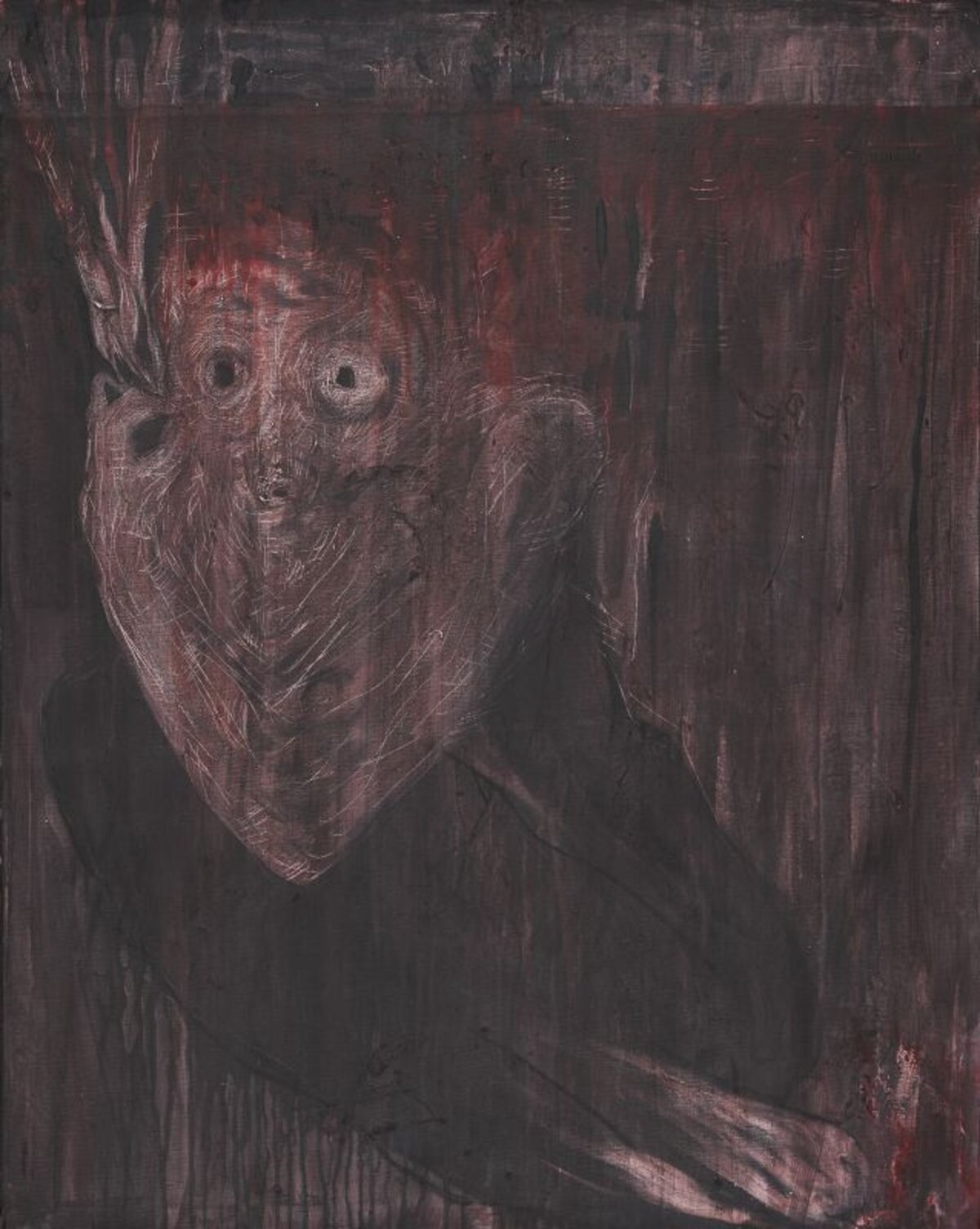
Afghan painter and video-maker Mahdi Hamed Hassanzada was the first to react to the lynching of Farkhunda, which began shortly before he made his way by taxi to the Cactus Cafe, a centre for artists situated close to where she was attacked. He recounted how the taxi driver, learning of the young woman’s death, shouted in joy, and invited Hassanzada to look at the vile video footage that had begun circulating on social media. For the artist, it was a profound shock to witness how the driver, a seemingly ordinary man, could be gripped, in an instant, by such hate.
In one of his paintings, Kabus (meaning "nightmare"), on show in Marseille, he depicts himself as the anguished character living in constant fear amid the violent environment of Kabul.
He went about creating a vast mural at the Cactus Cafe which depicted the terrible ordeal of Farkhunda, and which was later destroyed under pressure from religious extremists, when soon after the arts café was closed. Photos of Hassanzada’s mural feature at the exhibition in Marseille along with other works by the artist, born in 1978 and who now lives in the US. The theme of the mural was reprised by miniaturist Ali Momeni, who depicted the young student as “beautiful and sensual” and with a cup of wine, which represented what he said was “the temptations that scare and wake bestiality and frustrations”.
Enlargement : Illustration 2
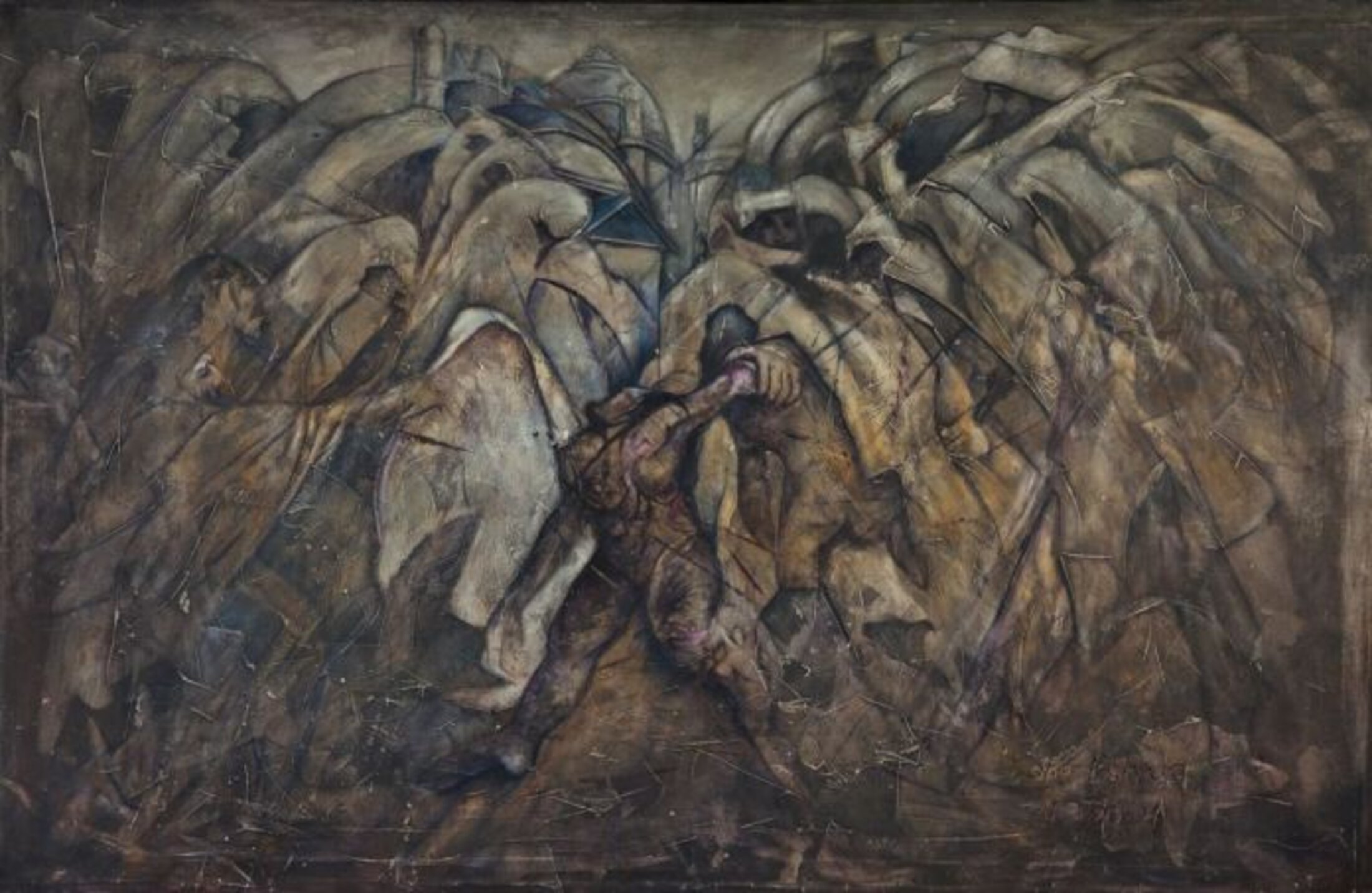
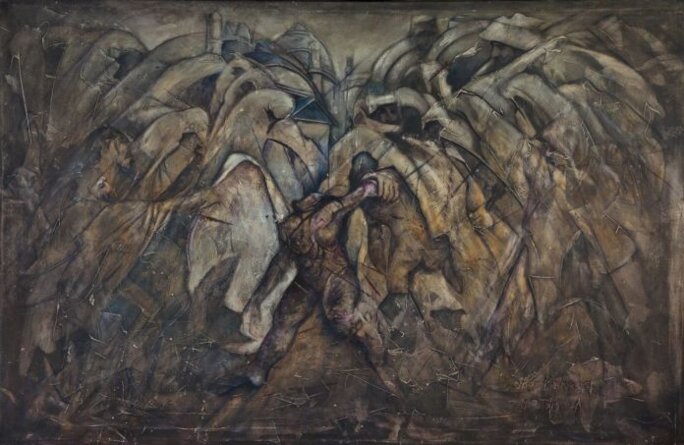
Another painter, Latif Eshraq, born in 1970, depicted the lynching in an oil painting (above) entitled simply Farkhunda, also on display at the Marseille exhibition along with other works by Eshraq. The young student is shown nude (nudity is an absolute taboo in Afghanistan) at the centre of the painting – which exhibition curator Guilda Chahverdi explained is a representation that says “she carries the truth, she is the truth” – surrounded by the dark figures of the bloodthirsty mob among which is the artist, as a frightened figure.
In fact, all 60 works on display at the Marseiile Mucem bear witness to a contemporary art which, as the subtitle of the exhibition announces, exists “under fire” of war and the dangers of terrorist attacks, shaped by the daily violence and fears that accompany citizens and, with the deterioration of the security situation, the trials and tribulations of exile. Women are of course the first victims of the troubles. But others are the Hazaras, a minority ethnic and mostly Shiite Muslim group – the majority of the Afghan population is Sunni Muslim – whose painful history of persecution culminates today with recurrent murderous attacks launched against them by the Taliban and so-called Islamic State group.
Latif Eshraq is of Hazara descent, and another of his paintings showing in Marseille, and no less striking than Farkhunda, is Tabassom. This depicts the gruesome outcome of a hostage-taking, apparently by Islamic State, in central Afghanistan of around 20 passengers of a bus in the autumn of 2015. Seven Hazari hostages were found beheaded, while the others were released. The victims included a nine-year-old girl called Tabassom. “I cannot understand how, in the name of god, one can cut off the head of a child,” said Eshraq. “The canvas I painted expresses my revolt over these cut heads. The murder appears at the centre [of the painting]. Tabassom wears a red headscarf and is dressed in white. The canvas bears her name, which signifies ‘smile’.”
Another artist from the Hazara community whose works are showcased in Marseille is Kubra Khademi, 31. In a daring street performance in February 2015 (see video below), she denounced the sexual harassment Afghan women are regularly subjected to, some of who are also denied their own personal visibility with the wearing of the chadri, the shroud that covers the body from head to foot with just a strip of netting to see out of. Her performance consisted of walking along a busy thoroughfare in the centre of Kabul wearing protective body armour below her headscarf.
This was a metal suit that covered her breasts, torso, crotch and behind, in a bulging shape that also drew attention to her feminine features. The experiment was recorded in an eight-minute video, when menacing and jeering groups of men followed her, and both the metal suit and the images are on display at the exhibition in a work called Armor.
“I was raped at the age of five,” she said in an interview published in the exhibition catalogue. “It is unfortunately more common than one might think. I regretted not having iron pants. That’s where the armour comes from, an apparel that protects us from ‘males’. I talk of ‘males’ because there is nothing left of humanity in these men; They shout, they want to touch. Nothing else figures in their stare other than bestiality. That’s what I wanted to make seen and be lived in, in the performance carried out in the heart of the town.”
Khademi later left Afghanistan and now resides in France.
Under the Taliban contemporary art was invisible
“The themes than return incessantly are insecurity and the relationship with history and faith,” commented Iranian-born exhibition curator Guilda Chahverdi, who lived in Kabul between 2005 and 2013, where for three years she was the director of the French Institute. “The artists use worldwide techniques but without for as much leaving aside forms that are borrowed from the cultural and artistic heritage of their country.”
That is demonstrated in the works of Mohsin Taasha, born in Kabul in 1991, a painter who has previously been showcased at the prestigious two-yearly Art Biennale in Venice. He borrows the patterns from printed cloths that are very popular among the Hazari, called “apple blossom”. The cloth is used for many purposes, including for headscarves or belts. Because death is a regular feature of his work, he reminds us that the Taliban used it also to hang men with, telling them just before their execution that they are to die along with their own culture.

Enlargement : Illustration 4

Popular legends, passed on orally and which penetrate souls with a force that written words cannot, sit comfortably with the modernity of the contemporary works on show. The half-angel, half-demon “divs” – ogres with horns and wings which haunt pre-Islamic Persian literature – can be found in the works showing in Marseille. Latif Eshraq, who painted them onto his ill-fated mural at the Catcus Cafe in Kabul, presents them here in the form of ectoplasms which, he said, “surround us, wear our clothes, inhabit our streets, pray in our mosques”, and which “could be each one of us”.
Kabul is indeed a town that is inhabited by fear, as if lived in by the divs and other baleful presences. Who knows, in this sense, whether those, at the door of a school or hospital, who brutally set off their suicide bombs are not demons or ogres disguised as human beings?
Before the fall of the Taliban, contemporary art in Afghanistan was completely invisible. The change came with the arrival of the internet, the multiplication of TV channels (around 50 are now available in the country), the encouragement of international programmes for engagement in aesthetic practices, and the presence of money.
“From 2008 and up until 2012, one can speak of a golden age for contemporary creation, with an emulation between artists and, for the first time, a culture economy,” said Guilda Chahverdi. “Artists benefited from this boom and the call for more and more numerous projects which they took part in. But in parallel, there was the development of insecurity, which they also felt.”
After that period came a downturn, notably with the emigration of Afghainstan's social elites, beginning in 2014. But despite this, the artists continued with their activities “It was for them to pass on the climate that was theirs and to make known the complex nuances of their society,” added Chahverdi. In that sense, the anguish from the constant presence of death, of fear, of living in hiding, is transcended in the works showing in Marseille, but which also reveal an obsession among the artists with a never-ending search for security.
The kharmohra – the donkey stone – is at the centre of so many installations here, like that of Abdul Wahab Mohmand. This is because, he explained: “You must buy it, pay the mullah who breathes the verses of the Koran over the stone so that the wish is realised. In that there is an obvious parallel with security, an objective that has cost the international community billions of dollars without result. These beliefs, hopes, manipulations and disillusionments have been at the heart of our history for decades. We believed the promises of security, counted on them by building houses, founding families, engaging in studies. The years have passed and…nothing. [Today] we are even speaking of negotiations with the Taliban.”
Enlargement : Illustration 5
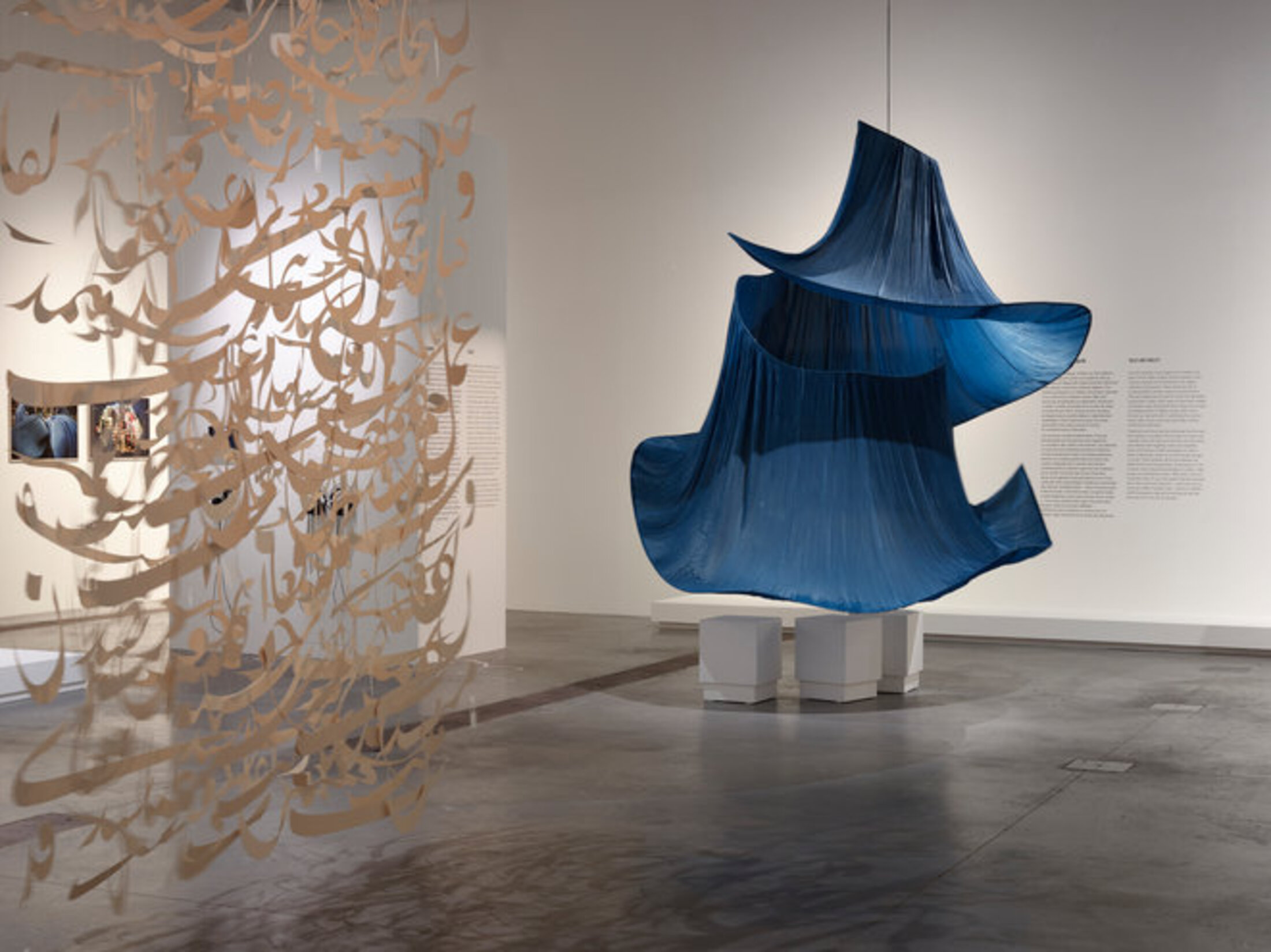
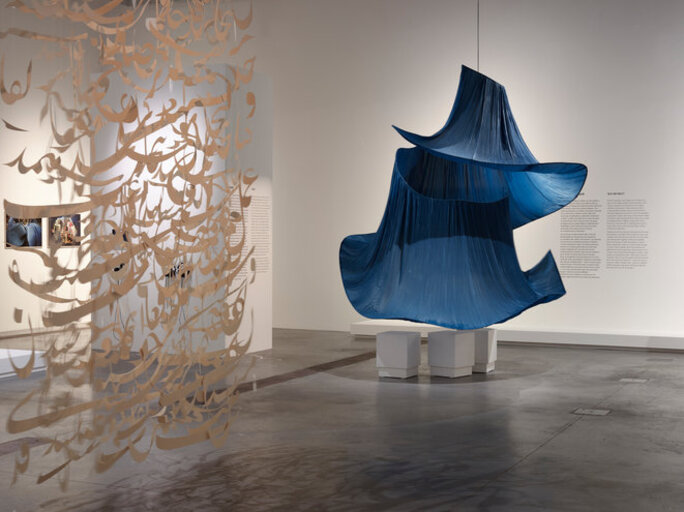
However, the work on display that attracts most attention is undoubtedly that which carries most hope, while making reference to what is today the most obscure symbol of Afghan culture – the chadri. This is the work by fashion designer Zolaykha Sherzad, born in Kabul in 1967, and which is a vast, floating arrangement of silk called Hawa-ye Azad.
The form of the sky-blue cloth represents the first letter of the word hawa, which in the Dari language signifies “air”, “time”, space” and even “wind”. It demonstrates that the symbol of the confinement and subservience of women can take flight, and become a space that suspends time. “This structure, by the dynamics of its curves, inspires the repetition of an infinite circular movement,” said Sherzad. “It evokes the wind, suspension, and mystic thought.”
On a bank of the river Kabul, in the heart of the Afghan capital, a small memorial stands in memory of the atrocious lynching of Farkhunda Malikzada. Following her murder, 49 men were eventually arrested. Three of them, including Mullah Zainuddin, were sentenced to death, which was afterwards commuted to a prison sentence of 20 years. Eight others were handed 16-year jail sentences, and a minor was sentenced to ten years in detention. Eleven police officers were given one-year jail sentences for failing to protect the young woman. Farkhunda’s brother Najibullah, speaking to the BBC after the rulings in July 2015, said: “It's a real theatre. The whole world laughs at the judicial system of Afghanistan. Do the judges have families, sisters, mothers - or not? Do they have a heart? We will not accept this decision.”
-------------------------
'Kharmohra: Art Under Fire in Afghanistan' is showing at the Mucem (Musée des Civilisations de l'Europe et de la Méditerranée, the "Museum of European and Mediterranean Civilisations") in Marseille until March 1st. More details are availble at the museum's website here.
Open every day except Tuesdays, from 11am to 6pm. Entrance fee: 9.5 euros, and (reduced price) 5 euros.
-------------------------
- The French version of this article can be found here.
English version by Graham Tearse