


A piece of cloth separates them. That, at any rate, is what the two contenders in this Sunday's decisive round in the French presidential election would have us believe. When, on the campaign trail recently, he was tackled about his stance on feminism by a young woman wearing a headscarf, Emmanuel Macron asked her if she had been forced to cover her hair. She responded that she wore a scarf of her own volition. He then stated that it was “great” that a woman could ask him such a question. “It's the best response to all the nonsense I've been hearing,” said the centrist president, during the encounter at Strasbourg in north-east France.
This was a clear reference to his far-right rival, Marine Le Pen, who has proposed introducing fines for wearing a headscarf in public spaces, shops and “all places that receive the public”. In the past she has likened it to an “Islamic uniform”. More recently, the candidate for Rassemblement National (RN) stated that the “ban on the headscarf is essential” even though just a few seconds earlier she had insisted that it was not the “most vital part” of her planned legislation. And last weekend, in an attempt to avoid having to give more details on the outline of her proposed law, she instead hid behind a plan to hold a debate in Parliament on the issue.
🗨 "C'est la meilleure des réponses à toutes les bêtises que j'entends"
— BFMTV (@BFMTV) April 13, 2022
L'échange entre Emmanuel Macron et une jeune femme voilée sur le féminisme ⤵ pic.twitter.com/WIfVPe5rLq
But on top of these electioneering stances, this highly-inflammable issue has provoked numerous controversies during the five years of Macron's presidency. Just two months ago the Senate, the French Parliament's upper chamber, sought to ban sports players who wore the headscarf from taking part in competitions. Meanwhile, at the end of 2019 the education minister Jean-Michel Blanquer declared: “The headscarf is not desirable in our society. It's not something to be encouraged.” This comment came after a far-right RN councillor had wanted to ban a mother wearing a headscarf from attending a meeting of the Bourgogne-Franche-Comté regional council in eastern France that pupils were visiting as part of a school trip.
In 2020 Members of Parliament from the right-wing Les Républicains party and the MP Anne-Christine Lang from the ruling La République en Marche (LREM) party had ostentatiously walked out of a public session because a senior figure from the teaching union UNEF, Maryam Pougetoux, had come to give evidence about the impact of Covid-19 on students. This was because she wears a headscarf. And Sara Zemmahi, a candidate for the LREM in local council elections in 2021 at Montpellier in southern France saw the ruling party withdraw their support for her because she, too, wore a headscarf.
Such events, and this is far from being an exhaustive list, have contributed to an ever-greater gap between the country's Muslim citizens and its political leaders. This gulf has also been widened by the current government's law against 'separatism', which critics say has fuelled Islamophobia and increased mistrust of Muslims in general.
An endless procession of rows and controversies
Isabelle still finds it hard to understand how a scarf that covers her head could be the object of national debate. Aged 42, she looks after her five children in Villeurbanne, a “cosmopolitan town” on the outskirts of Lyon in eastern France where her style of dress poses no problems at all.
She has worn a headscarf for 23 years and says she is still amazed that the issue remains an endless subject of debate, and puzzled at the idea that it might have any effect on the everyday lives of French people. “It's beyond me,” she said. In 2019 Isabelle - and other mothers who wear a headscarf, such as Sabah Kadi who is quoted later - told Mediapart how she coped with these never-ending controversies.
As usual, Isabelle has kept up with events during the current electoral campaign. She decided to vote for the radical left candidate Jean-Luc Mélenchon in the first round, in which he came third. “I don't like him but he was the least bad, he was the only one to attack the violence and abuses committed against Muslims,” she explained.
In the second round on Sunday April 24th she will vote, grudgingly, for Emmanuel Macron, simply to help stop Marine Le Pen from winning. “Lots of people around me are planning not to vote. And I understand them, the current president stabbed us in the back and abandoned us in order to please a racist France, he didn't want to be seen to be trailing behind the far-right,” she said.
For a week Sabah Kadi, aged 39, stuck to her guns. She was determined to leave the ballot paper blank in the second round vote, a rejection of both candidates. For this mother-of-five children aged between nine and 16, who lives in Clichy-sous-Bois in the eastern suburbs of Paris, it was simply impossible to vote for Emmanuel Macron. Her arguments were well-honed. “I can't vote for someone who closes mosques. He has established justice that's based on emotion not justice based on legality. You don't govern by crackdowns,” she said.
I've never known such a racist and sickening campaign.
These reasons led her to write to the French president at the end of last year. In her letter she set out her complaints about his policies towards Muslims citizens during his presidency.
But, after calm reflection, she changed her mind. She says she will now vote, and will urge those around her to vote, for the current president to continue in office. Sabah Kadi explains that she has decided not to allow her own bitterness and reservations to “serve the shameful project of the far-right” and says that “in terms of citizenship the good, or in this case the least bad, of the nation takes precedence”. In the first round of voting she supported Jean-Luc Mélenchon. “It's not that I go along with everything that he proposes but he's the least bad. He changes with the wind and has gone from anti-headscarf to a great defender of Muslims,” she said.
For the first time Zakia Meziani, aged 50, the mother of four children aged between ten and 19, has been completely uninterested in a presidential election campaign. Though she is usually passionate about every local and national election, this time around she has not followed a single debate or sifted through any manifesto.
“I can't take any more of the political climate that's dominating in France, it's disgusting, I've never known such a racist and sickening campaign,” said Zakia, from Tourcoing in northern France, who however will still make it a point of honour to vote, as she has always done since being eligible to do so.
Zakia Meziani has worn a headscarf since she was a teenager, for so long in fact that she can no longer explain what led her to first put one on. “It's part of me,” she said simply. She has spent nearly four decades in the north of the country, putting up with personal slights and discrimination because of her decision to wear this piece of cloth on her head. Zakia was already wearing a scarf when what became known as the 'Creil affair' broke in 1989. This involved three middle school pupils in a town north of Paris who refused to remove their headscarves in class, prompting months of media, political and intellectual controversy.
It proved both a national landmark case and a personal turning point for Zakia. “That affair traumatised me and still traumatises me. I gave up on a career in teaching,” she said. Zakia Meziani is the daughter of Algerian immigrants who came to help rebuild France in the 1950s, and as a Muslim wearing a headscarf says she is “used to being stigmatised”. But she adds that “today the violence has increased, there is completely unabashed racism”.
She continued: “Islamophobia is not just the preserve of the far-right, of the Le Pens [editor's note, a reference to Marine Le Pen and her father Jean-Marie Le Pen], of the hard right. Emmanuel Macron, who in 2017 had given a conciliatory speech on secularism, has stabbed us in the back. He's let members of his government such as [interior minister] Gérald Darmanin and [education minister] Jean-Michel Blanquer get off the leash during the second half of his presidency. This freedom to use racist language, the fact that we're at the centre of rows without ever being given our say, that's very violent,” added Zakia Meziani, who runs a feminist and anti-racist association, 'Identités Plurielles', which supports women whatever their faith or origin.
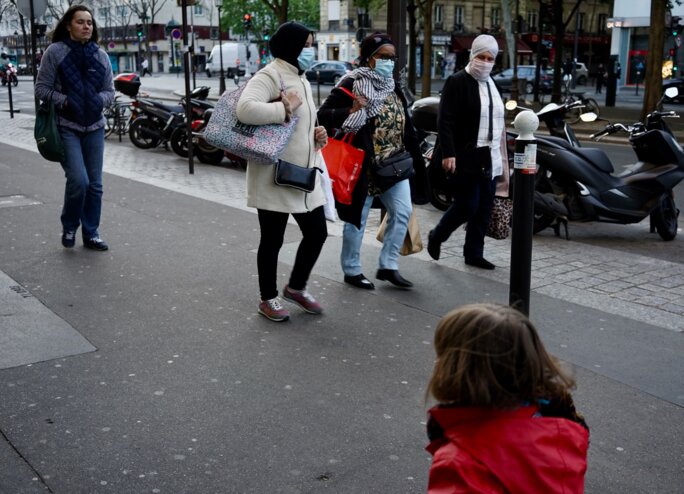
Enlargement : Illustration 2
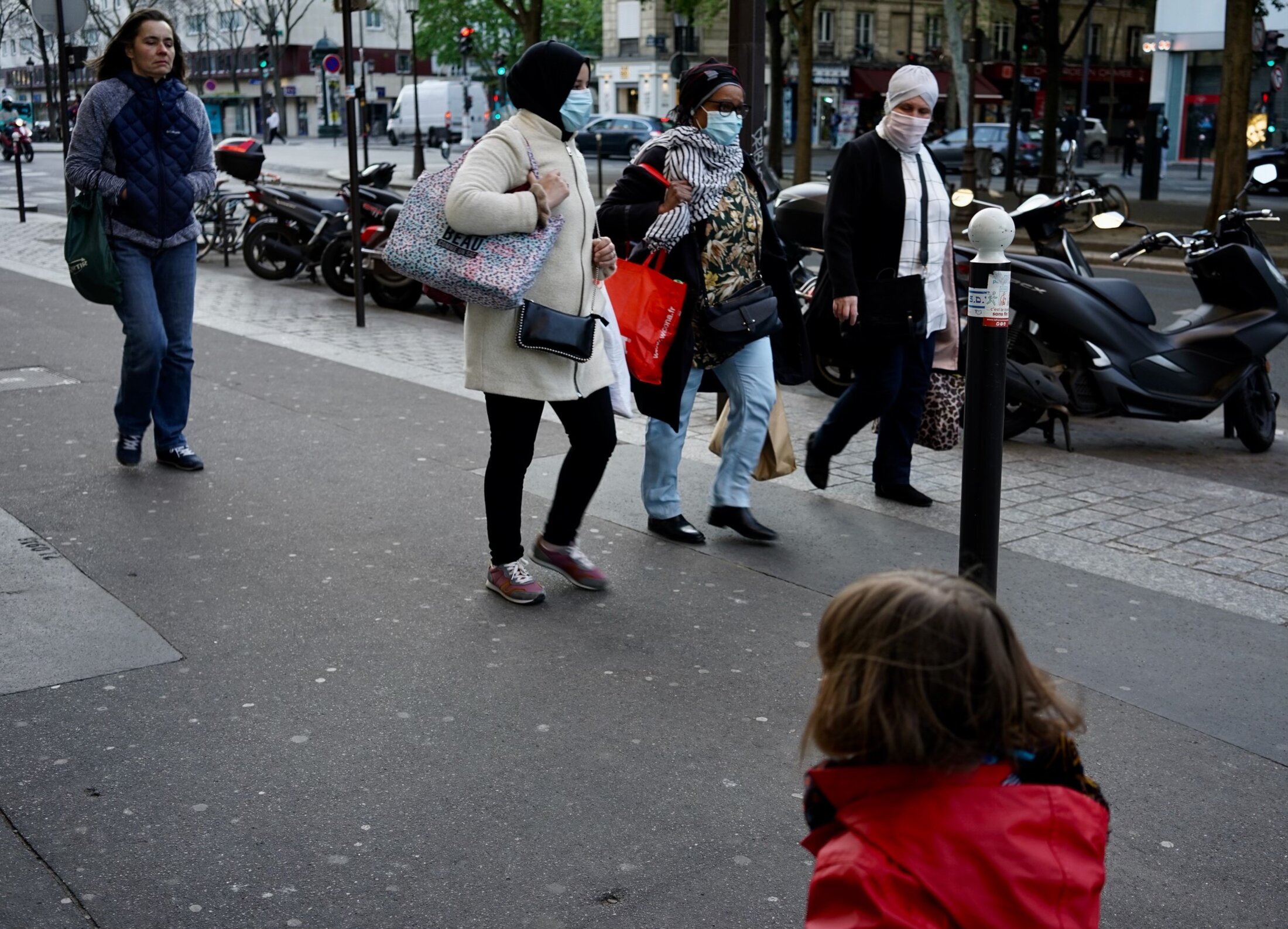
Zakia Meziani recalls several “violent episodes” during Macron's presidency. And for her the law on 'separatism' marked one further grim milestone. “This racist law was hatched by our former mayor Darmanin, who used to belly-dance in the mosques when he was mayor of Tourcoing. The closure of mosques that this has led to, the dissolving of the CCIF [editor's note, the Collective Against Islamophobia in France], one of the few places where victims of Islamophobia were listened to, all that has worsened the climate of fear: victims prefer to keep quiet,” she said.
Isabelle shares a similar view. “Macron anticipated the demands of the far-right with his law against separatism. He closed down Muslim associations, mosques and Muslim schools under false pretences. Some children have been left by the wayside,” she said. She says she is very disappointed by the way that members of the government use the headscarf “as a scapegoat, as an issue” and added: “People focus on that, the scarf is on my head not on that of others....”
Isabelle also said that she regretted the gulf that exists between the public debate and the reality on the ground. “I don't come across problems in my daily life, I feel fine in everyday life. But I do feel stigmatised by the debates on television, the comments from politicians, the raising of the stakes that you hear on the Right and Left,” she explained.
Isabelle converted to Islam and is married to a man of Tunisian origins. She recalls that during the 2017 election campaign Emmanuel Macron gave a unifying speech about people living together, a subject she is very sensitive to given her own marital situation. At the time she was receptive to it. “But the return to the stick was violent, he led a policy of witch-hunts, as Nicolas Sarkozy had done in his time,” she said.
Over the last 23 years Isabelle says that public discourse has moved to the right. “In the first round [editor's note, of the presidential election on April 10th] four of the candidates were hostile to the headscarf. We feel we're permanent targets, it's tiring and distressing. There's a ready tendency to dump this issue on Muslim women as if we'd chosen to be radical,” Isabelle added.
Sabah Kadi still finds it hard to to know where to position herself as a woman who wears a headscarf. “I've taken a while to respond because I don't consider myself to be a news item but a member of society, a French citizen,” she explained. “It's simple, politicians and the media have stirred up the debate around this issue. I don't have to justify my existence for the past 20 years. There's also this idea that we must be reassuring too. But it's like asking my left kidney to behave as if it's a transplant, when it was in fact born in the body that contains it,” she said.
In her youth she was influenced by her father, a trade unionist, who taught her always to fight. And she refuses to be disheartened by the ongoing rows about the headgear. “We're stigmatised, you'd have to be blind not to see that, but we're intellectually independent which means we don't get depressed,” said Sabah Kadi. “My friends and I say that it's like we've got Aerius in us – it's a brand of antihistamine. We no longer get worked up by provocations over the headscarf, you see people who aren't affected get more offended than us.”
Fighting the headscarf ban - and refusing to remain passive
She considers the public space ban on headscarves proposed by Marine Le Pen to be scandalous but she sees it as just a “dream” in constitutional terms. Sabah finds it hard to believe that France would in fact risk becoming the first country in the world to “put its citizens under supervision” in this way. “She's saying it for effect, she wants to be more Zemmour than Zemmour,” she added, referring to the defeated first round far-right candidate Éric Zemmour.
Indeed, she and her friends laugh at the proposal and its potential effects, which border on the absurd. “We'll all get fined or we'll wear hats or plastic bags!” But on a more serious level Sabah Kadi says she believes one should never give up the struggle. She herself was excluded from her secondary school for wearing a headscarf. She then took – and passed – the baccalauréat examination as an independent candidate.
“And even if Marine Le Pen does ban the headscarf we'll work together and get even more involved in society. We'd appeal to the European Court of Human Rights. How could one allow women's bodies to be controlled like this? It would a return to the days when women weren't allowed to wear trousers,” she said. “It would be tiring to lodge a complaint each time but we would do that.” Sabah Kadi also thinks that Arab and other Muslim countries might themselves protest at the measure and ostracise France by refusing to trade with the country or invest in it.
Zakia Meziani is just as combative. “I was still a student when we set up an association in the 1990s, after several female friends and I had experienced discrimination at university,” she said. “It was something new, Muslim women wearing a headscarf who were taking part in public debate locally, as citizens who were being discriminated against because of their origins, their religion and also for wearing a headscarf.”
We'll remain Muslims with or without the headscarf. If the problem is our Islamic-ness then it won't change anything.
Isabelle is a little more resigned and feels that the possibilities of fighting back are limited. She is also dismayed at how little the women involved are listened to. “When you try to fight against these stereotypes they try to trap you or distort your remarks. The comedienne Samia Orosemane was misled when she appeared in a report on [TV channel] M6 on radical Islam, and a student from Lyon was manipulated in the same way over an issue in Roubaix [in northern France],” she said.
She finds it impossible to envisage Marine Le Pen winning. “To ban the headscarf as she wants is the ultimate raising of the stakes, it's going to the culmination of all the Islamophobic policies that have been implemented. You can't say it's not possible because we're in a democracy, but when the far-right take power it's never great.”
Isabelle admits that she has not thought about what she would do if the Rassemblement National candidate were to win and implement her ban. “I don't know what decision I'd take, I'll wear a hat, I don't know. But in any case, we'll remain Muslims with our without the headscarf. If the problem is our Islamic-ness then it won't change anything,” she said. She thinks that such a ban would also be the prelude to other measures aimed at making life impossible for Muslims, such as the outlawing of the ritual slaughter of animals or circumcision. Isabelle wonders if they might have to leave the country; the family has already lived abroad twice.
'A parallel law'
Sabah Kadi, who studied law, thinks that it is vital to get involved in associations and fight against discrimination to counter the menace of the far-right. At her children's primary school a mother wearing a headscarf was barred from an end-of-year school trip on the basis of an amendment from the French Senate that was never in fact adopted in law. “Her children were sad, and this exclusion had no legal basis. A Muslim citizen cannot be unaware of the laws that affect her,” she said. Sabah also thinks that the Parliamentary elections in France this June will be a key moment.
One event in particular shocked all the women to whom Mediapart spoke: this was the assault on two teenage girls, one of whom was wearing a headscarf, in Montpellier by a 61-year-old former police officer on April 12th. Reports say that racist language was used against the victims. Isabelle thinks that this kind of violence flows from a general mood of mistrust felt towards Muslims. She says she was shocked by the video images of the incident but “not surprised because on such occasions some people think their hate is legitimate and think that they can act with no shame”.
Sabah Kadi thinks that an unspoken “parallel law” exists that makes such an assault possible. “By letting ourselves be insulted we allow that,” she said. “But these attackers are cowardly. I've been insulted many times and each time I was alone. When I'm with my husband or son no one says anything to me...”
“Whether they wear a headscarf or not, all the Muslim women I know are afraid,” said Zakia Meziani. “Afraid of being assaulted, of being spat in the face yet again. They're afraid for their children, for their daughters whom they order not to wear a headscarf. They've all realised that no one would defend them and that this piece of cloth would be an obstacle to study, work and walking in public areas. When I urge a woman who is the victim of an assault to report it, she begs me to do and to say nothing.”
-------------------------------------------------------------------------
- The original French version of this article can be read here.
English version by Michael Streeter