


A step has been thoughtfully placed in front of the bus door. It is a gesture designed to help passengers climb up into the bus that is parked next to the mayor's office at Billy-le-Grand, a small village of just 120 inhabitants south-east of Reims in northern France. The bus will remain here for two hours, the time it takes for eight local residents to receive their vaccinations against Covid-19. For the timetable and route of this particular bus, known as Vacci'bus, is a little out of the ordinary.
The vehicle has been hired by CITURA, the group in charge of transport in the Reims area, and has been converted into a travelling vaccination laboratory. This concept, launched by Catherine Vautrin, a member of the right-wing Les Républicains (LR) party and president of the Grand Reims urban authority, is quite simple: it involves going out to vaccinate residents aged 75 or over in the surrounding rural areas.
The travelling bus vaccination campaign began on January 19th and will eventually visit 46 small villages that have fewer than 250 inhabitants. “The state had decided to establish four vaccination centres covering an area of more than 300,000 inhabitants so we had to make sure there was a service to the public in the small villages. The Vacci'bus is a good way to do that,” said Alain Toullec, deputy president of the Grand Reims urban authority. He said he was pleased with the “good feedback” they had received since starting the scheme. “People seem happy,” he said.
The mayor of Billy-le-Grand, Fabien Charpentier, who has come to observe, also speaks of his support for the the initiative. As he does so Robert turns up, joking with the other councillors who are present about the way his glasses have misted up because of his mask. He lives just 200 metres away. Once inside the bus he is greeted by the doctor, Nathalie Brau. Normally she works as a doctor at the university hospital in Reims but she is here today in her capacity as a medical volunteer for the local fires service in the Marne département or county where Reims is situated.
Enlargement : Illustration 1
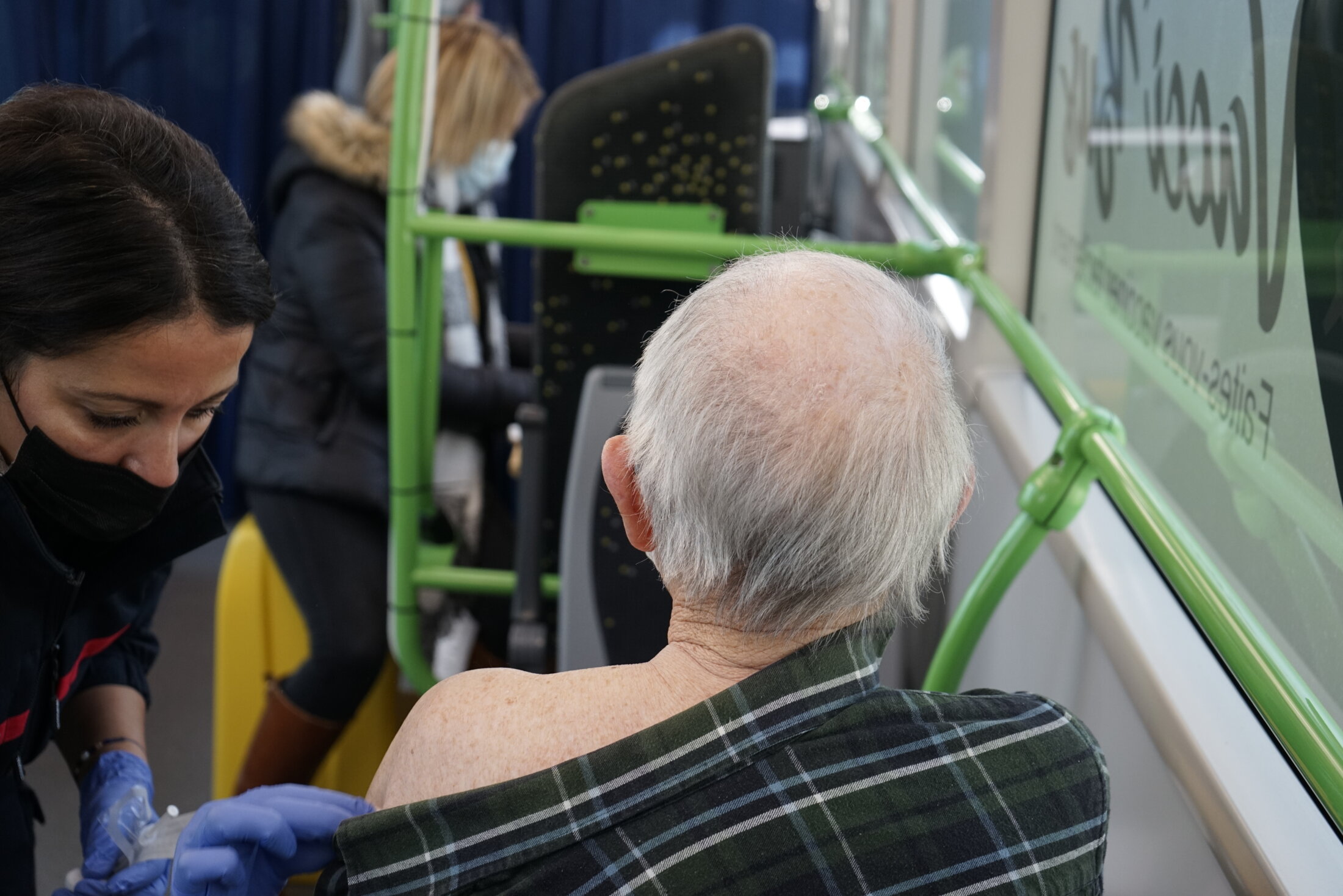
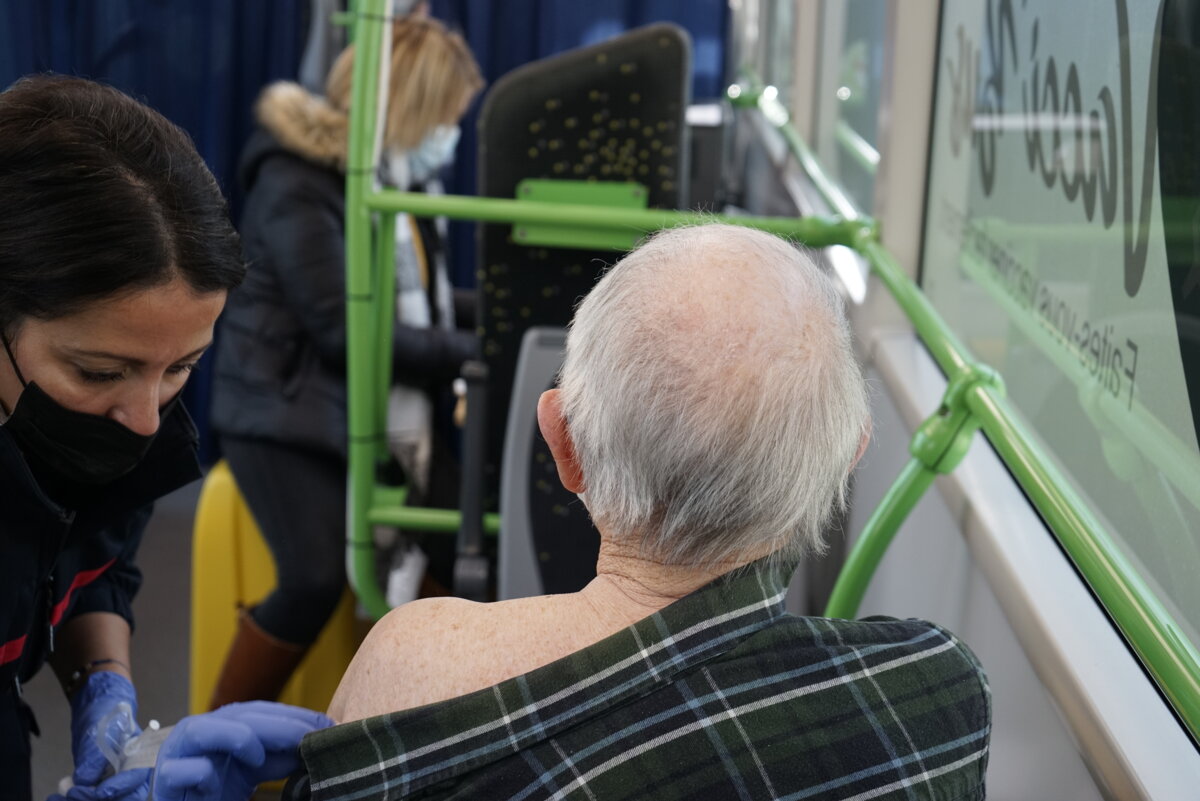
Alongside her is another fire service volunteer, nurse Naura Touaimia, who is here on a day-off from her job with the ambulance service SAMU. “It's nicer here,” she smiles. Right on cue, Robert starts to joke around with Dr Brau as he has his pre-vaccination consultation. “I was born in 1934, that's going back a bit!” he notes. Once Robert's medical history has been checked, Naura Touaimia gives him the injection. “Is that it? I didn't feel a thing,” he boasts before going to the post-vaccine monitoring zone; this consists of the seats at the back of the bus, where blue curtains have been drawn to maintain privacy. A conversation breaks out at the back; the previous patients are the parents-in-law of Robert's son. It's a small world on the Vacci'bus.
While the talk at the back of the bus is of the future arrival of a great-grandchild, Roger is hauling himself up into the bus. “How are you sir?” asks the doctor. “Feeling my age,” jokes the 85-year-old, who nonetheless tries to charm the nurse. He is from the neighbouring village of Trépail. “The mayor did the rounds a fortnight ago Saturday, when it was snowing, to tell us about the bus,” he explains. “Everyone thought they had to call on the Monday, the phones were overwhelmed. I tried to call a dozen times during the morning, I finally got through at midday.” To book your slot on the Vacci'bus you first have to make an appointment via the dedicated telephone line.
“Hello Chantal! That's it, it's done, you're vaccinated,” Roger suddenly exclaims as one of his old friends comes and sits close to the electric heater in the 'waiting room' at the back. Two radiators have been put into the bus, and some fridges that have been installed are running off a generator. “If it wasn't for the bus I perhaps wouldn't have been vaccinated,” acknowledges Chantal, whose granddaughter persuaded her to come. “She's a nurse and she still hasn't been able to have the vaccine! I'm reassured now, even if you have to wait for the second dose to be immunised,” she said. Dr Brau repeats this point to each bus 'passenger'; until you receive a second jab you only have a protection level of 50%. “In the meantime you have to continue to respect the protective measures,” she informs them.
Claude, who is 87, thinks she is “lucky”. She lives two kilometres from Billy-le-Grand and has come by car. On several occasions she phoned to make an appointment at one of the four vaccination centres in the region but with no success. So when her brother, who lives in the village, told her about the Vacci'bus, she jumped at the chance. “It's good that the bus is coming for us in the villages, even if it doesn't go everywhere,” she said. “The lockdown is long, we're alone, afraid and we don't see anyone.” The mayor, Fabien Charpentier, confirms the mood in the area. “Residents are afraid to go out and to mix with people. Even in our little villages we have positive cases, perhaps the vaccination will help to reassure them,” he said.
The bus scheme in the Reims region has been copied elsewhere, with authorities from northern France down to the Bordeaux region in the south west of the country getting in touch. The initiative has even attracted interest from abroad. On Tuesday January 26th the vaccination took place in front of cameras from two Japanese television stations, after a Korean station had had its turn. The mobile vaccination teams are happy with the attention. “In a way it's an honour to be taking part in such an activity,” said Audrey, the bus driver. She did not complain about waiting in the cold as her 'passengers' got vaccinated inside the bus. “What we're doing is truly multidisciplinary work,” said Noura Touaimia.
Every morning the logistics department at the university hospital in Reims delivers thirty vaccine doses plus compresses, gloves and masks to the bus service. Naura Touaimia admits she feels stressed each time she prepares the doses to be injected. “We can't afford to make a mistake,” she says, as she dilutes the doses with saline solution.
Enlargement : Illustration 2
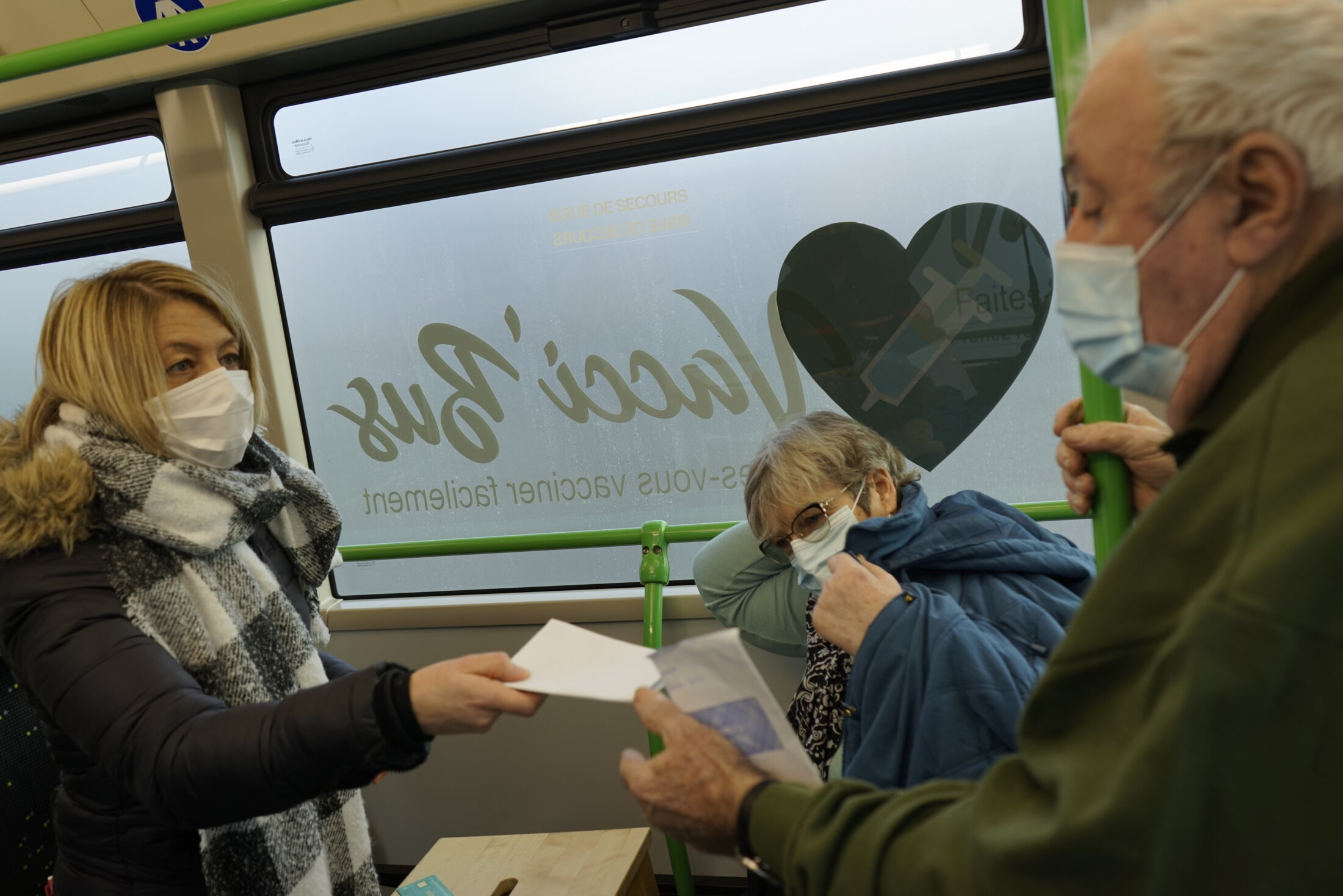
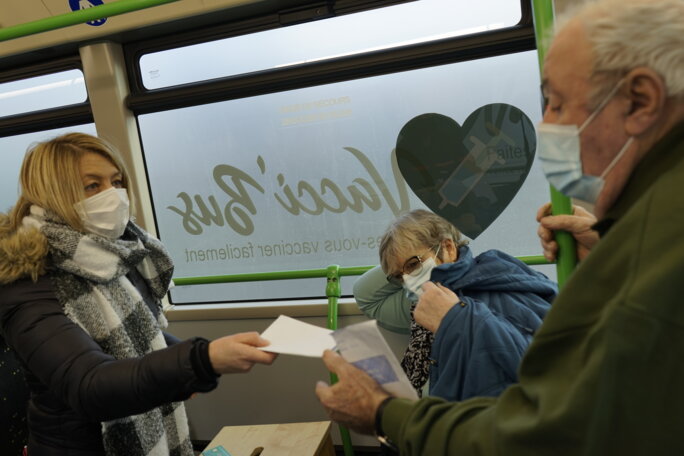
The second stop is at Saint-Léonard, a village with 104 residents. Jean-Claude's appointment is at 1.45pm but on the stroke of 1pm he is there, waiting for the Vacci'bus with a resolute air. The 76-year-old jokes about queuing up for the bus: “It looks like old people going off to do the shopping!” He and his wife Louise are getting vaccinated on the advice of their local doctor. “It will give us a sense of security, it will change our lives,” he says.
Jean-Claude takes advantage of the opportunity to ask Dr Brau if one of his friends can come and get vaccinated even though she has not made an appointment. She is not yet 75 – the age at which people are eligible for this round of vaccines – but she is considered at risk because of cancer. “I have got thirty doses of vaccine and twenty-seven people are registered,” says Naura Touaimia. Already that morning the mayor of Billy-le-Grand has asked if the nurse could add two people to her list. With Jean-Claude's friend, that makes three – which means all the doses will get used.
Jean-Claude immediately lets his friend know. “In every village people ask us about people they know who would also like to get vaccinated,” Naura Touaimia points out. “We don't manage the appointments, unfortunately. But all the doses are getting used, there's a real enthusiasm.”
She has barely arrived before Geneviève, Jean-Claude's friend who has been added to the list at the last minute, makes the same point. “There are some doses left and I'm benefiting from that,” she says. “Everyone should be vaccinated, it's the only way we'll get out of this.”
-----------------------------------------------------------------------------
- The original French version of this article can be found here.
English version by Michael Streeter