


In their quiet home in the countryside, C.'s grandparents have made pancakes. Her mother and brother are in the living room and two of her old housemates have joined them next to the fire. For more than three months the life of this extended family and friends has been been dominated by visiting rooms, letters and visits to the woman's prison at Fleury-Mérogis south of Paris where C. currently resides. Having been placed under formal investigation for criminal conspiracy to commit a terrorist act and remanded in custody, C., who is 30, faces a ten-year jail term if she is tried and found guilty.
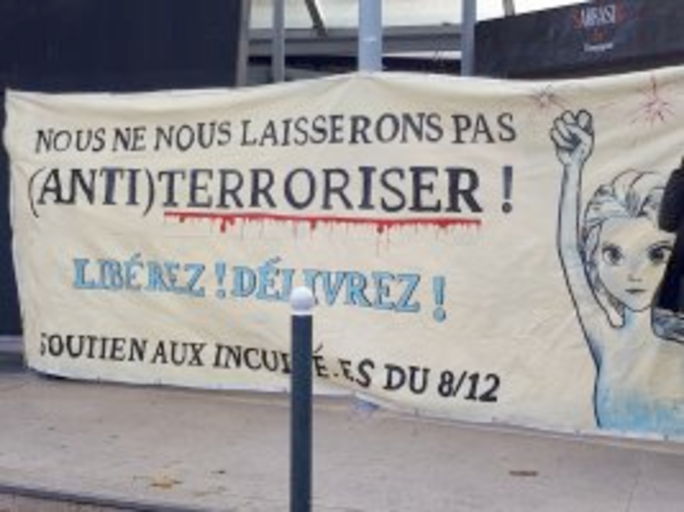
It was at 6am on December 8th 2020 that officers from France's domestic intelligence and security agency the DGSI arrested a total of nine people at various locations around France; Toulouse and Cubjac in the south-west, Rennes in the west and Vitry-sur-Seine south-east of Paris. This wave of arrests was the culmination of a judge-led investigation that had been opened by France's antiterrorist prosecution unit the Parquet National Antiterroriste (PNAT) in April 2020. It targeted an “ultra Left” group suspected of “planning violent action” against the forces of law and order. Investigators carrying out the probe, which was based on months of telephone taps and electronic eavesdropping, suspect the group of handling explosives and weapons.
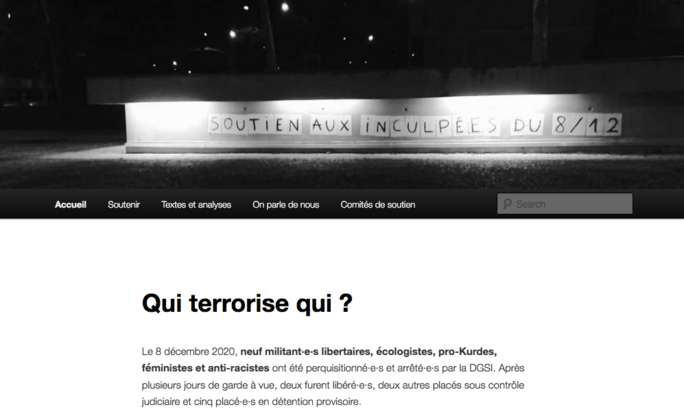
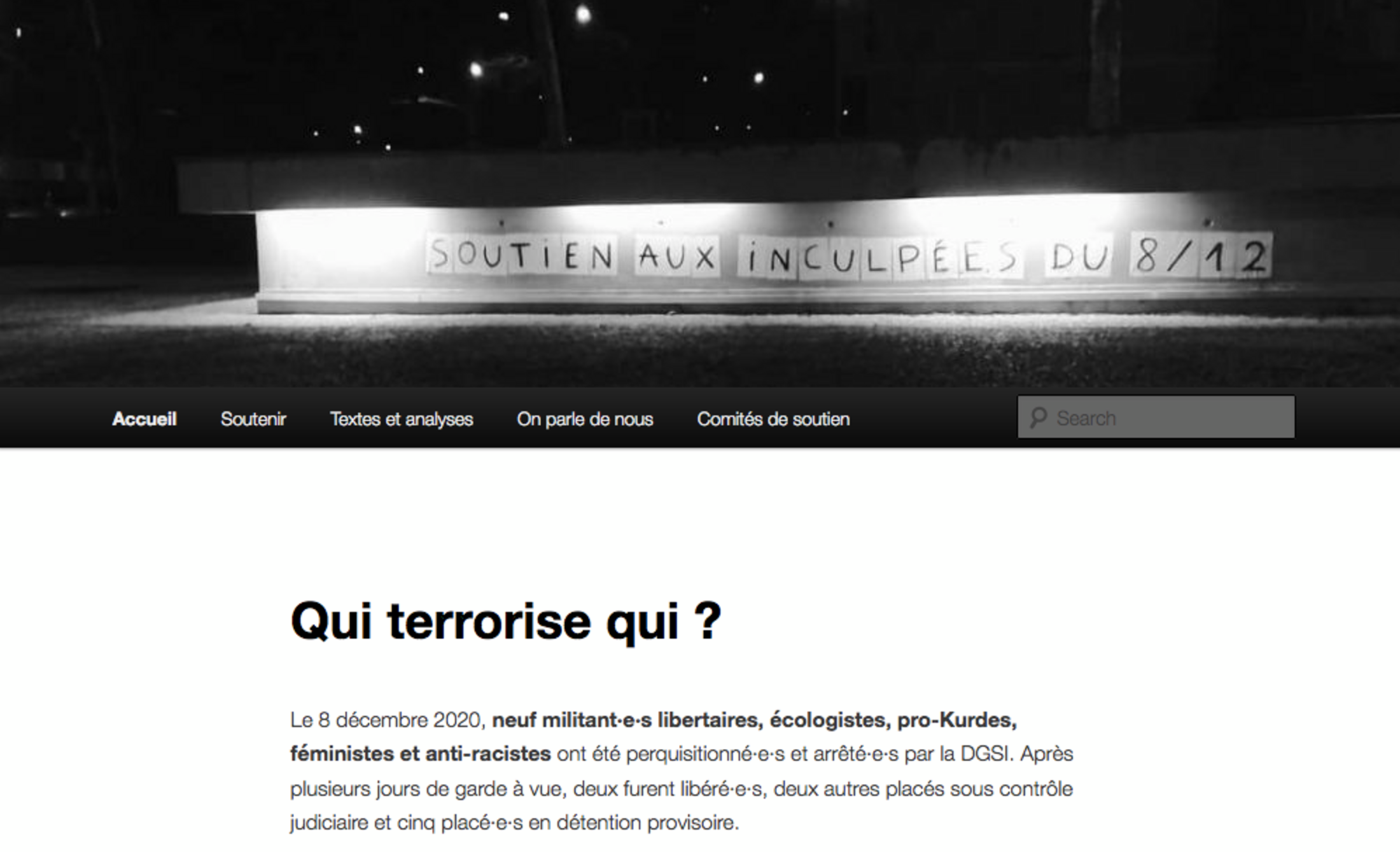
On December 11th 2020 six men and one woman were placed under formal investigation – one step short of charges being made – by investigating judge Jean-Marc Herbaut for criminal conspiracy in relation to a terrorist enterprise. Five of the seven were remanded in custody and the other two released on bail. Most of them describe themselves as “libertarian, environmental, pro-Kurd, feminist and anti-racist” activists, as their support group website states, though not all do.
The minister of the interior, Gérald Darmanin, quickly congratulated officers from the DGSI who were, he said, “protecting the Republic against those who want to destroy it”. The minister added: “Thanks once more for their action against these violent ultra Left activists.” Several articles of support were meanwhile published by friends of the arrested group, who are in their thirties.
Chaque jour les femmes et les hommes de la direction générale de la sécurité intérieure protègent la République contre ceux qui veulent la détruire. Merci une nouvelle fois pour leur action contre ces activistes violents de l’ultragauche. https://t.co/ZEOS2L0EEy
— Gérald DARMANIN (@GDarmanin) December 11, 2020
The exact details of what this group, some of whom have security files on them, was supposedly plotting remain a little vague. The DGSI think that one of the group, Florian D., who went to fight with Kurdish forces against the Islamic State from March 2017 to January 2018, set up a form of armed group when he came back to France from the Middle East. According to press reports at the time of the arrests, the police found in his lorry “products used to make [the explosive] TATP … steel ball bearings, a sawn-off shotgun, a revolver, and knife and ammunition”.
His profile therefore fits perfectly with the fears expressed over several years by the French intelligence services about the risks posed by French citizens returning from Kurdistan. In an article responding to these “fantasies”, the Collectif des Combattantes et Combattants Francophones du Rojava - an autonomous Kurdish-dominated area in northern Syria - wrote in support of their fellow combatant Florian D. They declared: “In returning home we were not expecting the Légion d'Honneur or even to be thanked by anyone, but we could not imagine that we would be designated as domestic enemies and treated the same as the jihadists we fought.”
Florian D., 36, who has been portrayed as the 'leader' of the group, was the only obvious common factor between all those put under investigation, who for the most part did not know each other. C. has been presented as Florian D.'s partner and accomplice. According to several people close to C., the pair did see each other but the relationship has not continued. Nonetheless, detectives suspect that in the spring of 2020 she went with Florian D. to the Indre département or county in central France to attend a “training camp” and make explosives under the guise of playing airsoft, a game similar to paintball.
Enlargement : Illustration 2
On the morning of December 8th 2020 C. and her four housemates from Rennes in western France were awoken by the sound of the glass in their front door breaking. Around 15 police officers had just smashed it down, even though it was not locked.
“I thought it was drunks who had got the wrong house or thieves,” recalls 37-year-old 'Bénédicte' – not her real name – who rushed to the doorway of her first floor room. “Dazzled” by a light, she was then pushed back into her bedroom by a shield. Her 33-year-old housemate 'Aurélie' – not her real name – heard the police officers enter each room shouting “put your hands on your head!” to those inside. Feeling “panicked” she stayed hidden in her bed until “someone opened the door”.
Each of the housemates was handcuffed in their bedroom and watched silently by armed and masked police officers. Aurélie says she kept on asking them what was happening. “I didn't understand. In my mind I was going to be taken off into custody,” she recalls. Bénédicte, who tried to identify their badges, says: “They didn't tell us that antiterrorism was involved nor that they had come for C.” In the end the women worked out that the officers who had broken into their house were from the DGSI. “I didn't know exactly who the DGSI were. I just thought that it was really serious,” remembers Aurélie.
Meanwhile, the officers had located C. “She heard them arrive and was waiting for them with her hands in the air,” says her mother. “She told herself that she must not panic because they could have killed her. One of them pointed their barrel at her body. She was in her knickers and after a while she asked if she could put on a tee-shirt. She wasn't hit but it was violent.”
After an hour the officers made all the housemates, apart from C., go downstairs to the living room and sat them around the table. “We weren't allowed to speak to each other. It lasted a little over two hours,” they recall. “The cops were discussing all and sundry and working in shifts. We asked questions but their only response was 'You'll learn about it in the newspapers'.”
The DGSI officers searched C.'s room and took her computer equipment. Three hours after they had arrived, the officers left with their suspect, whom they dressed in a balaclava. “We just exchanged glances,” recalls Aurélie. “Suddenly they took off our handcuffs and that was it.” C.'s grandmother shakes her head, noting: “All that leaves traces.”
The housemates immediately got in touch with C.'s brother 'Pierre-Henri' – not his real name – who lives in the same city. They spent all day calling lawyers and trying to find out where C. was being held, which turned out to be in DGSI premises at Levallois-Perret in the north-west suburbs of Paris. “She was taken from Rennes to Paris by train, wearing dark glasses and a mask and with her handcuffs hidden,” say her family.
Deeply affected by the “violence” of the arrest, C.'s family are still unaware exactly what it is she is accused of doing. “It's a political case,” says her brother, who like C. is an activist. “We share her political vision but this political vision is not criminal,” adds Benédicte. “She's someone who's committed, but what have they gone and invented?” Her grandmother says: “It's just unbearable for all of us knowing that C. is in prison.”
C.'s family are quite open about the causes that she supports. She is a feminist and environmentalist who volunteers for associations that help people who are isolated in society, one of which finds accommodation for people living on the street. She also does the layout for protest leaflets. “She's a very practical kind of person,” says Bénédicte. “She helped out in social accommodation, with DIY, electricity, painting. We do the garden together at the house, she's very knowledgable about plants. She's close to nature.”
At the time of her arrest C. had been about to start training to be an ambulance worker, having already done an initial course. Her family says that she had previously worked at holiday camps with the disabled and with youngsters in difficulty, and had worked as a carer and given lessons. “She's very altruistic, helping and listening, to the point where she sometimes forgets about herself,” says one family member.
C.'s family and fiends are angry about the accusations against her. Bénédicte speaks of a police “set-up” and wonders what lies behind it. “Antiterrorism is waved around to make people afraid. Coming here labelling us 'ultra Left' means nothing at all. C. was dragged away from us, she's going through it all on her own. It's inhuman.”
“They were hammering home the theme 'the Black Bloc must be smashed' for several weeks,” says Pierre-Henri, referring to the masked and hooded protestors seen at many demonstrations in France and elsewhere. “We want to raise the alarm over the fact that antiterrorism concerns everyone. Every time that ultra-repressive laws are applied against a minority of people it involves a toughening for all of society. And it works very well.”
Shocked by what has happened to his sister, Pierre-Henri is also astonished at the treatment meted out to Florian D. who had “gone to Rojava [editor's note, the area in north-east Syria] to support the environmental, feminist and communalist revolution being carried out by the Kurds against two fascist states, Turkey and Islamic State.” C.'s grandfather adds: “In theory, the Kurds are our allies.”
This is the first time that C.'s family and friends have spoken out. “Everything that we say could have repercussions,” says Bénédicte, who fears that anything she says might be “used against” her. In their letters to C. the friends deliberately keep things vague. “I don't even know if I can talk to her about things that have a link to activist issues, however distant: a book, a radio programme...” wonders Aurélie. C's grand-mother reveals that she also writes very “banal” letters.
Very few members of her wider family in fact know that C. is behind bars. Those who are aware are keeping it secret and maintaining a close eye on the situation. “Like all those close to someone who is detained, our lives operate on another timescale,” says Bénédicte. “What's happened to C. has massively disrupted the lives of those around her. Our lives are kind of suspended.”
'At the bottom of the stairs I had four weapons trained on me'
Among the nine people arrested on December 8th 2020 two were subsequently released with no further action being taken. Clo M., aged 35, was one of those. Her partner, S.G., aged 36, was himself placed under investigation and remanded in custody. He is a special effects munitions specialist at Disneyland Paris – formerly Euro Disney – east of the French capital. She is a cinema and television technician. They have been together for 15 years and own a small house at Vitry-sur-Seine south east of Paris.
On the morning of December 8th 2020 Clo M. heard a noise downstairs and thought it was burglars. She rushed down the stairs in her knickers and tee-shirt hoping, she says, that her presence would scare them off. “At the bottom of the stairs I had four weapons trained on me. My friend went ahead of me and stopped in his tracks when he saw that it was the police,” she says. “He was grabbed by the hair and pulled to the floor, and I was pulled down by my arms. We were quickly separated.”
The police officers told them that they were being held in custody in connection with an alleged terrorist criminal conspiracy. Clo M. still cannot get over it. “As they had said my surname and first name I realised they hadn't got the wrong house,” she recalls. “I had been on a demonstration two weeks earlier, I told myself it was linked to that. It was completely crazy. I couldn't think any more, I was scared.”
Handcuffed to an armchair, Clo M. watched as around thirty police officers got to work; there were explosives experts, the operational support group, and dog handlers who kept the couple's two dogs on a lead. She was present for part of the search, which lasted two hours. “I have lots of computers, hard drives, key drives, cameras and photo equipment. That's my job. It took time,” she says.
At around 2.30pm that day Clo M. was driven - handcuffed and hooded - to a DGSI building. She had never been to a police station against her will before. After an hour in a cell the police drove her off again, this time east of Paris where officers searched an old lorry that the couple had converted into a camper-van. She had not eaten since the previous day and the temperature was below freezing. “It was so cold, they even had trouble writing,” she says of the officers who were taking notes. At the camper-van the police seized a computer and “products linked to special effects”.
At the same time other officers were searching a yurt on land belonging to S.G.'s mother in the Vaucluse département or county in south-east France. His mother was also questioned at the scene though not arrested. Clo M. later learned that officers had taken away a “crossbow bought in an armoury” and a “machete brought back from New Caledonia which we use to make a path through the middle of the scrub”. Back at Vitry the police had also bagged up a rifle. “It belonged to my great-grandfather and it obviously wasn't loaded. My father lent it to me for a rock video clip because I found it attractive. I have screen grabs that prove that,” she says.
When she returned to the DGSI base at Levallois-Perret that evening, Clo M. was formally questioned for the first time. For three hours officers asked her “very general questions about politics” she says. “What did I think of Antifas, Black Bloc, Macron's Republic, of violence in demonstrations, where had I travelled?' recalls Clo M., who says she answered all the questions. “I thought that I shouldn't be there and that this would perhaps enable them to realise their error.”
During subsequent questioning officers wanted to know her views on Rojava and the Kurdish cause, and showed her photos of flags. They also questioned her about her relationship with Florian D. The young woman says she only agreed to answer questions that directly concerned her. During a third period of questioning she decided to remain silent, like most of the others who were questioned in custody.
In her soundproof cell, where she was permanently videoed, Clo M. pulled her “panda-head hood” over her eyes and tried to do yoga. She had time to think about the role that the police had ascribed to her: “A form of alibi for S.” The detectives read her extracts from telephone taps, and made a great deal of her partner's profession. “They were trying to twist reality to make it fit their theories. Everything became loaded. Yes, we spoke about fireworks, igniters. That's his job,” she explains.
To her great surprise, and after three days of custody, Clo M. was freed on the Friday morning. “They told me several times that I would be going to be brought before a judge [editor's note, the usual prelude to being placed under investigation and then possibly remanded in custody] so I really thought I would be. I thought I was going to be remanded in custody afterwards. But they put the balaclava back over my head to go out in the car and they dropped me off in front of a metro station with my bag,” she says. She called her stepmother, returned to Vitry and found out that in her absence the couple's friends had done some tidying up and fed the dogs.
Clo M. then began waiting for S.G. to come home, without realising that he was being remanded in custody. A month later, after he had initially been held in isolation, she got a pass to go and see S.G. in a prison visiting room. “He immediately asked to be able to do activities, to get training, but the status of 'terrorist' complicates everything,” she says. “He didn't even have the right to go to the library, the wardens chose the books for him. He has got quite a bit thinner, he is pale and sad, his face is drawn, but he's doing a bit better than at the start.”
Her own “trauma” still haunts her. “I was arrested on a 'normal' day and now I have the feeling it could happen to me again at any time. When I hear a car door slamming or a siren I think it's for me,” Clo M. says. She is still trying to recover her car and her computer equipment which were seized during the search and which she needs for work. Some employers are now no longer calling her. “I was honest, I told them what happened,” she says. “I feel like a pariah.”
Enlargement : Illustration 4
“We're living through a kind of film in which it's hard to understand the plot,” explains 'Mélanie' - not her real name – who is a friend of the couple. “As soon as we learnt that they were accused of 'terrorism' it got ultra scary,” she says. Mélanie describes the couple in their thirties as people who had been involved in punk rock and were quite “anti-system,” but who had done nothing wrong. “S. has never been violent, either in a demo or elsewhere. He doesn't fight. He has only been in custody once, in December 2019, because he'd got arrested getting off the CGT [trade union] bus in a gas mask. No further action was taken.” Melanie thinks that his “sensitive but authorised” profession has been held against him.
On February 8th 2021, two months after the first detentions, further arrests were made under antiterrorism laws. On that morning officers arrested a a young woman from the Dordogne in south-west France. She is the former flatmate of two people already placed under investigation, William D. and Bastien A. She spent three days in custody, first in Bordeaux and then in Levallois-Perret near Paris, before she was eventually released without charge. Looking back this young woman says she is astonished at the “disproportionate resources” deployed over a “planned attack that doesn't exist”.
Also on February 8th Marianne, a 28-year-old who is studying to be a special needs teacher, was arrested at Ustaritz in the Basque region of south-west France. She, too, at first thought she was being burgled; but it was in fact officers from a specialist police unit who had knocked her door down. “I was sure I was going to die, I'll never forget that fear,” she says now.
During the first Covid-19 lockdown in the spring of 2020 Marianne had stayed in the Dordogne with Willaim D. and Bastien A. Florian D. and his friend C. had joined them later with their van. Police officers searched Marianne's studio flat, seized her computer, her hard drive and her phone, searched her car, and then drove her to Bayonne with a balaclava on her head.
The student still struggles to understand what the DGSI investigators, who had come down from Paris, wanted from her. “First of all they asked if I was affiliated to a party, what I thought of Emmanuel Macron's politics, about people who didn't have a debit card, about Rojava,” she says. The investigators then wanted to know about arrangements at the house and about Florian. Marianne remembered him as a “nice, cultured, obliging” person. They also spoke to her about weapons, explosives and “paramilitary training”. She says: “I didn't know about that. These are not things that are a part of my life. I'm not politicised.”
Marianne remembers from her time in custody the “contempt” shown by the police officers and her own “naivety”. She recalls: “I was astonished that the two DGSI guys didn't even say goodbye to me when I was released. It was 6.30pm, I asked for a document to be able to go out after the curfew,” she recalls, referring to the system in France where you need to show justification for being outside after the Covid curfew or during a lockdown. “The officer photocopied a [proforma] certificate from the Sud-Ouest,” she says. This is a reference to the regional newspaper for south-west France which is one of many other regional papers that have carried examples of the certificates that French citizens need to copy and sign before going outside during Covid restrictions.
Since her arrest Marianne has gone back to live with her parents, who are farmers, and has not slept since in her studio flat in Ustaritz. She had to tell her school about what happened to her, as well as the owner of her studio who now has to repair the door that the police officers smashed down. For the time being she cannot recover her personal belongings which are still with investigators. “It's important that people know how it happens,” she says. “Had the police summoned me to come in I'd have reacted in the same way and handed over my computer and passwords.”
It is tempting to compare this case with the last time the antiterrorist authorities invstigated the spectre of the 'ultra Left', back in 2008. This was in the so-called 'Tarnac affair'. On that occasion police officers had gone to the village of Tarnac in the central département of Corrèze and locations in other départements to arrest around ten people who supposedly belonged to an “ultra-left, anarchist-autonomist” group. This group, supposedly led by a man called Julien Coupat, was accused of having sabotaged railway lines on the high-speed TGV network.
Ten years later an investigation carried out with the resources of the state's antiterrorist forces, and whose credibility was largely undermined by the defence, ended in a standard criminal trial in which the defendants were cleared of all the major charges. Since then the antiterrorism prosecution unit PNAT has not taken on any more cases linked to the 'ultra Left', despite repeated requests by prosecutors in the south-east city of Grenoble to do so over a series of arson attacks with an apparent political motive.
However, so far the arrests of December 8th have not caused the same political and media uproar as the Tarnac case did. Apart from the Tweet by interior minister Gérald Darmainin and some comments from France's national intelligence coordinator Laurent Nunez, the case has attracted relatively little fanfare. Only the daily newspaper Le Parisien and the news magazine Le Point , reporting just after the arrests in December, revealed the initial elements of the investigation and described the “unusual profile” of some of those placed under examination based on their questioning and on police reports.
Since then investigating judge Jean-Marc Herbaut has continued his work in silence. As have the lawyers acting for those under investigation who declined to comment for this article. Those at the centre of the probe were questioned in mid-February and new hearings are scheduled in the coming weeks.
-------------------------
If you have information of public interest you would like to pass on to Mediapart for investigation you can contact us at this email address: enquete@mediapart.fr. If you wish to send us documents for our scrutiny via our highly secure platform please go to https://www.frenchleaks.fr/ which is presented in both English and French.
-------------------------
The original French version of this article can be found here.
English version by Michael Streeter