


For several decades in his native Cameroon, it was impossible to utter Ruben Um Nyobè's name in public without risking arrest and imprisonment. Even in recent years the authorities in the West African country have not organised any official recognition or tribute to this symbol of the national struggle for independence. Now, in a bid to re-awaken people's memories and awareness, the Cameroonian musician Blick Bassy has paid homage to Ruben Um Nyobè in his fourth album, which is entitled 1958 after the year in which this major figure in Cameroonian independence was killed by the French colonial army.
A singer, guitarist and composer born in 1974, Blick Bassy became closely interested in Ruben Um Nyobè when he sought to discover the causes of the “political, economic and social chaos” into which Cameroon has plunged. As a child he heard of this historic figure in stories told by his mother, and also at school where he was “presented to us as a terrorist”, recalls the musician.
It was only much later that Blick Bassy understood his importance. “I discovered his writings which stunned me. We knew Um Nyobè as someone who fought for independence. In reality he was fighting for universal values, such as equality between men,” he says.
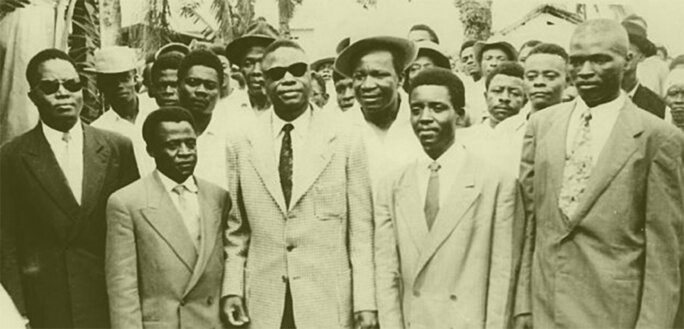
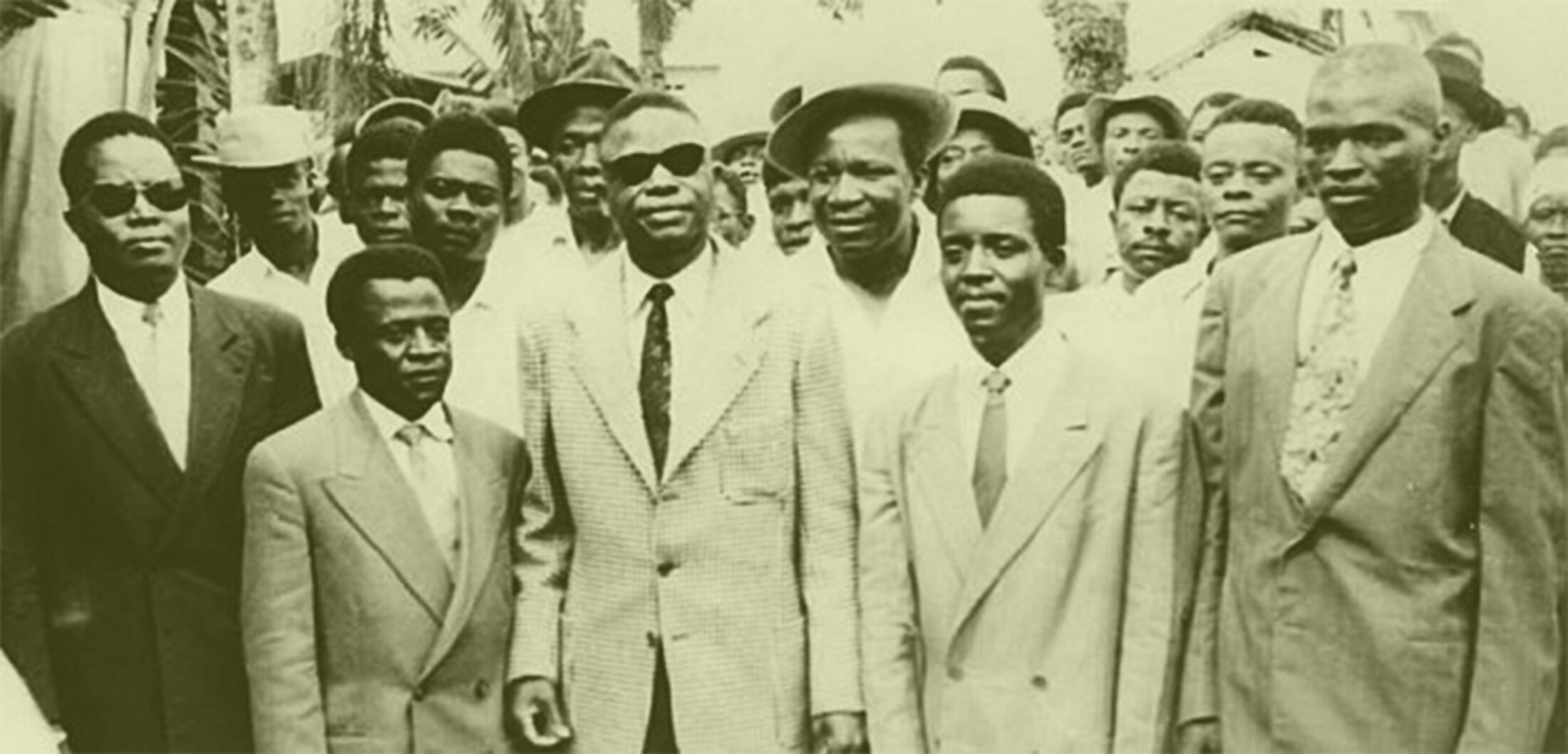
When Ruben Um Nyobè was born in 1913 in a little village in the south of Cameroon, in what is now the département or county of Sanaga-Maritme, the country was a German colony. He grew up in a Protestant area and became a court clerk, and was involved in political debate and was active in the trade union movement. In 1948 he was elected general secretary of the newly-created Union of the Peoples of Cameroon ('Union des Populations du Cameroun' in French or UPC).
This political party campaigned for the independence and reunification of Cameroon, which since the end of World War I had been divided into two: under a League of Nations mandate the eastern part was administered by France and the western part by Great Britain.
The UPC's ideas rapidly gained ground among all levels of a society worn down by forced labour, the colonial system and racism. The intelligence and charisma of Ruben Um Nyobè, who was devoted to the cause, played a key factor in the party's popularity. Worried about the standard of living among the people, whose lifestyle he shared, Um Nyobè travelled the country to inform and convince his fellow citizens. He called for the country's unification and attacked the strategy of the colonialists which he said consisted of pitting “tribe against tribe by making some believe that they were more intelligent, and others that they were very rich and were going to dominate the country”. He warned at the time: “We can't afford to allow the existence of ethnic groups to be used as a way of having political fights or personal conflicts.”
To those who accused him of being anti-French, he replied that he was simply “anti-colonialist”. Ruben Um Nyobè declared: “We are allies of all the supporters of the rights of people and nations to determine themselves, without consideration of colour.” A staunch believer in non-violence, he counted on the power of the law to obtain independence. On three occasions – 1952, 1953 and 1954 – he went to the United Nations in New York to plead his case before the institutions there. His supporters spoke of him as “Mpodol”, which in the Bassa language of the area he came from broadly means “spokesperson” for his people.
The Cameroonian historian Achille Mbembe, who has devoted much of his work to the UPC, says that Ruben Um Nyobè was a “remarkable intellectual, a teacher, a man with local roots and a reader of the post-war international system”. The historian continues: “He left behind him many writings which I have collected and published. These writings show an intelligence, a capacity for analysis and independence and moral authority what were without equal at the time. There was something about him which resembles the character of [anti-colonial figure] Amílcar Cabral.” Achille Mbembe adds: “There's also something about him which speaks to a profound moral rectitude, something that the colonial administration itself recognised. Perhaps more than anything it's this incorruptibility that in the end makes him an exceptional figure in African resistance. In fact, colonial domination rested on the conviction that Africans were basically corrupt beings. Yet right to the end Um refused to let himself be corrupted.”
While the colonial administration was aware of Ruben Um Nyobè's immense qualities and of the “clarity of his reasoning” as the book Kamerun (published by La Découverte in 2011) states, it also saw him as a threat to its interests and fought him with ferocity. In July 1955 the French government dissolved the UPC, forcing its leaders to hide or go into exile. A section of the UPC took to the forest, launching guerrilla operations while the colonial army hunted them, presenting them as “terrorists” spreading terror.
Like others, Blick Bassy's grandfather, who lived in a village close to the one where Um Nyobè was from, had to flee the army's operation and lived in the forest for more than a year.
On September 13th 1958 Ruben Um Nyobè, who had taken refuge in his home region without ever taking up arms, was killed by a French army patrol. The colonial authorities showed disdain for his body, burying it with no funeral ceremony and covering it a slab of concrete.
'There's nothing to expect from France that we can't do for ourselves'
Even though the war continued, this tragic death announced the political defeat of the UPC whose ideals of justice and freedom would never be realised. When in 1960 Cameroon officially became independent, France installed Ahmadou Ahidjo as the first head of state and continued to pull the country' strings. With the active assistance of the French, the new Cameroonian army pursued members of the UPC for ten years, as the latter still fought for full independence.
The war cost the lives of tens of thousands of people at least.
Enlargement : Illustration 3
Over the course of the following decades only some older people kept the memory of Ruben Um Nyobè alive, within the discreet safety of their families. “I had a grandmother, Susana Ngo Yem, it was she who set me on the path of a man who had disappeared, whose memory had been buried under the debris of state bans and censorship,” says Achille Mbembe. “In fact, for a long time after his death it was forbidden to mention Um's name in public, to wear his image, to quote him, to refer to his teachings or his writings,” adds the historian.
Achille Mbembe continues: “It was all as if he had never existed and as if his struggle had just been some mundane criminal enterprise. On some days when I was very little I heard my grandmother sing some songs of lament while doing domestic chores. Often the central figure of these songs was Ruben Um Nyobè. I imagine that, as Um had been deprived of a funeral after his execution and his hasty burial at the cemetery of the Presbyterian mission at Eseka [editor's note, in central Cameroon], these songs were there to accompany his ghost and to open the way to possible rest, to make up for the unspeakable injustice of which he was a victim after his death.”
The ban relating to Ruben Um Nyobè was lifted in 1991: the Cameroonian government passed a law rehabilitating him and two other UPC leaders, Félix Moumié, who died in 1960 having been poisoned by a French secret service agent, and Ernest Quandié, publicly executed in 1971. But nothing else was done to rehabilitate them and the trauma from the previous era still lingers.
Indeed, when Blick Bassy spoke to his father a few years ago he had to reassure him. “He whispered when speaking about Um Nyobè because he was afraid,” says the musician. “After independence many of those who had been suspected of having belonged to the rebellion disappeared. Those who lived through that are still not free of the spectre of death from that period. We mustn't forget that we are still governed by the same party that was created to counter Um Nyobè and who campaigned for a partial independence,” adds Blick Bassy, referring to the Cameroon People's Democratic Movement (CPDM), which was known as the Cameroonian National Union when it was founded in 1960.
Sixty years after the death of the independence leader, the legacy in Cameroon is a bitter one: the concept of public interest remains vague, debates about ideas are non-existent, corruption is infecting all areas of society and the country's natural resources are being exploited by multinational corporations. “Can we claim that we are truly independent, buckling under a double burden internally and externally?” asks Achille Mbembe. “What can we say about the ideal of the reunification of Cameroon when the desire for secession has never been so strong among the English-speakers? And the ethnic fragmentation? Cameroon has become a subordinate province,” says the historian.
With his album 1958, released by the label No Format/Tôt ou Tard, Blick Bassy wants to get his compatriots to question, to rediscover their past and to refashion their collective destiny. “Young people don't know a great deal and are not looking to find out. Yet we have a responsibility,” he says. “There were people in the past who decided to fight for the common interest, while knowing that they were going to die. What are we doing with this legacy?”
In one of the texts, Kundè, Bassy imagines being Um Nyobè and has him say in 'Bassa' - the musician's native tongue as well as Um Nyobè's: “I sacrificed myself for our country and I left you the alphabet that will allow you to rewrite our history. I've left some seeds so that you can build a better future.”
The appeal is also one for the French state to take heed of. “Today anti-French sentiment has become terrible in French-speaking African countries. It all started with the dishonest relationship established between France and these states. France would benefit from formally acknowledging that it had made some mistakes, did some negative things. It's only after that there can be a fresh start between it and the countries involved,” says Bassy. Up to now the French authorities, who have long denied ever waging a war in Cameroon, have only vaguely accepted any responsibility, when President François Hollande conceded in 2015 that there had been “repression”.
The historian Achille Mbembe thinks that “there's nothing to expect from France we can't do for ourselves. The fate of Um, just like that of Africa, is in our hands. We need to know this and get organised as a result.” One certainty, he says, is that Ruben Um Nyobè was the person who “for the first time in our history imagined Cameroon as a concept. Through him Cameroon went from being a colonial invention and a geographical accident to an Idea and a plan. Um opened up the imagination. That's the reason why he he will be with us until the end of time.” While he and his comrades had “suffered a defeat” the imagination that they sparked “cannot be erased”.
The words and music of Blick Bassy's music, which is both elegant and powerful, and which has both nostalgic and more upbeat tones, gives fresh impetus to this imagination. Thanks to this gem of an album, 1958, and two videos, Ngwa and Woñi, made by the South African Tebogo Malope - aka Tebza – there is little doubt that the musician will help spread the message of a man whom he describes as his “hero”.
Blick Bassy will be performing in concert at La Cigale in Paris on April 15th before going on a world tour.
---------------------------------------------------------------------------
- The French version of this article can be found here.
English version by Michael Streeter