


The closing stages of the United Nations COP30 climate conference in Belém, Brazil, were dominated on Friday by the failure to reach an agreement on a roadmap for reducing the use of fossil fuels, which requires the agreement of all of the close to 200 countries taking part in the talks.
Meanwhile, the Paris-based, intergovernmental International Energy Agency (IEA) this month published its annual report, with an outlook on energy transition. According to the IEA, global oil consumption may reach a ceiling point around the year 2030, while the deployment of renewable energies reached a new record in 2024, and that for the 23rd consecutive year.
Energy transition, the focus of the COP30 talks, is driving an explosion in worldwide demand for the minerals necessary for the so-called “Green” technology, such as that used for wind farms, solar panels or the production of electric vehicles.
Between 2017 and 2022, the demand for lithium rose three-fold, while that for nickel rose by 40%, and for cobalt by 70%, and the prices for these key minerals for energy transition jumped accordingly. “As a result,” notes the IEA, “energy transition minerals, which used to be a small segment of the market, are now moving to centre stage in the mining and metals industry.”
That includes in Brazil, already one of the biggest producers of iron and bauxite globally, and where, in the north-eaststate of Pará, home to Belém, sits the world’s largest opencast iron mine.

Enlargement : Illustration 1
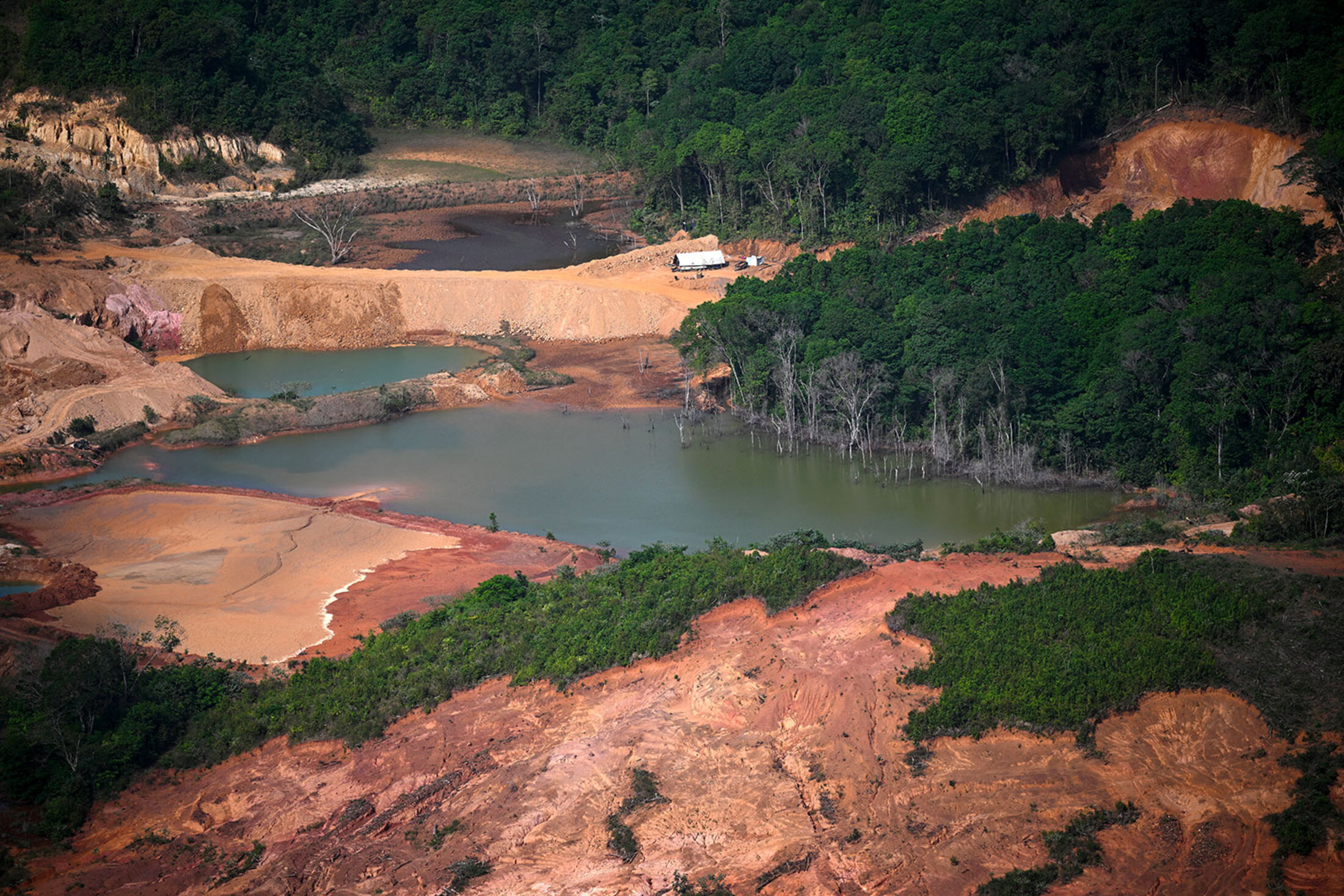
In Pará, the demand for raw materials has led to a boom in mining activity, to the detriment of indigenous populations, while also contributing to the deforestation of the Brazilian Amazonia.
The COP30 summit was notably marked by protests by groups representing indigenous people from Brazil but also other South American countries, calling for a halt to the unbridled exploitation of their populations and their land by private mining companies, whose polluting activities are driven in no small part by the lucrative market opened up by energy transition.
Earlier this week, Mediapart’s correspondent at the summit, Mickaël Correia, met with Jeremias Santos, an activist with the Movimento pela soberania popular na mineração (Movement for Popular Sovereignty in Mining, or MAM), which is a major campaigner against the harmful mining practices in Brazil and for the right of indigenous populations to control the land they live on.
In the interview below, he argues why energy transition must in parallel include the dismantling of the current practices of mining productivism, which represent a “new form of colonialism” in the violence meted out against indigenous communities, and the destruction of ecosystems.
-------------------------
Mediapart: When and why was the Movimento pela soberania popular na mineração (MAM) created?
Jeremias Santos: The structure emerged a little more than ten years ago, in 2012, on the occasion of a meeting of several rural and social organisations, including the Movement of Workers Without Land (MST), and which understood the need to take up – beyond the issue of agrarian reform – the problems linked to the [activities] under ground, the latter belonging, according to Brazilian law, the state.
The movement sprang up in the Carajás region, in the south-west of the state of Pará where, at the height of the military dictatorship in the early 1980s, one of the biggest mining projects in Brazil was developed. In that region, considered to be one of the most mineral-rich in the world [editor’s note, including iron, gold, tin, bauxite, manganese, nickel and copper], the Brazilian mining giant Vale built a huge hydroelectric dam, a railway line and port terminal for the exportation of these resources it extracted from the Amazonian underground.
Our political birth was the occupation, at the time of this meeting in 2012, of the railroads belong to the private group Vale.
Mediapart: The mining industry has a long history in Brazil.
J.S.: It has existed since colonisation. The current Brazilian mining model presents strong similarities with the colonial period, during what was called sertanismo, a violent colonial activity established in the 17th century, fuelled by the myth of El Dorado, during which Whites explored the Brazilian back-country to extend the country’s frontiers, looking for gold, while capturing indigenous peoples to put them into slavery. They are imaginary concepts, relationships with the territory which continue to exist in Brazil today.
After the industrial revolution and technological progress, new minerals were discovered, notably iron for exportation, which attracted the interest of the [1964-1985] military dictatorship. Today we see a boom in this sector because of energy transition.
Mining, then, is a historical phenomenon in this country.

Enlargement : Illustration 2

In Brazil, there also exists, since a long time ago, an economic and political consensus that mineral extraction is a key element in the development of the country. But in reality, the Brazilian state created for itself an economic dependence towards this sector. Furthermore, during this time the Brazilian people have not managed to exercise an increased control of the extraction of these natural resources, and which are among the most strategic for the country.
Mediapart: How does the MAM organise itself to fight against this extractivism?
J.S.: We have a presence in around 20 of the country’s states. We work with the indigenous populations here in Pará, with the quilombos of Rio Grande do Sul, in Bahia, in Ceará, and in Minas Gerais. Also in cities like São Paulo and Rio de Janeiro. We give support to communities already threatened by mining activity, where we collectively organise autonomous assemblies - what we call “base groups”. Then we also have horizontal collectives [meeting] about, among other things, racial issues, or those of gender or politics.
[…] In territories where mining activity is already implanted we take up the question of mining revenue, of financial compensation that mining companies should pay, of reducing environmental damages, and the creation of public consultations with the state and mining companies.
Mediapart: In terms of mining activities, what today are the greatest threats in the Brazilian Amazonia?
J.S.: They are very much concentrated in Pará. There are firstly the ecocidal practices of Vale, which continue and yet have been known about for a long time in this forest basin. Research by the federal university of Pará revealed, about ten years ago, that in the south-east of the Pará state, the land and 99% of the indigenous Xikrim people are contaminated by heavy metals. In early 2020, the public prosecution services even decided to take action against Vale for repeated offences of environmental pollution.
One can also mention the American mining group Alcoa which, in the west of Pará, at Juruti, extracts bauxite, for aluminium production, in a region where the indigenous Tapajós, Arapiuns and Borari people live. And close to Belém, the Norwegian industrial group Hydro, along with Artemyn, which belongs to an American investment fund, extract, respectively, bauxite and kaolin. Their activities cause numerous forms of harm; water and air contamination, health problems among the population, not to mention intimidation of the latter.
Mediapart: Who are the principal victims of mining activities?
J.S.: Clearly, they are the indigenous and [Quilombos] Black populations, because these are lives which the Brazilian political system esteems to be less important. Necropolitics, to cite the term coined by [Cameroonian historian and political theorist] Achille Mbembe, exist here whereby the state uses its right to give or take away the lives of people from certain racial groups who inhabit areas described, in the name of extractivism, as “sacrificed zones”.
Multinationals count these lives in spreadsheets for envelopes of financial compensation or reparations. The logic, which is profoundly colonial, is to say “establish the mine here and allow for a budget for the lost lives, and in any case no-one will be worried about it because it concerns Blacks and natives who always die in the name of these projects”.
In other words, ecological transition, which is exploding the demand for minerals, drives new forms of colonialism with regard to the violence perpetrated against populations designated by race.
Mediapart: We have seen the emergence of indigenous people attending this COP30. Does that represent an important political step for you?
J.S.: Our Pará state is one of the most dangerous in Brazil for engaging in activism to preserve ecosystems, and also for the defence of the land of indigenous people and quilombolas. That has been the case since the military dictatorship.
Thanks to the COP30, we are at last seen, and it is a powerful occasion to shine light on our common struggles and to underline the contradictions that exist in Brazilian policies on environmental issues.
But after this climate summit, the mining companies, the agroindustry giants and the forestry companies will continue to exploit our territories. For us, the COP30 is just one stage on a long path of struggle which remains for us to travel on.
-------------------------
- The French version of this report and interview can be found here.
English lightly abridged version by Graham Tearse