


The ongoing coronavirus pandemic has led to a fresh debate about the nature and limitations of globalisation. Supporters of de-globalisation are once again making their voices heard, not least in France. A number of renowned philosophers consider that the pandemic marks a point of no-return and are already bidding farewell to what some dub the 'hyper-globalisation' of recent decades. Meanwhile some politicians in France are calling for world trade rules to be set aside in order to relocate strategically-important pharmaceutical companies domestically.
Yet in one corner of Brussels this debate has not yet really begun. In particular there is little or no sign of it at 'DG TRADE', the European Commission's department for trade which is responsible for negotiating the European Union's free trade agreements with the rest of the planet. “It's the classic reflex of any institution: we don't want to saw through the branch we're sitting on. That limits self-criticism,” acknowledged one official who works in the department, and who insisted on remaining anonymous.
Faced with the reality of the Covid-19 virus crisis it is true that some Brussels totems have quickly been set aside, and within the space of just a few days too. For example the EU's Stability and Growth Pact, which limits member states' budget deficits to 3% of GDP, has been suspended. And the rules on the extent to which states can help their businesses have quickly been relaxed. But the debate on the future and merit of free trade agreements has not yet started, perhaps because such deals are deemed so much a part of the EU's DNA that the subject is too controversial.
Indeed, when trade ministers from members states held a video conference on Thursday April 16th, the subject was not even raised; instead the entire focus was on the short-term handling of the crisis, on issues such as the supply of face masks. Mediapart also understands some officials in DG TRADE, who are working from home, have even received instructions to accelerate the timetable in their trade talks with New Zealand, a country with five million inhabitants at the other end of the planet. Privately many officials look upon such instructions with derision, given the scale of the economic crisis that is taking shape.
In theory there are six free trade deals currently under negotiation, with Australia, Burma, China, Indonesia, New Zealand and the Philippines. But on top of these there are also the talks with London over the post-Brexit trade arrangements between Britain had the EU. This a subject that the new DG TRADE boss Sabine Weyand knows very well, as the German official was number two to Michel Barnier in the withdrawal talks with London that took place from 2016 to 2019.

Enlargement : Illustration 1
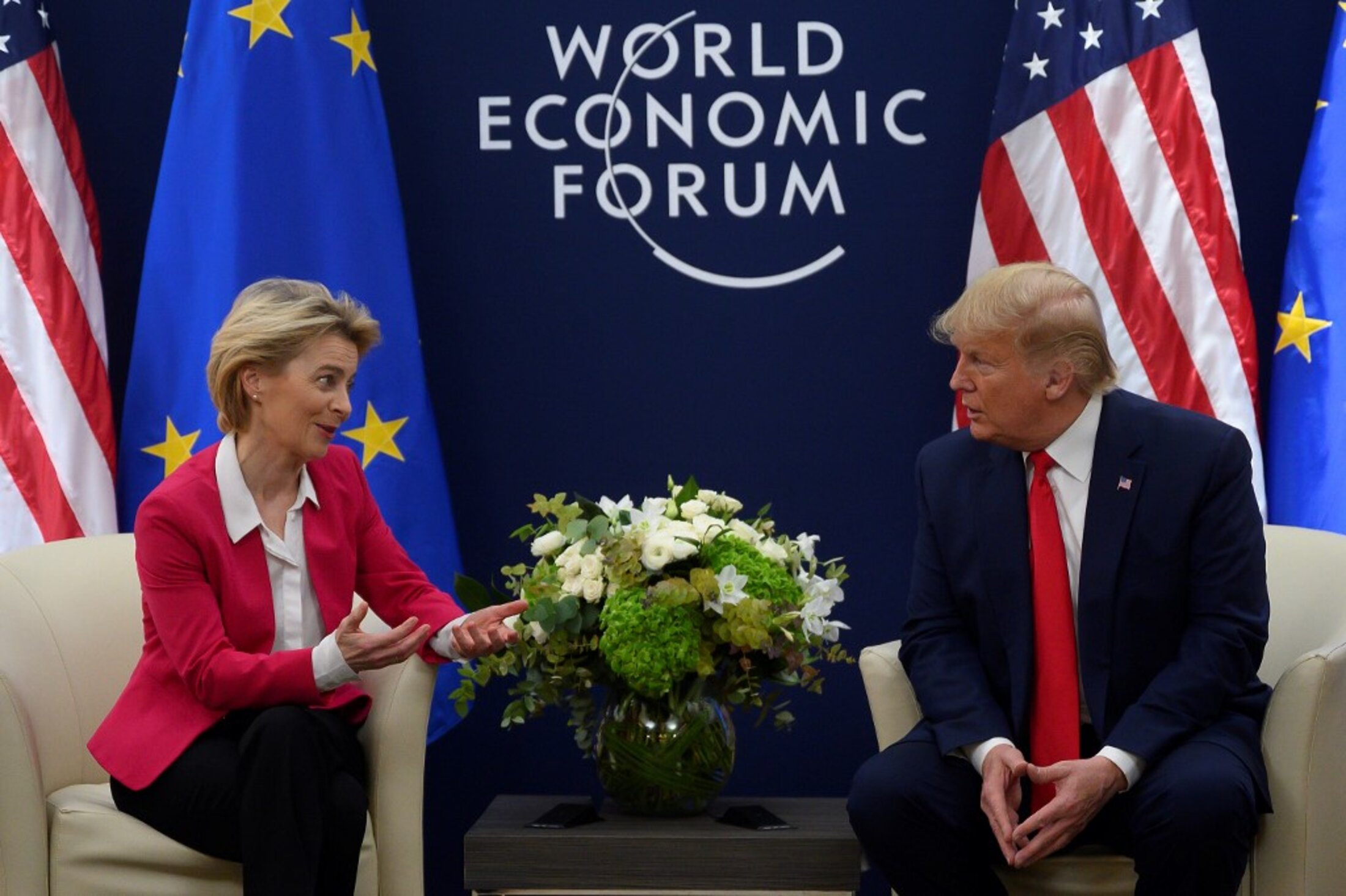
Then there remains the prospect of some form of trade deal with Donald Trump's United States, an idea that was kick-started again by the new president of the European Commission, Ursula von der Leyen, during the World Economic Forum at Davos in January this year. On February 26th the Irish EU trade commissioner Phil Hogan said he thought a “mini-deal” with the United States was possible.
Even as the Covid-19 pandemic accelerated, Hogan spoke with his American counterpart, US trade representative Robert Lighthizer, by videoconference on March 16th and March 24th to discuss the latest situation in the talks. “The Commission is conducting these discussions with full respect for the mandates that have been granted and is committed to obtaining a balanced outcome,” a Commission spokesperson told Mediapart. However the question arises: is the mandate given by European voters in the spring of 2019 for the Commission to negotiate this deal – a deal to which Paris was opposed at the time – still valid in the post-Covid-19 era?
The Commission's response is that part of its efforts to strengthen “transatlantic regulatory cooperation” - the plan to reach agreement on common standards between the EU and the US to help boost exports – concern some sectors relevant to the fight against the epidemic. These include medical equipment, medicines and vaccines. In other words, the Commission still sees free trade as the key to both fighting Covid-19 and to relaunching the economy after the pandemic.
Hogan, who until becoming trade commissioner in 2019 was responsible for agriculture and rural development, has remained in the background during the current crisis. His public interventions have been rare, one coming at the end of the G20 meeting of trade ministers at the end of March where he called for reform of the World Trade Organisation (WTO). Yet following on from Brexit in 2016 and then the crisis with the EU's free-trade deal with Canada – known as CETA – in 2017 when the Belgian region of Wallonia almost scuppered the agreement, the Covid-19 pandemic is the third major shake-up that DG TRADE has faced in recent years. “In the college of 28 [European] commissioners some are more active than others,” admits one European official. “There's a vast soft underbelly among the ranks of the commissioners. How many of them have said something intelligent in the last few weeks?”
The new Commission president, Ursula von der Leyen, first of all became entangled in the row over 'Corona bonds', the financial mechanism which would have involved all EU member states borrowing from the markets on the same terms, a measure requested by Italy but rejected by Holland in particular. She then publicly apologised to Italy for the lack of solidarity shown by the rest of the EU at the start of the outbreak in northern Italy. The commissioner for competition, Margrethe Vestager, suggested that EU member states should buy stakes in companies to counter the threat of Chinese takeovers. And France's Thierry Breton, the commissioner for the internal market and services, hardened the rhetoric – to an extent – on the need to relocate some key strategic supply chains to Europe. Meanwhile vice-president Frans Timmermans, who is heading the Commission's 'Green Deal', has called for the future economic recovery to help finance projects linked to the EU's environmental goals. But that is about sum of the commissioners' interventions so far.
As for the European Parliament, on Friday April 17th it passed a resolution on “EU coordinated action to combat the COVID-19 pandemic and its consequences” which did not mention the issue of free trade deals. “It was a missed opportunity,” said Younous Omarjee, a European member of Parliament for France's radical-left La France Insoumise or 'Unbowed France' party. He, like many MEPs on the Left, believes that the time has come for a “questioning of the EU's whole trade policy”.
Nonetheless there are likely to be growing calls to continue the approach that began in limited fashion under former Commission president Jean-Claude Juncker for Europe to put an end to its “commercial naivety”, in particular in relation to China. This approach included new rules on reciprocity for public contracts and a new methodology – still regarded as too timid by critics – to better measure non-European investment in critical sectors and, where this cannot be done, potentially to block that investment. There have also been so-called “commercial defence” measures aimed at protecting the EU from Chinese dumping practices.
However, on these deeply sensitive issues as on so many others in Brussels, future progress depends less on the European Commission or the European Parliament and more on the member states, and on one of them in particular – Germany.
----------------------------------------------------------------------
- The French version of this article can be found here.
English version by Michael Streeter