


Earlier this week the French Senate held the first of two parliamentary consultative debates to explore how to make France a more attractive destination for skilled foreign professionals and students, an issue that has long been neglected and submerged under the anti-immigration policies and political rhetoric of the government’s predecessors.
The result has been that France is, by all accounts, losing its attractiveness for foreign talent, notably in comparison with its European neighbours Britain and Germany. Following up on an election campaign pledge by President François Hollande, the socialist government plans to present a bill of law this summer to reform its immigration legislation to attempt to facilitate and encourage professional immigration which it recognises as an economic necessity.
The turnaround in approach comes after a number of countries, including the United States, Canada, Australia and Germany, have launched innovative programmes to entice skilled foreigners to play a part in their economic activity. What was once a political taboo is now the subject of an open and aggressive competition to attract an ever-increasing pool of talent worldwide.
"Our journey is not complete until we find a better way to welcome the striving, hopeful immigrants who still see America as a land of opportunity, until bright young students and engineers are enlisted in our workforce rather than expelled from our country," said US President Barack Obama in his inaugural address for his second term of office on January 21st, (while also promising to beef up security around US borders).
Obama has made reform of American immigration policy one of the priorities of his mandate and, despite the reactions of some after the Boston bombings, the changes are so awaited – the last major reforms date back to 1986 – that a U-Turn appears unthinkable.
Pressure for reform has notably come from business leaders in California’s Silicon Valley, where Facebook co-founder, chairman and CEO Mark Zuckerberg has co-launched FWD.US to lobby for change. Writing in The Washington Post earlier this month, in an opinion piece entitled ‘Immigration and the knowledge economy’, Zuckerberg argued not for altruism but a defence of the country’s economic interests: “To lead the world in this new economy, we need the most talented and hardest-working people. We need to train and attract the best. We need those middle-school students to be tomorrow’s leaders.”
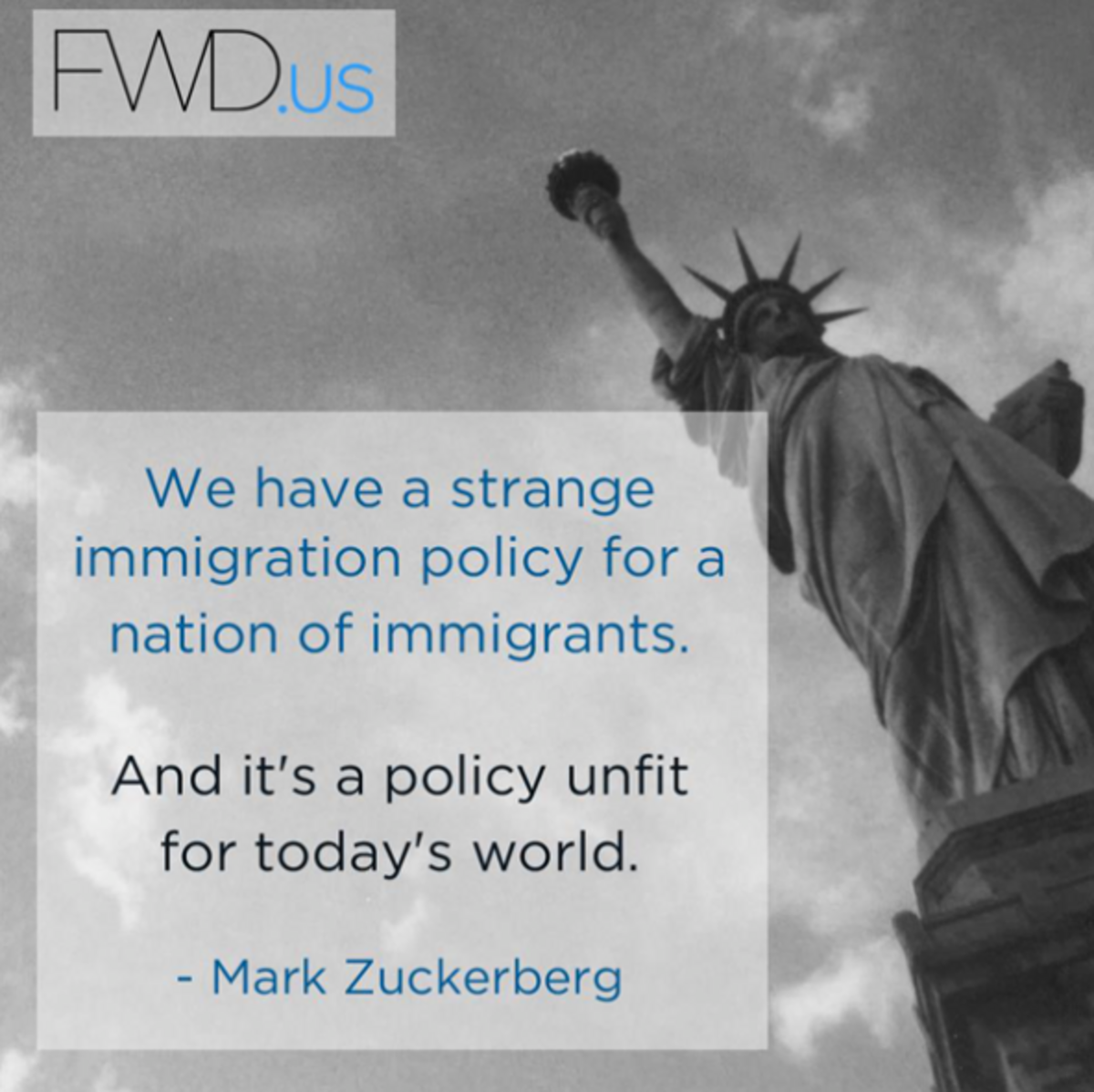
“Given all this, why do we kick out the more than 40 percent of math and science graduate students who are not U.S. citizens after educating them? Why do we offer so few H-1B visas for talented specialists that the supply runs out within days of becoming available each year, even though we know each of these jobs will create two or three more American jobs in return? Why don’t we let entrepreneurs move here when they have what it takes to start companies that will create even more jobs?” He, too, considers that immigration reform should include “effective border security”
Business chiefs in France have largely kept away from the issue, as if paralysed by what they consider an overly sensitive debate. A rare exception are those who make up a think-tank called the Cercle d’outre-Manche , or Cross-Channel Circle, made up of French company heads working in France and Britain. The organisation, which proclaims itself dedicated to “promoting the best practices of the two countries”, calls in a study it published in March for what is regarded as a British approach and which favours professional immigration over that which reunites immigrant families, arguing that, for France, “immigration is necessary for the country and should be managed in such a way as to contribute to an increase in the economic wealth of France”.
'France no longer a country of strong immigration'
Following up on President Hollande’s election campaign pledge last year, one of the first decisions of his government under Prime Minister Jean-Marc Ayrault was to annul the so-called ‘Guéant circular’. This was a move by former conservative president Nicolas Sarkozy’s interior minister Claude Guéant to restrict the granting of work permits to foreign, non-EU students, many of whom were graduates who had been offered employment after their studies in the country (see here and here).
Subsequently, the government announced it would organise consultative parliamentary debates in both the lower and upper houses on the issue of professional immigration and student mobility, which would not be finalised with a vote but which would serve as a basis for a bill of law expected to be presented in July. The debate in the lower house, the national Assembly, initially planned for April 16th, has been postponed to May 29th because of the lengthy passage of the government’s bill proposing the right to marriage and adoption for same-sex couples.
The debate in the upper house, the Senate, was held on April 24th, when interior minister Manuel Valls argued that “the truth is that we never talk about our migratory flows [...] Which foreigners can or should we welcome?” adding: “There are foreigners who, by their talents, constitute not a danger for [the] employment [market] but an opportunity for our growth.”
Valls was joined in the debate by the Minister for Higher Education and Research, Geneviève Fioraso. “The government considers that foreign students and researchers are a source of enrichment and opportunity, not a problem,” she told the assembled senators. “They are the managers of tomorrow, wherever their professional path takes them. Mobility creates partnerships that are useful for the development of our relationships of exchange abroad, and which are in sorely need [of that].”
The French interior ministry’s General Secretariat for Immigration and Integration, the SGII, provided one of the strongest arguments in favour of reforming immigration policy. In a report drawn up especially for the parliamentary debates (available, in French only, here), it observed that the reality of immigration flows in France were “too often little understood or presented for polemical ends”. The SGII found that “France is no longer a country of strong immigration”, as it was during the period between the two World Wars and its post-1945 three decade-long economic boom familiarly called ‘les Trente Glorieuses’, (‘the wonderful 30 years’). Today, immigrants total 8.4% of the French population, according to the last census, which is quite unremarkable among member states of the Organization of Economic Cooperation and Development, the OECD.
Germany has three times as many qualified immigrants than France, while Britain has twice as many as France, according to a report by the Economic Analysis Council, an advisory body on economic affairs to the French government.
“The policies led these past years, aimed at rebalancing the proportion of professional immigration compared to immigration of family members, and to develop the welcome for qualified professional immigrants, has in tne end had a very moderate impact of migratory flows,” reports the SGII.
In 2012, France delivered 17,000 new long-term residency permits to foreigners from outside the European Union to exercise an economic activity (EU nationals have no need of a work permit). That represents just 9% of the total number of residency permits delivered in 2012 (193,000), compared with a ratio of more than 20% in Britain, Canada, Spain and Italy, according to OECD figures.
A special residency card of ‘competence and talent’ created in 2006 by then-interior minister Nicolas Sarkozy, for professional immigrants, has proved a flop: in all, it was attributed to just 1,364 immigrants, an average of 200 per year. “French policy on migration tried to favour the recruitment of qualified workers but without causing any major inflexion,” notes the SGII, describing the judicial and bureaucratic framework for favouring professional immigration both “complex and dissuasive”.
In other words, past French immigration policy, that of ‘selected immigration’, has not contributed to making France’s economy more competitive. If anything, it has divided immigrants into the good – those who are qualified - and the bad – made up of those who are unqualified and the wives and who rejoin husbands already in place.
US remains favoured destination
After a steady rise that began at the end of the 1990s, the number of foreign students granted residency permits in France fell by 10% in 2012, when they totalled 59,000, illustrating a drop in demand. The French higher education system, however, remains well-regarded, and France and Germany are the most popular non-Anglophone destinations for foreign higher education students. But the competition to attract the young elites of developing countries is heating up, with the creation of regional higher education ‘hubs’ like in Singapore, Qatar and Malaya which are all targeting masters and PhD students in sciences.
“In less than a generation, the number of students worldwide will have more than tripled,” reports the SGII, “the sign of a true revolution in the geopolitical organization of knowledge and strategies to valorise teaching models.” It insists that the issue is an urgent one for developing French excellence, noting that of the 6.24 million people in France it describes as “highly qualified”, 12.5% were born outside the country.
While France appears to be losing its attractiveness, other countries, among them its direct economic competitors, are on the offensive to lure foreign talent. Among them is Germany which, with a declining population and a lack of skilled workers, has created an employment agency that travels around the world to put candidates into contact with German employers. After easing conditions last year for the highly qualified to obtain a residency permit, it now plans the same for the semi-skilled.
The European Commission has encouraged such an approach for some years, because of the ageing of the populations of EU member countries. On March 25th last, it presented the substance of a new proposed directive aimed at encouraging foreign students and researchers to Europe, to help improve “growth and competitiveness”, by doing away with what it considers to be too many administrative obstacles currently in place. The proposed directive includes measures that would allow researchers to remain in a country for 12 months following the end of their activities or studies in order to find employment or to set up a business. It would also give non-EU students to engage while studying in paid work for up to 20 hours per week (against ten hours allowed today).
The European Parliament recently adopted a resolution advising the creation of a system in practice in Australia, whereby immigration offices are opened abroad to help immigrant candidates with their linguistic and social integration before travelling.
However, the US, which counts 43 million inhabitants who were born outside the country, remains the favoured destination for an estimated half of the world’s highly qualified migrants. Immigration is as much an economic necessity for the country as it is an opportunity for those arriving, as illustrated in established studies that estimate foreign-born inhabitants are on average responsible for 30% of all patents registered in the US, and 25% of companies created there.
Meanwhile, it is no coincidence that the founders of FWD.US come from Silicon Valley, where many high-profile company chiefs are foreign-born, such as Intel’s former CEO Andy Grove (from Hungary) , Sun Microsystems’s co-founders Vinod Khosla (India) and Andreas Bechtolsheim (Germany), Yahoo Inc’s co-founder Jerry (Taiwan), Google co-founder Sergey Brin and Instagram co-founder Mike Krieger (Brazil).
-------------------------
English version by Graham Tearse