


All it required was one little phrase to further fuel the already fierce opposition to the French government's proposed pension reforms, and Élisabeth Borne managed to find it. The prime minister declared on the radio on January 29th that both pushing back the age of retirement from 62 to 64 and accelerating the timetable for increasing the number of years you need to work to qualify for a full pension were “no longer negotiable”.
No matter if Pierre-Louis Bras, the president of the government's own pensions body the Conseil d’Orientation des Retraites (COR), considers that the reforms are not vital in terms of public finances. In her declaration, Élisabeth Borne demonstrated the government's impatience as it tries to win a highly symbolic victory over an issue which is no less important itself.
Ever since 1995, when the government under prime minister Alain Juppé had to withdraw its social security reform plans, the issue of pension reform has become a totemic one for any administration wanting to earn its “reformist” spurs and eager to show that they know how to govern against “the street”. Such governments use rhetoric that seeks to portray the traditional Left and the trade unions as the conservatives, and that it is they, the executive, that is supporting “action” and “change”.
Enlargement : Illustration 1
Yet in addition to the grandstanding, the pension reforms also risk destabilising the social contract that has underpinned the country since 1945, by draining the lifeblood from the aptly-named Social Security system and its promises of solidarity and support. After the three previous reforms in 2003, 2010 and 2014, this further assault could indeed be the one to bring the whole structure crashing down. The current debacle over state hospitals reminds us that no matter how strong a public service may be, it cannot always withstand constant attacks.
Also on January 29th the minister of the interior Gérald Darmanin boasted of the values that the ruling majority is supposedly defending with its reform plans, namely “work, the values of endeavour, merit and empowerment”. But such statements cannot mask the evidence: the plans put forward by Emmanuel Macron and his government are unfair and brutal. They are unfair and brutal both on a social and political level, and in substance and form.
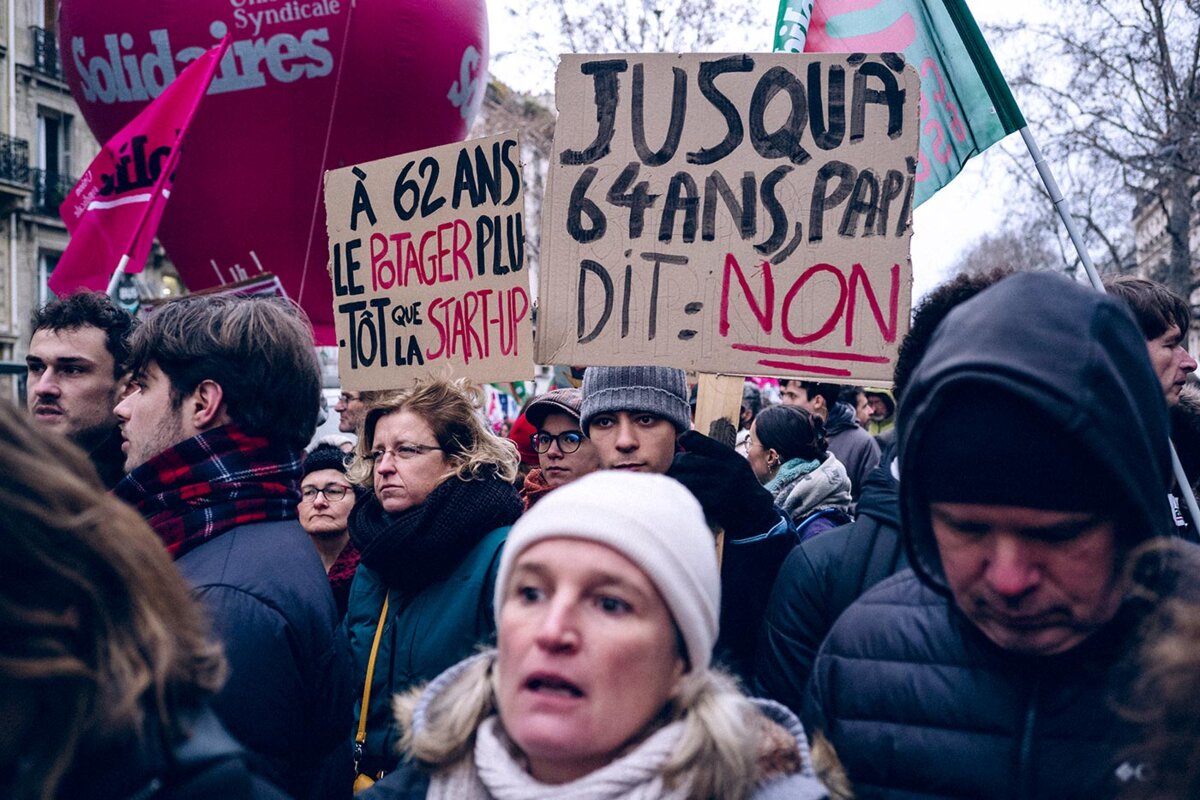
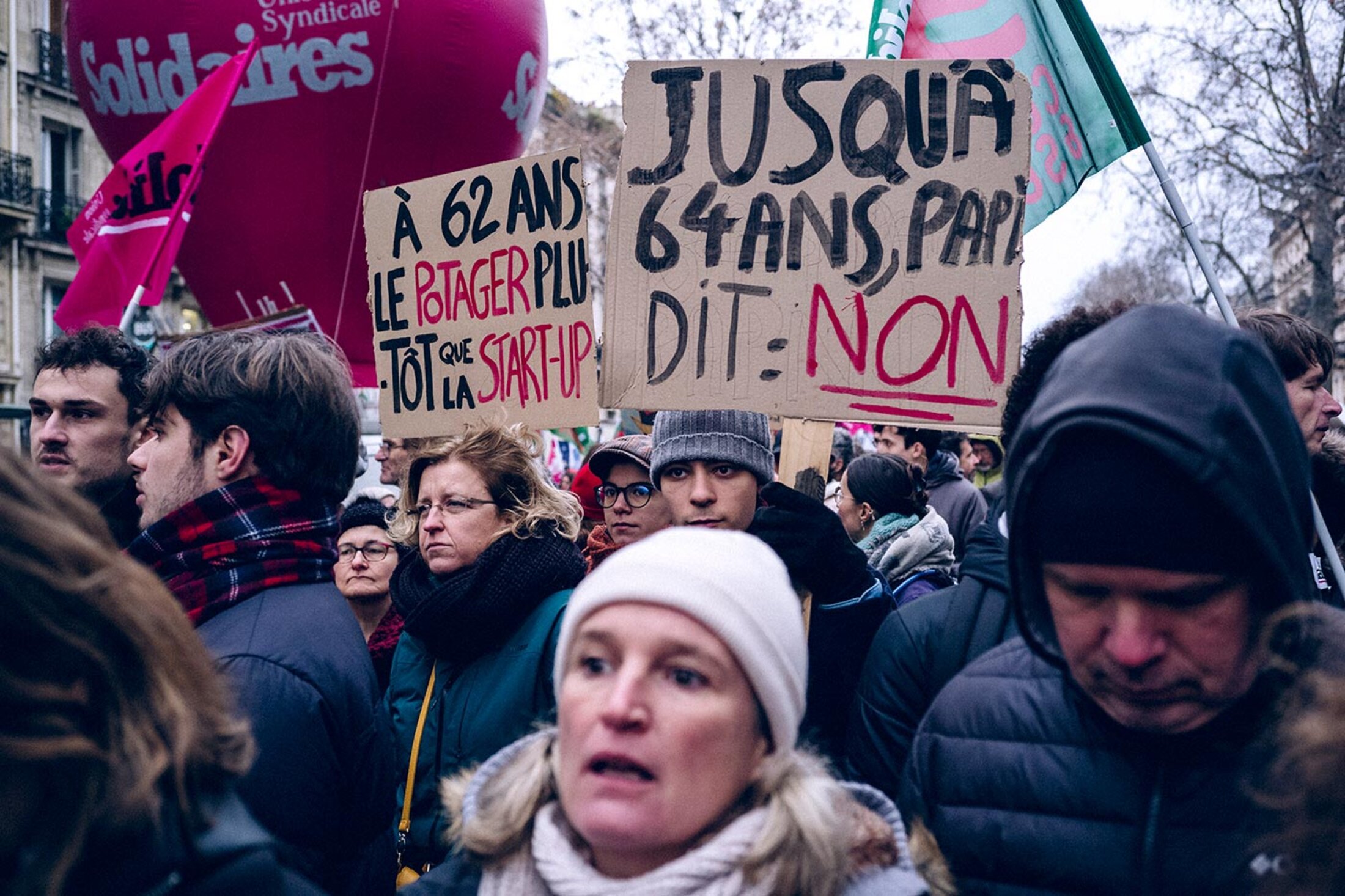
It was opposition to this injustice that led a million people to march against the reforms on January 19th as they answered the call of all trade unions, who have adopted a united stance for the first time since 2010. And it is against this brutality that people have been marching this Tuesday, including several dozen Mediapart staff after the issue was debated at a general assembly.
The labour minister Olivier Dussopt may well promise that these reforms will leave “no losers”. But an analysis of the government's decisions tell the opposite story: workers born on or after September 1st 1961 will have to wait longer to get their pensions – ranging from 62 years and three months right up to 64 for anyone born in 1968 or after. The risk is that this will increase the number of people forced to wait for their retirement while unemployed, on welfare payments or simply without any resources at all.
Only people who start work before their eighteenth birthday and can thus complete the full quota of pension contribution years will now be able to retire at the current retirement age of 62; and that is a tiny minority of the population. Moreover, workers born between 1961 and 1974 will have to work more qualifying years that they had previously been told (from a quarter to up to three-quarters of a year longer for those born in 1965 and 1966) to get their full pension entitlement.
For those who had planned to work beyond the legal age of retirement despite working all their pension qualifying years, these reforms are also bad news. For they will now miss out on the 'bonus' contribution years they could have acquired between the ages of 62 and 64, and will thus not get the bigger pension they had hoped for.
These reforms will automatically have a greater impact on poorer people, even if the government is to keep to 67 the age at which anyone who has not worked the full number of contributory years still gets their full pension, and even though people who are unable to work through disability will still get their full pension at the age of 62.
Dying sooner after reaching retirement age
These decisions are far from neutral choices, they are the root cause of all the injustices the reforms will lead to. Requiring people to work for two more years, often when their bodies are already worn out, is no trivial matter; as a result of previous reforms and even without taking these new planned changes into consideration, the length of time people live in retirement in France is already set to stall and then go down.
In other words, working longer means dying sooner after reaching retirement age, or even before reaching retirement at all. The analysis is even more bleak when you look at the figures on life expectancy for those in good health. And these figures themselves mask another obvious point: that manual workers die much earlier than middle managers (6.4 years earlier according to the official statistics agency INSEE) and spend their retirement years in poorer health.
Finally, and despite what the government keeps saying, women will not on average do better as a result of these reforms. In this regard it is striking how Élisabeth Borne keeps repeating that the government will “protect” women by not touching the 67 cut-off age for qualifying for a full pension. In doing so she is implicitly acknowledging that these reforms present a risk against which a part of the population needs protection.
Reforming the pension system as Emmanuel Macron is doing means attacking the social fabric of society. Opposing these plans – without denying the many inequalities that the current system contains - means seeking to avoid a deepening of inequalities and rejecting the idea that a permanent rolling back of rights is the only option.
The government already knows that it has lost the public opinion battle. Yet though he is out of arguments, the president has not given up on making this reform the landmark legislation of his second term of office. Indeed, he is preparing to force it through Parliament.
The detailed examination of the reform bill in committee stage has already started at the National Assembly, and it will come before all Assembly members on February 6th. The government has been planning to move as quickly as possible, using constitutional tools to push the measure through that have never been used for a reform measure of such scale. There is even talk of doing away with a vote in the Assembly. You would have to be blind not to be aware of the risks that Emmanuel Macron is taking in relying just on the rightwing Les Républicains party as his somewhat weak allies.
When you have a government that ignores the huge demonstrations that have taken place across all of France - which involve far more than the usual protest groups – and a government that disdains the eight trade unions, overlooks the opposition from all sectors of society and ignores opposition parties, then you also have a government that risks pushing too many citizens into the arms of the far right. This danger to democracy must be opposed as a matter of urgency.
-----------------------------------------------------------------------------
- The original French version of this op-ed article an be found here.
English version by Michael Streeter