

Carine Fouteau

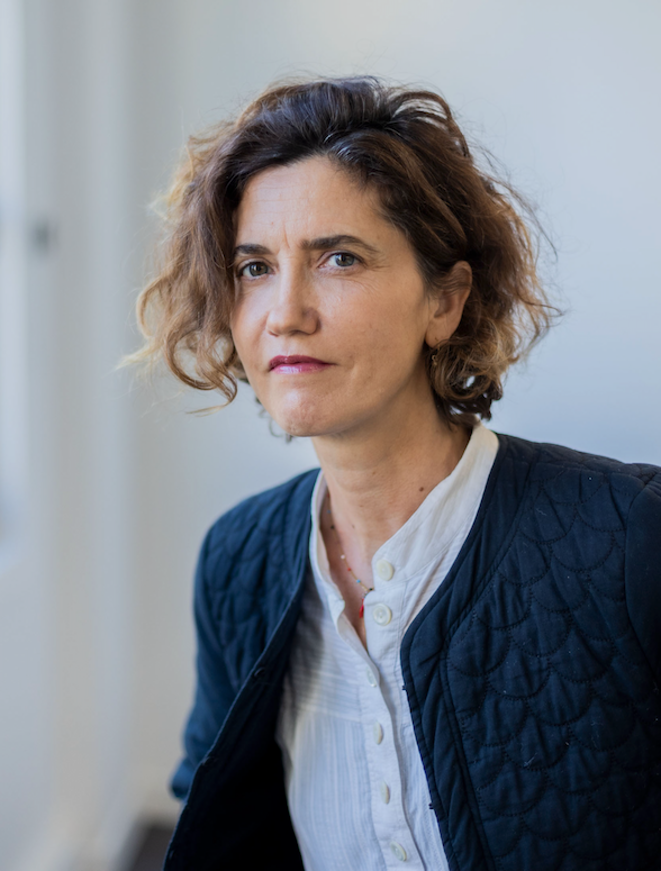
Nommée présidente et directrice de la publication de Mediapart en mars 2024.

Carine Fouteau est née en 1974. Licenciée d’histoire à l’Université Paris I, diplômée de Sciences Po Paris, titulaire d’un master de journalisme à New York University, elle est embauchée en 1999 sur le site internet des Échos et rejoint quelques mois plus tard le quotidien papier pour suivre les conditions de travail. En 2003, elle ouvre un nouveau poste consacré aux enjeux de société : laïcité, démographie et immigration. Sur son temps libre, elle écrit pour la revue culturelle, politique et sociale Vacarme.

Elle quitte les Échos à la suite du rachat du titre par le groupe LVMH et rejoint Mediapart en 2008 dès sa création pour suivre les questions migratoires. Pendant dix ans, elle enquête sur les morts aux frontières de l’Europe, les méfaits de Frontex, le durcissement continu des politiques d’accueil européenne, la torture en Libye, la fabrique de l’illégalité et les violences administratives et policières subies en France par les migrants et les demandeurs d’asile.

En mars 2018, elle succède à François Bonnet, cofondateur de Mediapart, à la direction éditoriale de Mediapart, poste qu’elle occupe aux côtés de Stéphane Alliès jusqu’à octobre 2023.

Co-auteure d'Immigrés sous contrôle (Le Cavalier bleu, 2008), avec Danièle Lochak, elle a également publié en février 2014 Roms & riverains, Une politique municipale de la race (La Fabrique), avec Éric Fassin, Serge Guichard et Aurélie Windels.

Declaration of interest

In the interest of transparency towards its readers, Mediapart’s journalists fill out and make public since 2018 a declaration of interests on the model of the one filled out by members of parliament and senior civil servants with the High Authority for Transparency and Public Life (HATVP), a body created in 2014 after Mediapart’s revelations on the Cahuzac affair.

Consult my declaration of interests

All his articles

  • What's pushing angry Chinese onto the streets of Paris

    France — Interview

    Earlier this summer, thousands of Paris' ethnic Chinese community took to the streets of Belleville, a district in the north of the capital, to call for increased security in the wake of escalating violence against them, including regular street assaults and robberies. The extent of the violence has alarmed community leaders and there is growing anger among this normally discreet population at what is perceived as insufficient concern by the authorities. Carine Fouteau talks to Emmanuel Ma Mung, a France-based expert on international migration and the Chinese diaspora, about the economic and social issues that are turning a once calm multi-cultural neighbourhood into a powder keg.

  • Investigating sex assault crimes in France

    France

    The case against former IMF chief Dominique Strauss-Kahn, charged in May with the assault and attempted rape of a New York hotel chambermaid, appears close to collapse after the alleged victim's credibility was all but destroyed by a prosecutors' investigation. The handling of the case, by the New York Special Victims Unit and District Attorney's office, has come in for sharp criticism from some in France, where Strauss-Kahn's perp walk, initial imprisonment and subsequent house arrest were seen to be humiliating, harsh and ultimately unjust. So just how do the French handle such cases? Carine Fouteau reports.

  • Revealed: how French Football Fed's ethnic graph created a new division

    France — Investigation

    Following its exclusive revelations of a plan to introduce an ethnic quota on players entering French Football Federation national training academies, Mediapart publishes here a graph (pictured) prepared by federation officials earlier this year that identified in yellow the players in its national youth and senior teams who, because of their family origins, were believed to be "susceptible at any time to play for another sporting nation" by obtaining dual nationality.

  • Sarkozy, Berlusconi unite to block free movement in Europe

    International

    French President Nicolas Sarkozy and Italian Prime Minister Silvio Berlusconi this week called for a reform of the Schenghen Agreement that allows passport-free, cross-border travel across most of the EU. They want the treaty to allow for a return to tight policing of frontiers, in reaction to the arrival in Europe in recent months of thousands of migrants fleeing strife-torn North Africa (photo). Carine Fouteau reports on why such a move is unnecessary and more of a nod to domestic electoral considerations than a considered response to a growing humanitarian crisis.

  • EU barricades rise as dictators fall

    International — Analysis

    Following the arrival this month of thousands of Tunisians on the island of Lampedusa, Italian foreign minister Franco Frattini has warned that the fall of Libyan dictator Muammar Gaddafi will open a migratory exodus of 'biblical proportions'. Carine Fouteau reports on how pro-democracy revolts sweeping away the dictatorial regimes of the Arab world have opened up an embarrassing issue for the European Union, which for years has relied on the despots of North Africa to help control clandestine migration from the continent.

  • France's deepening health gulf

    France

    The standards of services provided by the French healthcare system are among the very best in the world. However, the divide in life expectancy between different social categories of the French population is one of the deepest among developed countries. This disturbing paradox is detailed in a major recent study of healthcare in France, reviewed here by Carine Fouteau.

All his blog posts

Mediapart’s journalists also use their blogs, and participate in their own name to this space of debates, by confiding behind the scenes of investigations or reports, doubts or personal reactions to the news.

Carine Fouteau (avatar)

Carine Fouteau

Mediapart Journalist

33 Posts

5 Editions