


France's care homes for the elderly have been reducing their contact with the outside world in recent weeks in a bid to avoid the heavy death toll that occurred this spring when the Covid-19 epidemic was at its peak. Yet even so, the second wave of the virus which has emerged after the summer is still having a deadly impact in some areas.
There have been 20 deaths out of 70 residents in one care home in the Aveyron département or county of southern France since September, and around 15 residents died at a home in the Ain département in south-east France in late August. A further 13 people have fallen victim to Covid-19 at an establishment in the Nouvelle-Aquitaine region of south-west France and there have been deaths at homes in the southern départements of Drôme, Ariège and Vaucluse too.
Even where there have not been deaths, the mood is sombre. “These places are no longer real places to live,” said Sylvie Dupont, a former nurse, who is in charge of care homes for France's Salvation Army foundation the Armée du Salut, with more than a little sadness in her voice. “Of course, it's no longer a lockdown like in the spring, but it's an internal system that remains almost closed,” she said. “We have limited our contact with the outside world, our events, and the time we spend close to residents. We wear masks all the time and the outside world scarcely enters.”

Enlargement : Illustration 1
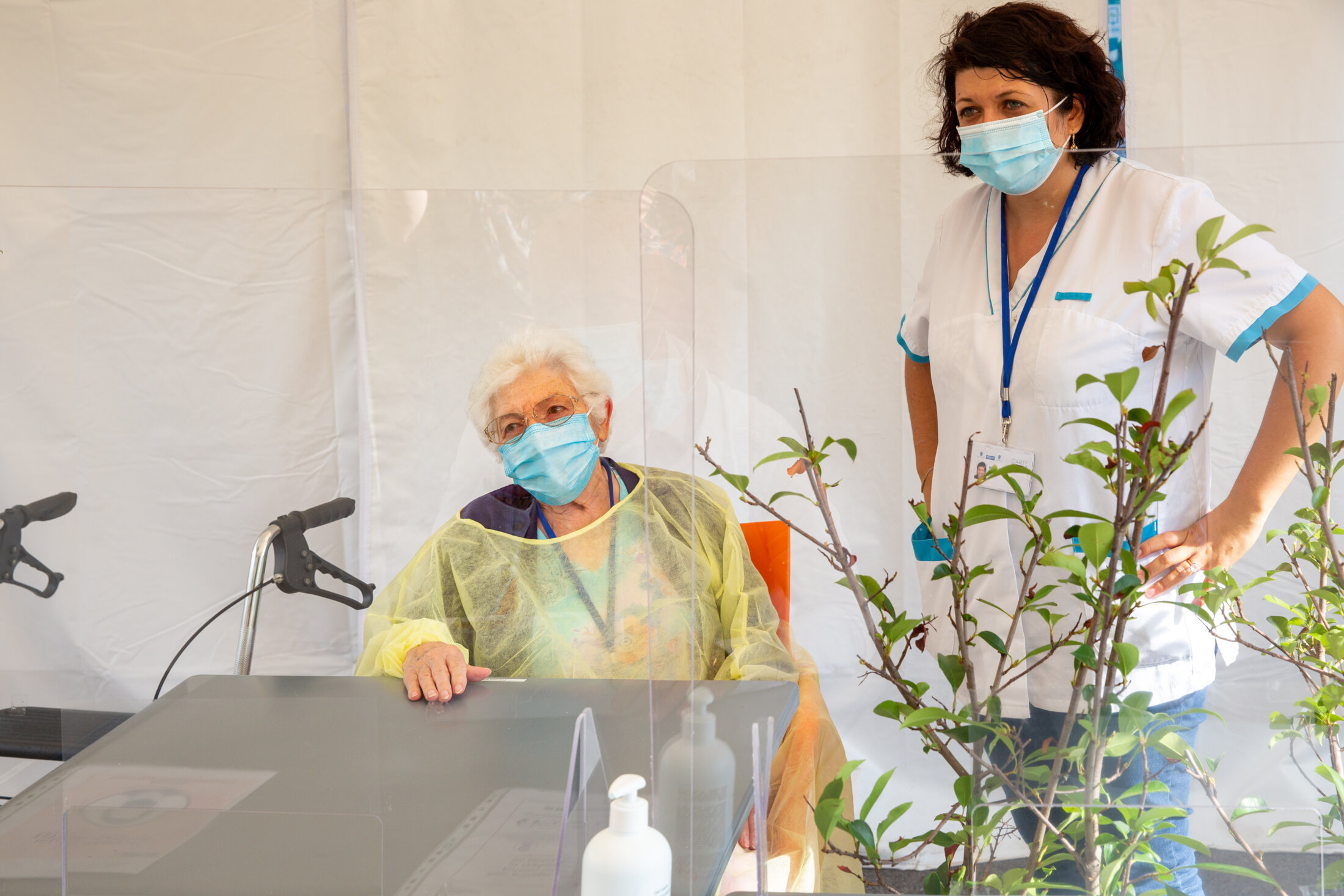
Tatiana Dubuc, a representative of the CGT trade union, works in the public sector care homes in Le Havre in northern France where two homes have recently banned all family visits again. “Residents don't understand that it's coming back. We fear that some will again start to slip away,” she said. “Little by little they let themselves die.”
Some families are also less accepting of the strict rules than they were in the spring, as mistrust grows in the face of the epidemic. “They hear such contradictory things, sometimes they are panicked, sometimes they are told that it's all okay,” said Sylvie Dupont, who has had to reintroduce restrictions on visitors in homes in some regions too. “We have some families who refuse to put their masks on, others who try to get in through the ground-floor window to see their loved one at any cost. The directors are constantly trying to get people to respect the law, it's a tense atmosphere,” she added. And Christmas is soon approaching when for many families the likelihood of being able to bring their loved one home for the festive period seems remote.
Yet some lesson have been learnt from the grim days of April. “We have some cases in our homes but we've now managed to make sure that they don't spread,” said Tatiana Dubuc. “We've set up a specific Covid unit with twelve beds, so as soon as there is any suspicion the patients are transferred there. And we have more or less all we need in terms of protection, unlike the first time when we had to make appeals for masks to be donated ...”
With the staff better protected they are no longer falling ill in droves, thus cutting the huge amount of sick leave which earlier this year led to personnel being replaced by temporary workers with little or no training. Yet Mediapart has been told by many different people in the sector that care workers, nurses and cleaners all still feel they are working with the “sword of Damocles” hanging over them, amid the fear that “it's starting again”.
In some publicly-run homes telephone help lines have been installed for staff to use. Pascal Champvert, president of AD-PA – an association which represents bosses in the French care sector – and vice-president of the European Ageing Network, said that France's Ministry of Health has also promised financial provision for all homes – whether private or public sector – to pay for psychologists to support staff.
Yet the structural problems that were exposed by the health crisis earlier this year have not gone away and in fact have grown. And speeches from President Emmanuel Macron in which he has praised the “heroes in white tunics” have not changed matters. Because of a lack of funding the ratio of staff to care home residents in France, which is already one of the lowest in Europe, is unlikely to change.
Staff at a publicly-run care home in Angers in west central France, where there are 410 residents and which is due to be merged fully with the local teaching hospital soon, went on strike from September 29th until October 9th, when they agreed to suspend their action. They are demanding replacements for 22 staff who are off sick, and also a boost in overall staffing numbers; the establishment has been under pressure since the hospital began budget cuts in 2016. Families of angry residents have also joined the movement.
“It's a vicious circle, working conditions have got so bad that while some stick it out, others succumb, and they are taking in turn to drop like flies,” explained Emmanuel Dubourg-Davy, general secretary for the Force Ouvrière (FO) union in Angers. “Covid has put care homes on the alert, with the fear that it's coming back again. Everyone is exhausted.”
It was against this backdrop that the industrial action began. “The carers were told that they were magnificent, they were applauded for their devotion, and today we have to go on strike to get new staff at a time when they're talking about a second wave!” protested the trade unionist. And while the Angers teaching hospital is now planning to recruit around 20 people in a bid to calm the protest, these are just contract staff who will be paid around 200 euros less a month than the permanent staff. The existing workers have rejected this idea.
It has been a struggle to fund pay rises in the car sector, where the work is difficult and when it is already hard to attract new staff. “Our teams have problems because of the vacant posts, and the difficulty in recruiting is becoming catastrophic,” said Sylvie Dupont. “It's not easy to get someone to come and work in a care home, even less so with Covid.”
Among publicly-run care homes – which make up around 40% of the sector – carers at those establishments which belong to a hospital can claim the 'Covid bonus' the French government has given to the hospital sector. But they can only receive it if they can show they worked for a certain number of days during the three months of the height of the epidemic. From March 2021 they will also receive a pay rise of 180 euros a month promised to nurses in public hospitals during the month-long consultation process with the government called the 'Ségur de la santé'.
In the rest of the sector, where there is a range of different employers and agreements, there are fewer prospects for a pay rise. Those public establishments which are run by local authorities, and not the public health service, do not expect to see any extra money to fund them. Nor are the homes run by not-for-profit associations any better off. “We've been told about an increase of 160 euros but no official decree has been published,” said Sylvie Dupont.
Finally, for workers in the remaining part of the sector, private care homes, the government has left the issue of pay for trade unions and management to sort out. These negotiations are always tense and even more so when they involve large heavily-financed groups such as Korian or Orpea (see Laurent Mauduit's investigation for Mediapart here, in French)
Another overlooked area is the entire domestic care sector, whether public, private or not-for-profit. For these home care workers Covid bonuses have been handed out haphazardly depending on the département where the staff are based, and there is little prospect of a pay rise. Pascal Champvert, of the AD-PA association, is angry about this. “Yes, the state abdicate its responsibility for the départements, which they don't finance. But at the head of the départements we have elected representatives, especially from the Right, who have in previous positions in Paris voted for a reduction in funding for local authorities without batting an eyelid! The domestic care workers are paying the price today, and that's intolerable.”
As Mediapart has reported on many occasions (see here and here, in French), domestic care workers are even more badly paid than their colleagues in care homes, who are themselves already close to the poverty line. At the start of the health crisis domestic nursing assistants and carers also remained without protection for longer than others, while still looking after their patients. Pascal Champvert said the refusal to acknowledge the huge financial vulnerability of such workers was a major “political mistake”. He said: “They did their bit once before, will they do so again if the situation gets worse? We've already seen lots of staff move to care homes or hospitals, which is increasing our already considerable difficulties in recruiting domestic carers.”
The new government minister with responsibility for the care sector, Brigitte Bourguignon, who is under pressure from employer organisations and unions, wants to start a new consultation. This comes as a new law, which will set up and fund a new 'fifth arm' of the welfare system - the care sector - is expected to pass at the end of the year. Some doubt that yet another consultation is really necessary when several reports have already been written on the issue since the start of Emmanuel Macron's presidency. The last of these, commissioned by the Ministry of Health and written by former minister Myriam El Khomri, is called: “Mobilisation plan for careers working with the elderly”. That was just a year ago, before the Covid-19 epidemic struck.
------------------------------------------------------------------------------
The French version of this article can be found here.
English version by Michael Streeter