


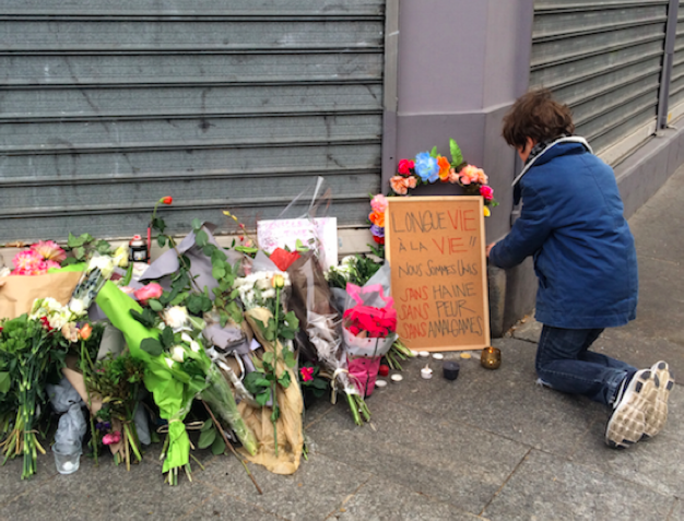
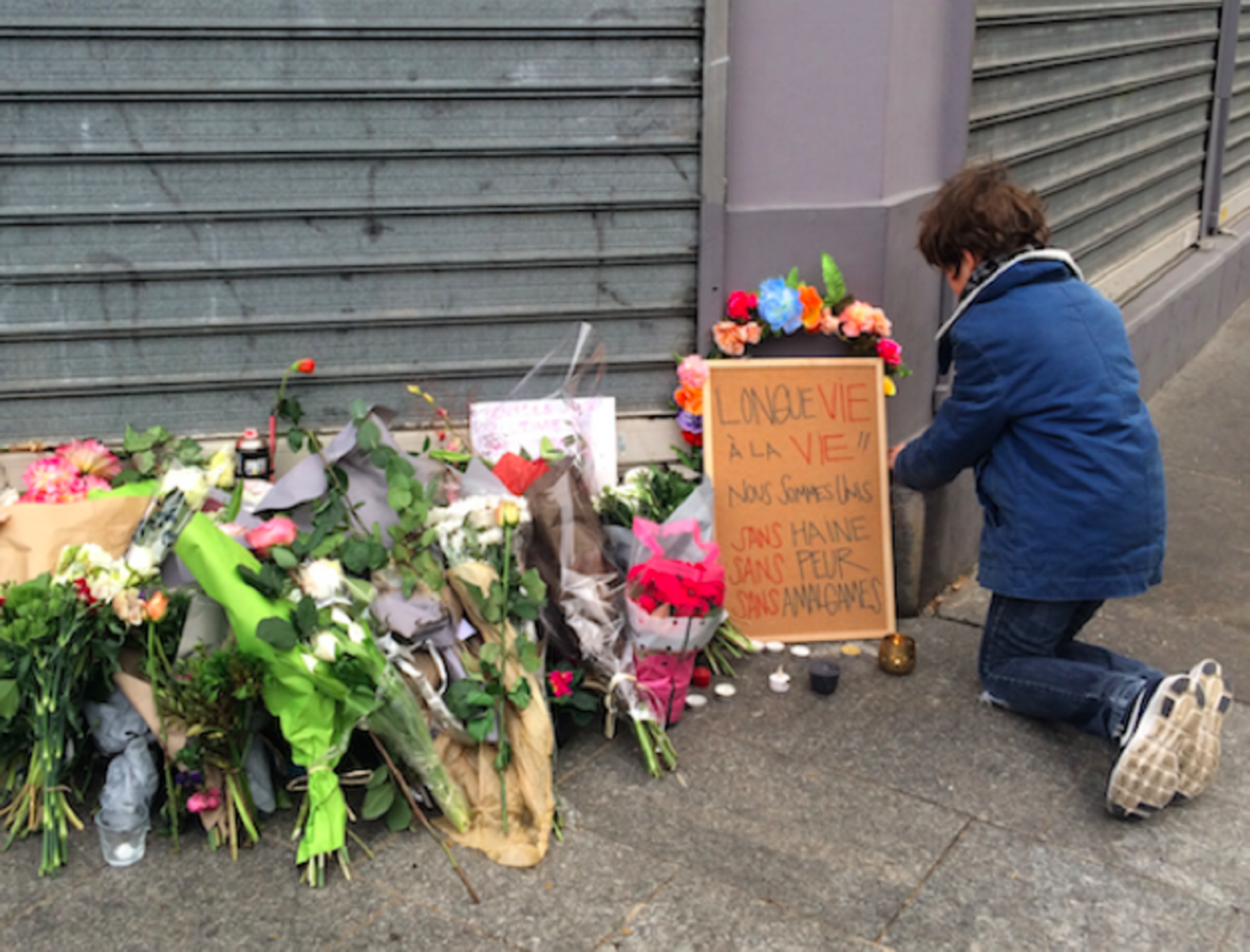
Just like every morning, some arrived in groups, laughing and digging each other in the ribs; some were in a bad mood; while others were running because they were late. But on this Monday morning, November 16th, there was a difference: many of the pupils arriving at this private Catholic school, Saint-Michel-de-Picpus, in Paris's 12th arrondissement, were clutching a white rose in their hand. These were to be laid in the school's chapel in memory of Romain, 25, an English teacher and former supervisor in the collège – a secondary school for 11 to 16-year-olds - and a pupil's mother. Both were killed in Friday's terror attacks in Paris.
The flower tribute idea came from a group of pupils on the internet over the weekend and was embraced by the school staff. At 10.30am on Monday all the pupils at the collège and lycée – which takes students from the age of 16 - at Saint-Michel-de-Picpus observed a minute's silence. Nearby, two friends in their first year at the lycée, Hortense and Camille, had taken refuge on the steps of the library to have a cigarette. White roses poked out from one of their bags, ready to be deposited in the chapel. The friends gave a bleak verdict on the weekend's events. “These attacks suddenly seem more real: everyone can be hit, at any time. That's what is frightening,” they said.
Enlargement : Illustration 1
Many pupils interviewed near the school drew comparisons with the attacks in January to underline the fact that, as far as they were concerned, the latest attacks had reached a new level. “In January the targets were in a sense symbols. Here, this was mass carnage,” said Julie and Margot. A few metres away, at a busy point situated between two nursery schools, two junior schools, a collège and a lycée, council worker Fettouma Hassan, whose job it is to see schoolchildren safely across the road, lacked her normal smile. Gone, too, was the good humour that she normally makes it a point of honour to show while doing her job. “My stomach's been in knots for two days. That's not Islam. What is the point?” asked the 50-year-old. “I'm thinking of the little ones who are going to school today. How are you going to explain that?”
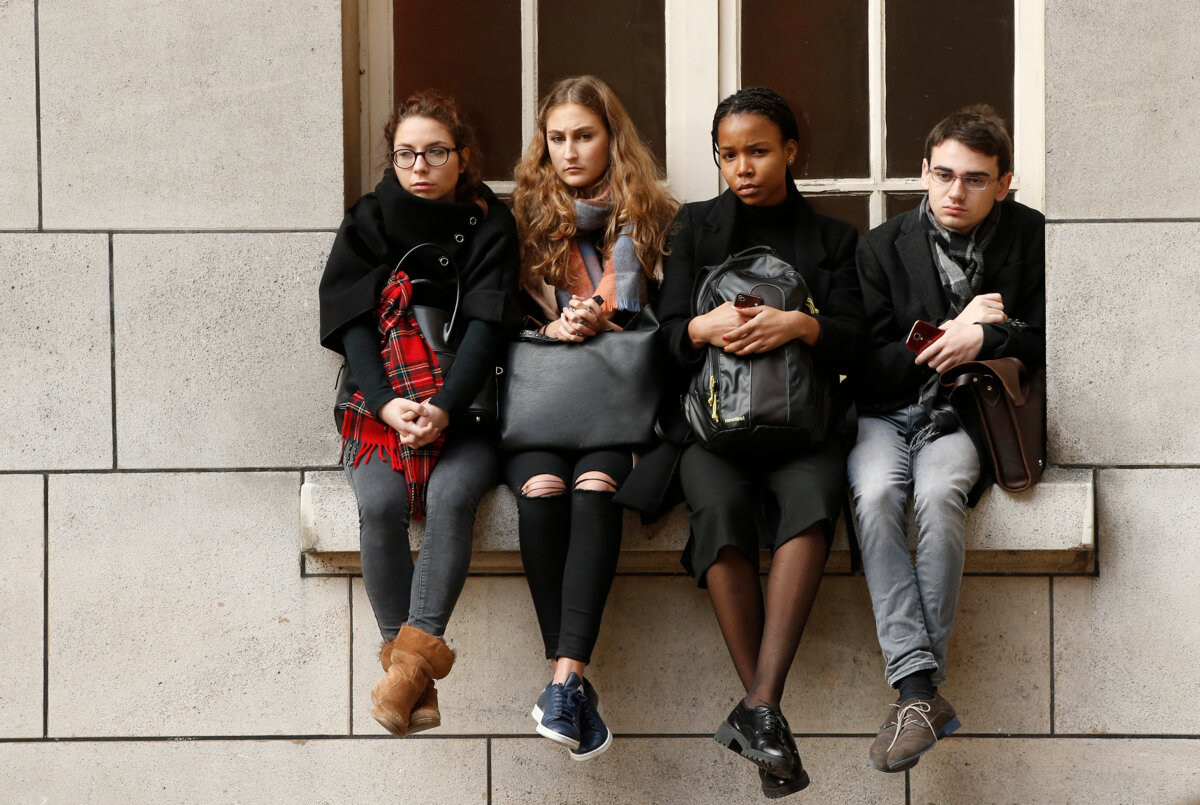
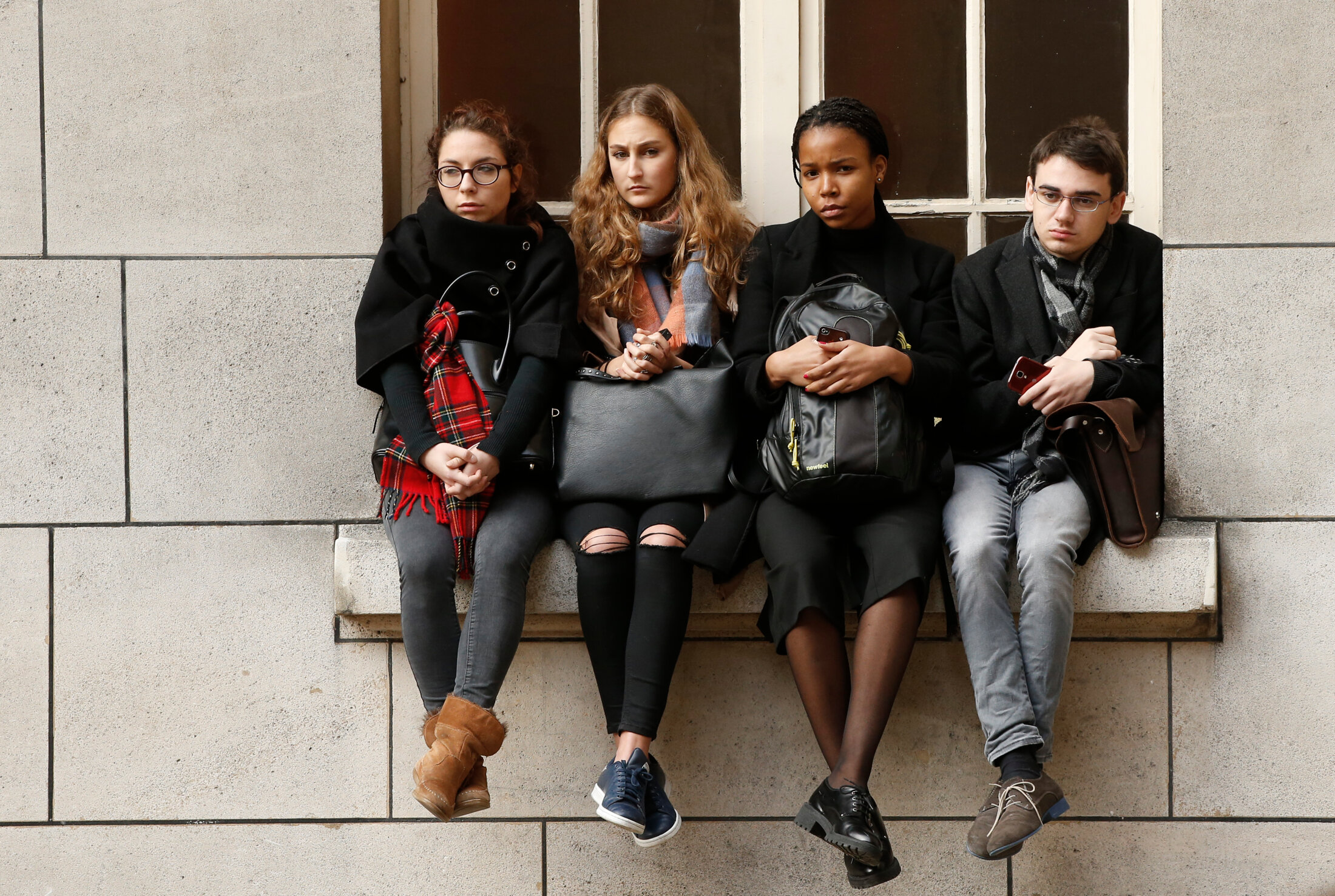
Explanations are precisely what Capucine aged 19, and 20-year-old Anaïs, both history students at the Sorbonne university in the city's 5th arrondissement, were seeking. They were sitting at a table on a café terrace in rue Saint-Jacques, smoking cigarette after cigarette and watching the police vans blocking access and removing parked cars. President François Hollande, prime minister Manuel Valls, education minister Najat Vallaud-Belkacem and the junior minister for higher education, Thierry Mandon, were due shortly for the minute's silence at the Sorbonne.
The two friends were going too. “Being together is really the priority. The lessons, let's see later on,” said Capucine, who had just bought the newspaper Le Courrier international. “This fanaticism raises questions for me, I need to understand what produces that.” Anaïs agreed. “I'm asking myself lots of questions too. For example, I don't yet know if we've reached a point of no-return.” On Friday evening the two young women had been out in the city's 20th arrondissement, and like others they described their panic, the text messages they sent and received and their fear of “being at the wrong place at the wrong time”.
For them, however, the day afterwards was “even worse”. On Saturday they spent the day holed up at their place, eyes glued to their telephone screens, poring over Facebook. “I've never seen so many messages of hate,” said Anaïs. “I deleted a lot of 'friends'. My heart goes out to Muslims. Everyone asks them to justify themselves, I really don't see why they should have to do so,” she said. The square at the Sorbonne was starting to fill up. Some small groups of students were laughing on the terrace, others had swollen eyes and haggard expressions. They did not want to talk. They had “lost someone” on Friday.

Enlargement : Illustration 2

Six stops on the train out of Paris, and a thousand or so people were paying homage in the cold, in front of the student centre at the Paris-Est-Marne-la-Vallée university east of Paris. Inside, many teachers and students were in tears, and administrative staff were in shock. One student was wounded and two lecturers lost their life at the Bataclan concert hall on Friday when it was attacked by the terrorists. One was Nicolas Classeau, director of the university's institute of technology, a music fan and champion of computer technology, in whose honour a sheet hastily turned into a banner was being displayed. The other man who died was geography lecturer and associate professor Matthieu Giroud, who was honoured with flowers and candles in a neighbouring building.
A little earlier that morning Matthieu Giroud's students had gathered in a lecture hall. “We only finally learnt yesterday that our colleague had died,” explained history professor Frédéric Saly-Giocanti. “Without really having had the time to prepare we spoke to them about Matthieu, of what he believed, about the fact that the entire university community had been affected.” Some students, those doing Masters degrees and who were closest to the lecturer and particularly deeply affected by his death, had gathered in a small room to write a text in his tribute. Others took their place in the queue to sign the book of condolences, placed under his photo.
“We were due to see each other on Wednesday,” said Cloé, who is in her first year studying human and social sciences. The death of this lecturer, who was described as a “super teacher”, increased the feeling among the students of just how close they were to this tragedy. They all live in the Paris suburbs, not far from the shootings, “We must carry on as before but we're afraid,” admitted Oriane. “We go out in those districts, we go and see mates in Paris, it could have been us.”

Enlargement : Illustration 3

As a geographer Matthieu Giroud was particularly interested in the idea of “social mixing”, at how it was made use of, of the gentrification of working class areas and multiculturalism. In other words, a world of subtlety and shade that Islamic State, who have claimed responsibility for the killings, abhor. In February 2015 the organisation dedicated its magazine Dabiq to the “extinction of the grey zone”, in other words all those who do not want to see the world in black and white. It was to precisely this world that Matthieu Giroud's colleagues and students paid tribute on Monday morning.
“This morning we wanted to warn about tarring everyone with the same brush,” said Frédéric Saly-Giocanti. “To say that the murderers claim allegiance to a murderous Islam, and that it is all part of a broader conflict, so that the young people can relate what they experienced on Friday with the rest.” Yet though they are in shock, the murdered lecturer's students are astonishingly lucid. “We've had war for a long time in the Near East as well as the Middle East. Only, for once, it's on our soil,” said Florian, 19, who had spent Friday night receiving news of his friends who were trapped in a bar in rue de Charonne, one of the Paris streets where a restaurant came under deadly attack.
'That's not Islam'
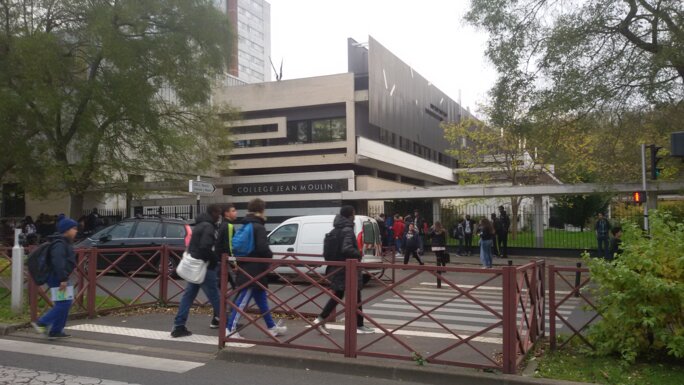
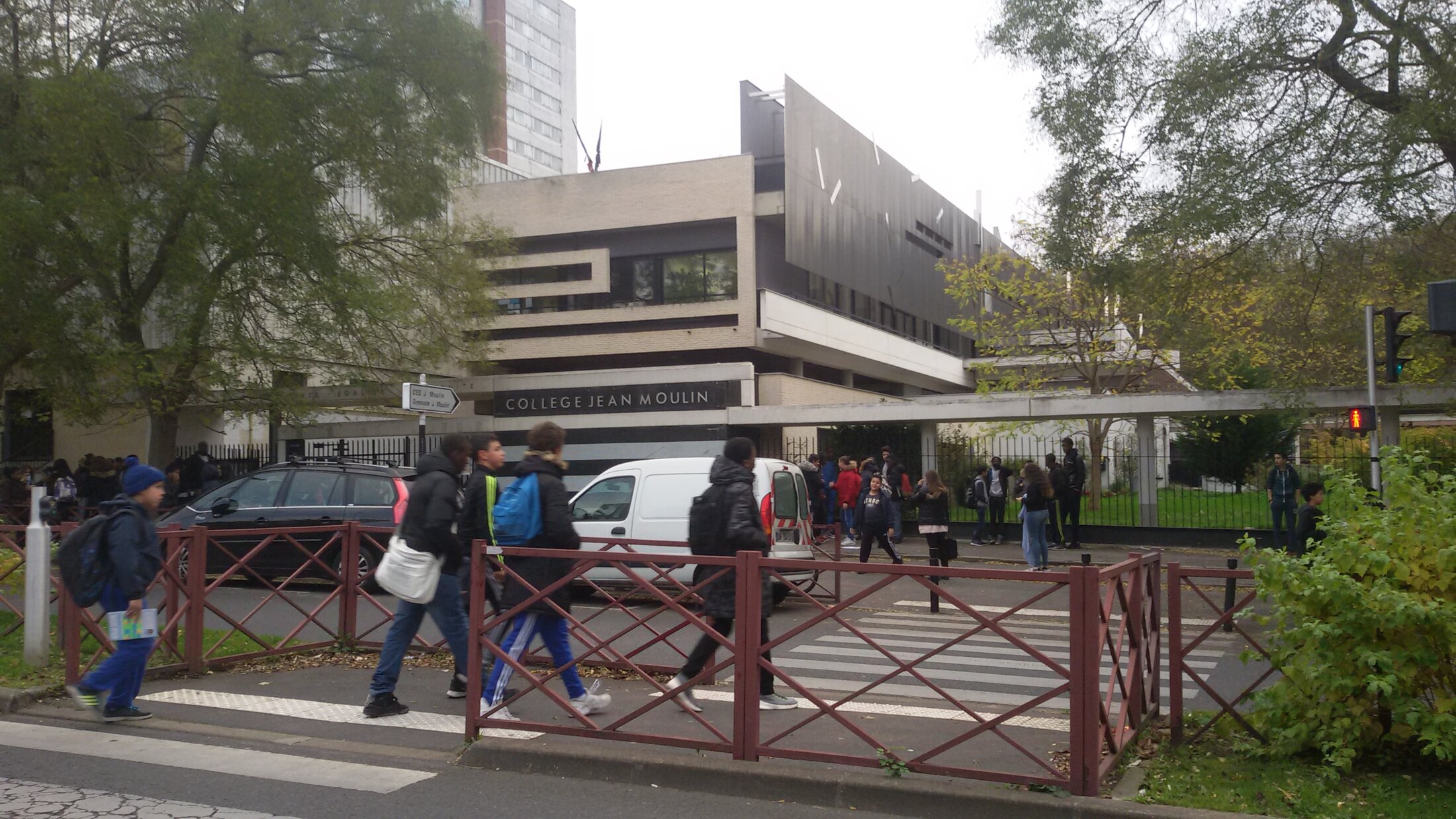
Malik and his friends were sitting on a bench a few metres from the Jean-Moulin collège in Montreuil, east of Paris, waiting for classes to start. They were joking around. What were his mates called? “He's Mohamed, a real jihadist's name!” Ibrahim and Wesle were also there. But as soon as the conversation started their faces became serious. There was no more laughter. Malik lowered his gaze. “What they did, that's not good.” Ibrahim, looking off into the middle distance, said: “There will be other attacks, it's not going to stop there.”
The school is in the upper part of Montreuil, and since September it has been in a priority education area for schools that need extra help. The pupils come from a mixed background, but some are from families in serious hardship. The pupils talking to Mediapart were in the fourth year of middle school – aged 13 to 14 – and were not exactly sure where the Bataclan hall targeted by the terrorists was. “It's not a place where I would go,” said Malik. But they were watching the televised football match between France and Germany at the State de France, north of central Paris, which also came under attack. Montreuil is also the town where one of the cars used in the attacks was later found abandoned. It was parked in rue Édouard-Vailland, not far from the Croix-de-Chavaux metro station. “That's very close to the swimming pool where we go all the time!” said an astonished Malik.
Enlargement : Illustration 4
Last weekend Ibrahim's parents stopped him from leaving the house to hang around with his mates. “But we're not afraid,” they said in unison. They do not intend to change the way they live. They are Muslims and did not see any connection with the attacks. “That's not Islam,” said Ibrahim. “The Koran says you don't have the right to kill. The media must be made to understand that the jihadists are not Muslims.” Malik added: “For me at any rate it's not even the fault of jihadists … these are guys who are completely confused. But it's society that is seeking to... and they respond with Kalashnikovs because that's all they have...”
In the end, they have no explanation. “Why is France targeted?” asked Malik loudly. He thought it was a good idea to bombard areas controlled by Islamic State in Syria, and they they “should be tortured as they themselves do, they have to be shown that we're a strong country”. Wesle, though, did not agree. “That will cause even more damage! It's pointless shooting at them, they're better armed than us.”
That was also the view of 18-year-old Vincent, an apprentice plumber who was working in the area on Monday morning. Vincent, who was wearing work boots and work trousers, and had headphones on, had no doubt about it: “Hate breeds hate. What Hollande is doing [editor's note, stepping up French air strikes against Islamic State] is an act of stupidity. If you seek to destroy them there will always be one who will come back and get revenge.” Vincent lives in Montigny-lès-Cormeilles, in the county or département of Seine-Saint-Denis, where the Stade de France is based. His cousin lost a friend at Bataclan.
He would like to carry on with his same lifestyle and refuse to bow to the terrorists whose aim is to frighten people, but when he is asked whether he would go to a concert any time soon he answered: “There’s a major show of electronic music on December 4th. I can’t remember where, but it’s a thing that attracts a lot of people, sort of like the technoparade. I counted on going there, but I’m not so sure now.” Then he paused. “It’s going to happen again, there are loads of them, the radicalized, in France,” he said, referring to Islamist militants.
Enlargement : Illustration 5
On the other side of the Beaumonts park in Montreuil is the collège Lenain-de-Tillemont. Like Jean-Moulin, it is classed as a REP+ school, meaning it prioritises improving the educational standards of pupils from poor and often immigrant populations. After the minute’s silence held across France on Monday, Fatoumata, a young teenager in third year, was on her lunch break. She said they had talked “about that” all morning, and that “we didn’t really do classes”. She said she appreciated the chance to talk. “The teacher let us express ourselves, everyone talked, and then she explained things to us.”
Among the subjects were the French air strikes launched at the weekend against Islamic State group positions in Syria. “It’s a bit for revenge that Hollande does that, it’s to answer back,” said Fatoumata. “But we know very well that they as well will answer back,” she said. Her classmate Oumar quickly cut in: “It’ll come back to hit us. There’ll be a counter attack, for sure. I’m afraid for myself and my family.”
Earlier in the morning, close to the lycée Jacques-Monod in the 11th arrondissement of central Paris, where a large number of the attacks occurred on Friday, Mediapart came across four girls seated on the pavement, chatting. “This year, the Christmas presents will be from over the internet,” said one of them. “Do you remember I went to see Kev Adams at the Bataclan last year?” asked another, called out Léa. “Imagine, that could have been me.” They repeated over and over that they are frightened, that they look at everything going on around them, that they feel safe nowhere, “not even” in the local supermarket. Asked about the significance of the thought “it could have been me”, they referred to the January terrorist attacks in the French capital, which above all targeted the journalists at Charlie Hebdo magazine and the Jewish customers of a kosher store. “At that time it was shocking, but it was focused, precise,” said one of the girls, Marie. “But here, it’s everyone.”
'I’m afraid but I don’t want to change my life'
Wendy, 21, was sitting at the terrace of a Starbucks café in the centre-north 9th arrondissement of Paris, waiting for her classes at a vocational school to begin. She had just stopped talking on the phone with her parents who live in the provinces and who she said “naturally” worry about her safety. “I’m afraid but I don’t want to change my life,” she explained. “That’s why I’m sitting on the terrace. What worries me is that there’s no-one around me […] Our elders fought for us to be free, it’s out of the question that our freedom be taken back.”
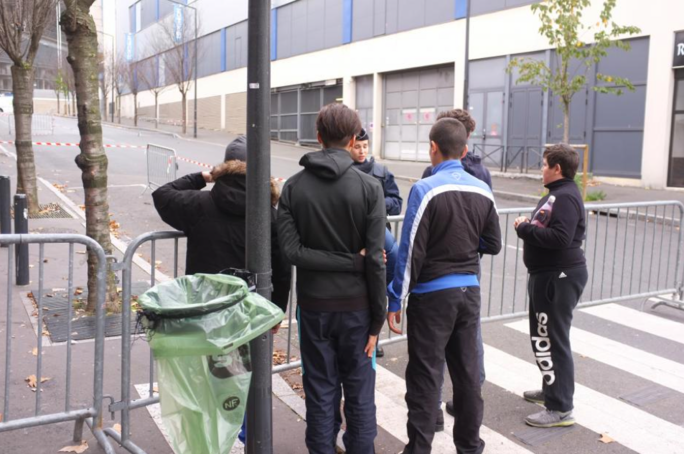
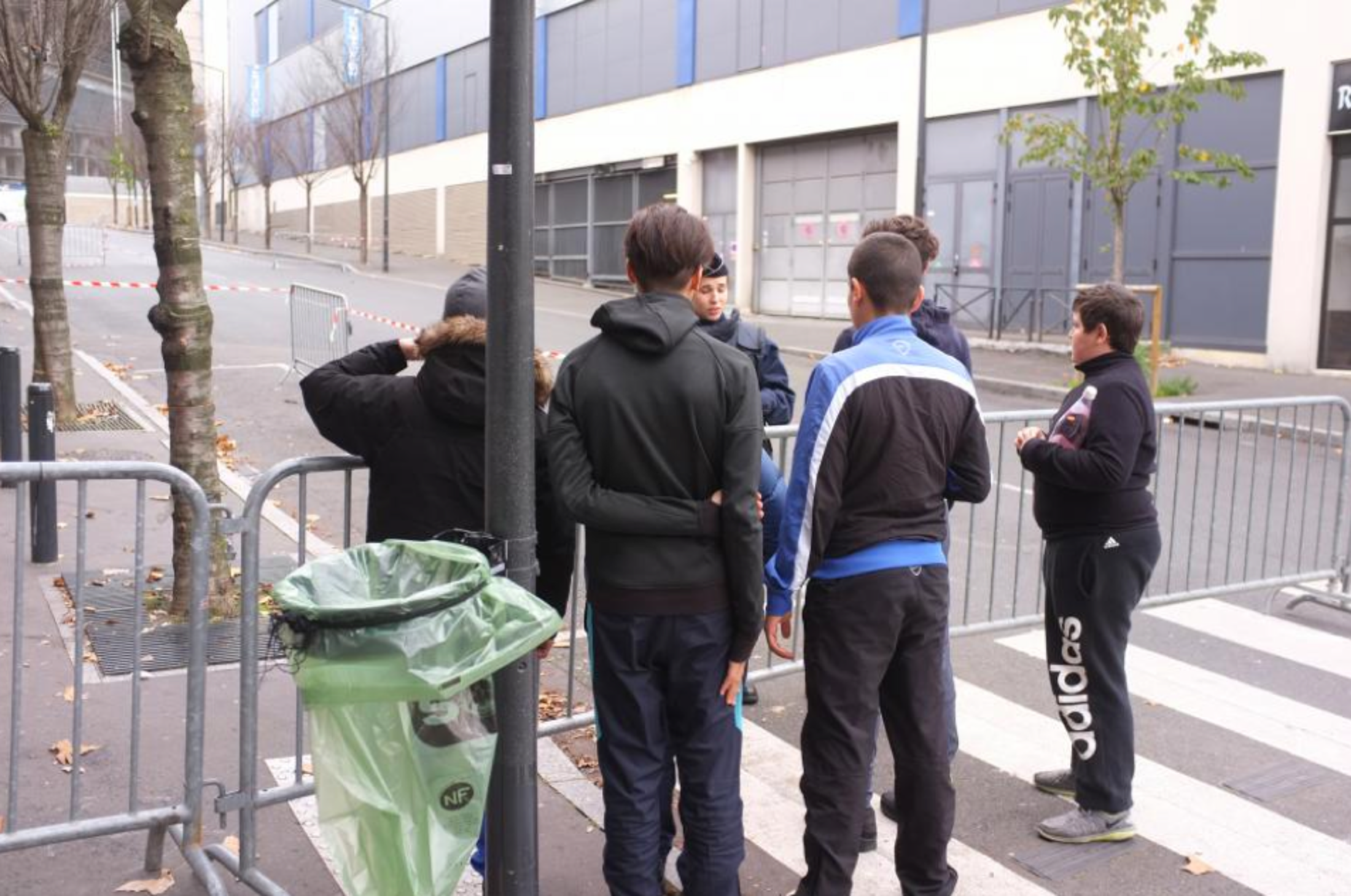
Over in the 19th arrondissement in the north-east of Paris, Soifa, a pupil with the collège Guillaume-Budé, had other things on her mind. “They’re going to call off going to the swimming pool,” she said, speaking outside the school gates. The headmaster, who was in a meeting with teachers to prepare the discussions with pupils, made clear that the press were not welcome inside. But in the street, in the metro, on the phone, the children talk of nothing else. Fatma came rushing up to a group of friends outside the school. She said she had not slept all night. “I heard the lift, I had the impression that the thugs had come for me,” she said. He mother had told her not to go onto Facebook, and most of the young teenagers Mediapart spoke to had been kept inside their homes all weekend.
Enlargement : Illustration 6
The pupils at the collège Guillaume-Budé have had a crash course on the troubles of the planet. Just in front of the collège is the Jean-Quarré vocational school specialized in hotelier trades. For several months it had been home to hundreds of migrants, until they were evacuated one morning last month. On the other side of the street, at the foot of the buildings that line the Place des Fêtes, soldiers with automatic weapons stand guard outside a community centre for Jews of the Chabad movement. Since the January terrorist attacks, the security for the centre has been tightened. “We’ve never had war in France and now we’re afraid that it will come to us,” said Soifa. She has a cousin who was at the Stade de France on Friday evening to watch the football match between France and Germany, where two suicide bombers blew themselves up just outside the main gates. The uncle of her classmate Aïcha was also there.
Moving south into the 20th arrondissement, which fills a vast swathe of south-east Paris, the same fears and questions were voiced. Two secondary schools, the lycée Hélène-Boucher and the lycée Maurice-Ravel, are situated close together, and stand just a short distance from the vast Porte de Vincennes roundabout on the tip of Paris. That is where, on January 9th, gunman Amedy Coulibaly, who claimed to be acting for the Islamic State group, attacked the Jewish kosher store Hyper Casher, murdering four customers and wounding nine others. From midday to 5p.m., when police commandos stormed the store and killed Coulibaly, the pupils of the two lycées were kept locked inside.
During the morning on Monday this week, a school steward at the lycée Maurice-Ravel was urging pupils outside to hurry up and join their classes, giving a friendly tap on the shoulder to each of the boys, and a warm smile to each of the girls.
At the same time, a group of girls aged between 14 and 15 were taking a break after their first hour of teaching. “The teacher has let us chat with each other for a good half hour, so that we talk about what we’re thinking,” explained one of them. “There was a lot of silence, during several minutes we said nothing between us. Only afterwards did we begin class.”
Another, Ashcaa, admitted “I was afraid to go to school”, while her classmate Lou-Andréa, said she was afraid to take the metro train. “With the number 1 line always crowded, how can you feel at ease?” she asked.
The girls spoke of how they were glued to their smartphones as of Friday evening. Sending text messages, but also going onto social media like Facebook and Snapchat to get news about people close to them. They too regard the butchery last Friday evening as being something different to the murders in January. Blue lives beside the République square in central Paris, close to where several of the attacks on Friday took place. “Here, it’s us, it’s our neighbourhood that’s targeted,” she said. “One of my friends lives in the building that’s stuck beside the Bataclan. She was at home on Friday evening. She locked herself in a room and closed the windows. She heard the shots, she thought they could shoot at her home. I spent all day Saturday with her to try to reassure her.”
A mixed group of 16-17-year-olds next came out after their English lesson. They, too, said they had found it difficult to talk at first when their teacher asked them if they wanted to discuss Friday’s events. “Two days later, we still find it difficult,” said one of the boys. “We all come from those neighbourhoods,” said another.
“These are places that we know or where we hang out,” said one of the girls, Mélina. “The Saint-Martin canal, the Bataclan. Depending on the weekend, it could have been us. Of course we’re happy to say to ourselves that we weren’t hit, but it clearly affects us.” Another, Anouk, spoke of how a fortnight earlier she had gone to a concert by French electronic music performer Rone at the Olympia concert hall in central Paris. “They’ve hit us in our intimacy,” she said.
They tried, in their individual manner, to describe the fear that grips them. “The aim of the terrorists is to frighten, to terrorise, and it works,” said Rayan, with a thin smile. “We’re not reassured in fact,” added Mélina. We’re not sure that the state has the means to protect us. And then, they again bombed [Islamic State] in Syria, there could be worse things yet [to happen] in France.”
Another, Jade-Salomé, lives on the rue des Rosiers, in the Jewish neighbourhood of the Marais district in central Paris. On Sunday evening, she was present when there was a mass movement of panic in the street, when crowds of people began running and bars swiftly barricaded themselves shut after what was wrongly thought to be a shooting. She said she was worried that there will be more terrorist attacks.
At the nearby lycée Hélène-Boucher, two boys, Solal and Sacha, said they also did not feel they were in security in their daily lives. “But we don’t have the choice, we have to take the metro to get to school,” said Sacha. He criticised what he called “the enormous cracks” in the interior ministry’s management of security. “People who organise such coordinated attacks, that naturally leaves a trace,” he said. “They’re going to have to take more serious measures. For peace in the future, we’re not too optimistic, but maybe we’ll be better protected.”
Amid all of Mediapart’s many interviews with the youths, interesting and thoughtful viewpoints mostly emerged. But there were also some wild comments, mostly from the younger, less informed children. These included the idea that President François Hollande was behind the terror attacks to gain political support before next month’s regional elections in France. Meanwhile, one pupil from a class of 16-17-year-olds asked: “Sarko [editor's note, Nicolas Sarkozy] had closed the borders, why did Hollande reopen them?” apparently in ignorance of the fact that the systematic control of borders, reintroduced by Hollande at the weekend, were suspended 20 years ago when France joined the Schengen free movement area of European Union countries.
But such comments were marginal, and above all denoted the great confusion in which youngsters in and around the capital are now plunged after their city was hit by major deadly attacks for the second time in just ten months.
------------------------------------------------------------------------
- The French version of this article can be found here.
English version by Graham Tearse and Michael Streeter