


The corruption scandal that has engulfed the European Parliament this month is fast snowballing into one with wider implications than its media nickname of “Qatargate” suggests, as suspicions deepen over Morocco’s role in the alleged cash-for-influence network.
Members of the European Parliament (MEPs) last week approved by an overwhelming majority a resolution which set out its first measures in reaction to the alleged slush fund operated by Qatar to gain support for its interests in the chamber. The approval of the resolution, which garnered 541 votes in favour, two against and three abstentions, enacts the suspension of all legislative work in connection with Qatar and the withdrawal of security passes for access to the parliamentary buildings by Qatari representatives, pending the outcome of an ongoing judicial investigation in Belgium into the suspected bribery scam.
The scandal publicly erupted on December 9th when police raided the Brussels home of Greek MEP and former vice-president of the parliament, Eva Kaili, 44, and her Italian partner Francesco Giorgi, 35, who worked as a parliamentary assistant. They are currently in detention after the police raid found cash sums totalling around 150,000 euros stashed in suitcases.
Another 750,000 euros in cash was also found in a hotel room occupied by Kaili’s father, while 600,000 euros were discovered at the home of Pier Antonio Panzeri, 67, a former Italian leftwing MEP who subsequently set up a Brussels-based human rights NGO, Fight Impunity, and who was also arrested. Giorgi had worked as Panzeri’s assistant when the latter was, until 2019, an MEP.
According to the Fight Impunity website, the NGO’s honorary board includes former French prime minister Bernard Cazeneuve, former EU commissioners Dimitris Avramopoulos and Emma Bonino - a former Italian foreign affairs minister - and the former EU foreign policy chief and vice president of the European Commission, Federica Mogherini. None have been accused of wrongdoing, and all have announced their resignations from Fight Impunity in the wake of the scandal.
The Belgian investigators suspect that the total of the cash sums – 1.5 million euros – was a slush fund to buy influence within the European Parliament in favour of Qatar, including a mooted removal of visa requirements for Qataris entering EU countries which needed the approval of the parliament.
The police raids followed a covert operation by Belgium’s secret services in July, reportedly acting on intelligence from a joint investigation, involving several other countries, into foreign interference in EU policy-making. The Belgian agents secretly broke into the Brussels home of Panzeri where they discovered about 700,000 euros in cash. They documented their findings and left the premises, and the stash, undisturbed. The evidence they uncovered was handed to Belgian investigating magistrate Michel Claise and the country’s federal anti-corruption services.
When MEPs threw out an amendment naming Morocco
But a closer examination of the almost unanimous move by MEPs in favour of the emergency measures last week reveals divisions behind the scenes, with the rejection of one out of the 39 amendments that were submitted for inclusion in the overall resolution.
The rejected amendment, proposed by Spanish MEPs from The Left group, concerned the involvement of Morocco in alleged corruption within the parliament, and which Belgian investigators appear to suspect. It proposed that the European Parliament, “Expresses deep concern about the allegations that Morocco has also attempted to influence Members, former Members and staff of the European Parliament through acts of corruption [and] calls for the application of measures in line with those applied to the representatives of Qatari interests while investigations are ongoing”.
The amendment was narrowly rejected (253 against, 238 for and 67 abstentions). Contacted by Mediapart, its joint proposer, Sira Rego of the Spanish IU communist party, said she was not surprised by the outcome given what she said was “the influence that Morocco holds in this Parliament and within the EU”, and in particular concerning votes on the situation in the Western Sahara, a disputed territory which Morocco lays claim to. “We think, if one is to believe sources close to the investigation and cited in the press, that this is not only about a ‘Qatargate’, but also a ‘Moroccogate’,” she said. “We cannot separate the one from the other. I am afraid […] that those who voted against this amendment will have to explain themselves on the subject.”
How the French MEPs voted
According to Mediapart’s calculations, a small majority of all the French MEPs were in favour of the amendment. In the detail, 26 were for taking measures against Morocco. They were made up of members of the Green EELV alliance, the radical-left LFI party, the Parti Socialist and its ally Place Publique, and some from the French contingent in the centre-right Renew group, which includes French President Emmanuel Macron’s recently renamed Renaissance party.
The 13 French MEPs who voted against were from the conservative Les Républicains party (LR) and some from the Renew group, while another 18 French members abstained, primarily made up of the far-right Rassemblement National and Reconquête parties.
Macron’s Renaissance party was the most divided on the issue. Six of its MEPs rejected the amendment, including Nathalie Loiseau, a loyal Macronist and the group’s regular commentator on international affairs. Eight others approved the amendment, including Pascal Canfin, a former Green and general director of the WWF’s French arm. Fabienne Keller, a former conservative senator, abstained.
Within the Macronist contingent in the European Parliament, there is talk of unease at a move that jumps the gun on the ongoing investigation, and some refuse in principle to support amendments which come from a Left they consider to be too radical, notably on international issues.
Gilles Boyer, a French conservative and former advisor to Macron’s first prime minister Édouard Philippe who was elected as an MEP on a Renaissance ticket in 2019, said that he did not wish to vote an amendment based on “allegations, in the absence of proven facts”. Dominique Riquet, another former conservative and latterly elected to the European Parliament on a Macronist ticket, regarded by the Moroccan press as a “good friend” of the North African kingdom, and who has campaigned for a recognition by the EU of Morocco’s claim to the Western Sahara territory, voted against the amendment.
French conservative LR party MEP, Arnaud Danjean, who in an interview last week with French daily Le Monde spoke of his concern about the “vulnerability” of the European Parliament in face of interference from states outside the bloc, rejected the amendment. “The resolution was required to concentrate on precise details and above all operational recommendations linked to ‘Qatargate’,” he said. “To include at this stage allegations about Morocco was not the point […] We’ll see with the follow-up of the investigation whether other countries are to blame.”
As for the French far-right, while the Rassemblement National (RN) party, the former Front National, its president and MEP Jordan Bardella abstained over the amendment, just as also did its far-right rival party Reconquête led by the polemicist Éric Zemmour.
Questioned by Mediapart, MEP Nicolas Bay, who left the RN to become executive vice-president of Reconquête, said in a written reply: “To my knowledge, it is only accusations concerning Morocco, contrary to Qatar, where there is a case of being caught red-handed. It doesn’t seem to me just to apply to Morocco the same sanctions as those towards Qatar […] Furthermore, Morocco is a friendly country for France, with which we have much better cooperation than with Algeria for example.”
The Moroccan ambassador with close links to Panzeri
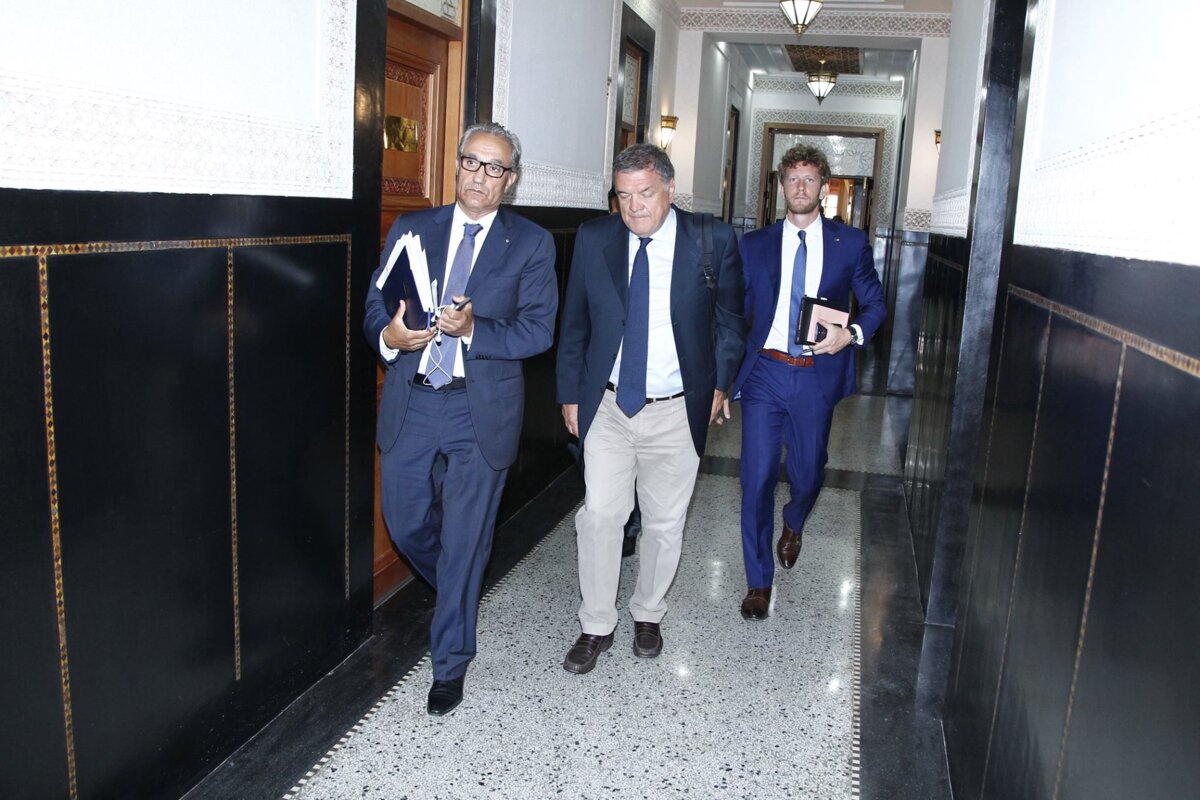
The removal of the amendment specifically naming Morocco came as leaks from the official Belgian investigation into the affair increasingly pointed to Rabat’s involvement. Eva Kaili’s husband Francesco Giorgi has been reported by Belgian and Italian dailies Le Soir and La Repubblica, citing documents from the investigation, to have confessed to his involvement in the corruption and has detailed that Morocco was involved in it as well as Qatar.
Enlargement : Illustration 1
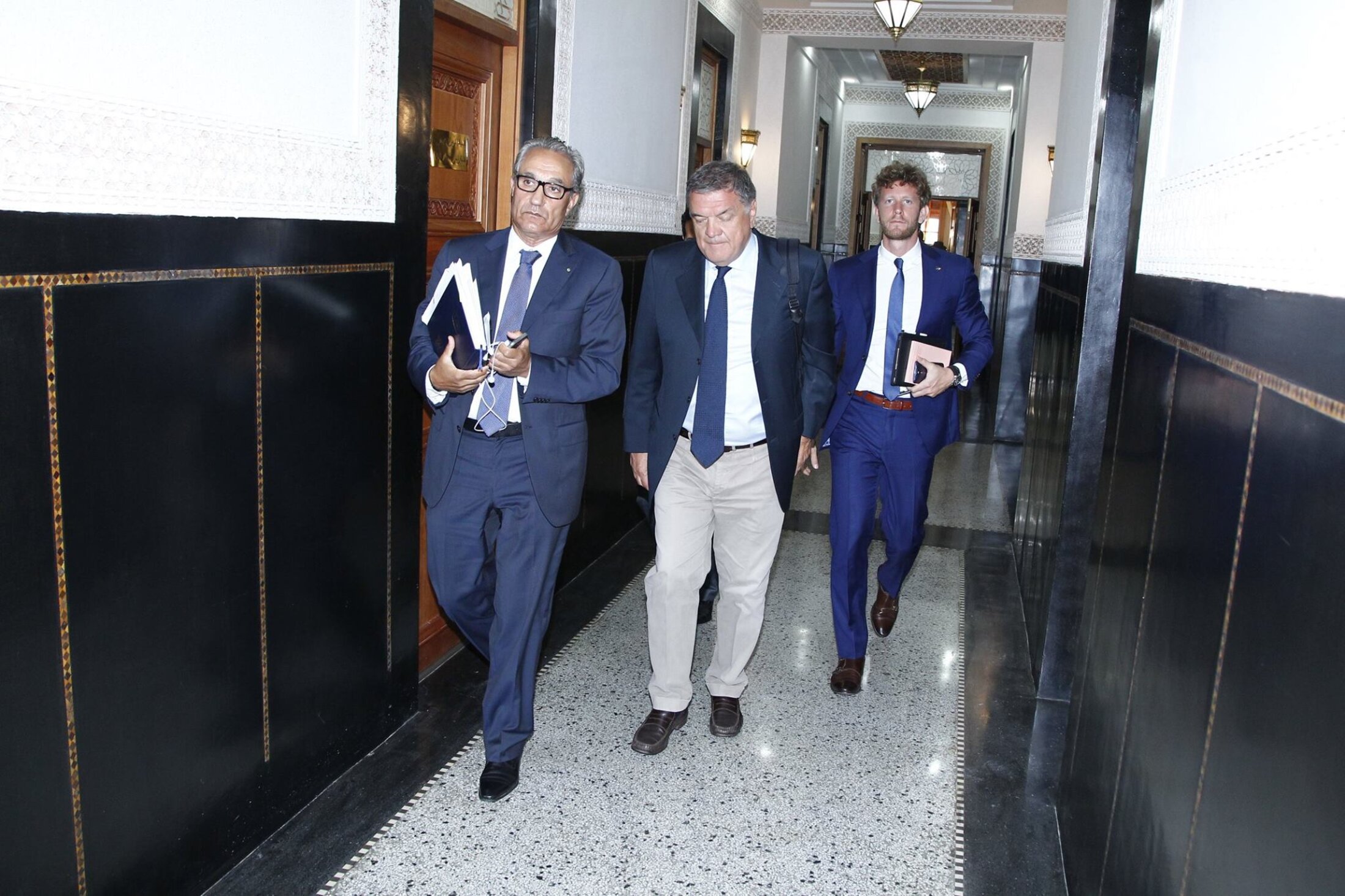
Already last week, Belgian justice minister Vincent Van Quickenborne, answering questions in the federal parliament, indirectly implied that Morocco was a target of the judicial investigation launched in the summer, as has been suggested by media reports. While he dodged naming the North African kingdom, he spoke of a country that had been previously cited for “interference” and notably concerning “fishing rights”, an obvious reference to a fisheries deal between the EU and Morocco in which Rabat was keen to include fish caught off the disputed Western Sahara territory as its own.
Meanwhile, the website Politico reported how Antonio Panzeri’s wife and daughter, against who Belgium issued an international warrant for their arrest in Italy, were suspected of receiving gifts from Morocco via the current Moroccan ambassador to Poland, Abderrahim Atmoun. According to Italian daily La Repubblica, Panzeri and his wife had use in Italy of a credit card belonging to Atmoun.
Politico has also revealed how Atmoun and Panzeri have enjoyed close relations over many years, notably when Panzeri headed the European Parliament’s Maghreb delegation, and Atmoun was co-president of the EU-Morocco joint parliamentary committee. That report included a picture of Panzeri being awarded a decoration by Moroccan king Mohammed VI in 2014 for his services to the kingdom.
According to Le Soir, Atmoun, who began his career as a businessman, is fast emerging as a key figure in the corruption scandal. He co-presided the EU-Morocco joint parliamentary committee between 2011 and 2019, and presided the joint friendship committee of the Moroccan House of Councillors and the French senate between 2009 and 2015. In 2011, then French president Nicolas Sarkozy made him a knight of France’s order of the Légion d’honneur, which website Maroc Diplomatique described as “a first for a Moroccan politician”. Also decorated by King Mohammed VI in 2014, Atmoun, in an interview with Moroccan weekly Tel Quel in 2017, has described his role as being that of a lobbyist for Morocco, and notably in the negotiations over fishing rights.
La Repubblica, which until now has appeared well informed on the progress of the Belgian probe, has reported that another influential Moroccan is implicated in the investigations. He is Mohammed Yassine Mansouri, a friend of Moroccan king Mohammed VI who became one of the most senior cadres in the country’s security administration. Mansouri and King Mohammed both studies at the country’s Royal College, specialised in the education of the princes and princesses of the Alaouite dynasty.
Mansouri, the head of Morocco’s counter espionage and intelligence agency, the DGED, which is under the immediate control of the royal palace, was seen in the official stands during this month’s World Cup games in Qatar, alongside Moroccan foreign affairs minister Nasser Bourita and Abdellatif Hammouchi, head of Morocco’s General Directorate for National Security and secret services.
Mansouri, a jurist by training, was director of the MAP, the country’s state-owned press agency, before working in Morocco’s interior ministry where he was the first individual from a civilian background to head an intelligence service as sensitive as the DGED. He is particularly involved in the issues and strategy surrounding the Western Sahara, which is a major concern for the Moroccan regime.
Mediapart contacted several former MEPs who worked alongside Pier Antonio Panzeri in the European Parliament’s social democrat group (the Progressive Alliance of Socialists and Democrats) and during parliamentary missions. They described Panzeri as being particularly focussed on Moroccan affairs throughout his term as an MEP, from 2004 to 2019, when he sat for ten years on the European Parliament’s foreign affairs commission and presided, between 2017 and 2019, its subcommittee on human rights.
It was after he failed to be re-elected in 2019 that Panzeri created his NGO, Fight Impunity, which allowed him to continue to access the European Parliament and, it is suspected, to continue his activities as a lobbyist. According to a report by Politico, the NGO, registered in Belgium as a non-profit organisation, has never published its annual accounts, as required by Belgian law.
The Qataris “dropped in, they invited themselves into a web of corruption already built by Morocco”, commented a source within the parliament, whose name is withheld. “And now the last to arrive are the first to be thrown out. The Qataris are thrown out, but the Moroccans are in the place since much longer.”
Both Qatar and Morocco have separately denied committing any wrongdoing in relation to the alleged corruption under investigation in Belgium.
-------------------------
- The original report in French on which this article is based can be found here.
English version, with some added reporting, by Graham Tearse