


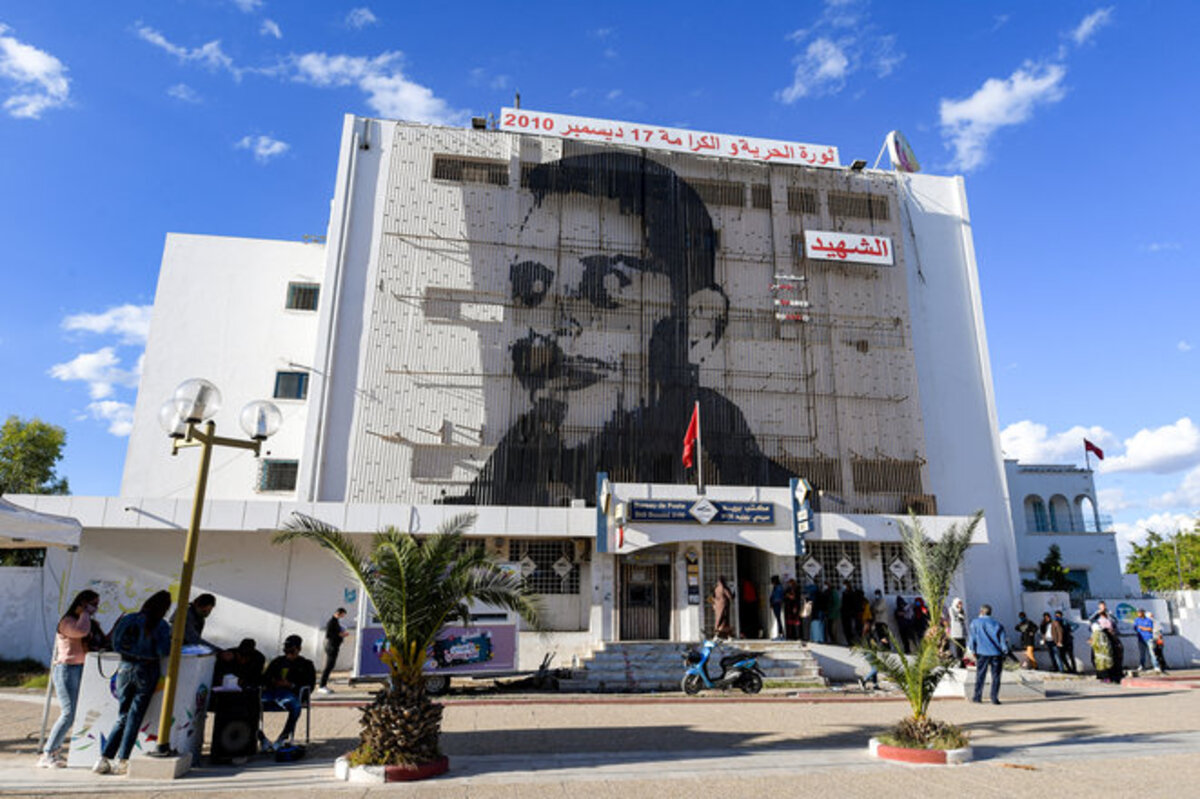
On December 17th 2010, in the central Tunisian town of Sidi Bouzid, 18-year-old school student Nidhal Rchidi was sipping a coffee close to the local Governorate administration building. He was taking a break between two lessons, as he prepared to sit mock exams, when suddenly people in the street around him began running.
He remembered how a crowd surrounded an ambulance that then sped off, sending a stall of fruit and vegetables flying. Rchidi learnt that the commotion was caused by the self-immolation of Mohamed Bouazizi, a street vendor who came from his neighbourhood.
Bouazizi, 26, had complained about being regularly harassed and humiliated by officials and police who would confiscate his produce as he went about his business selling fruit and vegetables from a push-cart to support his widowed mother and five siblings. It was reportedly the confiscation of his scales by police that day which was the final straw. Standing in front of the local governor’s office, in a horrific gesture of desperation and defiance, he doused himself with paint thinner and set fire to himself.
A few kilometres away that day, Ghaith Dhay, a friend of Rchidi’s, was in the middle of a maths lesson when he too heard the news. It was a cousin of Dhay’s, the owner of a hardware store in the town centre, who had sold the flammable liquid to Bouazizi shortly before his act. “My cousin and others thought that he was just going to threaten the police with it,” recounted Ghaith. “No-one thought he would go ahead with it.”
Bouazizi suffered such severe burns that he remained in a coma until his death two and a half weeks later on January 4th 2011. By then, the spontaneous protests that began in Sidi Bouzid immediately after his self-immolation had become mass protests that swept Tunisia, amid long-simmering anger over poor economic conditions, high unemployment, spiralling food prices, corruption and suppression of human rights under the regime of strongman president Zine El Abidine Ben Ali.
Enlargement : Illustration 1
The unrest became what was dubbed as the “Jasmine Revolution”, the first of a so-called Arab Spring of revolt that swept North African countries. On January 14th, Ben Ali was forced to flee to Saudi Arabia amid the rapid collapse of his regime.
When Mohamed Bouazizi set fire to himself, Hamadi Khelifi, a friend of both Rchidi and Dhay and, like them, aged 18, was then living with his family in the north-east coastal town of Sfax while finishing his secondary school studies. On hearing about the tragedy, he swiftly took a bus to Sidi Bouzid and was soon taking part in the early demonstrations triggered by the street vendor’s desperate act.
“For several nights, it was chaotic, we would go out in the evening to take part in the protests,” recalled Rchidi. “The young folk confronted the police. During the day, unions, lawyers and civil society demonstrated. That was what exhausted the police during the first 15 days that followed the tragedy in December. I saw police officers who threw their helmets to the ground, such it was that they couldn’t take any more.”
Ten years on, he has proud memories of how neighbourhood committees were spontaneously set up to protect some parts of the town to prevent looting and violence by the police.
Enlargement : Illustration 2
Dhay recalled the incessant rhythm of the daily street protests which first erupted in Sidi Bouzid, and the sight of seemingly peaceful young men who “during the day would go out with their slicked-back hair to drink coffee and who came back at night in balaclavas to match up to the police and the teargas”.
The three young men all took part in the subsequent mass protests against the regime during which more than 300 people died.
Ten years on, the urban face of the town of Sidi Bouzid has changed. Private medical clinics have opened, a municipal swimming pool has been built and a number of streets have been reconstructed. But on a social level, the rate of those living in poverty in the surrounding region remains high, representing 23% of the population according to data published in September 2020 by Tunisia’s national statistics institute (in French, here). The unemployment rate, according to 2019 figures, is 15.1%. Local industrial activity is largely absent, and public construction projects, like in other regions of Tunisia, are stalled.
In early December this year hundreds of young people took part in street protests in the town of Regueb, around 40 kilometres south-east of Sidi Bouzid, following the death of a 17-year-old boy who had set fire to himself several weeks earlier in front of an administrative building, apparently in desperation at the conditions of poverty in which his family live. Self-immolation is now recorded as the second most common form of suicide in Tunisia, often committed in public places and in relation to social and economic problems.
While Nidhal Rchidi, Ghaith Dhay and Hamadi Khelifi are no longer demonstrating, they remain strongly attached to the ideals and values that mobilised them during the revolution in 2011. All three went on to study at university, and Dhay later left Tunisia for France, the former colonial ruler of the counrty, where he found work in the field of business management.
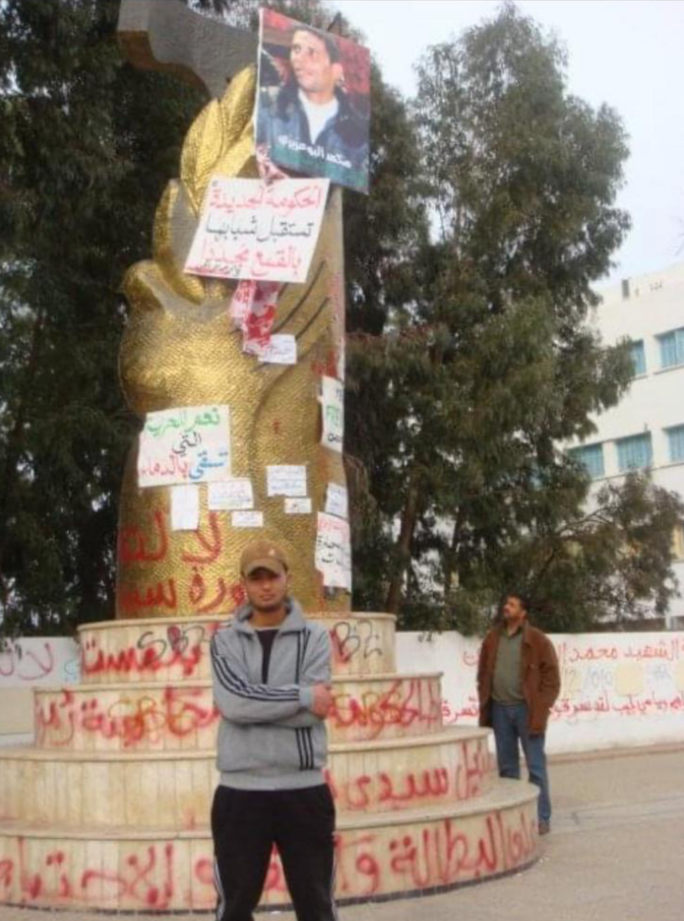
Enlargement : Illustration 3
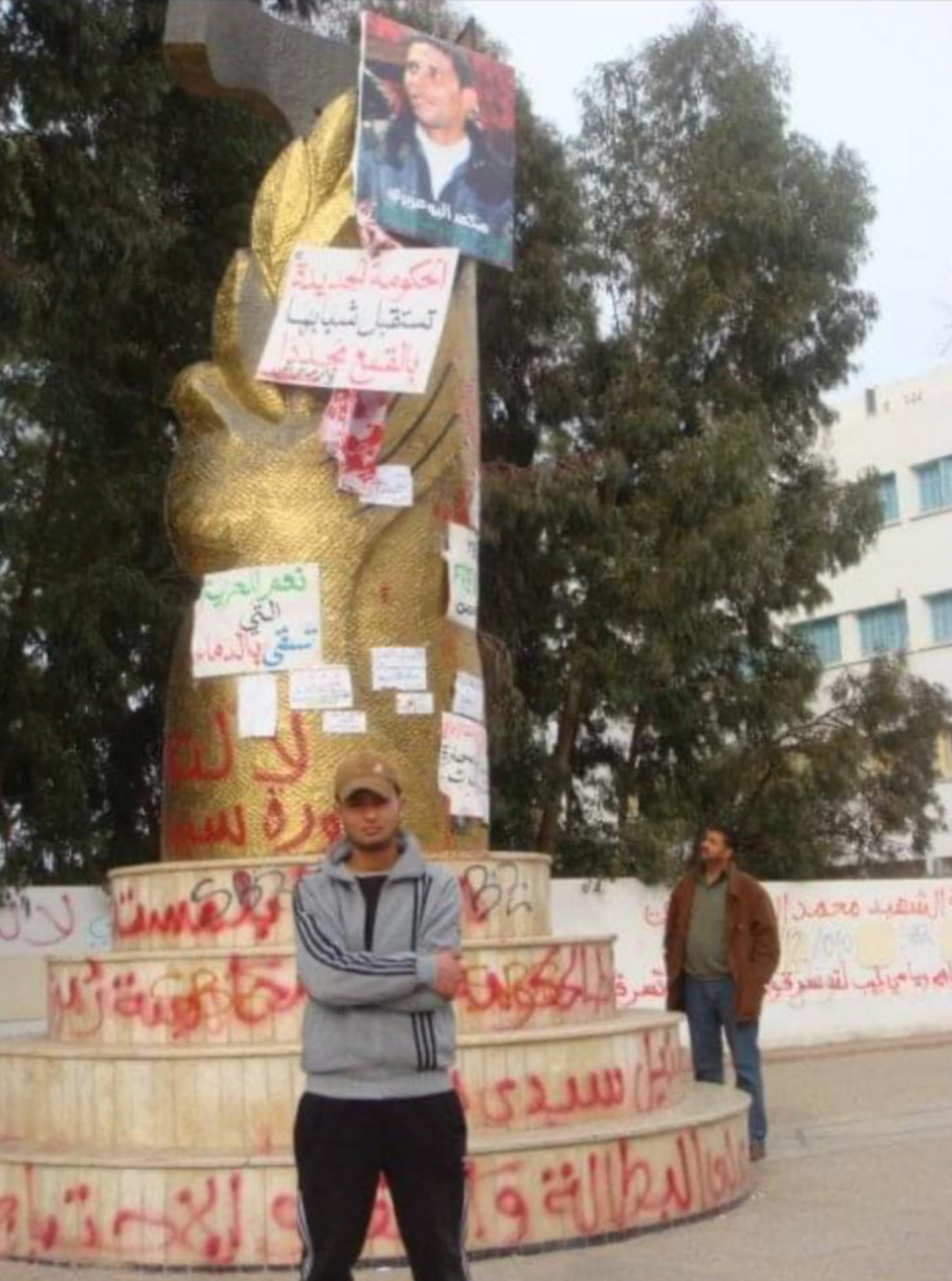
He returned home to be close to his family after the outbreak of the Covid-19 pandemic, and says he wants to engage in working for his country, despite the current fragile economic context. “It’s really important that there is still a diaspora which comes home, even ten years after […] If everyone leaves, one finishes up by leaving the country to the less qualified whereas there are still opportunities for entrepreneurship, for development, in Tunisia.”
He represents that section of a divided public opinion which sees hope for the future of the country. In the aftermath of the fall of the Ben Ali regime there have been three legislative elections and two presidential elections amid recurrent crises, marked by political assassinations in 2013 and terrorist attacks in 2015. The population is still in debate over the type of political system it should adopt, amid arguments over the positive and negative effects of the democratic model introduced after decades of autocracy.
The Tunisian parliament is made up of different political groups, with very opposing ideologies and no proper majority, leading to frequent clashes and political crises. Tunisian President Kais Saied, a jurist and former academic, who was elected in October 2019 with more than 70% of votes cast, still retains popular support but has little room for manoeuvre in Tunisia’s semi-parliamentarian regime.
“Finally, a little like what was predicted upon his election, he has found himself isolated because lacking political support except for that of those who voted for him,” commented Selim Kharrat, a co-founder of Al Bawsala, a Tunisian NGO that monitors and promotes political good governance. “Today, his margin for manoeuvre remains very limited and, after one year of his mandate, he hasn’t done very much apart from ready-made populist speeches.”
It is Tunisia’s young adult population which finds itself trapped in a laborious political transition. According to data from the International Labour Organisation and published by the World Bank, the unemployment rate among 15-24-year-olds is 36.5%. While legislation has eased the creation of start-up companies, and the proportion of small- and medium-sized businesses has increased by 31% since 2010, the number of unemployed adults with professional qualifications is around 250,000 people (out of a population of around 11.5 million).
Nidhal Rchidi, Ghaith Dhay and Hamadi Khelifi each have a family member or friend who is jobless. Their different paths are an illustration of the hopes and disillusionment of the young generation that took part in the 2011 revolution.
Khelifi is now studying in the US for a master’s degree in law at the University of Pennsylvania. He has mixed feelings of where Tunisia is today, notably regarding the limits imposed on free expression. Under the Ben Ali regime, he would seek out news reports online via a proxy server, and would ignore omnipresent police spies by buying the opposition newspaper Al Mawkif.
After the toppling of the regime, he continued militant activity, joining NGO’s active in anti-corruption and anti-torture campaigning, and took part in the Truth and Dignity Commission, an independent tribunal launched in 2014 to investigate serious human rights violations by Tunisia’s previous regimes.
But in 2016, he published a mocking text in bad taste on his Facebook account in which he called on the bodyguard of then Tunisian president Beji Caïd Essebsi to take example from the killing in December that year of Russian ambassador to Turkey Andrei Karloiv by an off-duty Turkish policeman. Khelifi was placed under police surveillance and made subject to so-called S17 measures which, introduced in 2013 and targeting terrorism, restricts travel. He was finally able to leave Tunisia in 2015 to study in the US, and one year later he was sentenced in absentia to three months in prison for his Facebook post.
“The problem is that numerous bloggers and activists are still arrested and convicted on the basis of their Facebook posts,” said Khelifi. “That shows that we are still in a police state where freedom of expression remains relative.” While he is proud of his involvement in the overthrow of Ben Ali, he calls for more structural changes in Tunisia.
Meanwhile, Rchidi has remained loyal to his native town of Sidi Bouzid. The son of a dressmaker and a municipal employee, he now works as a psychologist for troubles teenagers in a state-run institution. “I wanted to make a difference, from within my town,” he explained. “Psychologist is a profession that is not very common here, and I wanted to help.” He said that it is his profession that has helped him understand the causes of the revolution. “I have been to some out-of-the-way places, even around Sidi Bouzid [and] I have seen the [social] insecurity of the population and the frustration of youngsters, above all [among] the after-generation which has grown up with the revolution.”
He said he tries to give them back the self-confidence, that which allowed him to make good of his life. “We had a cultural vacuum even if we had a bit of access to the internet or the local library,” he added. “The young Tunisians of today have for the most part smartphones and different references to us. It is perhaps from them that will come the change that we still have difficulty in seeing in the country. Our generation had been too marked by the succession of crises and the gap between our ambitions and reality, but it’s the price to pay.”
While social tensions are heightening, the powerful Tunisian General Labour Union, the UGTT, with a claimed membership of more than 500,000, has called for a revival of the national dialogue process – the so-called Tunisian National Dialogue Quartet – first introduced in 2013 to support economic and social reforms following the political crisis brought on by the assassination of two opposition party leaders.
The UGTT wants to bring together unions, business representatives, politicians and civil associations in an independent commission supported by the president, and which would include apolitical figures in order to avoid the recurrent conflicts that block the process in Parliament. “Current conditions are not very favourable for this kind of dialogue, but it’s not as if there are other alternatives at present,” commented Selim Kharrat from the NGO Al Bawsala.
But such debates are observed at a distance by Nidhal Rchidi, Ghaith Dhay and Hamadi Khelifi who, like so many other young Tunisians of their generation, have moved away from active politics.
-------------------------
- The original French version of this report ( this English version includes added reporting) can be found here.