


François Hollande could not have been more explicit when he gave his famous campaign speech at Le Bourget near Paris in January 2012 during the last presidential election. “It's for our country's youth that I want to be president of France,” he said, promising that young people would be his priority if he were elected. Yet four years into his five-year term and the president is now faced with one of his worst nightmares: that of a protest movement by students and school pupils against his plans to reform the country's employment laws.
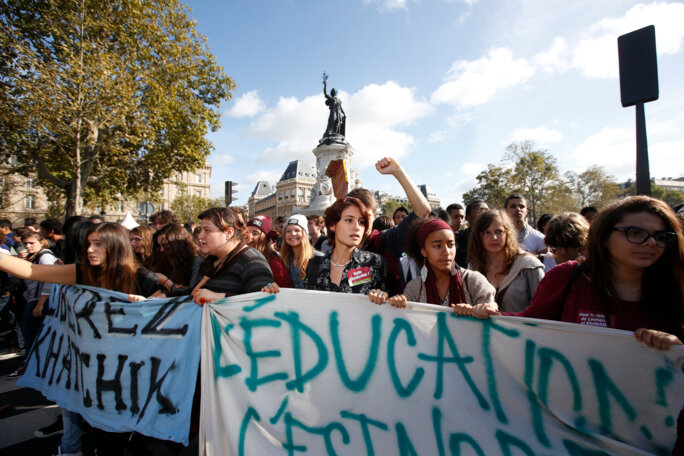
Already numerous student and youth groups, some 20 in all, have called on members to demonstrate on Wednesday March 9th to get the bill withdrawn, even though its formal presentation to ministers has already been postponed by two weeks because of the opposition. These groups include student unions such as CGT Jeunes, Solidaires étudiant-e-s, UNEF and UNL plus the youth wings of the Socialist Party (PS), the French Communist Party and the New Anticapitalist Party (NPA). The call for action has been backed by organisers of an online petition against the bill – which has now attracted more than a million signatures – and supported by some employee unions too.
The main complaint from youth organisations is that the government's bill will only serve to make job insecurity even worse for young people. The president of the leading students union UNEF, William Martinet, says that this government measure is the “straw that broke the camel's back”. He points to the promises that he says Hollande has failed to keep in relation to young people, such as the full-scale rolling out of a plan to fund and train jobless youngsters under 25. “Young people are fed up,” says Martinet. “We've been walked all over for four years. We're quietly getting our revenge. The only time when young people make their voice heard is when they take to the streets. We mustn't let this chance pass,” he adds.
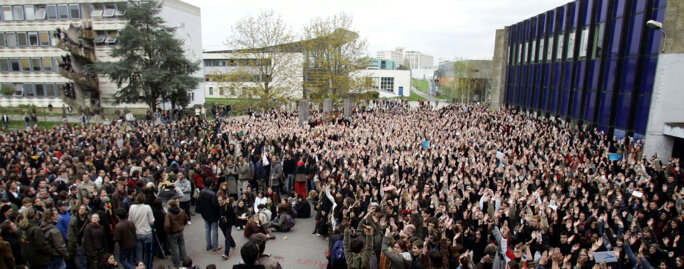
Student meetings are planned in universities from this Monday, March 7th, leaflets will be handed out in front of secondary schools and a campaign is taking shape on social media. But at this stage it is still too early to predict the scale of the student mobilisation. The organisers know that their main challenge lies in turning what is currently merely a virtual protest into a real mobilisation on the streets.
François Hollande and his government think that the protest planned for March 9th will be limited. “For the moment the feedback does not suggest extreme mobilisation in the universities. Especially as young people's evident difficulties go well beyond the confines of traditional student unions,” says one government advisor. The student and pupil organisations have also had very little time to mobilise people, especially in areas such as the Paris region and around Toulouse where schools were on holiday last week. And unlike the widespread student and pupil protests in 2006 and 1994, which were against measures aimed at the young, the employment law bill is not specifically targeting young people apart from a section on apprenticeships. “This time's there a less precise objective,” says one minister.
Nonetheless the government remains very wary. It was caught completely unaware by the strength of the online petition campaign. “When [the government] launched their Twitter account @loitravail [editor's note, to challenge the petition] it was like [Minitel] Manuel Valls against YouTube,” says the socialist MP and government critic Benoît Hamon, in a reference to the pre-internet telecommunications network France once had. Ministers are also aware that several factors are coming together at the moment: an unpopular government, living conditions that are getting worse for young people, a high level of unemployment which casts a shadow over young people's futures, and a new generation which did not experience the big mobilisation a decade ago against new work contracts proposed by the government of prime minister Dominique de Villepin under President Jacques Chirac.
“Young people and the CFDT [trade union] are the key,” says one worried minister. “And it's now ten years since [young people] have undergone the initiation rite of a big social protest movement.” Another minister adds: “There's no anxiety but this call to demonstrate is not just a flash in the pan. We're not taking it at all lightly.” The proof of this is that at the start of last week one of President Hollande's advisors, Vincent Feltesse, called several youth organisation leaders to take the pulse of the coming mobilisation and to explain the government's decision to hold more discussions over the bill.
For any government a social protest movement by the young can be a nightmare. This is because they are often unpredictable, because they attract strong support, at it affects the parents and grandparents of those protesting, and because repressing a youth movement always represents a political defeat. Socialists in particular recall the well-known phrase by future president François Mitterrand during the famous protests of May 1968: “If youth is not always right, a society that is unaware of and strikes it is always wrong.”
Enlargement : Illustration 2

The youth organisations are very well of their potential power. “Every social movement aims to put pressure on the government. Even more so, obviously, one year before a presidential election. It can change things,” says Samya Mokhtar, of the secondary school pupils' union UNL. The former president of the young socialists' movement the Mouvement des jeunes socialistes (MJS), Thierry Marchal-Beck, recalls how he was called by the Elysée in the middle of the so-called Léonarda affair in 2013. She was the pupil expelled to Kosovo with her family having been detained while on a school trip and whom President Holland later spoke to by phone, telling her she could return – though without her family. The affair caused an outcry in many schools. “It was the first time [I'd been contacted]! I'd never had any contact in the past...they wanted to know my feeling about the scale of the mobilisation,” recalls Marchal-Beck.
“A student or school pupil movement is like toothpaste; you can get it out of the tube but you can't put it back in,” says Gwenegan Bui, who is the stand-in Member of Parliament for Marylise Lebranchu while the latter remains a government minister, and herself a former head of the MJS. The generation of ministers in power today are marked by the memories of student and youth protests from 1986, 1994, 1995, 1998, 1999 and those already mentioned in 2006. They also remember the tragedy of 1986 when 22-year-old student Malik Oussekine died in police custody following mass protests against university reforms. “A social movement, with provocation, violence and a tragedy...that can blow away a government,” says one current minister. It must also be remembered that France is still in a state of emergency.
“The story of 1986 was instructive in my union training,” says Caroline De Haas, a former UNEF leader and one of the people behind the anti-employment bill online petition. “After Malik Oussekine's death we knew that the Right was afraid of youth movements. During the [protests in 2006] we felt that.” She adds: “A youth movement always spills over. It erupts on the public stage and can from their point of view quickly become uncontrollable.”
'No magic red button to make young people go out onto the streets'
Since the announcement of the postponement of the employment bill's official presentation, ministers have been ramming home the same message: that the government has listened and that a text that even some ministers feel is too liberal needs to be rebalanced. “Resuming a dialogue is better than the 'I'm convinced I'm right' approach of Alain Juppé,” says a minister. This is a reference to a remark made by the then-prime minister a few months before the massive protest movements of December 1995, the first year of Jacques Chirac's first presidency. “It's a very different approach,” adds the minister.
But the operation to denigrate opponents has also begun. On Thursday March 3rd the employment minister Myriam El Khomri said it was “absurd that young people are afraid of this law...they are the victims of this great [job] insecurity, the short-term contracts, the work placements,” she said on France 2 television. “This law is made so that young people...can get into jobs market more easily on a permanent contract,” she said, attacking what she called the “disinformation and manipulation over this bill”.
The minister in charge of government relations with Parliament, Jean-Marie Le Guen, also referred to “manipulation” over the planned reform. “Yes there've been clumsy attempts to imitate the Black Baron,” he told France Inter radio. This was a reference to an episode of a new political drama called Black Baron, broadcast by Canal+ satellite channel. In it, an elected socialist president fears having to face a youth protest movement orchestrated by one of the people close to him, the 'Black Baron'. The series is written by Éric Benzekri, a long-time Socialist Party activist who was close to former minister Jean-Luc Mélenchon – who has now left the party – and Julien Dray, an ally of François Hollande. At the time Benzekri knew him, Dray was in charge of youth organisations on behalf of the PS, such as the UNEF.
“The Black Baron is me,” Julien Dray told the magazine Marianne. He showed the weekly title a copy of an article in Le Monde dating from October 1988, which highlighted the influence of Trotskyists in a strike by nurses against the government of then-prime minister Michel Rocard. In it Dray is referred to as the “black baron of social agitation”. Though Benzekri himself put things into perspective - saying the character is “above all the portrait of a generation, that of Julien Dray but also [current PS first secretary] Jean-Christophe Cambadélis and Jean-Luc Mélenchon, that Left that was active in the streets, spoon fed by [then president] François Mitterrand” - the reference to Dray has already spread.
Writing about the current UNEF president in business magazine Challenges, the journalist Bruno Roger-Petit said: “Black Baron season 2, episode about the student movement against the government and for real, it's tomorrow. Do you know William Martinet? No. Not yet.” A government minister, speaking on condition of anonymity, is meanwhile convinced someone is behind the latest protest threat. “The appeal by organisations for young people to demonstrate, it's not a natural movement. Hamon is surely behind all this, it's got his name on it,” says the minister.
Former education minister Benoît Hamon, who left the government in 2014 over its economic policy, himself smiles at the idea. He knows the leadership of UNEF and the MJS well, and in 1993 was the first leader of the MJS when it became “independent” of the Socialist Party itself, while today he is still one of the senior figures in the left-wing of the PS, and thus close ideologically to many in the MJS leadership. “But I'm neither an intermediary nor a point of contact. We don't have a guardian - subsidiary relationship, all that's finished with,” he says. It is far removed from the days when when he first led the young socialists. “At that time we took our instructions from [first secretary of the Socialist Party] Michel Rocard. But it's nothing like that today! I don't have a magic red button under my desk to make young people go out onto the streets!”
“The parties are today incapable of controlling youth organisations,” says Pouria Amirshahi, a former UNEF president and current MP who has just announced he is quitting the PS. “Partly as a result of the trauma of our break with Camba [editor's note, Cambadélis].” When Amirshahi was at UNEF the student union because independent from the oversight of party figures such as Jean-Christophe Cambadélis and Julien Dray during a period of great and bitter tension among socialist 'comrades'. “In 1999 Claude Allègre [editor's note then education minister] called me in to ask how to stop a secondary school protest movement from developing. But you can't!” says former MJS president Gwenegan Bui.
Such control is even harder now at a time when UNEF, the MJS and the UNL are not the only youth organisations around: many other groups, often more radical, are active in universities. And as Pouria Amirshahi says: “A youth movement is about getting involved, seizing the moment. When that happens it's irrepressible.”
Enlargement : Illustration 4

The youth organisations close to the the PS confirm that while they do have links with the left wing of the party, UNEF and the MJS no longer prepare their plans in the 'Black Baron's' offices. They are also acutely aware of the ways that people will try to discredit them. “They'll tell us that the bill doesn't affect us and that we're paranoid because we're anxious about the future,” predicts William Martinet. “They're going to try to psychoanalyse the movement to deny that it's really the essence of the text that causes us a problem.”
“It's crazy, they're doing exactly the same as the Right,” protests Benoît Hamon. “In week one you say that the young people are being manipulated. In week two that they're demonstrating for something other than the targeted text. In week three they'll say that it's irresponsible to put young people in the streets and put them at risk. And in week four they will announce a major conference on youth unemployment...”
At the Elysée the idea that youth organisations are puppets of socialist leaders still holds sway. The generation currently in power has not known anything else. And Julien Dray is a regular visitor at the Elysée. “Hollande, Valls and Camba are still stuck in the structures of the 1980s with youth organisations being used by the PS or the far-left,” says one former MJS leader, who asked not to be named. Meanwhile a former UNEF leader says: “Thanks to his old-style model, Hollande thinks that youth organisations are led by someone behind the scenes. And that speaking to them is almost like an internal PS discussion.”
The ex-UNEF leader continues: “The Elysée never contacted us directly but through intermediaries. Hollande couldn't imagine speaking to us normally about our claims, and that what we were saying came from our own heads.” After the death of Rémi Fraisse during clashes over plans for a dam at Sivens in south-west France in October 2014, interior minister Bernard Cazeneuve called in former student leaders and people involved in human rights groups, as well as the president of the MJS at the time, Laura Slimani, to talk.
In the end the protests after that tragedy were limited in scale, with some street marches before the movement evaporated when the school holidays arrived. However, if a large-scale social protest movement should emerge during the next few weeks over the employment bill, it seems fair to assume that calling some youth leaders in for a lunch will not make much of a difference.
--------------------------------------------------------------------
- The French version of this story can be found here.
English version by Michael Streeter