


How can one turn a diffuse cultural majority into tangible electoral victory? That is the political riddle that green-minded parties have to resolve ahead of the 2022 presidential election in France. For these parties are convinced that environmental issues now occupy a central place in the public mind, especially among young people who may have an influence on how their parents vote.
There is lots of evidence to support this view. This includes the huge marches for the climate that have taken place since 2018, the success of the L'Affaire du Siècle petition (signed by two million people in a month, it calls for legal action against the French state for its inaction over the climate), the link established between numerous natural catastrophes and global warming, and the findings of opinion polls. There is also the passion kindled by the new environmental intellectual movement, involving such figures as director Cyril Dion, anthropologist Nastassja Martin, the geographer Andreas Malm, philosopher Baptiste Morizot, and essayist Corinne Morel Darleux.
On top of this there has been the Covid pandemic, which has been described as an effect of the environmental crisis.
Enlargement : Illustration 1
“It's not a political issue it's the political issue,” says Marie Toussaint, a Member of the European Parliament for the Europe Écologie-Les Verts (EELV) green party and political advisor to the party's presidential candidate Yannick Jadot. Yet the level of participation at the September primary election in which Jadot was selected – 122,670 voted – does not indicate a huge groundswell of popular interest, even if that figure is higher than the number of EELV party members.
And though the Greens took control of some cities and major towns in the 2020 municipal elections – including Lyon, Bordeaux, Poitiers, Strasbourg, Annecy and Tours – this 'green wave' was checked at the regional and county elections that followed in June this year. This is proof that turning societal awareness into green votes is not an automatic process.
The 'climate generation' seeks its spokesperson
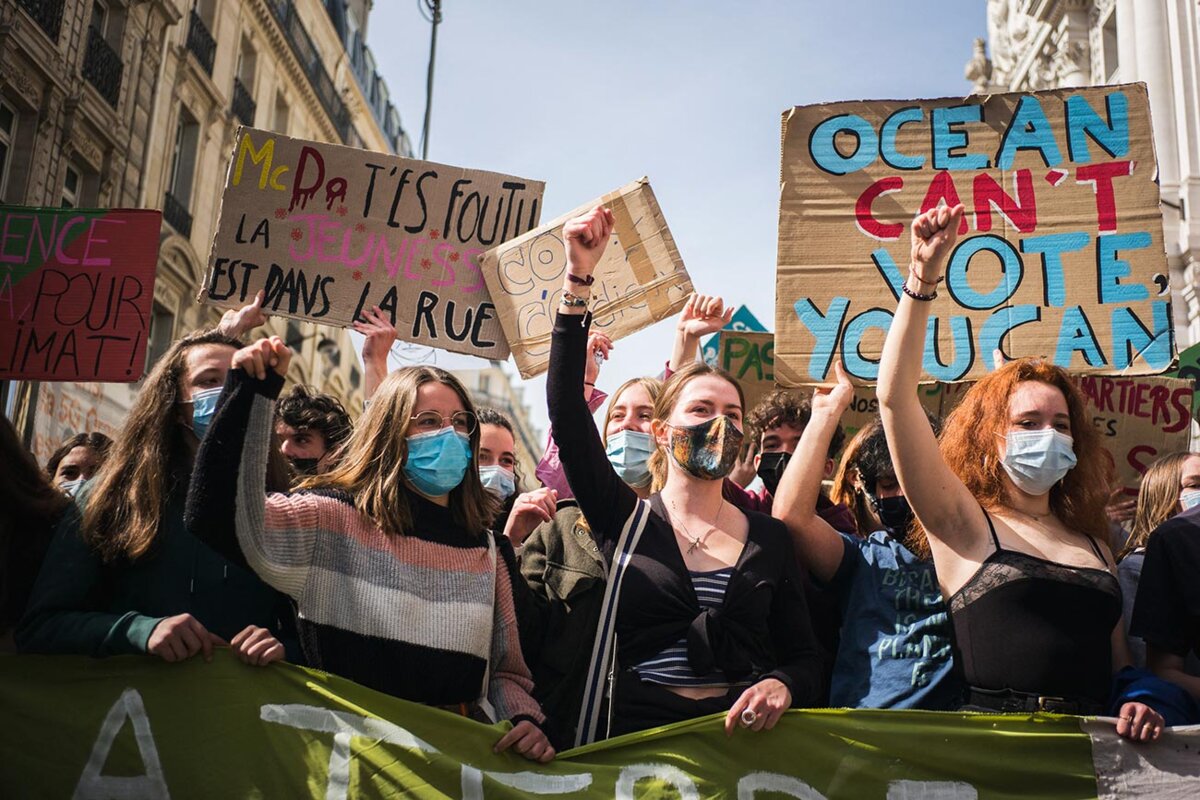
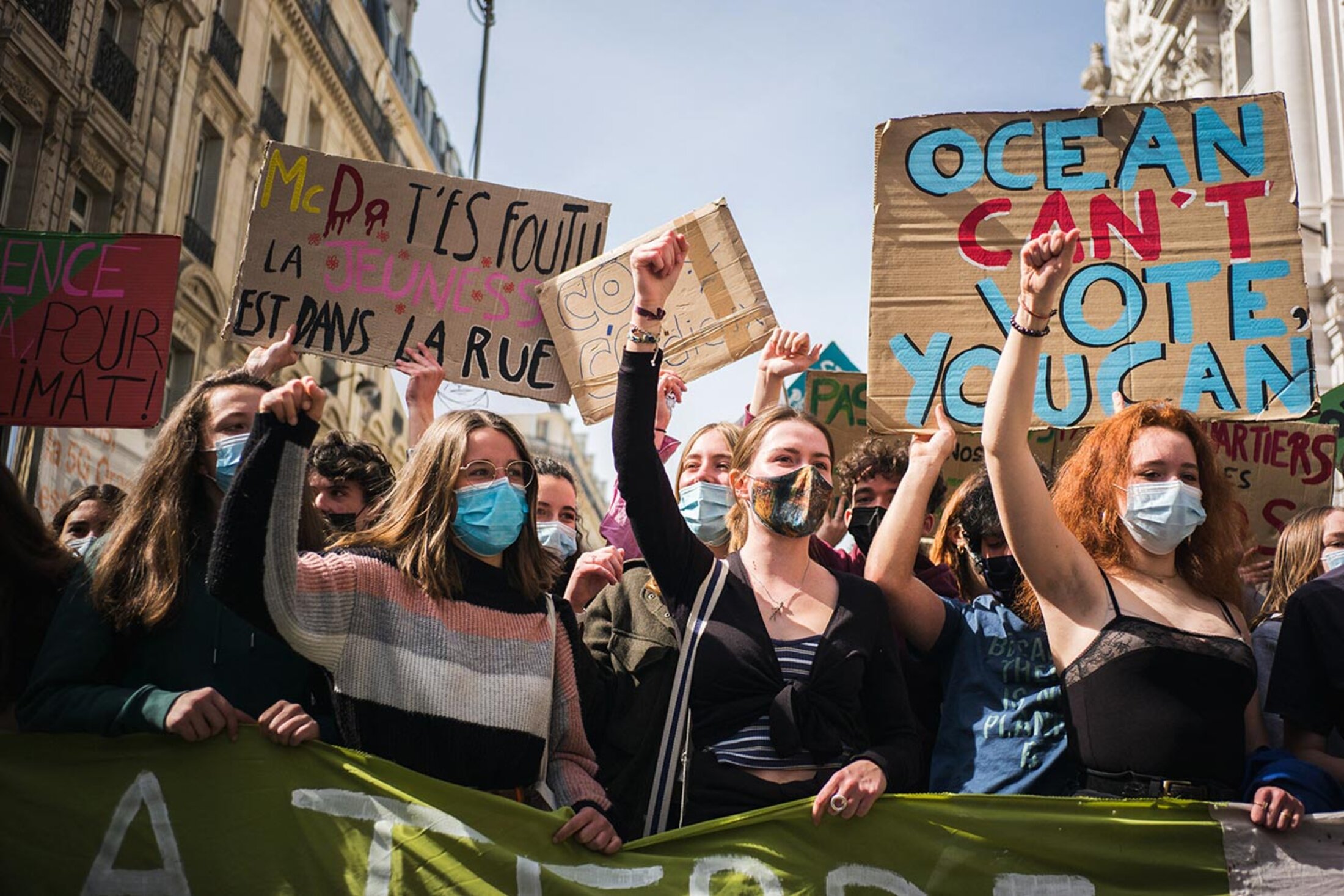
At the forefront of this collective awareness is what is known as the 'climate generation', who have been stepping up their activities while the COP26 climate summit takes place at Glasgow in Scotland. In France several climate marches took place on November 6th plus a number of civil disobedience protests, for example against the creation of irrigation reservoirs in the Deux-Sèvres département or county in western France.
This climate awareness comes against the backdrop of a particular political context. “The re-politicisation of the climate movement is linked to the institutional disappointments that have taken place under Macron, including his climate law [editor's note, passed in 2021] which was a huge slap in the face for us, and which shows that everything's blocked at a national level,” says Victor Vauquois, a former YouTuber on the channel 'Partager, c'est sympa' ('It's good to share'), and who has been very active in recent years in the environmental movement Alternatiba. Nonetheless, there is a connection between this increased climate awareness and the presidential election in April and the Parliamentary elections that follow later in 2022.
The idea that stands out today is that you can't be credible without accepting that 2022 is important.
While the climate movement was born out of rejection of the electoral path, recently some of its activists have shown themselves to be more open to the political process ahead of the elections in 2022. In the background some are even working on plans to send a new generation of environmentalist MPs to the National Assembly.
“The sense of urgency has led to different political attitudes since 2018 but the idea that stands out today, in the organisations that are the driving force in the climate movement such as ANV-COP21 and Alternatiba, is that you can't be credible without accepting that 2022 is important,” says Maxime Gaborit, a political scientist and specialist in climate mass movements.
“It's an historic moment, not because there is a general yearning over environmental issues, but because there remains very little time to change the direction of climate warming according to the latest report from the IPCC [editor's note, the Intergovernmental Panel on Climate Change],” says Élodie Nace, spokesperson for Alternatiba.
It is as if the climate movement, realistic about its own powerlessness to change the course of events, is edging towards the most conventional form of participation there is: voting. An example of this changed thinking can be seen in the open letter written in June 2021 by climate justice campaigner Maxime Ollivier entitled: “Je n’irai plus marcher pour le climat” ('I will no longer march for the climate'). This fresh approach becomes even more significant when one considers that 82% of young voters – aged 18 to 35 – who make up most of the climate movement abstained at the regional elections this year.
Mathilde Imer, one of the originators of the Citizen's Convention on Climate in France and now spokesperson for Primaire Popularire, which is campaigning to have just one left-wing candidate at the presidential election, has noticed the change. “The climate movement came up against a brick wall. It marched, went on strike, carried out civil disobedience, took legal action against the state, and conducted democratic experiments such as the Citizen's Convention, and ultimately nothing or not very much came out of it,” she says. “This political wall has led some individuals to question whether they shouldn't also have some presence inside the institutions.”
This conclusion stems from lessons learnt during the short history of the climate movement which became politicised when it came into contact other movements, movements which themselves are potentially in search of an electoral outlet. These include the 'yellow vest' protesters - with whom some joint marches have already occurred - the committee that seeks justice on behalf of Adama Traoré who died in police custody in 2016, and with whom the 'climate generation' marched in July 2020, and also feminist movements and the anti-globalisation movement.
“Thanks to them we have a much more political understanding of things, we have identified our opponents, who are some politicians and the capitalist, racist, productivist, patriarchal system,” says Élodie Nace. “But will this politicisation result in a massive vote in 2022? I don't know. It's our job to help mobilise people.” In the climate movement domain Extinction Rebellion is one group that continues to keep its distance from the ballot box, which it considers to be pointless.
The tough challenge of turning climate awareness into votes
The political parties are well aware of what is at stake. Already they are seeking to forge links with the climate movement. Marie Toussaint, whom EELV presidential candidate Yannick Jadot has appointed as his political advisor, was co-founder of the climate justice association Notre affaire à tous (it calls itself 'Our common concern' in English). The presidential candidate for radical-left La France Insoumise (LFI), Jean-Luc Mélenchon, devoted one of his first political rallies in April to the topic of water, and his recent replacement as president of the party's Parliamentary group is Mathilde Panot, a young MP who is closely in touch with popular environmentalism. Meanwhile the Socialist Party (PS) invited palaeoclimatologist and IPCC member Jean Jouzel to speak at a meeting to launch the presidential campaign of its candidate Anne Hidalgo at Lille in northern France.
Some ideological bridges have also been formed with these parties. “Political environmentalism is no longer inward-looking,” says environmental activist Marie Pochon, citing the way parties of the Left have adopted environmental policies and themes such as the crime of ecocide, climate justice and the climate wealth tax. But climate activists regard the fragmented nature of the Left as irresponsible.
Our political offer must gain impetus, generate enthusiasm. The environmentalism of government is not the environmentalism of green technocrats.
This frustration leads to a twin sentiment of resignation and anger, as summed up by Lise Benoist, member of the Zetkin Collective (which has produced White Skin, Black Fuel: On the Danger of Fossil Fascism, published by Verso Books). She says: “I'm not uninterested in the presidential election but with so many candidates on the Left, we know that it's lost in advance. Yet the next five years of the presidency will be decisive for climate action. It's our last chance.”
With that in mind 350 young people who campaign on the climate have published an open letter in which they make clear their views to the presidential candidates: “Divided, you won't have our vote.” Mathilde Imer, of Primaire Populaire, says: “The movement is split between those who think that it's already over and those who see a tiny opening for victory, on condition that people come together. Those people are quite angry and are taking the lead in getting things to change.”
According to political scientist Maxime Gaborit, who belongs to the collective group Quantité Critical – which this year produced an in-depth study of the 'climate generation' - the votes of the climate movement participants swing between Yannick Jadot of the EELV and Jean-Luc Mélenchon of the radical-left LFI, according to how radical the activists are.
Indeed, during the primary to choose the green candidate for the presidency, the 'climate generation' tended to favour Yannick Jadot's competitors, who placed more emphasis on the need for systematic change. Jadot, meanwhile, was already focussed on reaching out to those who were less environmentally motivated. “We must restore hope to an entire generation. And not only to those who've demonstrated for the climate,” says Marie Toussaint.
But can Jadot broaden his appeal before he has completely convinced the hard core who are committed over the climate? That is his dilemma. His past as a Greenpeace leader in France, when he was in the front line of non-violent direct action, is already a distant memory. He now has to make a move to rekindle his connection with the movement.
“We don't lack radicality,” insists Jadot's political advisor Marie Toussaint. “But our political offering must gain impetus, generate enthusiasm. The environmentalism of government is not the environmentalism of green technocrats. It must be an environmentalism that is comfortable about shaking things up to bring about change,” she says.
A fresh impetus will certainly be needed, if only to ensure that the environment is a key issue at the centre of media debate. At the moment, with the media frenzy over the likely candidature of far-right polemicist Éric Zemmour, that will be no easy feat.
--------------------------------------------------------------------------
- The original French version of this article can be found here.
English version by Michael Streeter