


It was to widespread acclaim that French-Algerian journalist and novelist Kamel Daoud, 54, won France’s prestigious Goncourt literary prize last November for his latest novel Houris. Set during the so-called “Black Decade” of the 1992-2002 war in Algeria between the ruling regime and Islamist groups, Daoud was praised for breaking a taboo on examining those sombre years when, it is estimated, the bloody conflict claimed up to 200,000 lives.
The book was prevented from being published in Algeria through a 2005 law of national “reconciliation” which outlaws public debate of what it calls the “national tragedy”, and Daoud's Goncourt award was initially ignored by the bridled media.
Houris follows the destiny of a young pregnant woman called Fajr (Arabic for Dawn), whose throat was cut open by jihadists when she was a child, leaving her permanently scarred and mute.
But soon after the book was published in August 2024, and before the awarding of the Goncourt prize in November, a 31-year-old Algerian woman, Saâda Arbane, accused Daoud of “stealing” her own story to use it, without her permission, as the story of Fajr.
Houris follows the destiny of Fajr (Arabic for Dawn), a young pregnant woman whose throat was cut open by jihadists when she was a child, leaving her permanently scarred and mute.
But soon after the book was published in August 2024, and before the awarding of the Goncourt prize in November, a 31-year-old Algerian woman, Saâda Arbane, accused Daoud of “stealing” her own history to use, without her permission, as the story of Fajr.
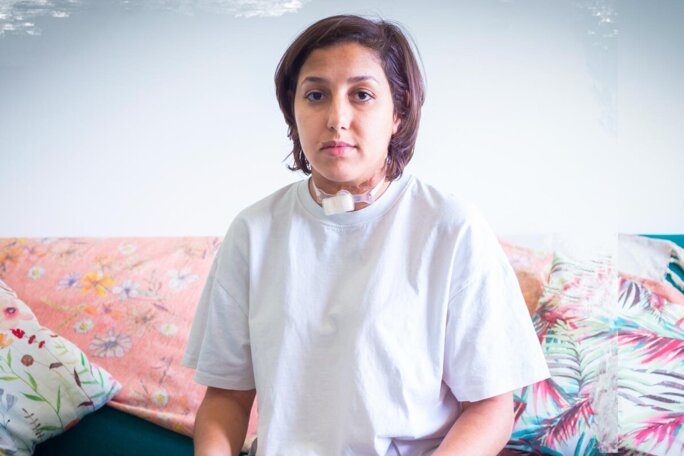
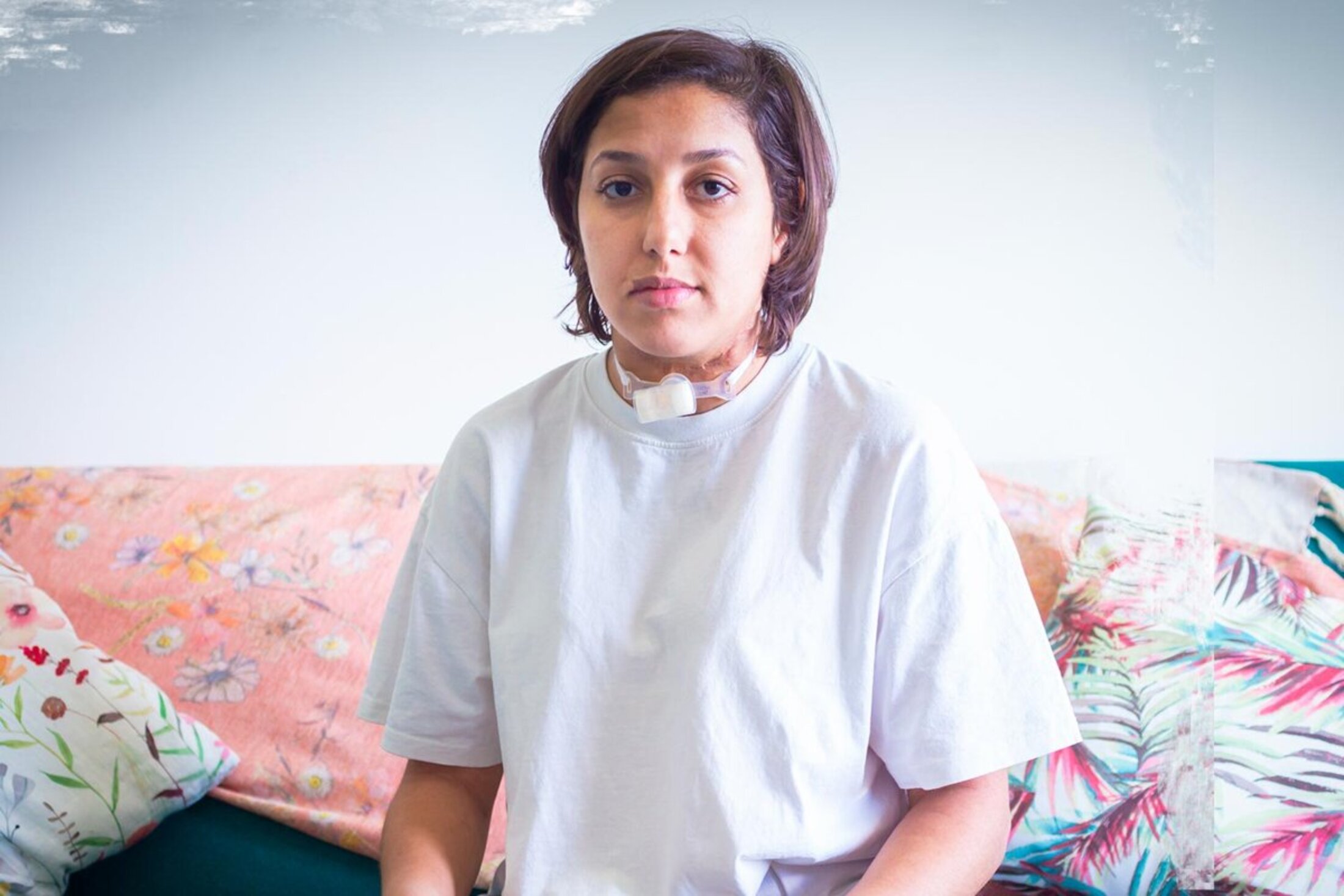
Islamic terrorists attacked Arbane -and her family on July 26th 2000 at Zaaroura, in north-east Algeria, when her parents and four of her siblings were murdered. She and a brother were left for dead but both survived.
For eight years, between 2015 and 2023, Arbane was in therapy as a patient of Daoud’s psychiatrist wife, Aicha Dehdouh, to whom she recounted, as well as the tragic events of her childhood and their aftermath, many other intimate details of her life.
Kamel Daoud has firmly denied the accusation that he stole Arbane’s story and that he and his wife violated the confidentiality of a patient’s medical records. Arbane, meanwhile, has claimed that Daoud approached on three separate occasions to ask for her permission to use her story, but that she flatly refused.

Enlargement : Illustration 1

As Mediapart reported in February, many of the details concerning Fajr are identical to Arbane’s experiences, from the cutting of her throat during the massacre of her parents and four siblings in a jihadist attack (Arbane, then aged six, and a brother were left for dead but survived), to the detail that both Daoud’s heroine and Arbane lived in the town of Oran, in the neighbourhood of Hai El Yasmine. Mediapart found 28 striking similitudes between the two.
They both went to the same school, the lycée Lotfi, and both were interested in perfumes and horses. They had a conflictual relationship with their adoptive mothers, are managers of a hairdressing business, and both came close to having an abortion by swallowing three pills.
Arbane, who underwent a tracheotomy after the attack, was left with a 17-centimetre scar around her neck and a cannula (which she hides behind a scarf). Daoud describes Fajr as having “a restitched wound of 17 centimetres”. Elsewhere in the text, Fajr says: “Look at my cannula, this big plug in plastic”. Mediapart has seen evidence that Daoud originally planned to entitle his book Joie (Joy), which is the meaning of Arbane’s first name, Saâda, in dialectal Arabic.
Enlargement : Illustration 2
She has filed an official complaint against Daoud in France for invasion of privacy and filed another complaint in Algeria for violation of medical confidentiality. The latter was accepted as admissible by an Algerian magistrate last November, and, it has now been revealed, has led to the issuing of an international arrest warrant against Daoud.
The complaint in France, in which Arbane dis also seeking 200,000 euros in damages, led to a preliminary hearing last Wednesday in Paris, which was mostly a simple formality. Daoud and his publisher Gallimard are required to present their case in detail before a second hearing on September 10th.
Mediapart Daoud is also the subject of a complaint for defamation in France, following a comment published in French daily Le Figaro on April 3rd. “It’s a demonstration of force, Algiers can file a complaint against Kemel Daoud in France,” he said apparently referring to Arbane’s complaint, then the only legal procedure launched against him.
In that complaint for defamation, her French lawyers, Lily Ravon and William Bourdon, argued that “the attempts by Kamel Daoud to deviate from the public debate” – over the original complaint by her – “have crossed another unacceptable stage when he pretended that the complaint filed against him in France was [in fact filed] by Algiers”.
Daoud has openly criticised the Algerian authorities on many occasions. He left his native country to settle permanently in France in 2020, because of what he said was “the force of things”, and was subsequently granted French citizenship. He writes a regular column on international affairs for French weekly news magazine Le Point.
Last week the French foreign affairs ministry, and Daoud’s lawyer Jacqueline Laffont, confirmed a report by Le Point that Algeria had launched two international arrest warrants against Daoud. “Kamel Daoud has just been informed that, without any other detail, two international arrest warrants have been issued against him by the Algerian justice system,” Laffont said. “The motivations behind such Algerian warrants can only be political and are part of a number of procedures engaged to reduce to silence a writer whose latest novel evokes the massacre of the ’Black Decade’ in Algeria,” Laffont told French daily Le Parisien.
The international arrest warrants are related, separately, to Arbane’s complaint filed in Algeria and another filed in the country by a National Organisation of Victims of Terrorism. According to French broadcaster TV5Monde, under Algerian law an international arrest warrant can be issued against a person who is wanted for questioning in a case and who lives abroad.
Laffont said she would take immediate action to request that Interpol drops the arrest warrants.
The Algerian move has come at a period of high tensions between Algiers and Paris, and which notably flared after French President Emmanuel Macron last year recognised Morocco’s claim of sovereignty over the territory of Western Sahara. Algeria, Morocco’s neighbour, supports the territory’s pro-independence Polisario Front in a longstanding bitter dispute.
Algeria refused to accept its nationals deported from France for criminal activity, and in mid-April, 12 French embassy staff were expelled from Algeria in a tit-for-tat response to the arrest in France of an Algerian consulate official accused of taking part in the kidnap in of an exiled opponent of the regime in Algiers. Further aggravating the crisis is the continuing detention in Algiers of Boualem Sansal, a 75-year-old writer of joint French and Algerian nationality who was arrested in November last year for having placed in doubt the accuracy of Algeria’s official borders.
“During the civil war in the 1990s, writers were assassinated,” Daoud told Le Point. “Today, they are put in prison and arrest warrants are launched against them.”
Both Daoud and Gallimard have claimed that Arbane’s legal action and the controversy over Houris is fuelled by the diplomatic spat. Arbane categorically dismisses the suggestion she is being manipulated. “The plot and all that, I don’t have any business with that,” Arbane told Mediapart in February. “I am telling my story, that’s all. And by defending it publicly, I’m revealing my privacy to the rest of the world.”
For her lawyers, “Saâda Arbane, a free woman and far from any politicization, today finds herself, and despite herself, at the centre of a political news story whereas all that she wants is to obtain the recognition by the French justice system of the violation of her private life by Kamel Daoud”.
-------------------------
- The original French version of this report can be found here.
This updated English version by Graham Tearse